
The Pre-Dinner Hour Nobody Admits to Loving
Everyone performs wellness in the Hamptons. Morning runs, cold plunges, Pilates instructors who drive out from the city on Thursdays. Yet what actually happens in the hour before guests arrive tells you more about a person than their workout routine. The cultural choices made in private — the things you watch when nobody is watching you watch — are the truest signal of what someone actually values.
Consequently, Broadway streaming in the Hamptons has become something of a quiet status tell. It doesn’t announce itself. There’s no algorithm-curated thumbnail in a group chat. However, when you start noticing it, you see it everywhere. The hedge fund principal who keeps referencing a particular production of Glengarry Glen Ross. The media executive whose dinner conversation keeps circling back to a National Theatre revival she caught on BroadwayHD three weeks ago. The art world fixture who, when asked what she watched over the long weekend, mentions a streaming production of King Lear with such casual specificity that the table goes briefly silent.
This is broadway streaming hamptons as cultural currency. And it is circulating fast.
Why the Serious Money Moved Away From Netflix
The streaming wars produced a paradox. More content exists than ever before, yet the experience of choosing something to watch has become genuinely exhausting. Research from McKinsey’s 2024 consumer media study found that decision fatigue now ranks among the top three reasons affluent viewers disengage from general streaming platforms entirely. Furthermore, the collapse of prestige television’s golden era — the post-Succession void is real — left a particular audience without a home.
BroadwayHD filled it. The platform offers something the algorithmic giants structurally cannot: scarcity. A filmed production of Hamilton with the original cast is not a content category. It is an artifact. Additionally, the act of choosing it signals that you understood what you were watching and why it mattered before it became a licensing deal or a film adaptation. That distinction, trivial as it sounds, carries enormous weight in rooms where taste is the primary social currency.
Moreover, Broadway streaming requires context to appreciate fully. You have to know the show’s history, the director’s body of work, what the reviews said when it first opened. This is not passive consumption. It is active cultural fluency — exactly the kind that the Hamptons crowd, quietly and consistently, prizes above almost everything.
The Shows That Keep Coming Up at Dinner
Ask the right people what they’ve been watching and patterns emerge. The productions that travel from the couch to the conversation tend to share certain qualities. They are either canonically important — the kind of show a person feels they should have seen and somehow never did — or they are deeply specific, the kind of choice that only someone with real theater knowledge would reach for.
Several titles dominate. The National Theatre’s Fleabag stage production, raw and precise in a way the television series never quite matched. The original Broadway cast recording and filmed production of Sunday in the Park with George, Sondheim at his most demanding and most rewarding. Patti LuPone in anything, but especially Company. The filmed Kinky Boots, which functions simultaneously as a feel-good crowd-pleaser and a genuinely sharp piece of musical theater. And, for the more adventurous, the 2014 National Theatre production of King Lear with Simon Russell Beale — widely considered one of the finest Shakespearean productions of the past two decades.
These titles circulate through the East End’s cultural conversation with the same energy as a good restaurant recommendation. Notably, the recommendation carries weight precisely because not everyone is watching. Broadway streaming hamptons remains, for now, a minority sport. That will change. It always does.
BroadwayHD and the Quiet Genius of Bonnie Comley and Stewart Lane
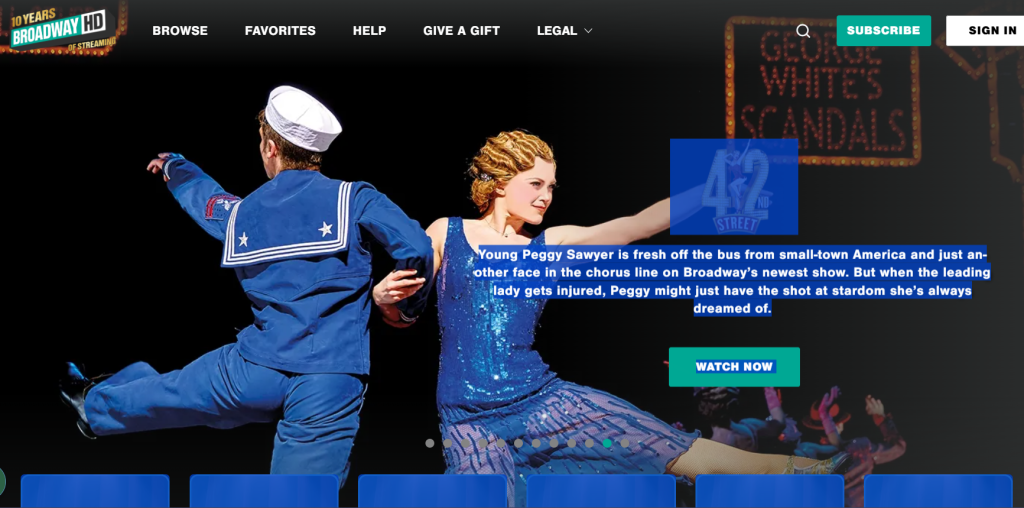
The platform behind this cultural moment is BroadwayHD, co-founded by producer Bonnie Comley and six-time Tony Award winner Stewart Lane. The premise, when they launched it, was straightforward: filmed productions of Broadway and West End shows, available on demand, at a fraction of the cost of a single ticket. The insight, however, was more sophisticated than it first appeared.
Comley and Lane understood that the audience for live theater extends far beyond the geographic radius of a Broadway theater. Additionally, they recognized that filmed theater, done well, is not a substitute for the live experience — it is a distinct cultural object with its own value. A filmed production of a great show preserves something that would otherwise evaporate the moment the run ends. It creates an archive. It democratizes access. And, as it turns out, it gives a certain kind of discerning viewer exactly what they were looking for in a streaming landscape that had started to feel indistinguishable from background noise.
The library now spans hundreds of productions. Tony Award winners, Olivier Award winners, National Theatre broadcasts, classic revivals, and contemporary originals. For the viewer who finds prestige television increasingly formulaic, it is the most interesting room in the building.
The Cultural Flex You Actually Earned
There is something worth naming about what broadway streaming hamptons actually represents socially. This is not performative culture consumption — the kind where someone buys a book because the cover looks good on a shelf. Streaming theater requires attention. It rewards knowledge. It produces the kind of references that land differently at a dinner table, references that signal not just that you watched something but that you understood it.
According to a Harvard Business Review analysis on cultural capital and social influence, shared aesthetic experiences remain among the most durable forms of social bonding among high-net-worth cohorts. The research suggests that cultural fluency — knowing the same productions, referencing the same performances — creates trust and affinity faster than almost any other social mechanism. Broadway streaming, in this light, is not merely entertainment. It is relationship infrastructure.
Furthermore, it is infrastructure that travels. The Hamptons home, the West Village apartment, the ski house in January — BroadwayHD moves with you. The conversation it generates moves with you too.
Before Polo, After Cocktails: The Full Picture
The Hamptons summer has a rhythm. Polo Hamptons on weekends, dinners that start at eight and run until midnight, mornings that begin earlier than anyone admits. Woven into this schedule, in the quiet hours that belong to no one’s calendar, broadway streaming hamptons has found its natural home.
It is not a substitute for any of the above. Rather, it is the cultural connective tissue — the thing that gives the dinner conversation something to grip, the reference that lands when the room is full of people who have spent their lives paying attention. The shows themselves are almost beside the point. What matters is the habit of watching things that require something of you. That habit, more than any other, is what separates the Hamptons crowd that talks about culture from the one that actually has it.
BroadwayHD is where the latter lives. And this summer, they are watching.
Related Reading:
The Social Life Hamptons Dining Guide: Where the Real Tables Are
Polo Hamptons 2026: Everything You Need to Know Before You Go
You already know the difference between a room full of people and a room where something actually happens. Social Life Magazine exists for the second kind of room — the Hamptons crowd that collects experiences, not just addresses.
If BroadwayHD belongs in front of your audience, we can put it there. Editorial features, brand activations, and strategic placement that reach the people who matter most. Contact us at sociallifemagazine.com/contact to start the conversation.
Ready to own the page? Submit a paid feature at sociallifemagazine.com/submit-a-paid-feature and let’s build something that lasts longer than a summer.
Join 82,000 readers who know what’s actually happening in the Hamptons before anyone else does. Get on the email list here.
Polo Hamptons 2026 is selling out fast. Cabanas, sponsorships, and VIP access for brands that want to be in the room where the decisions get made. polohamptons.com
The print edition of Social Life Magazine reaches 25,000 readers across the East End, from Westhampton to Montauk, in the boutiques and galleries where your audience actually shops. Subscribe at sociallifemagazine.com/subscription.
Good journalism costs something to make. If this piece gave you something worth keeping, consider a $5 contribution here. It keeps the lights on and the standards high.
Author

Written by
Recent Posts

AI for personal finance: where PennyGuard fits

How to Pick a Homecoming Dress for Your Body Type (and Feel Amazing in It)

World Cup Injury Attorney for Vancouver Events
What a 3-Carat Engagement Ring Actually Costs in 2026: The Real Numbers
The Skincare Habits That Make a Real Difference Over Time
Categories
- Art
- Articles
- Business of Luxury
- Celebrities
- Culture
- Entertainment
- Events
- Faces of Summer 2026
- Fashion
- Fashion & Style
- Featured
- Finance
- Food, Spirits, Wine
- Hamptons
- Hamptons Celebrities
- Health
- Health & Beauty
- Lifestyle
- Luxury Lifestyle
- Press
- Profiles
- Real Estate
- Technology
- The Chronicles
- Travel
- Uncategorized
- Weddings