
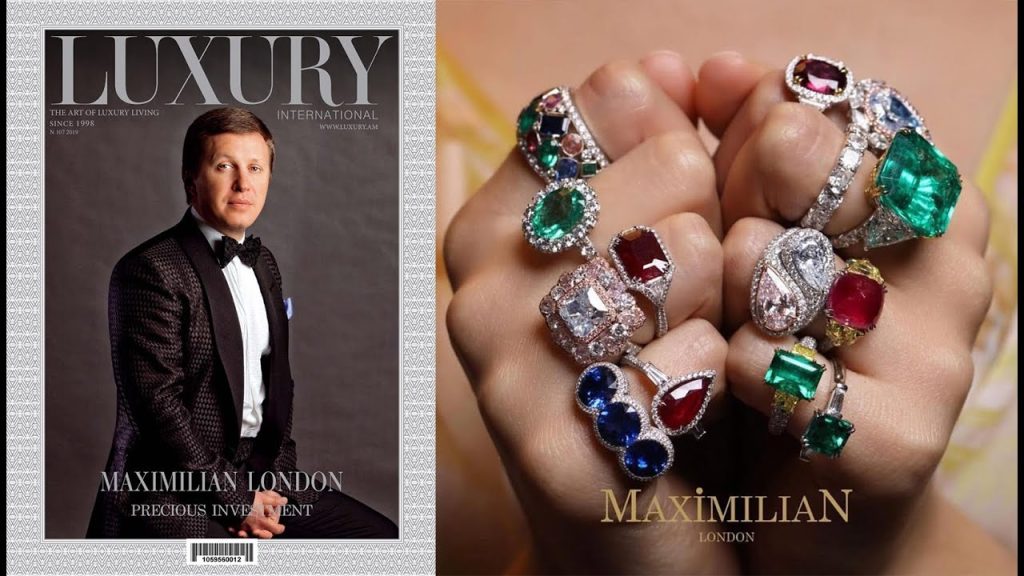
The most disruptive question in the 2026 diamond trade came from a running coach. In February, mid training block, he asked his client a question. Could a ring with a one carat diamond be made for three or four thousand dollars? The client was Maxim Artsinovich, founder of the MaximiliaN London jewellery house. Behind him sat thirty years in a trade where carat stones start at ten thousand dollars. At first he said it was impossible. But then he ran the numbers, and the numbers disagreed.
What followed is what Artsinovich now calls the Diamond Revolution. Natural diamonds certified by GIA, set in handmade 18 karat gold, sold at a 10 to 15 percent margin. By contrast, the great houses he grew up admiring run brand markups of 300 to 400 percent. His flagship boutique sits in the Dubai Mall between Cartier and Van Cleef & Arpels. That placement reads as homage or as a declaration of war, depending on your side of the counter.
For the Hamptons reader, the story runs deeper than jewelry. The carat diamond has worked as a class boundary for a century, the visible line between people who fly private and people who fly economy. Artsinovich decided the boundary was a rounding error. Anyone selling status for a living should watch what happens next, and everyone Out East is selling status for a living.
The Engineer Who Made His First Ring at Six
Maxim Artsinovich was born in 1970 into a military family, five generations of officers going back to the Romanov era. His father, a colonel and military pilot who also painted, taught his son to draw. The jewelry started early. At six, in love with the girl who shared his school desk, he filed a ring from a copper tube. Then he polished it until the copper gleamed like rose gold. That instinct never left.
The training that shaped him came later, and it was not aesthetic. In 1987 he entered a naval engineering college in Leningrad and graduated in 1992, in a city that had become Saint Petersburg while he studied. The curriculum built warships and nuclear submarines. Precision of blueprints, logic of form, tolerance for complexity. Jewelry design, by his account, came easily after that. Same discipline, nobler material.
At the college, he was already turning silver on lathes, teaching himself to solder with gas torches and weave handmade chains. His first collection, The Silver Bullet, arrived in the late nineties: silver bullets worn on the neck, unscrewing along a thread to hold a splash of perfume inside. Later came the silver I Love You ring, engraved in nine languages, a number that arrived in a dream. Companies in Russia, China, and Europe still copy it. Both silver lines survive, and every piece the house makes in 2026 is still made by hand.
Basel and the Education of an Eye
After naval service, Artsinovich went into distribution, and the inventory choice tells you everything. Beginning in 1997 he bought pieces from Cartier, Van Cleef & Arpels, Boucheron, and Chaumet, supplying them to the Russian market. Then came Basel, the largest jewellery fair in the world, where he met the leaders of the global trade and sketched relentlessly. Decades of that built what dealers call an eye, the visual command no course can teach.
One figure looms over his taste: Harry Winston, the king of diamonds. In the sixties and seventies Winston stripped away the curlicues of earlier eras and put the natural stone first. Minimal metal, forms as clean as New York bridges. Laurence Graff carried the style forward, one king departing as another arrived. Two houses still reign over that hard classic, Winston and Graff, and it is exactly this territory Artsinovich chose for his 2026 assault. Not the avant-garde. The throne room.
His conviction about handwork hardened along the way. As machines and artificial intelligence get cheaper, he argues, the scarce thing becomes the master’s hand and the ancient techniques of metal and stone. Humanity has always carried nature into jewelry, from the gold beetles in Cairo’s museums to the Art Deco borrowings from those same halls. A machine can copy the form. It cannot, in his telling, supply the soul.
The Math That Broke the Markup
Back to the coach’s question. Artsinovich’s first answer was the industry’s answer: a carat ring costs ten, fifteen, twenty thousand dollars, and the Rapaport wholesale sheets back that up for top color stones. But when he actually checked, small diamonds had quietly fallen by half across 2024 and 2025. The cause, he insists, was not lab-grown flooding the market. It was the global financial squeeze, because luxury is the last thing anyone buys and the first thing they stop buying.
So he rebuilt the product around commercial grades. Colors G through I, what GIA calls near colourless, with clarity from VVS2 down to SI1. Five grams of 18 karat gold. Handwork from master jewelers. The result: a bracelet with a 0.3 carat diamond at one thousand dollars. Earrings with a carat stone in each ear run 5,500, and carat rings sit between three and four thousand. Its ICON collection averages a 3,500 dollar ticket.
Margin is the headline. Ten to fifteen percent, against 300 to 400 at the Cartier tier. The trick that makes it survivable is velocity, because capital turns over in fourteen days. A diamond lands from the Dubai exchange and sits in a finished piece within two or three days. Volatility in gold or stones hurts less when your money never stands still. Sales, he says, started at one or two pieces a day in February and now run fifty to seventy.
The Dubai Arbitrage
None of this works everywhere, and Artsinovich is candid about it. The prices are UAE prices. Dubai levies no duties, so the flagship in the Dubai Mall can hold the line. On export, logistics and taxes stack another fifty to one hundred percent onto a piece. For now, in other words, the revolution has a zip code.
The marketing budget is essentially the price itself. He launched in February 2026 through his personal Instagram, three hundred thousand followers he describes as organic. The audience comes for his talk of business, ocean conservation, and homeless animals. In addition, he has directed ten percent of company revenue to charity for over twenty years. Orders arrived from London, America, the Gulf, Australia, and half of Europe within days. Multiple ateliers now run at once, because demand outpaces the bench. Trade press coverage followed, including The Art Newspaper Russia, which framed it as a jewellery revolution.
Natural Only, and He Means It
Every stone the house sets is natural and GIA certified, and Artsinovich treats that as theology rather than merchandising. Lab-grown diamonds have collapsed in price, down roughly 74 percent between 2020 and 2024 by his memo’s figures, with wholesale carats now under 150 dollars. In his framing, a thing whose price drifts toward zero cannot carry meaning, however brightly it sparkles. He also rejects the sustainability defense, pointing to the electricity burned growing synthetic stones.
The certification layer does real work in his pitch. GIA, the nonprofit that invented the 4Cs, stopped applying those grades to synthetics in 2025, assigning them simplified categories instead. From January 2026 the G7 requires provenance certification for stones above one carat. Both moves favor a house that only ever sold certified natural stones. Resale is the other argument: by his figures, a certified natural diamond holds 50 to 60 percent of retail on resale, while lab-grown stones often get refused at the counter entirely.
Who Actually Buys a 3,500 Dollar Carat
The buyer he describes is not the private jet passenger. It is the person with the morning coffee and croissant, the office job, the metro card. Within that group, the sharpest growth is women buying for themselves, ages 28 to 50, with their own income and no occasion required. Jewelry as self-purchase rather than gift is the structural shift of the decade, and the 2,000 to 7,000 dollar band is where it lives.
In the Gulf, the logic runs older and deeper. Jewelry in the Islamic world has always been a woman’s personal, inalienable capital, starting with the mahr, the marriage gift that secures her financially. A GIA stone in 18 karat gold stays liquid at any gold souk, no bank required. Artsinovich has positioned his product squarely inside that tradition: not an expense, an addition to a treasury.
Here is the status anthropology worth sitting with. For a century the carat functioned as proof of altitude, and the great houses charged 300 percent for the altitude, not the stone. Artsinovich is betting that a generation raised on direct-to-consumer math will pay for the stone and laugh at the altitude. Quiet luxury already trained them for it. The logo faded from the handbag, and now the markup is fading from the ring.
What This Means for the Big Houses
The incumbents cannot easily follow him down. Their markup is not greed so much as architecture: flagship rents on Place Vendôme, ambassadors, heritage marketing, all priced into the ring. Cartier and Van Cleef raised prices after the 2025 tariff shock. A ten percent margin would vaporize their model, which is precisely why Artsinovich calls his position a blue ocean. He swims ahead while the sharks are structurally forbidden from entering the water.
He is not the first to sense the opening. Tiffany has long run an affordable diamond line, Boucheron makes pieces with 0.3 to 0.5 carat stones, and Graff has courted younger buyers. But nobody at house level has published a 10 to 15 percent margin as the brand promise itself. They call him a killer of the diamond market. His answer: he found a niche ordinary people need and chose to earn a small margin. Twenty seven years in, this is no startup making noise. It is a house from inside the establishment, breaking the establishment’s favorite rule.
Where The Conversation Continues
Social Life Magazine covers the people repricing luxury because our readers are the people luxury is priced for. The founders, collectors, and connoisseurs in these pages fill the tents at Polo Hamptons every July. Their taste travels down Montauk Highway by August. If your house has a story about craft, value, and who gets to own beautiful things, this is the room to tell it in. The summer features are filling now, and so is the lawn.
Author

Written by
Recent Posts

AI for personal finance: where PennyGuard fits
How to Pick a Homecoming Dress for Your Body Type (and Feel Amazing in It)

World Cup Injury Attorney for Vancouver Events
What a 3-Carat Engagement Ring Actually Costs in 2026: The Real Numbers
The Skincare Habits That Make a Real Difference Over Time
Categories
- Art
- Articles
- Business of Luxury
- Celebrities
- Culture
- Entertainment
- Events
- Faces of Summer 2026
- Fashion
- Fashion & Style
- Featured
- Finance
- Food, Spirits, Wine
- Hamptons
- Hamptons Celebrities
- Health
- Health & Beauty
- Lifestyle
- Luxury Lifestyle
- Press
- Profiles
- Real Estate
- Technology
- The Chronicles
- Travel
- Uncategorized
- Weddings