
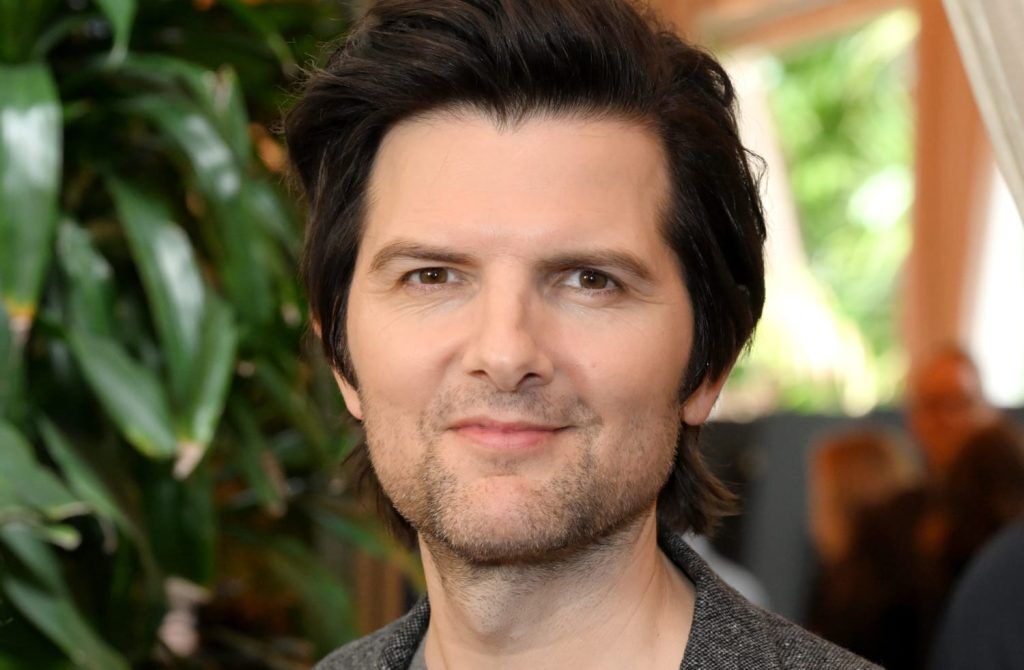
This is an origin story about fifteen years of being the best actor in every room that didn’t quite matter. Eventually, he found the room that did.
The Before: Santa Cruz, Teachers’ Kids, and the Drama Class Escape Hatch
Where Adam Scott Comes From
Adam Paul Scott was born on April 3, 1973, in Santa Cruz, California. His father Dougald was a biology professor. His mother Anne taught special education. They divorced when Scott was five. Consequently, he grew up with two older siblings. Education was valued above nearly everything else in their household. His brother David, Scott has noted, inherited their parents’ intellect. Scott, meanwhile, inherited their love of storytelling and pointed it at a screen.
Santa Cruz in the 1980s was a particular kind of California. Surf culture. Alternative music. A boardwalk that felt like freedom and like the edge of something simultaneously. Scott found his escape hatch in Harbor High School’s drama classes. Notably, he felt out of place in sports and academics. Theater gave him a community. The feeling of belonging to a cast mattered to him. He would spend thirty years chasing it at larger scales.
The American Academy and the Decision
After Harbor High, Scott enrolled at the American Academy of Dramatic Arts in Los Angeles, graduating in 1993. The academy’s alumni include Paul Rudd, Jessica Chastain, and Danny DeVito. Scott completed the program and immediately faced the decision every trained actor faces in their twenties. Training ends. The actual business begins. That gap turns out to be enormous.
Subsequently, he made his screen debut in 1994 in the independent film Cityscrapes: Los Angeles. That same year, he appeared as Griff Hawkins — a high school bully — in several episodes of Boy Meets World. Both credits were real work. Yet neither was what anyone would call a launch.

The Climb: Fifteen Years of Being Almost Right
The Guest Star Era
From 1994 to roughly 2008, Adam Scott built a resume that is simultaneously impressive and, in retrospect, a little heartbreaking to read. Credits accumulated across Murder One, Party of Five, ER, Six Feet Under, NYPD Blue, and Veronica Mars. A recurring role on Party of Five as Josh followed. He appeared alongside DiCaprio in Scorsese’s The Aviator (2004), playing Johnny Meyer. Holding his own in those scenes required everything he had. He did. Nobody noticed.
Additionally, Scott auditioned for Jim Halpert in The Office in 2005. John Krasinski got it. That near-miss defined those fifteen years: good enough for the room, not the one who left with the part. Still, he kept working. Notably, he appeared in Monster-in-Law, Knocked Up, and any number of films requiring dry, put-upon intelligence. Scott possessed that quality in abundance. The industry kept using him as a supporting player. He kept delivering more than the role required.
Step Brothers and the Comedy Turn
In 2008, Scott played Derek Huff in Step Brothers alongside Will Ferrell and John C. Reilly. Notably, the film grossed $128 million worldwide. Derek Huff is the obnoxious older brother — insufferable, precise, unexpectedly funny in the way that only actors who understand humiliation at a cellular level can be funny. Consequently, the role announced something important: Scott could do comedy at the highest level. He did not sacrifice the intelligence that made his dramatic work worth watching.
Then came Party Down.
The Cult Hit That Should Have Been Bigger
The Starz series Party Down ran for twenty episodes between 2009 and 2010 and was, by any reasonable metric, one of the best comedies on television. Scott played Henry Pollard — a failed actor in a pink bowtie, working as a cater-waiter. He delivered the defeated competence of a man who had believed in himself past the point where belief made sense. Unfortunately, the show was cancelled before it found its audience. Subsequently, the show found its audience anyway. Streaming gave it the longevity that network scheduling had denied it.
Party Down did not make Scott a star. However, it made him a cult figure among writers and directors and showrunners — the people who, a few years later, would be making decisions about who to cast in their prestige projects. Ultimately, that is a slower kind of currency. It spent eventually.
Ben Wyatt: The Role That Made Everyone Know His Name

Parks and Recreation and the Making of a Comfort Object
In 2010, Scott joined Parks and Recreation in its second season as Ben Wyatt. Ben is a state auditor sent to Pawnee, Indiana, to investigate the city’s budget crisis. Specifically, Ben Wyatt is a man of systems and standards and an almost painful earnestness about procedural integrity. Ben loves calzones. Notably, he is emotionally literate in ways that take him by surprise. He falls in love with Leslie Knope and spends several seasons trying to figure out what to do about it.
Scott played him for five seasons — 2010 to 2015. The performance earned him two Critics’ Choice Television Award nominations. More significantly, it made him one of television’s most beloved characters. Ben Wyatt became the kind of person people quoted to each other. Couples named him as their favorite. The internet rediscovered him every time someone found Parks and Rec for the first time.
What Ben Wyatt Cost and What He Gave
Ben Wyatt posed a paradox. He was warm and safe enough to define Scott permanently as the lovable straight man — the comic anchor who reacts to chaos rather than generating it. Additionally, the show ran during a specific cultural moment — the early-2010s golden age of ensemble workplace comedy — that valued ensemble over individual, warmth over edge, resolution over ambiguity.
Certainly, Scott gave the role everything it needed. Yet simultaneously, in smaller films and guest appearances, he was building a dramatic range that Ben Wyatt would never require. It accumulated quietly, like interest on a long-held position.
Meanwhile, the HBO limited series Big Little Lies gave him room to use some of it, playing Henry, Reese Witherspoon’s decent and slightly bewildered husband in a story full of women performing versions of themselves that bore limited relationship to who they actually were. Indeed, he was good in it. It pointed toward something.
Mark Scout: The Role That Changed the Accounting

Severance and the Arrival of Everything
In 2022, Severance premiered on Apple TV+ and Adam Scott became, at age forty-eight, the lead of the most critically acclaimed show of the year. He plays Mark Scout — a man who took a job at Lumon Industries after his wife died in a car accident. Specifically, the severance procedure prevents his work self from knowing there was a wife to grieve. The innie doesn’t suffer. The outie doesn’t remember. Both, consequently, are hollowed out in ways that accumulate across nine episodes until the cost becomes impossible to avoid.
Consequently, the role requires Scott to play two versions of the same man. One is the grief-flattened outie, going through motions outside. The other is the curious, awakening innie, beginning to suspect the arrangement is wrong. Notably, Scott must make that gap visible without ever stating it. Furthermore, it requires him to do this in scenes directed by Ben Stiller with the precision of a cinematographer who understands that stillness is a performance choice, not an absence of one.
The Emmy Recognition and What It Means
Subsequently, Scott received four Emmy nominations for Severance — two for acting and two for producing — and two Golden Globe nominations. He has not won yet. The industry has a specific reluctance about awarding lead actors in shows that operate at the level of ensemble excellence, as if the performance is somehow distributed across the cast rather than anchored in it. Nevertheless, the nominations tell the actual story: after thirty years, the academy finally ran out of reasons not to notice him.
Furthermore, Season 2 arrived in January 2025 and became, according to Apple, the platform’s most-watched series in its history. Additionally, Season 3 starts filming in mid-2026. The severance procedure is not finished with Mark Scout. Neither is the industry with Adam Scott.
Adam Scott Net Worth: The Full Accounting

What the Numbers Say
Adam Scott net worth sits at approximately $8 million as of 2026, according to Celebrity Net Worth. Notably, this is a modest figure by Hollywood standards for an actor with thirty years of credits and two Emmy nominations. It reflects the specific economics of a career built primarily in television comedy and supporting film roles during a period when those categories paid significantly less than they do now.
Nevertheless, the Severance era is changing the math. Industry estimates place Scott’s per-episode fee between $258,000 and $388,000 — which, across the nine episodes of Season 1 and ten episodes of Season 2, represents meaningful movement in the total. Additionally, he serves as executive producer, adding a revenue stream that compounds across residuals as the audience grows.
Real Estate and Assets
Meanwhile, Scott has maintained a presence in Los Angeles real estate across his career. He paid $889,000 for a Silver Lake home in 2007, selling it in 2012 for just over $1 million. Subsequently, in 2013, he paid $1.8 million for a home in the Hollywood Hills. The portfolio is modest by industry standards and consistent with a man who, by all available evidence, has been more interested in the work than in the architecture of wealth accumulation.
Additionally, he married publicist Naomi Scott in 2005. They have two children, Graham and Frankie. Furthermore, the family has remained largely private — notably absent from the celebrity real estate speculation and Instagram wealth display that characterizes much of Hollywood at his level of recognition.
The Hamptons Chapter: Why This Career Arc Belongs Here
What Severance Means to the People Who Summer East
Notably, there is a reason that Severance became the show that the Hamptons crowd argues about at dinner, and it is not accidental. The show’s central premise — dividing your professional self from your personal self, handing your best hours to an institution for relief from your own life — resonates most with the demographic that knows what that trade actually costs.
The people who close significant deals and drive east on the expressway in June understand Mark Scout without explanation. Consequently, Adam Scott’s performance lands differently for that audience. It is not entertainment. It is recognition. Indeed, the show is the most honest thing currently on television about the specific American arrangement that builds the Hamptons summer and exhausts the people living it.
Scott as a Cultural Index
Furthermore, Scott’s career arc — the fifteen-year grind, the cult loyalty, the late arrival of everything — is itself a kind of story that the Hamptons crowd recognizes. Typically, the most interesting people in any room out here did not arrive easily. They built something over time, in rooms that didn’t matter, until the room that did finally appeared. Ultimately, Scott’s story is their story — told in the language of television rather than finance. That is precisely why it carries weight.
Adam Scott net worth of $8 million is, in this context, the wrong number to focus on. The right number is the thirty years it took to become the person who could play Mark Scout the way Mark Scout needed to be played. That accounting is more interesting than any net worth estimate. Furthermore, it is more useful as a model for anything worth building.
Where Adam Scott Is Now

Season 3, the Podcast, and the Work That Remains
Currently, as of 2026, Adam Scott is the lead and executive producer of the most-watched series in Apple TV+ history, with Season 3 of Severance in development and a third season confirmed for production beginning mid-2026. He continues to host podcasts — U Talkin’ U2 to Me? with Scott Aukerman and R U Talkin’ R.E.M. Re: Me? with Conan O’Brien. Both reflect what defines his best work: genuine enthusiasm, without performance or irony.
Yet he does not appear to be building a brand. He does not appear to be positioning himself for a franchise. Specifically, he appears to be doing what he has always done — finding the best available work, doing more with it than the role requires, and waiting for the audience to catch up. Finally, after thirty years, the audience has caught up. The numbers will follow.
Additionally, Furthermore, Party Down returned for a revival in 2022, completing the circle on the cult hit that should have been bigger. It was, briefly, bigger. Henry Pollard came back in the pink bowtie. The internet lost its mind. Still, Scott remained, characteristically, the calmest person in the room — which is, at this point, the performance of a lifetime.
The people who built something real — the ones who spent fifteen years in the rooms that didn’t matter before finding the one that did — tend to end up in the Hamptons eventually. Social Life Magazine is where that story gets told. If Adam Scott’s arc resonates, the rest of what we publish will too. Our writers, strategists, and luxury-market analysts can place your brand, your business, or your story inside the cultural conversation at the exact moment it matters. Start the conversation here.
82,000 readers receive our exclusive email briefings on the Hamptons market, luxury culture, and the people who move between both. Join the list here.
Polo Hamptons 2026 is where the conversations from the magazine become the relationships that close deals. Two events. One summer. The exact demographic your brand needs in a tent with your logo on it. Sponsorship details here.
The print edition of Social Life Magazine reaches 25,000 households in the Hamptons corridor and 15,000 doorman buildings on the Upper East Side. It is the thing on the coffee table when the right person picks it up. Subscribe or advertise here.
If this piece was worth your time, the most direct way to keep independent luxury media that takes the culture seriously alive is a contribution here — any amount, no obligation.
Author

Written by
Recent Posts

Severance Season 1: A Field Guide to the Most Honest Show About Work

Adam Scott Net Worth: 15-Year Overnight Success

Chris Pontius Net Worth: The Man Who Survived Being Himself

Sandy Mahl Net Worth: The Woman Behind Garth Brooks Who Chose Silence

Tracey Walter Net Worth: The $3M Career Hidden in 200 Films
Categories
- Art
- Articles
- Beauty & Skincare
- Celebrities
- Celebrities|Entertainment
- Celebrities|The Chronicles
- celebrities|the-archive
- Chronicles
- Entertainment|Culture
- Event Photos
- Events
- Fashion
- Fashion & Style
- Featured
- Food & Beverage
- Food, Spirits, Wine
- Hamptons
- Hamptons Celebrities
- Hamptons Celebrities|Celebrities|The Chronicles
- Health
- Health & Beauty
- Lifestyle
- Luxury Lifestyle
- Press
- Profiles
- Real Estate
- Technology
- The Chronicles
- Travel
- Uncategorized
- Weddings