
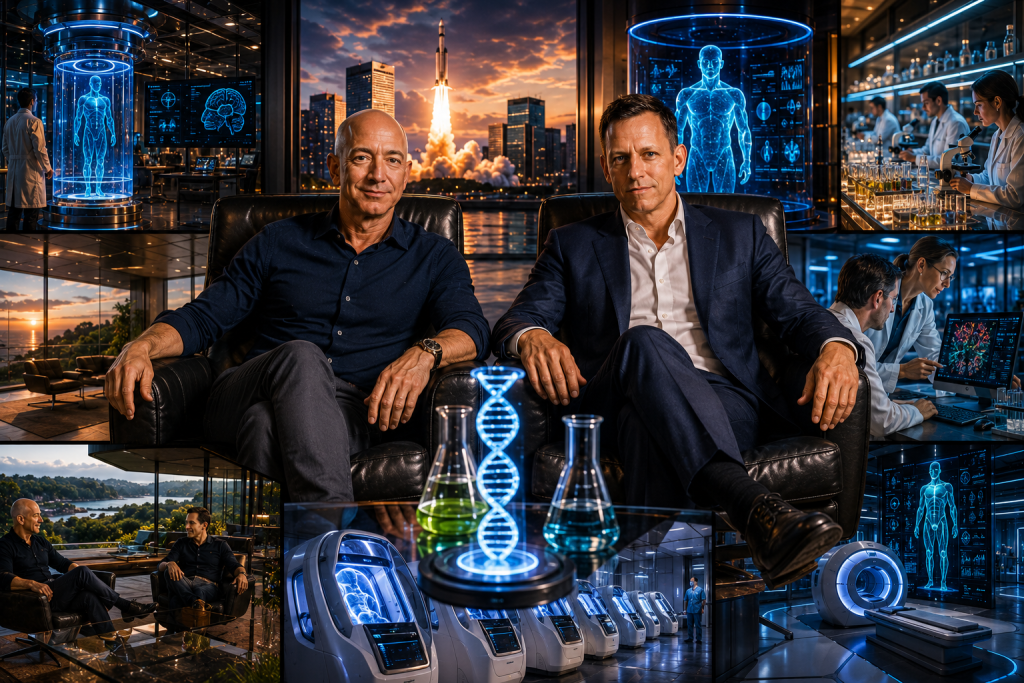
Jeff Bezos writes checks quietly. Peter Thiel writes manifestos. Both men have decided that dying is an engineering problem, and both have committed billions to proving it. The Bezos Thiel longevity investments represent the two dominant strategies in Silicon Valley’s war against aging: Bezos funds institutional science through corporate vehicles, backing $3 billion startups staffed by Nobel laureates. Thiel funds ideological conviction through nonprofits and personal protocols, donating millions to organizations that want to “make 90 the new 50 by 2030.” They co-invested in the same senolytic drug company. That company failed. Neither man changed course.
Together, the longevity billionaires of Silicon Valley have deployed more capital toward aging research than most countries spend on their entire biomedical budgets. Bezos alone backed what became one of the best-funded startups in biotech history. Thiel personally uses human growth hormone and has spoken openly about parabiosis, the study of young blood transfusions for anti-aging. Where Larry Ellison funded the foundational science and Bryan Johnson turned himself into the experiment, Bezos and Thiel occupy a different position entirely. They are the capital allocators betting that longevity will be the defining investment category of the century.
Jeff Bezos and the $3 Billion Bet on Cellular Reprogramming
In 2021, reports emerged that Bezos had invested in Altos Labs, a biotech startup pursuing biological reprogramming technology. The premise is radical: use specific proteins (called Yamanaka factors, after the Nobel Prize-winning scientist who discovered them in 2012) to reset adult cells to a youthful state. In animal studies, partial reprogramming has extended lifespan and improved health markers. A 2024 Altos Labs study confirmed these results, showing that partial cellular reprogramming extended lifespan in treated animals.
Altos Labs raised $3 billion, making it one of the best-funded startups in biotech history. The scientific roster reflects the scale of the ambition. Shinya Yamanaka, the 2012 Nobel laureate whose discovery made the field possible, chairs the advisory board. Jennifer Doudna, who won the 2020 Nobel for co-creating CRISPR gene editing, was recruited to the team. Former GlaxoSmithKline chief scientific officer Hal Barron serves as CEO. The company operates research institutes in the Bay Area, San Diego, Cambridge (UK), and Japan.
Bezos also holds positions in Unity Biotechnology (senescent cell removal), Nautilus Biotechnology, Sana Biotechnology, and Denali Therapeutics. Each investment targets a different angle of the aging process. Together, they form a diversified portfolio in the business of biological decline. Bezos does not talk about these investments publicly. He does not post supplement stacks or biological age scores. He treats longevity like he treated cloud computing in 2006: a category that most people underestimate, backed by patient capital and an institutional approach that compounds silently.
Peter Thiel: Aging as Code to Be Hacked
Thiel’s approach to longevity carries the intensity of a philosophical position, not just a financial one. “I believe that evolution is a true account of nature,” he has said, “but I think we should try to escape it or transcend it in our society.” He has announced publicly that he wants to live to 120. To back that conviction, Thiel has donated $3.5 million to the Methuselah Foundation, a nonprofit whose stated mission is to make “90 the new 50 by 2030.” He has also funded the SENS Research Foundation, which pursues therapies to cure and prevent age-related diseases.
Where Bezos funds science, Thiel funds conviction. His interest in parabiosis (the transfusion of young blood as an anti-aging intervention) drew widespread media attention and no small amount of ridicule. Published profiles have linked him to human growth hormone (HGH) use and testosterone optimization, both standard tools in longevity medicine for managing age-related hormonal decline. Thiel does not see these as fringe interventions. He sees them as early applications of a technology stack that will eventually make biological aging optional.
Thiel’s net worth in 2026 is estimated between $12 billion and $16 billion, built primarily on Palantir Technologies (where he serves as chairman), Founders Fund, and early-stage investments including his legendary Facebook stake. “Rapid advances in biological science foretell of a treasure trove of discoveries this century, including dramatically improved health and longevity for all,” he said at the time of his Methuselah donation. Among the Bezos Thiel longevity investments, Thiel’s are smaller in dollar terms but larger in ideological commitment.
Unity Biotechnology: The Shared Bet That Failed
Bezos and Thiel found common ground in Unity Biotechnology, a San Francisco startup founded in 2011 on breakthrough research from the Mayo Clinic. The science was compelling. Senescent cells (damaged cells that stop dividing but refuse to die) accumulate in tissues with age, releasing inflammatory signals that accelerate decline. Remove the senescent cells, and the body functions younger. In mice, the concept worked beautifully. Removing senescent cells significantly reduced age-related pathology across multiple tissue types.
Unity raised $355 million and went public. Then its lead anti-aging candidate, an osteoarthritis drug called UBX0101, failed to meet its primary endpoint in a Phase II trial. Shares dropped 60% in a single day. Unity eventually delisted from NASDAQ and announced plans to dissolve. For the Bezos Thiel longevity investments, it was the first high-profile casualty.
That failure is instructive for the broader longevity economy. Biology is not software. The gap between promising mouse data and effective human therapy remains enormous. Capital alone cannot close it. What the Unity experience demonstrates is that even the smartest money in Silicon Valley can lose when the science does not translate. For investors evaluating longevity opportunities (and for the wellness brands reading this series), Unity is the cautionary data point: the category is real, but the individual bets carry genuine risk.
The Broader Silicon Valley Longevity Portfolio
Bezos and Thiel are not operating in isolation. Sam Altman, the OpenAI CEO, invested $180 million of personal capital into Retro Biosciences, a startup aiming to add 10 healthy years to the human lifespan. Retro now partners with OpenAI to use artificial intelligence for protein design in cellular reprogramming research. Larry Page, the Alphabet co-founder, launched Calico Labs in 2013 as a research company targeting the biological processes behind aging. Mark Zuckerberg and Priscilla Chan co-founded the Breakthrough Prize, which awards $3 million annually to scientists making transformative advances in understanding living systems.
Funding for longevity research hit $8.5 billion in 2024. Average funding rounds for longevity companies have grown by more than 20% over the past decade, reaching nearly $43 million. Discovery platforms alone raised $2.65 billion in 2024, representing 28% of total longevity investment. The capital is not speculative froth. It reflects a calculation that the longevity market, projected at $314 billion by 2030 in the therapeutics segment alone, represents one of the decade’s most asymmetric investment opportunities.
For the SLM reader, the pattern is clear. The same people who built the dominant technology companies of the last 30 years are now directing their capital and their conviction toward biological engineering. This is not philanthropy. It is positioning. Bezos, Thiel, Altman, and Page believe that whoever solves aging will control a market larger than cloud computing, social media, and search combined. The Bezos Thiel longevity investments are early entries in a race that will define the next century of wealth creation.
What $285 Billion and $14 Billion Buy Together
Bezos’s net worth in 2026 is approximately $285 billion, according to Celebrity Net Worth. Roughly 85% of his fortune is tied to his approximately 9% stake in Amazon, now valued at over $230 billion. Additional assets include Blue Origin (estimated at $50 billion to $100 billion), a real estate portfolio exceeding $300 million, The Washington Post, and investments through Bezos Expeditions. He was born in 1964, is 61 years old, and stepped down as Amazon CEO in 2021.
Thiel’s net worth sits between $12 billion and $16 billion, anchored by his Palantir stake (over $12 billion in public holdings alone), Founders Fund, and diversified venture investments. He was born in 1967 in Germany, is 58 years old, and studied philosophy and law at Stanford before co-founding PayPal. His investment in Facebook returned billions. His Palantir stake continues to appreciate as the company’s government and commercial contracts expand.
The combined Bezos Thiel longevity investments represent something specific in the capital hierarchy: patient money from people who have already won the game once and are now allocating toward what they believe is the largest remaining problem. Neither man needs a return from longevity research. Both expect one anyway. That combination of conviction and patience is what separates their approach from the consumer-facing biohacking of Johnson or the clinical practice of Peter Attia. Bezos and Thiel are not buying treatments. They are buying the companies that will sell the treatments to everyone else.
What Silicon Valley’s Bet Means for the East End
Every treatment offered at Hamptons wellness clinics exists downstream of the research that Bezos, Thiel, and their peers fund. NAD+ therapy traces back to work on nicotinamide pathways supported by longevity-focused research grants. Senolytic concepts, even after Unity’s failure, continue to inform supplement and treatment protocols. Exosome therapies, peptide treatments, and epigenetic testing all sit on a scientific foundation built with venture capital from the same investor class that produced the Bezos Thiel longevity investments.
Hamptons BioMed at 223 Hampton Road in Southampton offers many of the downstream applications: NAD+ drips, exosome treatments, epigenetic counseling, and the East End’s first medical-grade hyperbaric chamber. For the summer population that reads SLM and uses these services, understanding the upstream capital structure is not academic. It explains why the treatments improve every year, why new modalities appear every season, and why the pricing eventually comes down. Silicon Valley funds the research. The East End delivers the application. Social Life Magazine covers the connection.
For wellness brands and clinic operators, the Bezos and Thiel story carries a simple message: the smart money in the world is flowing toward your category. Every dollar these men invest validates the commercial premise that longevity is not a niche market. It is the market. If your business sits anywhere on the longevity spectrum, you are operating in a category that the wealthiest people alive believe will define the next century. That is not a trend. That is an investment thesis with $285 billion of conviction behind it.
Where The Conversation Continues
Bezos and Thiel represent the capital layer of the longevity economy. Social Life Magazine covers every layer, from the investors funding the science to the clinics delivering the treatments to the people rebuilding their bodies one protocol at a time.
If you operate in the longevity, biotech, or wellness space and want editorial visibility with the East End audience, reach out at [email protected].
For brands seeking premium placement, explore our Paid Feature options.
Stay current at sociallifemagazine.com.
Polo Hamptons returns July 18 and 25, 2026, at 900 Lumber Lane, Bridgehampton. BMW is the title sponsor. For sponsorship inquiries, visit polohamptons.com.
Already a reader? Subscribe to Social Life Magazine for five summer issues and Fall/Winter editions.
Support independent East End journalism via PayPal.
Frequently Asked Questions
How much has Jeff Bezos invested in longevity research?
Jeff Bezos is among the investors behind Altos Labs, which raised $3 billion for cellular reprogramming research, making it one of the best-funded biotech startups in history. He has also invested in Unity Biotechnology (senescent cell removal), Nautilus Biotechnology, Sana Biotechnology, and Denali Therapeutics. The total dollar amount of his personal longevity investments has not been publicly disclosed, but the portfolio represents one of the largest individual bets on anti-aging science.
What is Peter Thiel’s approach to longevity?
Peter Thiel approaches longevity as both an investor and a personal practitioner. Donations include $3.5 million to the Methuselah Foundation (which aims to “make 90 the new 50 by 2030”) and funding for the SENS Research Foundation. Thiel has spoken openly about his interest in parabiosis (young blood transfusions) and has been linked to human growth hormone and testosterone optimization protocols. He co-invested with Bezos in Unity Biotechnology and has stated publicly that he wants to live to 120.
What happened to Unity Biotechnology?
Unity Biotechnology was a San Francisco startup founded in 2011 to develop senolytic drugs that target aging “zombie” cells. Backed by both Bezos and Thiel, the company raised $355 million and went public. Its lead anti-aging drug candidate, UBX0101 for osteoarthritis, failed to meet its primary endpoint in a Phase II trial. Shares dropped 60%, and the company eventually delisted from NASDAQ and announced plans to dissolve. The failure illustrates the risk in longevity investing, even with significant capital backing.
How do Bezos and Thiel’s longevity strategies differ?
Bezos takes an institutional approach, funding large-scale research companies through corporate investment vehicles. His investments are quiet, diversified, and focused on foundational science like cellular reprogramming. Thiel takes an ideological approach, funding nonprofits, using personal longevity protocols, and speaking publicly about his belief that aging can be transcended. Both invested in Unity Biotechnology. Bezos funds the science. Thiel funds the conviction. Both believe longevity will be the defining investment category of the century.
Author

Written by
Recent Posts

AI for personal finance: where PennyGuard fits

How to Pick a Homecoming Dress for Your Body Type (and Feel Amazing in It)

World Cup Injury Attorney for Vancouver Events
What a 3-Carat Engagement Ring Actually Costs in 2026: The Real Numbers
The Skincare Habits That Make a Real Difference Over Time
Categories
- Art
- Articles
- Business of Luxury
- Celebrities
- Culture
- Entertainment
- Events
- Faces of Summer 2026
- Fashion
- Fashion & Style
- Featured
- Finance
- Food, Spirits, Wine
- Hamptons
- Hamptons Celebrities
- Health
- Health & Beauty
- Lifestyle
- Luxury Lifestyle
- Press
- Profiles
- Real Estate
- Technology
- The Chronicles
- Travel
- Uncategorized
- Weddings