
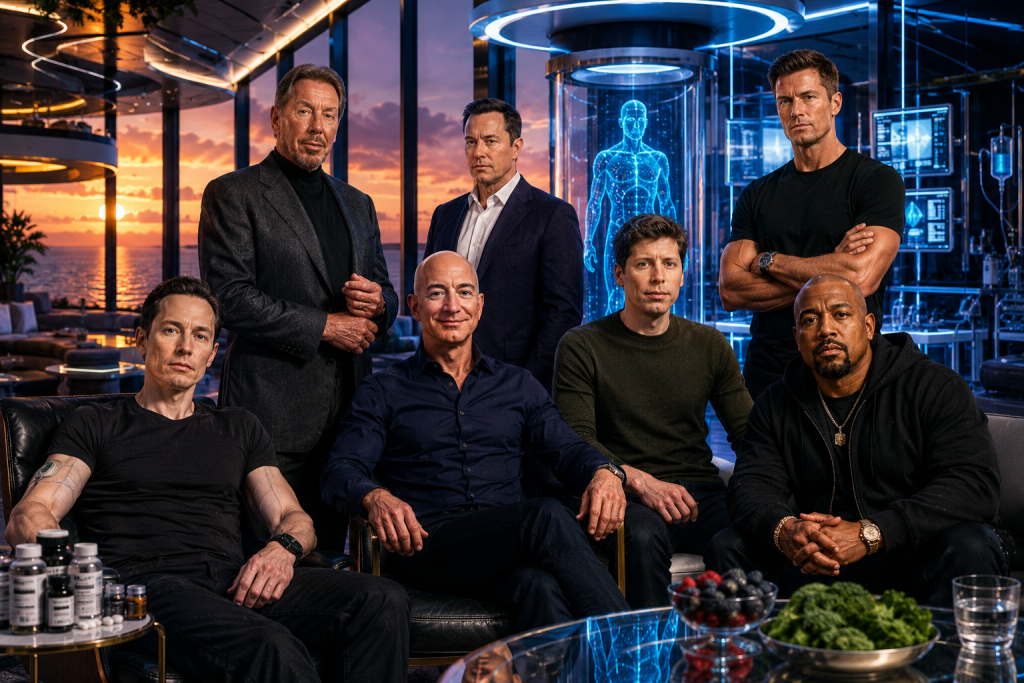
Bryan Johnson swallows more than 100 pills every morning. Larry Ellison has written checks totaling $430 million to laboratories studying why human cells decay. Jeff Bezos quietly backed a $3 billion startup built around one premise: that aging is a disease, and diseases have cures. These are the longevity billionaires, a new class of ultra-wealthy individuals who have decided that dying is a problem money can solve. And they are not wrong about the money part.
Fortune ran a cover story in February 2026 on Ellison’s next chapter. A month later, they profiled Daymond John’s transformation from thyroid cancer patient to obsessive biohacker. In between, the magazine ran a feature on $20,000 longevity weekends designed for people who believe that more time is the ultimate luxury. That sequence tells you everything about where the culture is headed. Longevity is no longer fringe science discussed in podcast footnotes. It is the fastest-growing premium lifestyle category in the world, and it sits at the exact intersection of wealth, wellness, and vanity that defines the Social Life Magazine reader.
What follows is a map of the people, the money, and the science behind the longevity economy. From a Southampton clinic offering the East End’s first medical-grade hyperbaric chamber to a San Francisco lab trying to reprogram human cells, the geography of ambition has never been wider. This is the story of the longevity billionaires who looked at the oldest problem in human history and opened their checkbooks.
Bryan Johnson and the $2 Million Morning
No one has made longevity more visible (or more polarizing) than Bryan Johnson. After selling his payments company Braintree to PayPal for $800 million in 2013, Johnson launched Project Blueprint, a self-described experiment to slow and reverse his own aging using data, discipline, and an annual budget north of $2 million. His daily protocol includes more than 100 supplements, strict caloric targets, constant biomarker tracking, and a rotating cast of experimental treatments that have included plasma transfusions and red light therapy.
In February 2026, Johnson raised the stakes considerably. He announced “Immortals,” an invitation-only longevity program priced at $1 million per year with exactly three spots available. Applicants must pass an interview, hire a dedicated assistant, and commit significant time to the regimen. The program includes a concierge team, 24/7 access to BryanAI (an artificial intelligence trained on Johnson’s own protocols), and continuous biomarker tracking. It also grants access to what Johnson calls “the world’s best health program.” Among today’s longevity billionaires, nobody performs the role with more commitment or more controversy.
Critics call him a narcissist running an expensive science fair on his own body. Supporters call him the most important health experimenter of his generation. Both camps keep watching. Johnson’s social media posts routinely pull millions of impressions, and his supplement recommendations move markets. Whether or not his protocols actually extend life, Johnson has accomplished something arguably more valuable: he made longevity a status conversation. In Bourdieu’s framework, he converted economic capital into symbolic capital, and the conversion rate is extraordinary.
Larry Ellison’s $430 Million War on Mortality
While Johnson performs longevity in public, Larry Ellison has been funding it in private for nearly three decades. The Oracle co-founder established the Ellison Medical Foundation in 1997 and channeled approximately $430 million into basic biomedical research on aging and age-related diseases. That money supported work at Harvard, the Buck Institute, Rockefeller University, and USC, where a separate $200 million gift created the Lawrence J. Ellison Institute for Transformative Medicine.
Ellison’s interest is not abstract. His biological mother left when he was a child. His adoptive mother died of cancer during his college years. “Death has never made any sense to me,” he told biographer Mike Wilson. “How can a person be there and then just vanish, just not be there?” That question, delivered with the certainty of a man worth $331 billion, reads less like philosophy and more like a product roadmap. Among the longevity billionaires, Ellison is the most patient and the most heavily capitalized.
At 80, Ellison still looks like a man two decades younger. Bryan Johnson himself noted on social media that Ellison “is doing a good job managing biological aging.” The Oracle founder follows a pescatarian diet, avoids alcohol, and exercises daily. His personal habits are almost comically disciplined for a man who spent decades known for yacht racing and lavish parties on his private Hawaiian island. Somewhere between the carrot juice and the check-writing, Ellison seems to have decided that outliving his competitors is the ultimate power move. Given his track record with Oracle, nobody should bet against him.
Jeff Bezos, Peter Thiel, and the $3 Billion Lab
Jeff Bezos has always collected frontier bets. Space exploration through Blue Origin. Media influence through The Washington Post. And now, the oldest frontier of all: human mortality. Bezos is among the investors behind Altos Labs, a biotech startup that raised $3 billion to develop biological reprogramming technology. The science aims to use what are called Yamanaka factors to reset adult cells to a youthful state, effectively turning back the clock at the cellular level.
Altos Labs assembled a scientific roster that reads like a Nobel Prize guest list. Shinya Yamanaka, who won the 2012 Nobel for discovering genetic reprogramming, chairs the advisory board. Jennifer Doudna, the 2020 chemistry laureate who co-created CRISPR, was recruited to the team. Former GlaxoSmithKline chief scientific officer Hal Barron leads as CEO. Bezos also holds stakes in Unity Biotechnology (senescent cell removal), Nautilus Biotechnology, and Sana Biotechnology, building a diversified portfolio in the business of not dying.
Peter Thiel’s approach carries a different energy entirely. The PayPal co-founder was an early champion of the Methuselah Foundation, a nonprofit whose stated goal is to “make 90 the new 50 by 2030.” Thiel has spoken openly about parabiosis, the transfusion of young blood as an anti-aging treatment. He also invested in Unity Biotechnology alongside Bezos. Where Bezos moves quietly through corporate vehicles, Thiel treats longevity like ideological conviction. Both methods end in the same place: billions flowing into laboratories that believe aging is optional. Among the longevity billionaires, Thiel is the most philosophically committed to the cause.
Sam Altman Bet $180 Million on Adding a Decade
Before he became the most recognized name in artificial intelligence, Sam Altman made one of the largest individual investments in longevity history. In 2021, the OpenAI CEO put $180 million of his own money into Retro Biosciences, a San Francisco startup with an ambitious and specific goal: add 10 healthy years to the human lifespan. That is not a metaphor. Retro’s scientific thesis centers on cellular reprogramming, autophagy (the body’s process of clearing damaged cells), and plasma-inspired therapies.
Retro Biosciences now partners with OpenAI itself, using artificial intelligence to design proteins that can temporarily convert regular cells into stem cells, which in theory could reverse the aging process at its source. According to the Financial Times, Retro has been in discussions with venture capitalists and sovereign wealth funds for additional funding. A massive U.S. data center is reportedly being considered to run the AI models required for the research.
Altman’s bet reveals something specific about the longevity billionaire mindset. These are not people making charitable donations to feel good at galas. They are applying startup logic to biology, treating the human body like a system with bugs that can be patched. Altman runs the company building the most powerful AI on the planet. His investment in Retro suggests he believes the same computational approach that powers ChatGPT can be turned toward the source code of aging. Whether that confidence is genius or hubris, $180 million buys a serious answer to the question.
Tom Brady Cloned His Dog. That Tells You Everything.
In November 2025, Tom Brady revealed that his current dog, Junie, is a genetic clone of his late pet, Lua, a pit bull mix who died in December 2023. Before Lua passed, Brady had a blood sample collected and sent to Colossal Biosciences, a Dallas-based biotech company in which he is an investor. Colossal produced an exact copy. The cost, based on standard cloning fees from Viagen (which Colossal subsequently acquired), runs approximately $50,000.
On its surface, this is a story about a rich man who loved his dog. Underneath, it is a statement about what the longevity class now considers normal. Brady joins Barbra Streisand and Paris Hilton in the small club of celebrities who have cloned pets. But Brady’s move carries different weight because of its context. Colossal Biosciences is not primarily a pet cloning company. It is the firm that claimed to have produced the world’s first de-extinction, bringing back dire wolves from 12,500 years of absence. Their mission statement talks about “reawakening the lost wilds of Earth.”
Brady, who turns 49 this year, has built his post-NFL identity around longevity. His TB12 brand sells supplements, workout programs, and a lifestyle built on the premise that biological decline is a choice. Cloning Lua was not sentimental excess. It was brand-consistent behavior from a man who has spent two decades insisting that the rules of aging do not apply to him. In the longevity economy, that kind of conviction is both product and proof of concept.
Daymond John: From Thyroid Cancer to Cold Plunges
Not every longevity billionaire started with a thesis about cellular reprogramming. Some started with a diagnosis. Daymond John, the FUBU founder and Shark Tank investor worth an estimated $350 million, was diagnosed with thyroid cancer in 2017. Doctors caught it during an executive physical that found a nodule on his thyroid, which turned out to be a stage two cancerous growth. After treatment, John was cleared. But five years later, he realized he weighed more than he had before the diagnosis and was, by his own admission, “taking my life as a joke.”
What followed was a conversion experience. His wife introduced him to biohacking, and the two went, as he told Fortune in March 2026, “down this rabbit hole.” Cold plunges came first. Then red-light bed therapy. Then hyperbaric oxygen sessions. His current protocol stacks 40-hour fasts alongside those treatments and the standard demands of running companies, filming television, and raising three daughters. Giving up alcohol produced the most dramatic results. A Dry January turned into permanent sobriety.
John’s story matters because it represents the other pipeline into the longevity economy. Johnson and Ellison entered through intellectual curiosity and existential dread. Bezos and Altman entered through investment logic. John entered through fear. A mortality scare reprogrammed his priorities, and now he spends significant time and money on protocols that the wellness industry would have called fringe a decade ago. For the medspa operators and regenerative clinics reading this, John is the customer avatar: successful, scared, and willing to pay whatever it costs to stay in the game.
What the Longevity Billionaires Are Actually Buying
Pull back the celebrity profiles and a pattern emerges. The longevity billionaires are funding three distinct categories of science, each at a different stage of maturity and each carrying a different risk profile.
The first is cellular reprogramming. This is the technology behind Altos Labs and Retro Biosciences. The core idea, discovered by Shinya Yamanaka in 2012, involves using specific proteins (called Yamanaka factors) to reset adult cells to a younger state. In animal studies, partial reprogramming has extended lifespan and improved health markers. The leap from mice to humans remains enormous, but the funding reflects genuine scientific optimism, not just billionaire vanity.
The second category is senolytics, the science of clearing senescent cells. These are sometimes called “zombie cells,” old cells that stop dividing but refuse to die, accumulating in tissues and releasing inflammatory signals that accelerate aging. Unity Biotechnology (backed by Bezos and Thiel) was among the first to pursue senolytic drugs commercially. Their lead compound failed a Phase II trial, and the company eventually delisted from NASDAQ. The failure is instructive: not every bet the longevity billionaires place will pay off. Biology is harder than software.
The third category is the consumer layer, the supplements, treatments, and protocols that are available right now. NAD+ infusions, peptide therapies, exosome treatments, red light therapy, hyperbaric oxygen, cryotherapy, and GLP-1 receptor agonists all sit in this tier. This is where the East End wellness clinics operate, and this is where the revenue flows fastest. The longevity billionaires fund the research. The clinics sell the results. And the gap between frontier science and consumer access has never been narrower.
Why Longevity Replaced the Birkin
Status has always required visible markers. For decades on the East End, those markers were real estate (the right address in Sagaponack), vehicles (the matte-finish Range Rover), and accessories (the Hermes bag that “just appeared” on the beach chair). Longevity disrupts the hierarchy because it introduces a new kind of capital: biological capital. Resting heart rate. VO2 max. Biological age versus chronological age. These are numbers that cannot be bought at auction or inherited from a trust.
Bryan Johnson publishes his biological age data openly. His claim that his body measures younger than his 48 years is both a scientific assertion and a status performance. When he posts results showing organ function of a man in his twenties, the subtext is clear: I have access to something you do not, and it shows. The longevity billionaires have turned health data into a flex, and their audience (wealthy, competitive, deeply aware of mortality) is paying attention.
For Social Life Magazine readers, this shift matters beyond personal health. It is reshaping the commercial landscape of the East End. Medspas that once sold Botox and fillers are now adding NAD+ drips and epigenetic testing to the menu. Wellness retreats that once offered yoga and meditation are now advertising cold plunge protocols and GLP-1 consultations. Every category is moving upmarket, and the consumer who once spent $3,000 on a weekend facial package is now spending $20,000 on a longevity assessment. The longevity billionaires set the agenda. East End entrepreneurs build the infrastructure. And Social Life Magazine covers the ground where those two forces meet.
The $27 Trillion Market Nobody Saw Coming
Strip away the celebrity profiles and what remains is a market so large it resists comprehension. The longevity economy, defined as the sum of all economic activity generated by and for people over 50, reached an estimated $27 trillion globally in 2026. That figure makes it larger than the GDP of every country on Earth except the United States and China. In the U.S. alone, people over 50 account for $8.3 trillion in annual consumer spending, more than the entire GDP of Japan.
Within that ocean, the narrower longevity therapeutics market (anti-aging treatments, gene sequencing, supplements, regenerative medicine) is growing at 25.2% CAGR and is projected to reach $314 billion by 2030. Funding for longevity research hit $8.5 billion in 2024. A Nature Aging study calculated global willingness to pay at $38 trillion for a single additional year of healthy life.
For Social Life Magazine readers, the relevant number is not the global figure. It is the local one. The East End of Long Island has become one of the densest corridors of premium longevity services on the Eastern Seaboard, and the growth shows no signs of stopping. Every IV drip lounge that opens between Westhampton and Montauk is a data point in a trend that is reshaping how wealthy people spend their wellness budgets. The shift from reactive medicine (fix what breaks) to proactive optimization (prevent the break) mirrors the shift from old money discretion to new money visibility. Longevity is not just a health category. It is a status performance, and status performances require an audience.
The East End Longevity Corridor
Hamptons BioMed sits at 223 Hampton Road in Southampton. It calls itself a “Biomedical Longevity Clinic” and offers red light therapy, IV vitamin infusions, NAD+ drips, exosomes, peptide facials, the East End’s first medical-grade hyperbaric chamber, NeoGen skin regeneration, infrared saunas, and epigenetic counseling. The clinic is led by integrative medicine expert Dr. Jeffrey Morrison, clinical nutritionist Tapp Francke, and longevity technology specialist Jess Arden. In January 2026, they opened a second location on East 70th Street in Lenox Hill, bringing the same services to Manhattan’s Upper East Side.
Hamptons BioMed is not alone. Wellness IV Hamptons operates a physician-led concierge service across the East End, from Southampton to East Hampton to Bridgehampton and beyond. Naturopathica Spa and Healing Center in East Hampton has been offering customized treatments and wellness services for years, building a loyal following among the summer crowd. LIVBETTER in Southampton combines aesthetics with wellness. Wave Social Wellness blends therapeutic treatments with community programming.
Together, these businesses form what might be called the East End longevity corridor, a geographic concentration of premium wellness services that mirrors the broader national trend but with a crucial difference: density. Within a 30-mile stretch from Southampton to Montauk, a person with sufficient resources can access nearly every longevity treatment the billionaires described in this article use. The $2 million version costs $2 million because Bryan Johnson pays for 30 doctors and custom protocols. The Southampton version costs significantly less and delivers 80% of the experience. For the Hamptons summer population, that math works just fine.
Where The Conversation Continues
Every story in this series begins with a question most people pretend not to ask: how long can I live, and what am I willing to spend to find out? Social Life Magazine has covered the intersection of wealth, ambition, and the East End for 23 years. The longevity economy is just the latest arena where those forces collide.
If you are a brand, a clinic, a practitioner, or a founder building in the longevity space, we want to hear from you. Reach out directly at [email protected] to start a conversation about editorial features, partnerships, and the intersection of your work and our audience.
For brands looking for premium visibility in front of a verified high-net-worth readership, explore our Paid Feature options. A feature in Social Life Magazine puts your name alongside the people and institutions shaping the culture of the East End.
Stay in the loop on longevity, luxury, and everything between. Sign up for the Social Life Magazine newsletter at sociallifemagazine.com for weekly coverage you will not find anywhere else.
Polo Hamptons returns July 18 and 25, 2026, at 900 Lumber Lane in Bridgehampton. BMW is the title sponsor. For partnership inquiries, sponsorship opportunities, and activation details, visit polohamptons.com.
Already a reader? Share this piece with someone building in the longevity space, or subscribe to Social Life Magazine to get five summer issues and our Fall/Winter editions delivered to your door.
If this journalism matters to you, you can support it directly via PayPal. Independent publishing in the Hamptons runs on readers who believe the story is worth telling.
Frequently Asked Questions
Who are the longevity billionaires?
The longevity billionaires are a group of ultra-wealthy individuals investing significant personal fortunes into anti-aging research and life extension technologies. The most prominent longevity billionaires include Bryan Johnson (Project Blueprint, spending $2 million per year on personal protocols), Larry Ellison ($430 million in aging research), and Jeff Bezos ($3 billion backing Altos Labs). Sam Altman invested $180 million into Retro Biosciences, and Peter Thiel was an early supporter of the Methuselah Foundation. Their combined investments have helped transform longevity from a niche scientific field into a mainstream commercial category.
How big is the longevity economy?
The longevity economy reached an estimated $27 trillion globally in 2026, making it larger than the GDP of every country on Earth except the United States and China. The narrower longevity therapeutics market, which includes anti-aging treatments, supplements, gene sequencing, and regenerative medicine, is projected to reach $314 billion by 2030 and is growing at 25.2% compound annual growth rate.
What longevity treatments are available in the Hamptons?
The East End of Long Island has developed a dense corridor of premium longevity services. Hamptons BioMed in Southampton offers the area’s first medical-grade hyperbaric chamber alongside IV drips, NAD+ therapy, red light treatment, exosomes, NeoGen skin regeneration, and epigenetic counseling. Wellness IV Hamptons provides physician-led concierge services from Southampton to Montauk. Naturopathica in East Hampton offers customized spa and wellness treatments. Multiple medspas and regenerative clinics between Westhampton and Montauk provide peptide therapies, cryotherapy, and functional medicine consultations.
How much does Bryan Johnson spend on anti-aging?
Bryan Johnson spends approximately $2 million annually on his personal longevity protocol, which he calls Project Blueprint. His daily regimen includes more than 100 supplements, strict dietary targets, continuous biomarker tracking, and experimental treatments. In February 2026, Johnson launched “Immortals,” a program offering his exact protocol to three clients at $1 million per year each, including a concierge team, 24/7 AI guidance, and access to advanced therapies.
Author

Written by
Recent Posts

AI for personal finance: where PennyGuard fits

How to Pick a Homecoming Dress for Your Body Type (and Feel Amazing in It)

World Cup Injury Attorney for Vancouver Events
What a 3-Carat Engagement Ring Actually Costs in 2026: The Real Numbers
The Skincare Habits That Make a Real Difference Over Time
Categories
- Art
- Articles
- Business of Luxury
- Celebrities
- Culture
- Entertainment
- Events
- Faces of Summer 2026
- Fashion
- Fashion & Style
- Featured
- Finance
- Food, Spirits, Wine
- Hamptons
- Hamptons Celebrities
- Health
- Health & Beauty
- Lifestyle
- Luxury Lifestyle
- Press
- Profiles
- Real Estate
- Technology
- The Chronicles
- Travel
- Uncategorized
- Weddings