

There is a specific kind of actor who does not perform power so much as emit it — who walks into a scene and causes the other actors, without being directed to, to take a half-step back. Brian Cox is that actor. He has been that actor since before most of the people watching Succession were born. His Brian Cox net worth of approximately $8 million reflects four decades of serious stage and screen work. The career behind that number runs on disciplined craft — the kind most actors discuss and Cox simply practices. What Succession did was not make him. It revealed him — to the 20 million people who hadn’t been paying attention — as exactly the actor Logan Roy required and that nobody else alive could have delivered.
Cox did not arrive as Logan Roy. He arrived as a working-class kid from Dundee, Scotland — dead father, mother in a psychiatric ward, the particular determination of a person who has decided the way out is through an impossible door. Unglamorous. Quiet. Absolute. He walked through it. What he built on the other side is not the story Succession told. In certain respects, it is more interesting.
Before the Empire: Dundee, 1946
The Before
Brian Denis Cox was born June 1, 1946, in Dundee, Scotland — a city of jute mills and ship yards, of working-class pride and post-war contraction. His father, Charles Cox, died when Brian was eight. Shortly after, his mother, Mary Ann, suffered a series of mental breakdowns and spent much of Cox’s childhood in institutional care. Cox and his siblings largely raised themselves, or were raised by older siblings, in circumstances that required a child to become, earlier than most, something approximating an adult.
Dundee did not produce many actors. It was not that kind of place. Cox has described his early interest in performance as a way of becoming someone else — a motivation that sounds superficially like escapism and is, on closer examination, something more precise: the understanding, arrived at through necessity, that identity is not fixed, that a person can construct something different from the materials available. This is the insight that drives most serious actors. Cox arrived at it before he’d seen a proper stage.
The Pivot Moment
At fourteen, Cox joined the Dundee Repertory Theatre as a junior member. This was not a glamorous entry into the profession. The rep theatre circuit in 1960s Britain was unglamorous by design — weekly productions, rotating repertoire, audiences who came because it was Tuesday and the theatre was warm. Cox learned stagecraft the way tradespeople learn their trade: by doing it repeatedly, under pressure, in front of people who expected competence.
He earned a place at the London Academy of Music and Dramatic Art at seventeen. LAMDA was, and remains, one of the serious conservatories — not the kind of place that produces celebrities, but the kind that produces actors. Cox graduated in 1965 and moved directly into classical work. The trajectory from Dundee to LAMDA to the Royal Shakespeare Company is, in retrospect, a clean line. At the time, it was an act of considerable will.

The Climb: Shakespeare, Hannibal, and Forty Years of Serious Work
The RSC and the Classical Foundation
Cox joined the Royal Shakespeare Company in the late 1960s and spent years inside the classical repertoire — Iago, Titus Andronicus, King Lear, Petruchio. The RSC in that era was the best classical training ground in the English-speaking world. It required actors to sustain complex language across three-hour productions, to fill large houses without amplification, to find the human truth inside elevated verse. Cox did this for years before he appeared in anything a mainstream audience would recognize.
This foundation matters for understanding what Brian Cox net worth actually represents. It is not the net worth of a celebrity. It is the net worth of a craftsman who spent two decades becoming exceptionally good at something before anyone outside the theatre world noticed. The film career that followed was built on that foundation, which is why it held weight when it arrived.
The First Screen Breakthrough
Cox’s screen career gained serious traction in 1986, when Michael Mann cast him as Hannibal Lecktor — the original screen version of the character, in Manhunter, a full six years before Anthony Hopkins defined the role for popular culture. Cox played Lecktor not as a theatrical monster but as a man of terrifying intelligence and complete stillness. The performance is, in retrospect, more frightening than Hopkins’s version. It relies on nothing external. The danger comes entirely from within.
The film underperformed commercially. Cox moved on without apparent distress. This is, it turns out, a recurring pattern in his career: significant work that does not immediately produce celebrity, followed by more significant work, accumulated quietly over decades. By the time Succession arrived, Cox had appeared in over 100 film and television productions. The audience that discovered him as Logan Roy was not watching a newcomer. They were watching someone who had been excellent, in full view, for forty years.
The Range Behind the Reputation

Between Manhunter and Succession, Cox built one of the more eclectic film resumes in contemporary British acting. He played William Stryker in X2: X-Men United (2003), Agamemnon in Troy (2004), Ward Abbott in the Bourne franchise. None of it received less than his full attention. Braveheart, Rob Roy, The Ring, Super Troopers — the range is almost deliberately uncommercial. Actors who trained in rep theatre tend to operate this way: a production is a production, and the audience in front of you deserves a prepared performer, whether the budget is $200 million or $200.
Additionally, Cox maintained a parallel stage career throughout. He returned to the RSC, performed on Broadway, directed. The theatrical work kept his instrument calibrated in a way that purely screen-based careers often don’t. When Jesse Armstrong needed an actor who could hold a scene without doing anything — who could be still and be dangerous — Cox was, functionally, the only serious option.
Logan Roy and the Role That Changed Everything
What Succession Required
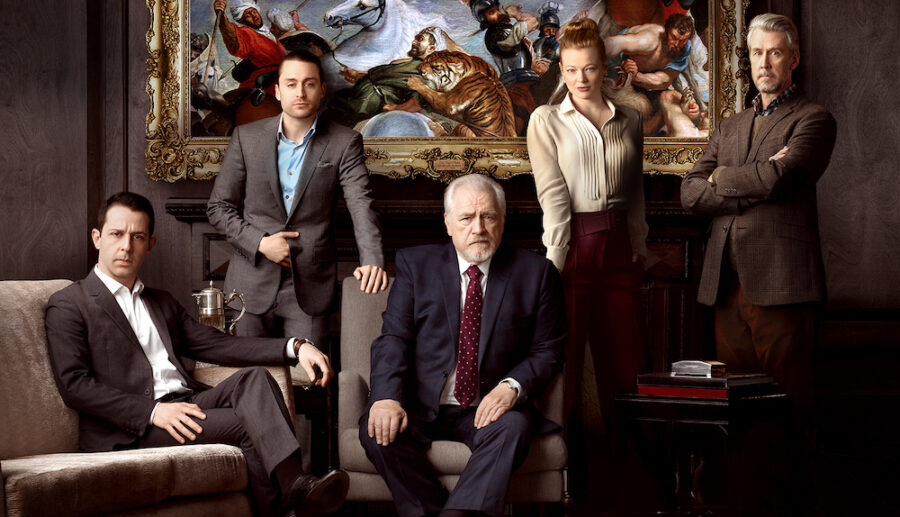
Succession launched on HBO in 2018. The role of Logan Roy required an actor who could play a patriarch so powerful that his children organized their entire psychological lives around him. Power on screen usually arrives as volume, aggression, physical dominance. Cox understood that real power — the kind the Roys’ world runs on — arrives as stillness. Making that feel earned, rather than performed, is a harder problem than it sounds.
He plays Logan Roy as a man who has made so many brutal decisions over so many decades that the brutality has become invisible to him. Like the smell of your own house: present in every molecule, entirely imperceptible. Logan never needs to raise his voice. He simply needs to be in the room. Cox delivers this with a physical precision — the quality of his attention, the pace of his speech, the specific weight of his silence — that makes every scene he’s in feel like a controlled detonation.
For a deeper look at what Logan Roy means as a cultural archetype, and how Cox’s performance anchors the Succession TV show legacy, the hub piece covers the full psychological field manual.
The Emmy and What It Actually Measured
Cox received Emmy nominations for Outstanding Lead Actor in a Drama Series in 2019, 2020, and 2022. He did not win. Jeremy Strong took the award in 2020 for his performance as Kendall Roy, which was deserved. Meanwhile, Kieran Culkin took home the 2024 Emmy for his Season 4 work as Roman Roy — the most naturally gifted performer in an ensemble that included Cox himself. Cox’s response to not winning was, characteristically, to continue giving the best performance on the show. The Emmy conversation missed the specific achievement of what Cox did with Logan Roy: he made the audience grieve a man they should not have liked, which required sustaining a performance of immense internal complexity across four seasons without ever showing the seams.
Furthermore, Cox’s Emmy nominations represent only the most visible recognition of work that spanned a forty-year career. The industry, when it finally arrived at his door with formal acknowledgment, was catching up with what the theatrical world had known for decades.
Brian Cox Net Worth: What the Numbers Mean
The Estimated Figure
Brian Cox net worth sits at an estimated $8 million as of 2025, according to multiple entertainment industry trackers. This figure reflects his complete career earnings across theatre, film, and television — including his Succession salary, which reportedly reached $500,000 per episode by the final seasons. For context, this places his earnings in a different register than the ultra-wealthy roles he plays, which is perhaps fitting: Cox has always been a craftsman whose relationship to money is professional rather than defining.
The $8 million figure is notably modest relative to his cultural footprint. Actors who spend decades in serious classical work and character roles accumulate critical reputation at a rate that outpaces financial compensation. Cox’s theatrical work, while significant, does not generate the kind of returns that franchise work produces. His blockbuster appearances — the X-Men franchise, the Bourne series — supplemented rather than anchored his earnings. Succession changed this calculus significantly.
What He’s Built Beyond the Money
The more accurate accounting of what Brian Cox has built lies outside any net worth estimate. He authored two memoirs — Putting the Rabbit in the Hat (2021) and The Rabbit Hole (2023). Both received serious critical attention. Both demonstrated a literary intelligence that surprised audiences who knew him primarily as Logan Roy. The books are candid about his Dundee childhood, his marriages, his politics, and his relationships with other actors — in a voice unmistakably his: direct, funny, occasionally caustic, never sentimental.
Cox holds dual citizenship in the United Kingdom and the United States. Politically, he has been outspoken — particularly on Scottish independence and American governance, in terms that leave no room for misreading. In 2003, the Crown awarded him a Commander of the Order of the British Empire (CBE). These are not the markers of a man who measured his life in awards or net worth. They are the markers of a person who built something specific and durable from a starting point that offered neither guarantee.
The Hamptons Chapter: Power in the Room
Where Brian Cox Fits East of the Bridge
Brian Cox does not maintain a visible presence in the Hamptons social circuit in the way that some of his contemporaries do. This is, characteristically, consistent. Cox has spent his career building the kind of reputation that doesn’t require a social circuit to sustain it. The work does the sustaining. However, Succession‘s presence in the cultural vocabulary of the Hamptons — where the show’s audience skews heavily toward exactly the demographic it depicts — means Cox’s Logan Roy haunts the social landscape even in his physical absence.
Notably, every dinner party east of the bridge since 2018 has contained at least one Logan Roy. The patriarch who can’t let go. The patriarch who tests rather than trusts. The patriarch whose love arrives as leverage. Cox made that character so legible that people stopped watching Succession and started looking around the room. Social Life Magazine has covered the Hamptons social world for 23 years. The Roy dynamic is not fiction in these rooms. It is furniture.
What Brian Cox Built: A Career That Outlasts Its Context
The Soft Landing
Brian Cox at 78 occupies a position that very few actors reach: genuine respect from every corner of the industry, across every medium, without the asterisk of a single defining role. Logan Roy is the most famous thing he has done. It is not, by any serious measure, the best — or rather, it is one excellent performance in a career of forty years of excellent performances, a career that will continue because Cox has never operated at the level where “what comes after” is a problem that requires solving.
He continues to act. After Succession wrapped in 2023, Cox appeared in Tetris (2023) and several other productions. Interviews reveal someone more honest and more entertaining than most actors manage. Books followed — opinions too. At an age when many contemporaries have retired or declined, Cox stays in full possession of his instrument and apparently in no hurry to put it down.
The Brian Cox net worth story is not, finally, about $8 million. It is about what a person from a difficult starting point can build through the consistent application of serious craft over the course of an entire life. The number is the artifact. The life is the achievement.
Ultimately, the Roys were always going to collapse. The man who played their patriarch will outlast them. That seems, on reflection, exactly right.
Related Reading
- Succession: The Show That Knew Your Family — Full Character Hub
- Jeremy Strong: Net Worth, Origin Story, and Where He Is Now
- Hamptons Hedge Fund Billionaires: Net Worth and the Philosophy Behind It
You already know which room this is about. The question Social Life Magazine has been asking for 23 years — in the Hamptons, in the rooms that matter, at the tables where things actually get decided — is not who’s in it. It’s what they’re really saying.
If your brand, business, or story belongs in those rooms, we’d like to talk. Editorial features, partnerships, and press inquiries start here.
To place your brand directly in front of the audience that recognizes this world from the inside, paid feature placements are available here.
82,000 readers receive the Social Life Magazine email — people who summer east of the bridge, own the homes, attend the events, and make the decisions. Join that list here.
Polo Hamptons is where the real version of this world shows up in person — sponsors, guests, and brand activations for the audience the Roys would have killed to reach. See what’s available at polohamptons.com.
Five issues a summer, 25,000 copies each, distributed between Westhampton and Montauk to the people who make the Hamptons the Hamptons. Print subscriptions here.
If this piece named something you recognized and couldn’t quite articulate, consider supporting independent luxury media. $5 keeps the lights on and the table set.
Author

Written by
Recent Posts

Ryan Gosling Net Worth: The $70M Art of Not Trying
Cillian Murphy Net Worth: The Art of Quiet Fortune

Margot Robbie Net Worth: Barbie’s $80m Power Broker

Barbenheimer Box Office: The Weekend Hollywood Faked a Comeback
Top Gun Maverick and the Extinction of the Movie Star Species
Categories
- Art
- Articles
- Beauty & Skincare
- Celebrities
- Celebrities|Entertainment
- Celebrities|Television
- Celebrities|The Chronicles
- celebrities|the-archive
- Chronicles
- Entertainment|Culture
- Event Photos
- Events
- Fashion
- Fashion & Style
- Featured
- Food & Beverage
- Food, Spirits, Wine
- Hamptons
- Hamptons Celebrities
- Hamptons Celebrities|Celebrities|The Chronicles
- Health
- Health & Beauty
- Lifestyle
- Luxury Lifestyle
- Press
- Profiles
- Real Estate
- Technology
- The Chronicles
- Travel
- Uncategorized
- Weddings