
The Before: Fifteen Towns, a Pilot Father, and Gloria Steinem’s Stepson
Despite this, christian Charles Philip Bale was born on January 30, 1974, in Haverfordwest, a market town in southwestern Wales that he would leave almost immediately. In turn, his family moved constantly — fifteen towns before he turned fifteen, crossing Wales, England, Portugal, and eventually the United States. Regardless, his father, David Bale, was a South African-born commercial pilot who ran a commuter airline, imported the first skateboards to England, marketed jeans, championed animal rights, and lived with the restless energy of a man who treated geography as a suggestion rather than a commitment. Indeed, his mother, Jenny, was a circus performer. Still, the household was nomadic, creative, financially unstable, and completely unlike anything that typically produces a Hollywood star.
The constant relocation meant Christian never settled into a school long enough to build roots. He adapted instead. The ability to arrive somewhere new, read the room, and become whoever the environment required — that skill, developed out of necessity by a child who never had a permanent address, would later become the most valuable asset in his professional toolkit. At eight, he booked a fabric softener commercial. At ten, he made his stage debut in a London West End production alongside Rowan Atkinson. He heard about the casting call for Steven Spielberg’s Empire of the Sun on the radio. His sister pushed him to audition. He was thirteen. He got the part. “It really came out of nowhere,” Bale has said. “We weren’t a family that had any connections. It was nothing like that.”
The Turning Point
In 2000, David Bale married Gloria Steinem — the co-founder of Ms. magazine and one of the most recognized feminists in American history — in a sunrise ceremony at the Oklahoma home of Wilma Mankiller, the first female Principal Chief of the Cherokee Nation. Christian became Steinem’s stepson. Three years later, David died of brain lymphoma at 62. Steinem called him the love of her life. There is a detail that connects the family in a way no screenwriter could have invented: before she married David, Steinem reportedly convinced Leonardo DiCaprio not to take the role of Patrick Bateman in American Psycho, clearing the path for Christian. The stepmother he would gain in 2000 had already shaped his career in 1999.
The Pivot Moment: American Psycho and the Beginning of Disappearing
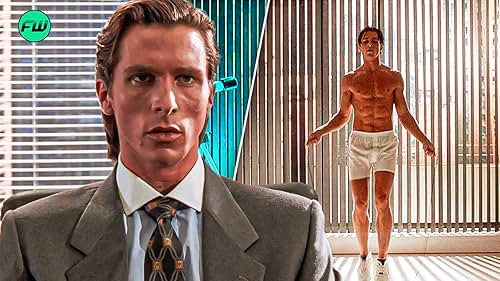
Meanwhile, the decade between Empire of the Sun and American Psycho was a wilderness. Bale appeared in Newsies (a musical that flopped), Little Women (a period drama that paid modestly), and a series of films that kept him working but not famous. Child stardom had given him a career. It had not given him an identity. American Psycho (2000) solved that problem by presenting the audience with a character who was entirely surface — a Wall Street investment banker whose obsession with business cards, restaurant reservations, and physical perfection masks the fact that he is also a serial killer. Bale played Patrick Bateman with a precision so controlled it reads as comedy on the first viewing and horror on every subsequent one.
The film earned $34 million on a $7 million budget and became a cult phenomenon. More importantly, it established the template for everything Bale would do next: total physical transformation in service of character. Bateman required a body fat percentage in the single digits. Bale achieved it through a regimen so extreme that the cast and crew reportedly found his dedication unsettling. The film paid him approximately $1 million. The role paid him something worth considerably more — the reputation as an actor who would do anything a part required, including remaking his own body from scratch.
The Climb: 121 Pounds, 221 Pounds, and the Batman Fortune
In 2004, Bale starred in The Machinist as Trevor Reznik, an insomniac factory worker so consumed by guilt that he has essentially stopped eating. Bale dropped to 121 pounds — a loss of over 60 pounds from his normal weight. He subsisted on a reported diet of one can of tuna and one apple per day. The transformation was so extreme that the crew couldn’t look at him. Photographs from the set show a man whose skeleton is visible through his skin. The film earned critical praise and minimal box office. It also caught Christopher Nolan’s attention.
Nolan was casting Batman Begins and chose Bale over Jake Gyllenhaal. The problem was that Bale had just finished being a skeleton. He had six months to gain 100 pounds and build it into a physique credible enough to wear the batsuit. He went from 121 to 221 pounds — nearly doubling his body weight in half a year. The achievement is physiologically absurd. It is also the reason Bale earned $9 million for Batman Begins, $10 million plus a $20 million performance bonus for The Dark Knight, and $15 million for The Dark Knight Rises.
Behind the Numbers
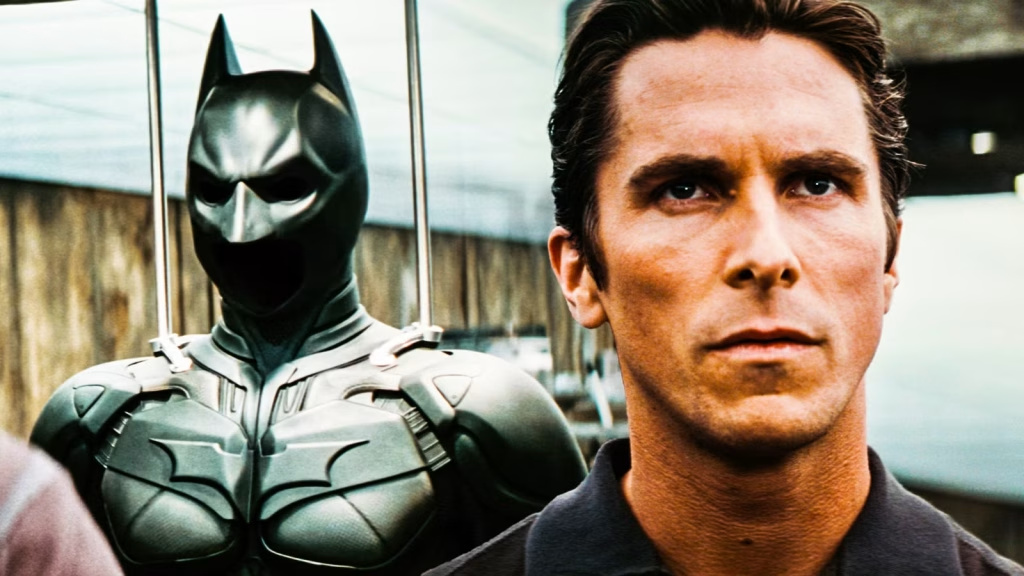
In fact, total Batman earnings: at least $54 million. The three films grossed $2.3 billion worldwide. Bale was reportedly offered $50 million to return for a fourth film. He declined. He was then offered $50 million for a brief cameo in Justice League. Ultimately, he declined that too. The refusals are worth more than the money, because they preserved the thing that generates the money: the belief that Christian Bale only says yes when the work justifies the cost.
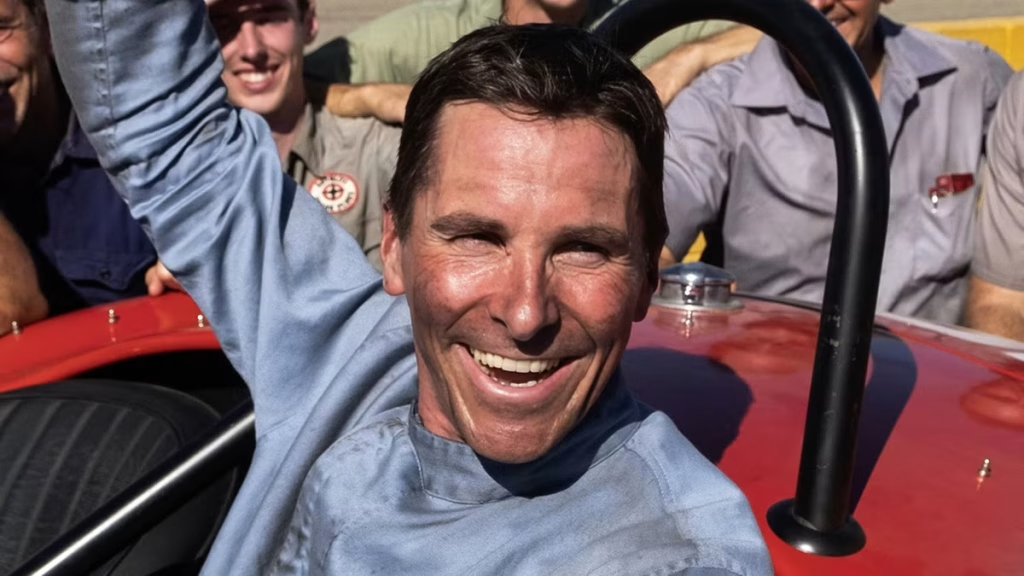
The body continued to be the instrument. For The Fighter (2010), he lost 30 pounds to play Dicky Eklund, the crackhead former boxer, and won the Academy Award for Best Supporting Actor. For American Hustle (2013), he gained 43 pounds and a combover. By contrast, for Vice (2018), he gained 40 pounds to play Dick Cheney and won a Golden Globe. For Ford v Ferrari (2019), he dropped weight again and earned $15 million. After Vice, he told interviewers what everyone who watched his career already knew: “I can’t keep doing it. My mortality is staring me in the face.”
The Hamptons Chapter: Brentwood Ranches and a Life Built on Privacy
Christian Bale’s real estate portfolio is concentrated entirely in the Brentwood and Santa Monica areas of Los Angeles, which tells you everything about his priorities. He and his wife Sibi Blazic — a former model and personal assistant to Winona Ryder, whom he married in 2000 — purchased their first home together in Santa Monica for $1.765 million in 2001. They still own it. In 2008, they added an 8.5-acre ranch in a different part of Brentwood for $13.5 million. In 2017, they paid $8.8 million for a mansion in Brentwood Park, which is now estimated to be worth more than $15 million.
The combined real estate portfolio is worth approximately $30 million, a substantial figure that nonetheless represents a modest percentage of his $120 million net worth. Bale does not collect properties the way other actors at his wealth level do. He does not own a New York apartment. He does not summer in the Hamptons. In particular, he does not maintain European residences. The consolidation is deliberate and consistent with a man who spent his childhood in fifteen towns and decided as an adult that he would never move again.
Subsequently, every interview reveals the same posture: private, guarded, allergic to publicity, and deeply suspicious of the celebrity apparatus that sustains his career. He has two children. He rarely discusses them. Specifically, he avoids red carpets when possible. His public appearances are minimal and almost always tied directly to promoting a specific film. The lifestyle is anti-Hamptons in geography but recognizable in philosophy — the quiet compound, the family-first architecture, the refusal to perform wealth for an audience.
What He Built: The Big Short and the Art of Being Unrecognizable
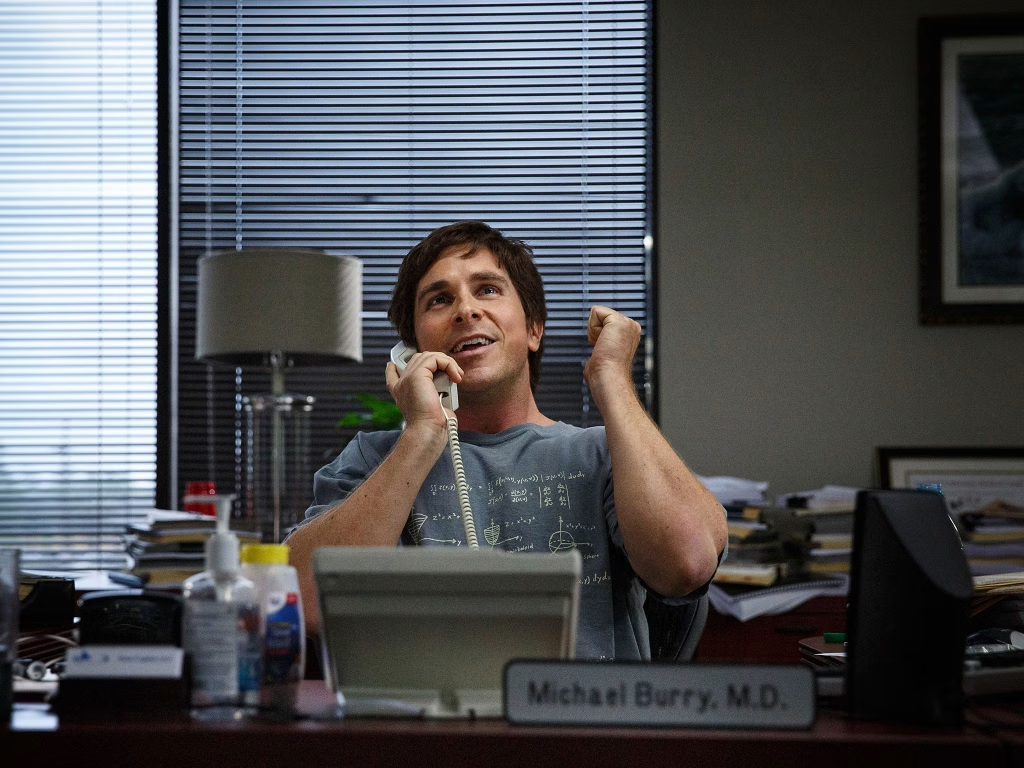
Bale’s performance as Michael Burry in The Big Short required a different kind of transformation. Not physical this time — Burry was an ordinary-looking man — but behavioral. Bale visited the real Burry at his Cupertino office and studied the hedge fund manager’s mannerisms: the glass eye, the avoidance of eye contact, the habit of wearing shorts and no shoes to the office, the heavy metal playing at maximum volume while he read mortgage bond prospectuses. Bale called Burry “a fascinating individual” and said he grew genuinely fond of him. The performance earned his fourth Academy Award nomination.
What makes The Big Short role significant in the architecture of the Christian Bale net worth story is that it represents the version of his career that has no commercial incentive. The Dark Knight trilogy made him rich. American Psycho made him iconic. The Fighter made him an Oscar winner. The Big Short made him something rarer: an actor trusted by directors to embody real people with enough precision that the real people approve. Burry signed off. Dicky Eklund signed off.
Meanwhile, the capacity to disappear into another person’s skin — not just their body but their nervous system, their eye movements, their relationship with silence — is the asset that no salary figure captures. It is also the asset that keeps the salary figures rising. Thor: Love and Thunder paid him $10 million for a single villain role. He did not need to lose or gain weight. He did not need to study a real person. As a result, he showed up, played Gorr the God Butcher with terrifying sincerity, and collected the check. That kind of payday only exists because The Machinist and The Big Short proved he could do something no other actor would attempt.
The Soft Landing: $120 Million and the Cost of the Instrument
Christian Bale’s net worth sits at an estimated $120 million. His films have grossed over $6.5 billion worldwide. He has won one Academy Award, two Golden Globes, and two Screen Actors Guild Awards. He has been nominated for more than 200 industry prizes and has won over 80. Similarly, he was named to the Time 100 in 2011. The Independent called him one of the greatest actors of the 21st century. None of these facts are things he would volunteer in conversation.
The body that built the fortune has taken damage that no medical professional would recommend. From 121 pounds (The Machinist) to 221 pounds (Batman Begins) to 143 pounds (Rescue Dawn) to 228 pounds (American Hustle) to 185 pounds (Vice) — the swings represent a cumulative stress on organs, joints, and cardiovascular systems that Bale himself has acknowledged cannot continue indefinitely. After Ford v Ferrari, he announced he would no longer undergo extreme physical transformations for roles. The declaration was less a retirement than an acknowledgment: the instrument that built the $120 million fortune is also a human body, and human bodies have limits.
The kid who heard about an audition on the radio, whose family lived in fifteen towns, whose father married Gloria Steinem and died three years later, whose stepmother accidentally cleared the path for his breakout role — that kid built everything on the principle that the work is the only thing that matters and the body is the tool you use to do it. In turn, the Big Short didn’t ask him to destroy his body. It asked him to sit in a chair and be someone else so completely that the real person couldn’t tell the difference.
The Cost
Ryan Gosling, Brad Pitt, and Steve Carell each delivered career-defining work in that film. But Bale’s performance is the one the real Michael Burry kept. Burry, the man who read the fine print no one else opened, watched Bale play him on screen and said he was satisfied. From a man who trusts data over people, that is the highest-paying compliment an actor can receive.
Related: The Big Short True Story: The Outsiders Who Bet Against America and Won · Ryan Gosling Net Worth: The $70M Art of Not Trying · Brad Pitt Net Worth: $400M Empire and Château Miraval · Steve Carell Net Worth · The Wall Street Movies That Rewired How America Thinks About Money
If you understand that the most valuable people in any room are the ones willing to become unrecognizable in order to do the work properly — then you already know why Social Life Magazine has spent 23 years covering the people who build things that last. Reach out to our editorial team to be featured.
Want to position your brand where discipline meets excellence? Submit a Paid Feature and let our editors build something worth reading.
What the Record Shows
Join 82,000+ subscribers who get our take on luxury, culture, and the Hamptons scene before anyone else. Subscribe to our email list.
Experience the intersection of sport, style, and status at Polo Hamptons — Bridgehampton’s premier luxury polo event, now in its seventh year with BMW as title sponsor.
Never miss a print issue. Subscribe to Social Life Magazine and get five summer issues delivered from Memorial Day to Labor Day.
Love what we do? Support Social Life Magazine and help us keep covering the culture that matters.
Author

Written by
Recent Posts
Frank Langella Net Worth: The Fortune That Four Tony Awards, an Oscar Nomination, and Six Decades of Mastery Could Not Make Larger
Demi Moore Net Worth: The $200 Million Comeback That Hollywood Said Was Impossible
Jeremy Irons Net Worth: The $25 Million Castle Dweller Who Played Power Without Wanting It
Steve Carell Net Worth: The Mailman Who Got Fired and Built a $100 Million Empire
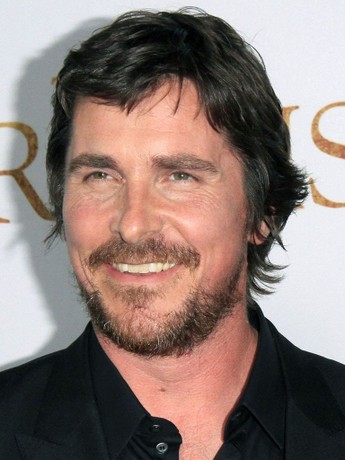
Christian Bale Net Worth: The Nomad Who Destroyed His Body and Built a $120 Million Fortune
Categories
- Art
- Articles
- Beauty & Skincare
- Celebrities
- Celebrities|Movies
- Celebrities|The Chronicles
- Chronicles
- Entertainment|Culture
- Event Photos
- Events
- Fashion
- Fashion & Style
- Featured
- Food & Beverage
- Food, Spirits, Wine
- Hamptons
- Hamptons Celebrities
- Hamptons Celebrities|Celebrities|The Chronicles
- Health
- Health & Beauty
- Lifestyle
- Luxury Lifestyle
- Movies|Culture
- Movies|Hamptons Lifestyle
- Press
- Profiles
- Real Estate
- Technology
- The Chronicles
- Travel
- Uncategorized
- Weddings