
Christine Baranski net worth lands between $8 million and $14 million in 2025, depending on which source you trust. Neither number is wrong. Both are insulting. This is a woman with two Tony Awards, 15 Emmy nominations, 216 episodes across two of the most respected legal dramas ever produced, and a role on The Gilded Age that critics keep calling the best work of a career already overflowing with best work. She won a single Emmy in 1995. Thirty years ago. The industry has been nominating her and not crowning her ever since, like a guest list that keeps inviting you to the party but never hands you the microphone.
That ratio — excellence divided by recognition — is the real Christine Baranski net worth. Not the bank account. The ledger of what happens when you build a career on craft instead of celebrity, on consistency instead of spectacle, on showing up with devastating precision for four decades while the trophies go to someone louder.
The Before: A Polish Newspaper Editor’s Daughter
Baranski’s father, Lucien, edited a Polish-language newspaper in Buffalo. Her grandparents performed in the Polish theater before immigrating to the United States. Her grandmother had her own radio show and wrote comedic sketches for the local Polish station. The performing gene didn’t arrive from nowhere. It traveled across an ocean and landed in Cheektowaga, a suburb where Polish Americans were the dominant culture and ambition meant working harder, not differently.
Lucien Baranski died in 1960. Christine was eight years old. Her brother Michael, an advertising executive, would die at 48. The early loss of her father — the man who ran the newspaper, who carried the cultural bridge between Poland and Buffalo — sits underneath every character Baranski has ever played. Consequently, the women she’s drawn to onscreen all share a quality: they hold things together after someone has left. Agnes van Rhijn holds together a crumbling social order. Diane Lockhart holds together a law firm after financial ruin. Maryann Thorpe holds together a friendship by refusing to be serious about anything. The architecture is always the same. Something broke early. Everything since has been structural repair.
The Pivot: Juilliard’s Neediest Student
At 16, Baranski discovered theater through a summer workshop in Buffalo. Two years later, she read an article in the Buffalo Evening News about Juilliard’s new drama division. She cut it out and taped it to her wall. She described the moment in a PBS interview: “I was this Polish girl from Cheektowaga who had an acting dream. To me, it was just the top.”

At 19, Juilliard awarded her $1,000 as “the most hard-working, economically needy student.” She spent it on two months in Europe. That detail reveals everything about Baranski’s relationship with money: she’s always valued experience over security. Furthermore, she graduated in 1974 without attending her own commencement because a director had already hired her for a production at the Stratford Festival in Connecticut. She was a working actress before she was technically a graduate. The career started running before she even picked up the diploma.
Meanwhile, she auditioned for Princess Leia in Star Wars. Carrie Fisher got the part. Consider the alternate timeline: Baranski in the gold bikini, Baranski with the blaster, Baranski delivering “Aren’t you a little short for a stormtrooper?” Instead, she went back to the stage. The theater kept her. The theater always kept her.
The Climb: Two Tonys and the Move That Changed Everything
Baranski’s Broadway career produced two Tony Awards before most people outside New York knew her name. The first came in 1984 for Tom Stoppard’s The Real Thing, playing opposite Jeremy Irons. The second came in 1988 for Neil Simon’s Rumors. In her acceptance speech, she announced that her win made her the 100th person to receive an award for working on a Neil Simon production. Nobody else was counting. Baranski was.
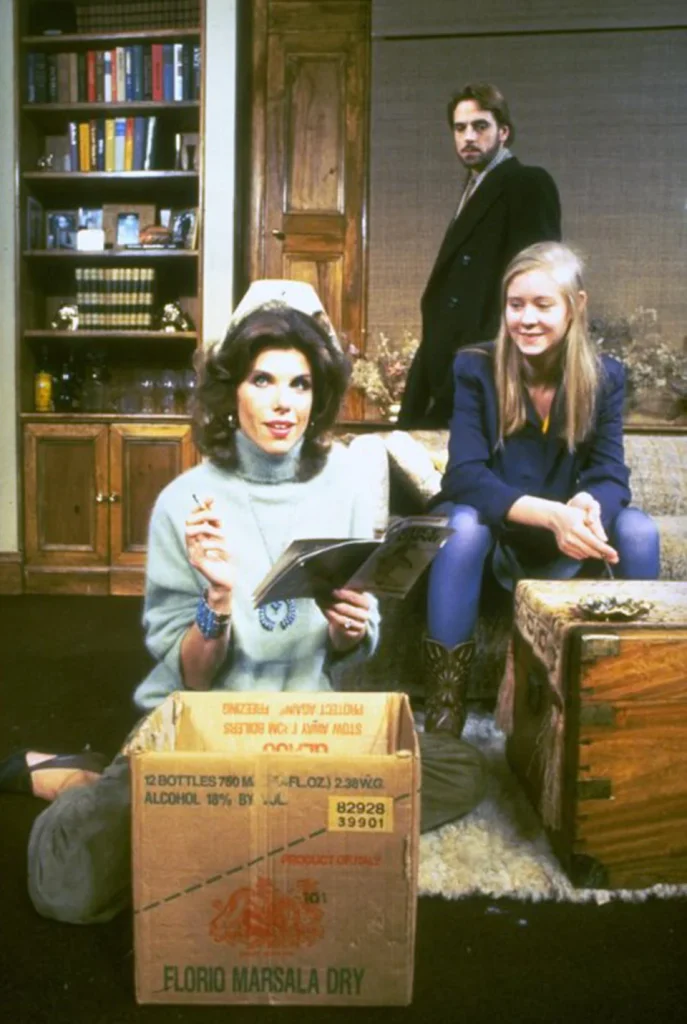
By the early 1990s, she faced a decision that every serious stage actor eventually confronts. New York theater was struggling. Audiences weren’t showing up for serious plays. Productions she poured herself into were closing without transferring to Broadway. “I left almost kicking and screaming,” she later recalled about moving to Los Angeles. “I almost called my agent in the middle of the night and said I can’t make the jump.”
She made the jump. CBS cast her as Maryann Thorpe in Cybill opposite Cybill Shepherd, and the role earned her the only Emmy she’s ever won — Outstanding Supporting Actress in a Comedy Series, 1995. Notably, the irony still stings: the one role that won was the one most unlike her. Maryann was a boozy, acerbic divorcée who said the quiet parts out loud. Baranski has spent every year since proving she can do infinitely more than that. The Emmys have agreed 14 more times. They just haven’t given her the trophy again.
216 Episodes: The Good Wife, The Good Fight, and the Quiet Empire
In 2009, CBS cast Baranski as Diane Lockhart in The Good Wife. The role would define the second act of her career more completely than anything else. Over 156 episodes across seven seasons, Diane became the avatar of a specific kind of professional woman: brilliant, principled, occasionally furious, always in control. When the show ended, CBS created The Good Fight specifically to continue Diane’s story. Baranski appeared in all 60 episodes and served as a producer.
The combined 216 episodes represent something unusual in television. Most actors of Baranski’s caliber cycle through roles every few years, chasing variety and awards heat. She stayed. Additionally, she took a recurring role on The Big Bang Theory as Dr. Beverly Hofstadter — Sheldon’s imperious mother — and earned four more Emmy nominations. That’s 15 total. One win. The gap between those numbers is the kind of statistic that would make a financial analyst nervous.
Simultaneously, Baranski built a film resume that included The Birdcage, Chicago, Mamma Mia!, and Into the Woods. She described the Mamma Mia! shoots as her favorite because she could “research” her character over martinis with old friend Meryl Streep after each daily wrap. The detail is perfect. Two Juilliard-trained actresses drinking martinis in Greece while singing ABBA. That’s not a career perk. That’s a life well-constructed.
Agnes van Rhijn and the Upper East Side Address

In 2022, Julian Fellowes cast Baranski as Agnes van Rhijn in The Gilded Age — a role that seemed designed in a laboratory specifically for her DNA. Agnes is old money, old rules, old New York. She views the nouveau riche Russells across the street with the kind of disdain that requires generations of practice. She is losing, and she knows it. The world is changing, and Agnes cannot change with it. That’s not weakness. That’s the cost of having principles in a market that rewards flexibility.
Season 3 pushed Agnes further into irrelevance. Her fortune dried up. Her sister Ada, newly wealthy, took control of the household. Baranski played the humiliation with a precision that made you feel the temperature drop in every room Agnes entered. Critics called it her best work on the show. The season drew a series-high 4 million cross-platform viewers, and HBO renewed the show for a fourth season before the finale aired.
Off-screen, Baranski’s geography mirrors her character’s. In December 2020, she purchased a $2.2 million apartment on East 74th Street — squarely within the zip code Agnes van Rhijn would recognize. She also maintains a home in Bethlehem, Connecticut, a 2,648-square-foot house built in 1787 that came through her late husband, actor Matthew Cowles. They married in 1983. He died of heart failure in 2014 after 31 years. Baranski raised their two daughters — Isabel, now a lawyer, and Lily, an actress — without a television in the house. She disapproved of the content. The woman who built a fortune on television didn’t trust television around her own children. That contradiction is the most Baranski detail imaginable.
What Christine Baranski Net Worth Actually Represents
The $8 to $14 million range tracks with what you’d expect from a career built on consistency rather than a single blockbuster payday. The Good Wife likely paid between $100,000 and $200,000 per episode during its peak years — strong money, but not the $1 million-per-episode numbers that top-billed network leads command. The Good Fight ran on a streaming platform with a smaller budget. The Gilded Age distributes its production money across an ensemble of 40-plus actors, elaborate sets, and historically accurate costumes that probably cost more per episode than half the cast’s salaries combined.
Furthermore, Baranski’s film roles have been almost entirely supporting parts. Chicago earned $307 million worldwide, but Baranski wasn’t carrying the billing. Mamma Mia! crossed $600 million globally, but the franchise belongs to Streep and Amanda Seyfried. The pattern holds: Baranski elevates everything she touches without receiving the top-line compensation. In another career, someone with her Tony count and Emmy nomination total would have anchored a franchise or negotiated a production deal. Baranski kept acting.
In 2018, she was inducted into the American Theater Hall of Fame. The Obama administration selected her as a Champion of Change for Arts Education. These honors don’t pay residuals. They do something else. They place a marker that says: this person mattered, even when the market didn’t fully reward it.
The Soft Landing: Connecticut, Football, and What Endures
Baranski lives quietly between Connecticut and the Upper East Side. She watches the Buffalo Bills with the kind of intensity her characters reserve for courtroom cross-examinations. “Everybody thinks this is some sophisticated lady, these characters that I play, they think that’s me,” she told Stephen Colbert. “They should be in a room alone with me when I watch the Buffalo Bills.” The line got a laugh. It was also the most honest thing anyone on late night has said about the gap between image and identity.
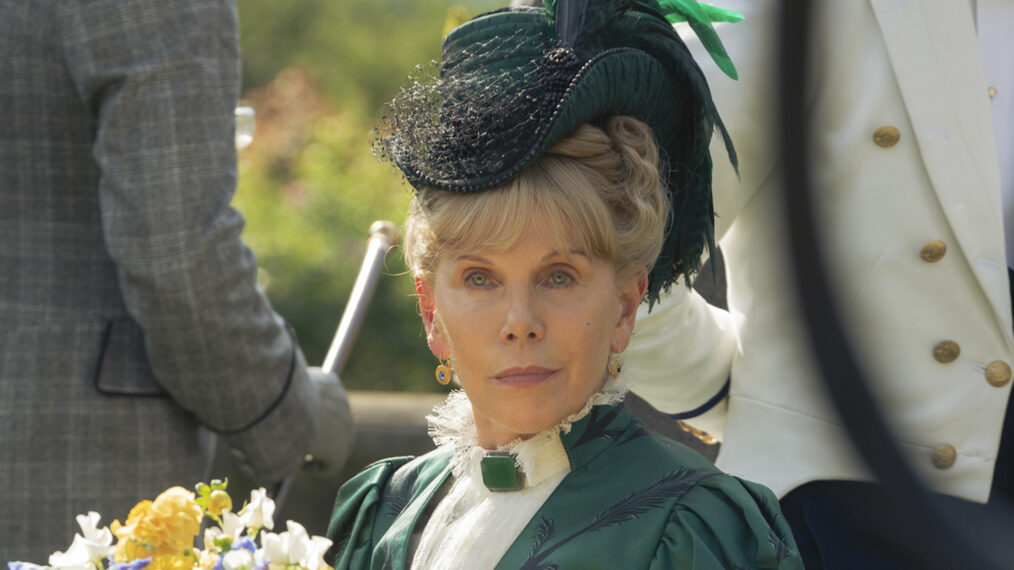
At 73, Baranski is still working. The Gilded Age Season 4 will bring her back as Agnes, a character she seems to understand at a cellular level — the woman who refuses to bend, even when bending would save her. Her career has followed the same logic. Fifteen Emmy nominations suggest the industry can see what she’s doing. One win suggests the industry can’t quite bring itself to say it out loud.
Christine Baranski net worth will fluctuate with future roles and residuals. The number will never capture what she’s actually worth to the industry she’s served since 1974. Some careers are measured in dollars. Others are measured in the silence that falls over a room when the person enters. Agnes van Rhijn doesn’t need to tell you she belongs. Neither does the woman who plays her. The room already knows.
Related Reading
- The Gilded Age Cast Net Worth: The Cast HBO Doesn’t Want You to Google
- Carrie Coon Net Worth: The Quiet Fortune of Television’s Most Nominated Actress
- Cynthia Nixon Net Worth: From Sex and the City to Political Reinvention
You know the feeling. You’re watching something unfold — a room shifting, a conversation turning, a door opening that wasn’t open before — and you realize you’re not just observing. You’re recognizing it. That’s what the best stories do. They hold up a mirror so polished you forget it’s glass. That’s what we do at Social Life Magazine. Twenty-three years of holding up that mirror to the most interesting people, places, and moments between the Shinnecock Canal and Montauk Point.
If your brand, your business, or your story belongs in front of the Hamptons’ most influential audience, we should talk. Visit sociallifemagazine.com/contact to explore editorial features, advertising partnerships, and custom brand activations with Social Life Magazine.
Ready to tell your story on your terms? Submit a Paid Feature and position yourself alongside the tastemakers, founders, and cultural architects who define the season.
Join 82,000+ readers who get our insider briefings on Hamptons lifestyle, luxury real estate, and the people shaping the conversation. Subscribe to the Social Life email list here.
Experience the Hamptons’ premier luxury sporting and social event. Polo Hamptons brings together the most discerning audience on the East End for world-class polo, brand activations, and the kind of afternoon that turns introductions into partnerships.
Never miss an issue. Subscribe to Social Life Magazine in print — five summer issues delivered to your door from Memorial Day through Labor Day, plus Fall and Winter editions distributed to Upper East Side doorman buildings.
Love what we do? Support Social Life Magazine with a $5 donation and help us keep delivering the stories, profiles, and cultural coverage that make the Hamptons worth paying attention to.
Author

Written by
Recent Posts
Christine Baranski Net Worth: Four Decades, 15 Emmy Nominations, and the Price of Being Undeniable

Morgan Spector Net Worth: The Most Terrifying Man on Television That Nobody Can Name
Cynthia Nixon Net Worth: The $20 Million Fortune That Bought the Freedom to Lose
Smart Travel Tips for a Hassle-Free Airport Commute

Carrie Coon Net Worth: The Quiet Fortune of Television’s Most Nominated Actress
Categories
- Art
- Articles
- Beauty & Skincare
- Celebrities
- Celebrities|Entertainment
- Celebrities|Television
- Celebrities|The Chronicles
- celebrities|the-archive
- Celebrities|TV Shows
- Chronicles
- Entertainment|Culture
- Event Photos
- Events
- Fashion
- Fashion & Style
- Featured
- Food & Beverage
- Food, Spirits, Wine
- Hamptons
- Hamptons Celebrities
- Hamptons Celebrities|Celebrities|The Chronicles
- Health
- Health & Beauty
- Lifestyle
- Luxury Lifestyle
- Movies
- Press
- Profiles
- Real Estate
- Technology
- The Chronicles
- Travel
- Uncategorized
- Weddings