
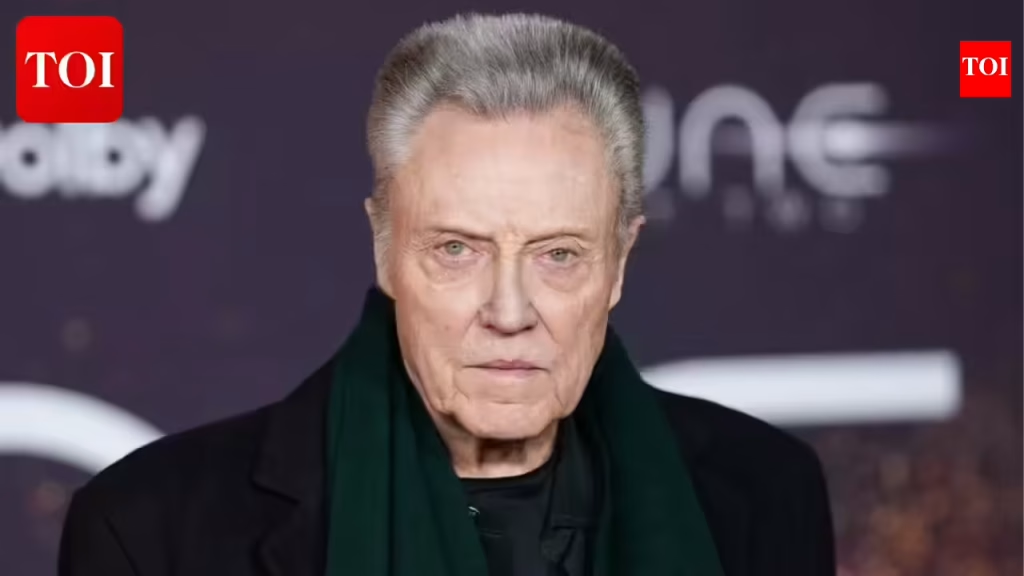
Christopher Walken Net Worth Origins: Astoria, the Bakery, and the Boy Named Ronnie
The Walken Family of Queens
Christopher Walken was born Ronald Walken on March 31, 1943, in Astoria, Queens, New York City. His father Paul was a German immigrant from Gelsenkirchen who arrived in America in 1934. He saved enough money to open a bakery at 29-13 Broadway in Astoria. The neighborhood was then predominantly German. His mother Rosalie was a Scottish immigrant from Greenock, Glasgow. She loved show business and pushed her sons toward it with the ambition of someone who had decided her children would go further than she had.
Notably, Ronald was the middle of three boys. Specifically, Kenneth had no interest in performing. Glenn and Ronald did. Consequently, Rosalie had them working as child models, then on television, then in acting roles. Ronald later described the experience with characteristic understatement: they used kids as furniture, he told Entertainment Weekly. He and Glenn took the subway from Queens to Rockefeller Center, where the television shows were shot, picking up work when it came.

The Bakery, the Dancing School, and the Lion
In the working-class Queens of the 1940s and 1950s, sending your kids to dancing school was, Walken has explained, simply what people did. You learned ballet, tap, acrobatics, and usually a song. Notably, that discipline proved formative in ways that extended well beyond musicals. The physical intelligence that made him distinctive on screen traces directly to those lessons. Every movement carried precise, almost choreographic quality. His body communicated what his words left out.
At ten, he appeared in a sketch with Jerry Lewis. At twelve, he and his brother Glenn originated the role of Michael Bauer on the soap opera The Guiding Light. As a teenager, he briefly worked as an assistant to a circus lion tamer — an experience that, in retrospect, is either the most Christopher Walken thing imaginable or a very early demonstration that he was drawn to proximity to dangerous, unpredictable things and had learned to remain calm around them.
Subsequently, he attended the Professional Children’s School in Manhattan, then enrolled at Hofstra University. However, he dropped out after a year. A Broadway chorus role had materialized, and theater was always going to win over academia for a boy who had been working professionally since he was a child.
The Name Change and the Road to Broadway
In 1964, while performing in a nightclub act, a fellow dancer named Monique van Vooren suggested he change his first name to Christopher. He agreed immediately. He has since noted that he wishes he had picked a shorter name — when he sees it in print, he told The Hollywood Reporter, it looks like a freight train. The legal name remained Ronald. The working name became Christopher. It suited him, and the industry remembered it.
Consequently, he toured with West Side Story, played King Philip of France in the original Broadway production of The Lion in Winter in 1966, performed Shakespeare at the Stratford Festival in Canada, and won a Theatre World Award for Tennessee Williams’ The Rose Tattoo. Additionally, in 1970 he won an Obie Award for his off-Broadway performance in Lemon Sky. By the time he made his first significant film appearance, he was already thirty. He had spent fifteen years becoming one of the best stage actors in New York.
The Deer Hunter and the Oscar That Defined Everything After

Annie Hall and the Year Everything Changed
In 1977, Walken appeared as Diane Keaton’s suicidal younger brother Duane in Woody Allen’s Annie Hall. Notably, the scene lasts approximately three minutes. Duane confesses — in a single unsettling monologue — that he sometimes fantasizes about driving into oncoming headlights while carrying passengers. Then he drives Alvy and Annie to the airport. The scene is funny and genuinely disturbing simultaneously — a combination that the industry would come to recognize as Walken’s specific territory and that no other actor has managed to occupy in quite the same way.
Subsequently, in 1978, Michael Cimino cast him as Nick in The Deer Hunter. Nick is a young steelworker from Pennsylvania who goes to Vietnam and does not come back whole. Consequently, the Russian roulette sequences won him the Academy Award for Best Supporting Actor. Director David Cronenberg later remarked that Walken’s face was the entire subject of any film he appeared in. Premiere magazine ranked it the 88th greatest film performance of all time.
What the Oscar Did and Didn’t Do
Ultimately, the award established Walken as one of the most significant actors of his generation. Paradoxically, it also started the typecasting process that defined the next two decades. Specifically, the industry took The Deer Hunter to mean: cast him as the threatening one, the unhinged one, the man in the room whose specific damage makes everyone else’s look ordinary.
For instance, Max Zorin, the Bond villain in A View to a Kill (1985), came next — blond-haired, cold-eyed, a Nazi experiment planning to destroy Silicon Valley. Then came Max Shreck in Tim Burton’s Batman Returns (1992) — a corporate predator behind a veneer of civic concern that was practically a dress rehearsal for Harmony Cobel. True Romance followed in 1993. One scene opposite Dennis Hopper — a Sicilian mob boss interrogating him about the whereabouts of his son. Quentin Tarantino later declared it one of the proudest moments of his career. Furthermore, Captain Koons in Pulp Fiction (1994) delivered a monologue about a gold watch hidden in a POW’s anatomy. It remains one of the most celebrated sixty-second performances in cinema history.
The industry cast him as the villain, the threat, the presence that organized everyone else’s anxiety. Notably, he was also, simultaneously, something else entirely.
The Other Walken: Dancer, Comedian, and Weapon of Choice

Pennies from Heaven and the Hidden Asset
In 1981, Walken appeared in Herbert Ross’s musical Pennies from Heaven and performed a tap-dance striptease that surprised every critic who had categorized him as exclusively dangerous. Indeed, Entertainment Weekly later listed the performance among the greatest Oscar-snubbed performances in cinema history. The dancing was real — thirty years of training, deployed in a film that nobody expected it in, doing exactly what unexpected things do in the right hands.
Throughout the 1980s and 1990s, he danced in cameos and supporting roles. Dance sequences appeared in films that had not asked for them. He hosted Saturday Night Live thirteen times and became one of the show’s most beloved recurring presences — most famously in the “more cowbell” sketch with Will Ferrell, which generated a cultural phrase that outlasted both the sketch and the decade.
Weapon of Choice and the Music Video That Changed Everything
In 2001, director Spike Jonze cast Walken in the music video for Fatboy Slim’s “Weapon of Choice.” The video shows Walken alone in a Marriott lobby — seated, then moving, then dancing with increasing abandon, then flying. He partially choreographed the routine himself. The video won six MTV awards. A VH1 survey of musicians and directors later voted it Best Music Video of All Time.
Specifically, the video reintroduced Walken to an audience that had only known him as the menacing presence in serious films. It reminded everyone of something they had always known. The dancing was always there, underneath the menace. The two qualities were not opposites. Instead, they were the same quality — precision, total commitment — expressed in different registers.
Shortly afterward, he earned his second Oscar nomination for Catch Me If You Can (2002). He played Frank Abagnale Sr. opposite DiCaprio with a melancholy warmth. That performance was the best argument yet that the villain roles had always been a fraction of his actual range.
Burt Goodman: Severance and the Role He Spent Eighty Years Building Toward

What Burt Requires
In Severance, Walken plays Burt Goodman — the head of Optics and Design at Lumon Industries, white-haired and deliberate, possessed of a gentleness so complete it seems structural. Burt falls in love with Irving Bailiff from the Macrodata Refinement department, across a departmental boundary that Lumon has made clear is not to be crossed, with a naturalness that suggests this is simply what humans do when you leave them alone in the right conditions.
Moreover, the role asks for something Walken has rarely been asked for on screen: pure warmth. Not warmth with menace underneath. Not warmth as manipulation. Warmth as a complete and final condition — the achieved serenity of a man who has made his peace with the available world and is offering that peace to someone who has not yet made theirs.
Why Only Walken Could Play This Role
Consequently, Ben Stiller needed an actor whose presence carried enough history to make Burt’s gentleness feel earned rather than simply given. Consequently, the casting only works because the audience already knows what Walken is capable of. Every scene between Burt and Irving carries the weight of an actor who spent fifty years making rooms uncomfortable, now choosing to make a room safe instead. Indeed, that contrast — the full Walken filmography operating silently as subtext beneath a quiet love story in a fluorescent office — is what makes the performance extraordinary.
Additionally, he brings one other thing that no younger actor can access: the specific gravity of a man in his eighties who has been working since he was ten years old. Furthermore, Burt Goodman’s stillness is the stillness of someone who has simply been around long enough to know that urgency is rarely the correct response. Walken has earned that quality in life. He does not have to perform it.
Read more: Severance Season 1, Episode by Episode: The Most Honest Show About Work Ever Made
Christopher Walken Net Worth: The Full Accounting
Where the $50 Million Comes From
Overall, Christopher Walken net worth of $50 million reflects over seventy years of continuous professional work across film, television, theater, and the occasional music video. His films have earned over $1.8 billion domestically and more than $5.1 billion worldwide. Residuals from that catalog — which includes films that remain in active rotation across streaming platforms — contribute an ongoing income stream that compounds as the audience for classic cinema grows.
Notably, his wealth was built without major endorsement deals or brand partnerships. Unlike most actors at his level of cultural recognition, Walken’s income derives almost entirely from performance work. He has worked consistently, across seven decades, without ever becoming dependent on any single franchise or revenue stream. Furthermore, that consistency — one hundred-plus films, regular theater work, fourteen Saturday Night Live hosting appearances — represents a model of career management that is both unusual and extremely durable.
Real Estate and Private Life
Walken and Georgianne own a farmhouse in Wilton, Connecticut, and an oceanfront home in Rhode Island. Indeed, the Connecticut property, by all accounts, is where Walken actually lives — meaning he genuinely is the man who grows his own food, has no cell phone, and sees primarily garbage men during periods between projects.
He and Georgianne met during the West Side Story tour in 1963. They married in January 1969. Georgianne became a respected casting director in her own right — working extensively on The Sopranos and Entourage. Remarkably, they have been married for over fifty-six years. They have no children. Walken has described this, with characteristic precision, as one reason he made as many films as he has.
The Hamptons Chapter: What This Career Means Here

The Walken Model and the East End
The people who build real things — who arrive at the Hamptons not through inheritance but through thirty years of showing up and doing the work better than anyone expected — tend to recognize something in the Walken arc that purely hereditary wealth does not produce. Starting in a bakery in Queens, he took the subway to Rockefeller Center to work as furniture. He dropped out of college when the work came. Fifteen years on Broadway passed before the film industry noticed him. Furthermore, he was already thirty when he made his first significant picture.
Furthermore, he never optimized for the category assigned to him. He danced in villain films and played gentle men in monster movies. He took the Fatboy Slim video because it was interesting. Consequently, the career that resulted is genuinely irreplaceable. No single performance accounts for it. Rather, the accumulated weight of all of them together created an asset that no career pivot or brand strategy can manufacture.
Ultimately, Christopher Walken net worth of $50 million is the financial residue of a man who spent his entire career doing what he found interesting. The farm in Connecticut, the absent cell phone, the garbage men — these are not eccentricities. They are the logical conclusion of a life organized around the work itself rather than the apparatus surrounding it.
Where Christopher Walken Is Now

Severance Season 3 and What Comes After
At eighty-two, Christopher Walken remains an active principal cast member on Severance. Season 3 enters production in mid-2026. He has indicated no intention of stopping. Indeed, this is consistent with everything else about his career: he has never retired from anything, never announced a final performance, never performed the gesture of graceful withdrawal that the industry periodically expects of its older actors.
Instead, he keeps working. He takes interesting jobs and declines uninteresting ones. By his own account, he has made movies that nobody saw and movies he himself has never watched. A film about Elvis in the afterlife appeared at the New York Shakespeare Festival. As a teenager, he trained as a lion tamer. His name changed because a lady in a nightclub act suggested it.
Specifically, the thing about Christopher Walken is that he has always been exactly who he is, without adjustment for the audience or the moment. The menace was real. Dancing was real. The gentleness in Burt Goodman is equally real. All of it, simultaneously, in the same person. Ultimately, that is either the definition of a great actor or the definition of a genuinely unusual human being. Most likely, it is both.
The people who built something irreplaceable — who spent decades doing the work for its own sake, in rooms that didn’t always recognize what they were watching, until the right room finally did — tend to understand the Hamptons at a frequency that purely transactional success never quite reaches. Social Life Magazine exists at that frequency. Our writers, strategists, and luxury-market analysts place your brand, your story, or your business inside the cultural conversation at the exact moment it matters. Start the conversation here.
82,000 readers receive our exclusive email briefings on the Hamptons market, luxury culture, and the people who move between both. Join the list here.
Polo Hamptons 2026 is where the conversations from the magazine become the relationships that close deals. Two events. One summer. The exact demographic your brand needs in a tent with your logo on it. Sponsorship details here.
The print edition of Social Life Magazine reaches 25,000 households in the Hamptons corridor and 15,000 doorman buildings on the Upper East Side. It sits on the coffee table when the right person picks it up. Subscribe or advertise here.
If this piece was worth your time, the most direct way to keep independent luxury media that takes the culture seriously alive is a contribution here — any amount, no obligation.
Author

Written by
Recent Posts

Christopher Walken Net Worth: The Baker’s Son Who Became Hollywood’s Most Irreplaceable Actor

Severance Season 1: A Field Guide to the Most Honest Show About Work

Adam Scott Net Worth: 15-Year Overnight Success

Chris Pontius Net Worth: The Man Who Survived Being Himself

Sandy Mahl Net Worth: The Woman Behind Garth Brooks Who Chose Silence
Categories
- Art
- Articles
- Beauty & Skincare
- Celebrities
- Celebrities|Entertainment
- Celebrities|The Chronicles
- celebrities|the-archive
- Chronicles
- Entertainment|Culture
- Event Photos
- Events
- Fashion
- Fashion & Style
- Featured
- Food & Beverage
- Food, Spirits, Wine
- Hamptons
- Hamptons Celebrities
- Hamptons Celebrities|Celebrities|The Chronicles
- Health
- Health & Beauty
- Lifestyle
- Luxury Lifestyle
- Press
- Profiles
- Real Estate
- Technology
- The Chronicles
- Travel
- Uncategorized
- Weddings