
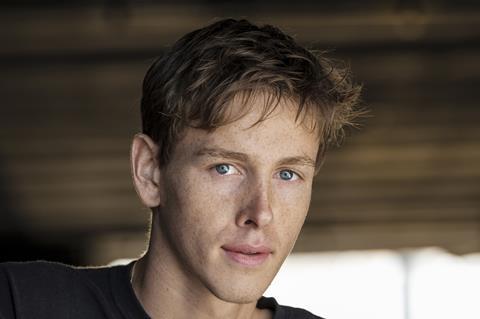
Harris Dickinson net worth is estimated at approximately $3 million in 2026, a number so disproportionate to his critical standing that it functions as a diagnostic tool for understanding how the entertainment industry values certain kinds of talent. Dickinson is 28 years old, has won the Palme d’Or (as the lead of Ruben Ostlund’s Triangle of Sadness), starred opposite Nicole Kidman in one of the most discussed films of the 2024 awards cycle (Babygirl), and shared a wrestling ring with Jeremy Allen White and Zac Efron in A24’s The Iron Claw. His resume reads like it belongs to someone worth $15 million. His bank account reflects the reality that arthouse cinema pays its stars in prestige, not in paychecks, and that the conversion rate between the two is neither immediate nor guaranteed.
East London to Sundance: no drama school, no safety net
Harris Dickinson was born June 24, 1997, in London’s East End, a detail worth pausing on because it contextualizes everything about how he moves through the industry. East London in the late 1990s was not yet the gentrified creative hub it would become. It was working-class, multicultural, and largely indifferent to the kind of self-conscious artistry that Dickinson would later embody. He did not attend drama school. He did not come through the RADA or LAMDA pipeline that produces most British actors of his generation. What he had instead was a face that cameras responded to with unusual intensity and an instinct for choosing material that the institutional gatekeepers would later validate.
Eliza Hittman’s Beach Rats (2017) was his announcement. The film, which premiered at Sundance when Dickinson was 19, follows a closeted teenager in Brooklyn navigating desire, masculinity, and the particular loneliness of performing a version of yourself that you know is incomplete. Dickinson, a straight British actor playing a queer American teenager, delivered the performance with a physical specificity that bypassed the usual questions about authenticity and arrived directly at the more important question: does this person feel real? He did. Hittman’s camera stayed on his face for long, silent takes, and the face held. That ability to hold a close-up without flinching or performing is the skill that separates actors who work consistently from actors who work occasionally, and Dickinson demonstrated it before he turned 20.
Triangle of Sadness and the Palme d’Or at 25
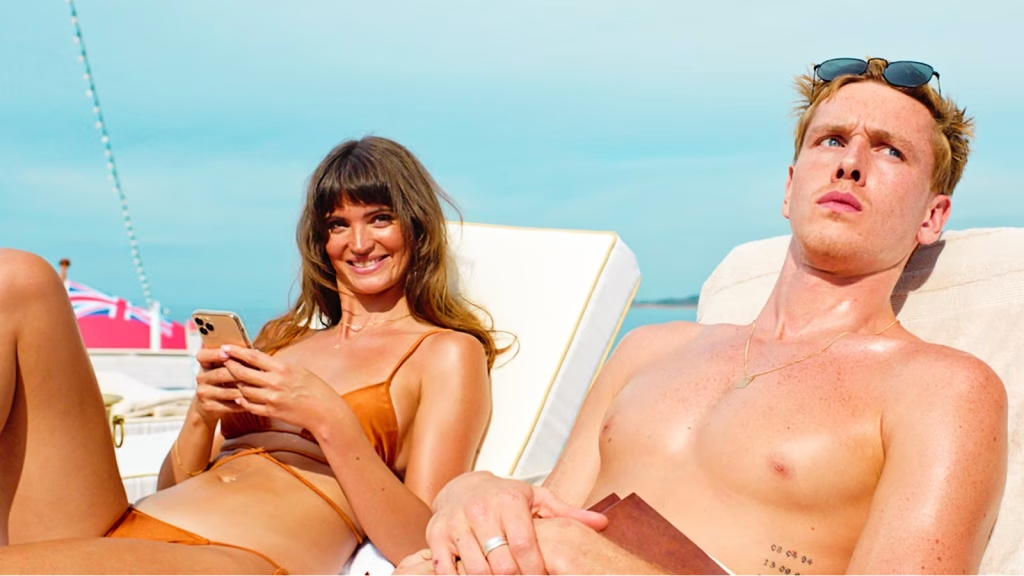
Ruben Ostlund’s Triangle of Sadness (2022) made Dickinson internationally visible in a way that Beach Rats, despite its critical success, had not. Ostlund’s satirical drama about wealth, class, and a luxury yacht that sinks takes its time establishing the power dynamics between Dickinson’s character (a male model named Carl) and his influencer girlfriend (Charlbi Dean, who died tragically before the film’s wide release). The first act plays as a relationship comedy about who pays for dinner. By the third act, the hierarchy has been completely inverted, and the people who were served are now serving.
Dickinson’s performance anchors the satire because Carl is not a villain. He is a participant, a person who benefits from systems he did not design and cannot articulate, and whose confusion when those systems fail is more revealing than any monologue about inequality could be. The film won the Palme d’Or at Cannes and grossed $50 million worldwide on a modest budget. Dickinson was 25. For context, Timothee Chalamet was 22 when he received his first Oscar nomination. Pedro Pascal was 38 when he played Oberyn. Dickinson’s Cannes win arrived earlier in his career than almost any comparable validation in his generation, and it arrived in a film that required him to be humiliated, seasick, and covered in vomit. Glamour was not the currency. Commitment was.
The Iron Claw and the Von Erich connection
In Sean Durkin’s The Iron Claw (2023), Dickinson played David Von Erich, the most charismatic of the wrestling brothers and the one whose sudden death demolishes the family’s remaining hope. David is the brother the audience roots for, which makes his loss the film’s most devastating moment. Dickinson built the character with a warmth and physicality that honored the real David’s reputation as the Von Erich most likely to succeed, and then he was gone, and the audience understood what the surviving brothers had to carry forward.
Sharing the screen with Jeremy Allen White (Kerry) and Zac Efron (Kevin) placed Dickinson inside a film that connected three entirely different audience bases. White brought the prestige-TV audience from The Bear. Efron brought the mainstream recognition from a decade of studio comedies. Dickinson brought the arthouse credibility that neither of his co-stars possessed at that point. A24 distributed the film, extending Dickinson’s relationship with the studio that functions as his de facto creative home. Each A24 credit compounds the next. Beach Rats led to roles in larger A24 projects. The Iron Claw led to more directors knowing his name. Babygirl confirmed that the talent scales.
Babygirl and the Kidman effect
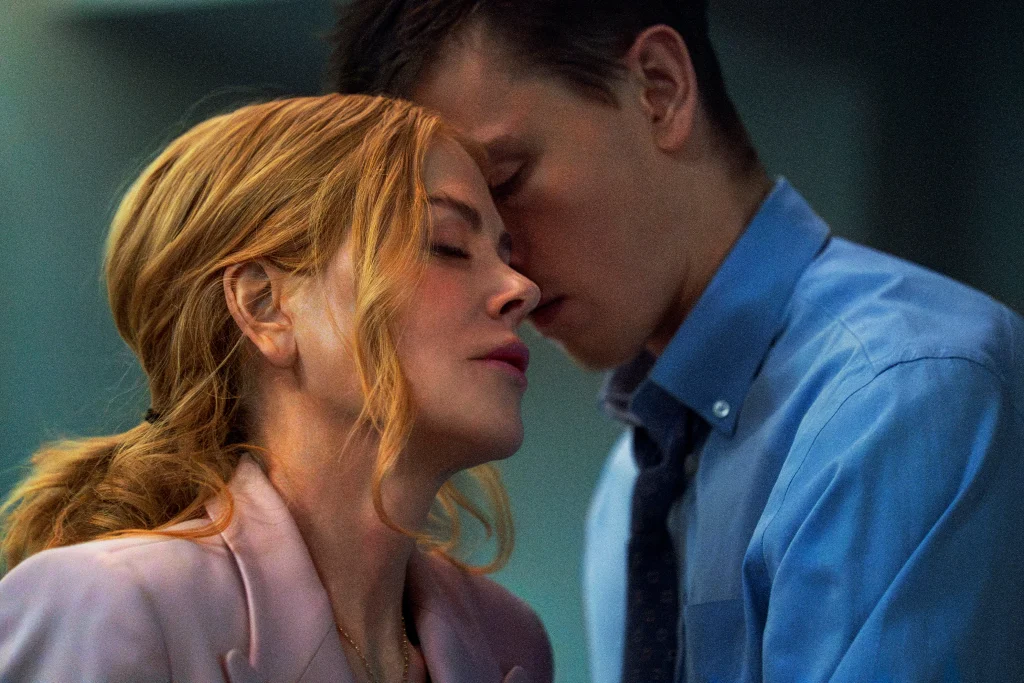
Halina Reijn’s Babygirl (2024) paired Dickinson with Nicole Kidman in a power-dynamics thriller that generated the kind of discourse that only films about desire and authority in professional settings can generate. Dickinson played a younger man whose relationship with Kidman’s corporate executive inverts the expected power dynamic in ways that the audience found simultaneously uncomfortable and compelling. The film was polarizing. The performances were not. Kidman, who has spent her career seeking out directors willing to push her into uncomfortable territory (Kubrick, Von Trier, Lanthimos), chose this project specifically because the material demanded an actor opposite her who could match her intensity without being intimidated by her stature. Dickinson matched it.
Playing opposite an Oscar winner of Kidman’s magnitude does something specific to a young actor’s market position. It signals to other directors that this person can hold the screen against the highest tier of talent without disappearing. It signals to agents that this person is ready for offers in a salary bracket above where they have been operating. And it signals to the audience that there is a reason you keep seeing this face in films made by people whose judgment you trust. That signal, repeated across Beach Rats, Triangle of Sadness, The Iron Claw, and Babygirl, has by 2026 accumulated into something approaching consensus: Harris Dickinson is one of the defining actors of his generation, and the paychecks have not caught up yet.
Why the net worth lags the talent
Dickinson’s $3 million net worth is a function of the market he operates in rather than a reflection of his value within it. Independent and arthouse films pay their leads between $100,000 and $500,000, with backend participation that generates meaningful returns only if the film crosses over commercially (as Triangle of Sadness did). Studio films and franchise roles pay ten to fifty times that amount. Dickinson has not yet taken a franchise role. Whether he will, and at what price, is the open question that determines whether his net worth doubles in the next two years or multiplies by five.
The actors he most closely resembles in career trajectory, Adam Driver and Robert Pattinson, both eventually took franchise roles (Star Wars, Batman) that catapulted their net worths past $10 million while maintaining their arthouse credibility. Dickinson’s path appears to be heading in the same direction, with A24 functioning as the credibility base from which a franchise leap would be launched. If and when that leap happens, the $3 million will look like a rounding error in retrospect. Until then, it is the price of artistic integrity in an industry that pays more for compliance.
Harris Dickinson net worth: the wealth breakdown
| Income source | Estimated range |
|---|---|
| Film (Triangle of Sadness, Iron Claw, Babygirl, etc.) | $2M – $3M |
| Modeling, fashion campaigns | $300K – $500K |
| Backend participation (Triangle of Sadness) | $200K – $400K |
| Residuals, festivals, misc | $100K – $200K |
| Current estimated net worth | ~$3M |
| Projected 2028 | $8M – $15M (franchise dependent) |
FAQ: Harris Dickinson net worth
What is Harris Dickinson’s net worth in 2026?
Harris Dickinson’s net worth is estimated at approximately $3 million in 2026, built primarily from independent and A24 film work including Triangle of Sadness (Palme d’Or winner), The Iron Claw, Babygirl, and Beach Rats.
Was Harris Dickinson in The Iron Claw?
Yes. Dickinson played David Von Erich alongside Jeremy Allen White and Zac Efron in Sean Durkin’s A24 film about the Von Erich wrestling dynasty.
Did Harris Dickinson go to drama school?
No. Dickinson did not attend drama school and did not come through the traditional British acting pipeline (RADA, LAMDA). He broke through with Beach Rats (2017), which premiered at Sundance when he was 19.
Where the conversation continues
Harris Dickinson is what happens when talent arrives faster than money does. A Palme d’Or at 25, Nicole Kidman at 27, the Von Erichs at 26. Every director who works with him confirms the same thing the camera confirmed in Beach Rats at 19: this person is real in a way that the audience cannot ignore and that the industry has not yet fully compensated. That $3 million net worth is a lagging indicator on a career the market has already priced higher. Whether the franchise call comes this year or next, the credibility is already banked. Everything else is arithmetic.
For more profiles, visit sociallifemagazine.com/contact. Polo Hamptons 2026: July 18 and 25 at polohamptons.com.
Author

Written by
Recent Posts

AI for personal finance: where PennyGuard fits
How to Pick a Homecoming Dress for Your Body Type (and Feel Amazing in It)

World Cup Injury Attorney for Vancouver Events
What a 3-Carat Engagement Ring Actually Costs in 2026: The Real Numbers
The Skincare Habits That Make a Real Difference Over Time
Categories
- Art
- Articles
- Business of Luxury
- Celebrities
- Culture
- Entertainment
- Events
- Faces of Summer 2026
- Fashion
- Fashion & Style
- Featured
- Finance
- Food, Spirits, Wine
- Hamptons
- Hamptons Celebrities
- Health
- Health & Beauty
- Lifestyle
- Luxury Lifestyle
- Press
- Profiles
- Real Estate
- Technology
- The Chronicles
- Travel
- Uncategorized
- Weddings