
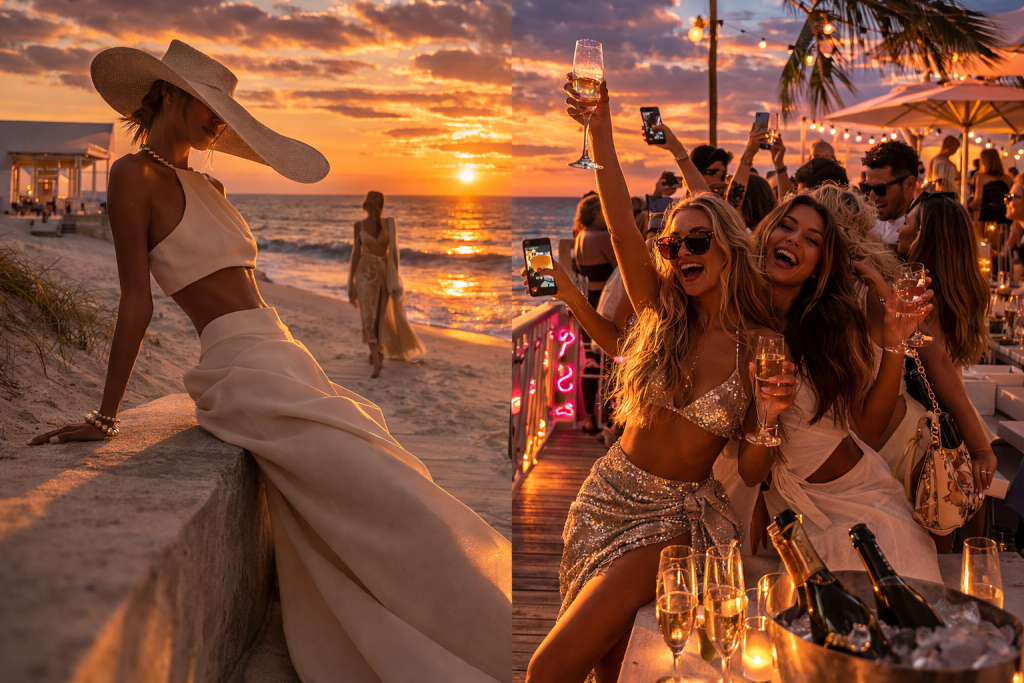
The counterintuitive thing about how Revolve and Jacquemus approached the Hamptons is that neither brand needed it. Revolve already had a billion-dollar e-commerce business and 7,500 influencers before they rented their first Water Mill mansion. Jacquemus, meanwhile, had shown collections in lavender fields in Provence, on a catwalk at Versailles, and in a wheat field outside Paris — none of which required a real estate transaction. Both brands arrived in the East End without boutiques, without storefronts, and without the institutional legitimacy that Hamptons fashion historically demanded. What they brought instead was something more interesting: budgets, algorithms, and a different theory of how desire actually moves.
They look nothing alike. One was founded by two California tech workers who got laid off in the dot-com crash and decided to read search data instead of looking for another job. The other was founded by a 19-year-old farm boy from Provence one month after his mother died in a car accident. Nevertheless, by summer 2025, both were operating in the Hamptons at the same moment, proving the same thesis through entirely opposite means. The East End noticed.
Part One: Revolve — The Algorithm That Learned to Party
The Before
Michael Mente dropped out of an entrepreneurship program at the University of Southern California to join a software startup in Los Angeles. Mike Karanikolas, meanwhile, studied computer engineering at Virginia Tech. The two men met at NextStrat, the startup, and were both working there when the dot-com bubble burst. Both lost their jobs. What they still had, however, was access to analytical search tools — the kind that showed you what people were typing into the internet at any given moment.
In 2002 and 2003, people were searching for fashion brands. Billion-dollar brands. By name. And finding almost nothing for sale. Mente observed later that these were companies with zero product online — and he did not say it like a criticism. Instead, he said it like a market inefficiency. He understood inventory before he had a fitting room. Consequently, they launched Revolve in 2003 with $50,000 of their own money — one-tenth of what a single Hamptons seasonal boutique costs to operate — and did not seek external funding for nine years.
The Pivot Moment
It was 2009, and the word “influencer” did not yet exist. Revolve had been operating for six years, building its catalogue of contemporary brands and watching what sold at what velocity. Mente found a blogger named Rumi Neely who wrote a site called Fashion Toast. She was, as he would describe it later, literally their customer — someone who shopped Revolve not for the discount but for the curation. Her audience trusted her choices the way people had once trusted Vogue, not because of institutional authority but because of proximity.
Revolve ran a marketing campaign with her. No playbook existed for this — no rate card, no industry category to bill against. Raissa Gerona, who joined the company as head of marketing in 2010, would build that entire infrastructure over the next decade. The campaign with Rumi Neely in 2009 was, ultimately, the first move in a game that only Revolve knew they were playing.
The Climb
By 2018, Revolve was projecting $1 billion in sales. Mente oversees the creative and merchandising side while Karanikolas runs finance, logistics, and technology. They still split responsibilities along the same lines established when they were roommates building the shopping cart together in 2003 — Mente designed the interface, Karanikolas ran the back end. The division of labor was set before they had employees, before they had a warehouse, before any of it was worth anything. It has not changed since.
In 2019, Revolve went public on the NYSE at a valuation of over $1.23 billion, raising $212 million in the IPO. The founders held a combined 56% stake and control over two-thirds of the voting shares through a separate entity called MMMK Development. Consequently, Mente’s personal net worth topped $1 billion by the time the stock doubled post-offering. He paid $45 million for a Beverly Hills mansion in 2025, having previously bought Matthew Perry’s house in the Hollywood Hills. Neither transaction has anything to do with fashion. Both, however, have everything to do with what happens when you read data correctly for twenty years while the industry you’re disrupting is busy attending runway shows.
Part Two: Jacquemus — The Brand Named After a Dead Woman
The Before
Simon Porte Jacquemus was born in 1990 in Salon-de-Provence, in the south of France. His parents were farmers. Growing up in an apple orchard in Mallemort — a town small enough that he learned to recognize Parisian visitors by their license plates — meant weekends spent selling fruits and vegetables by the roadside with his grandparents. He is on record saying that this experience, the roadside stand, the seasonal goods, the transaction built on trust and proximity, is where his understanding of fashion began. The connection, he says, explains itself. He has never felt the need to elaborate.
At the age of seven, he made his mother a dress from a piece of beige linen. She wore it to take him to school the next day, telling him he was very good. That moment, he has said, was the strong one. Ultimately, he understood his customer before he had a brand — and he has never had a different customer since.
The Pivot Moment
He arrived in Paris in 2008 at age 18, enrolled briefly at ESMOD design school, and left. One month after arriving in the city, his mother was killed in a car accident. She was 42 years old.
He did not go back to school. Instead, he stayed. A brand emerged from grief in less time than most people take to rebook a flight home — named after his mother’s maiden name, its first clothes sold by having friends wear them through stores uninvited during Vogue’s Fashion Night Out in 2010. A seamstress found at a flea market helped cut the early patterns. To fund the collections sewn at night, he worked days at the Comme des Garçons boutique on Rue du Faubourg Saint-Honoré. Rei Kawakubo saw his work at a showroom in Tokyo, thought he was too talented to hire, then hired him anyway — and eventually had her partner Adrian Joffe start buying his collections to sell in London.
That was the full sequence. His mother died, and the brand named after her was born. It remains independent, still his, and he has said he would rather shut it down than transfer ownership.
The Climb
By 2012, Jacquemus was one of the youngest designers ever to show at Paris Fashion Week. In 2015, he won the LVMH Prize special jury award — €150,000 and a year-long mentorship from an industry that had spent years watching him build without their permission. By 2018, the Le Chiquito bag had launched — a micro-structured handbag that started the miniaturization trend defining luxury accessories for the following four years. Kim Kardashian owned one, and Rihanna owned one as well. The bag, however, was not the point. The point was that a farmer’s son from Mallemort had defined a global aesthetic from a studio off the Place des Vosges.
Revenue reached €40 million by the brand’s 10th anniversary in 2019. By 2022, furthermore, the brand disclosed publicly it was on track to exceed €200 million annually, targeting €500 million by 2025. In February 2025, L’Oréal announced a minority investment and beauty partnership. Jacquemus has turned down every buyout inquiry he has received. He talks about that decision the way a farmer discusses not selling land: it is not complicated, it is simply not for sale. The brand carries his mother’s name, and he does not find this difficult to explain.
The Hamptons Chapter: The East End as Proving Ground
Revolve’s Water Mill Playbook
In the summer of 2015, Revolve rented a 6,363-square-foot mansion in Water Mill, New York. They invited more than 20 of the world’s most influential fashion bloggers — women from 12 different countries — and hosted four weekends of events in July. Chrissy Teigen hosted one evening. Hailey Baldwin attended. Kim Kardashian eventually came. The hashtag #RevolveintheHamptons generated nearly 5,000 Instagram posts. Furthermore, the participating influencers — each given clothing credits of at least $2,000 plus appearance fees — were required to post twice daily. Most exceeded that count significantly, because the property had been specifically engineered to manufacture Instagram moments.
The Revolve Hamptons program ran in 2015, 2016, and 2017, then stopped. Not because it failed — by every metric, it succeeded — but because the brand had extracted what it needed from the geography. The customer had been shown, repeatedly and at scale, that Revolve belonged in the same social ecosystem as the Hamptons. Notably, Revolve’s chief brand officer Raissa Gerona described it plainly: the area’s high cost of entry is part of what keeps it aspirational. Consequently, Revolve understood the East End the way a software engineer understands a system — as infrastructure with specific inputs and outputs, useful for the function it performs, not requiring permanent residence.
Revolve did not return to the Hamptons until summer 2025. That eight-year absence was not abandonment. Instead, it was the brand applying elsewhere — in Bermuda, at Coachella, in Cannes — what the East End had first taught it to do: manufacture aspirational proximity at scale. When Revolve came back in 2025, it arrived with a gifting suite, not a mansion. The mission had evolved. The thesis, however, had not.
Jacquemus at Montauk: The Confirmation Play
Jacquemus arrived at the Hamptons in a different register entirely. Activations at the Surf Lodge in Montauk — the open-air beach club that functions as the East End’s most photographed convergence point — placed Jacquemus in the same summer conversation as Net-a-Porter, Casablanca, and Alix Earle. This was not a distribution play. Jacquemus already has a SoHo store, Avenue Montaigne, and New Bond Street. What the Montauk activation accomplished was more precise: it put the brand in the same physical space as the people who had been buying it through screens, at the exact moment when the Hamptons operates as, in one observer’s description, “a hermetically sealed ecosystem of rich people who are interested in fashion.” Simon Porte Jacquemus was not there to introduce himself. Rather, he was there to confirm what the customer already suspected.
The East End Verdict
The diagnosis for both brands is ultimately the same, even though everything else about them differs. Neither came to the Hamptons to establish permanence. Both came to test whether their particular theory of desire — algorithmic for Revolve, emotional for Jacquemus — held up when the audience was standing in front of them. Both passed. The brands with permanent boutiques on Main Street — LoveShackFancy, Veronica Beard, TWP — watched this happen and, notably, did not have a clean answer for it. The full challenger map is more competitive than the legacy houses want to admit.
What They Built — And What the Net Worth Numbers Actually Say
Revolve: The Data Play Pays Out
Revolve’s trailing twelve-month net sales reached approximately $1.2 billion as of September 2025, with a 97 percent surge in net income in the third quarter of that year. The company’s market capitalization has ranged between $2.6 billion and $3.6 billion since the 2019 IPO. Michael Mente’s personal net worth is north of $1 billion, and the combined founders’ fortune was pegged at $1.5 billion at the IPO by Bloomberg. These numbers are, ultimately, the result of two people with no fashion experience, no fashion contacts, and no fashion credibility reading search data in California in 2002 and concluding that billion-dollar brands had left the internet unattended.
Jacquemus: The Independence Premium
Jacquemus revenue stands at over €200 million annually, with a target of €500 million by 2025. Notably, the brand has never taken institutional investment beyond a small L’Oréal minority stake for the beauty partnership. Every revenue figure, every store, every lavender field and Versailles runway is 100 percent independent — which in the fashion industry in 2025 is either naive or the single most sophisticated business decision a designer can make. Simon Porte Jacquemus has said he prefers to shut the brand down than give it to someone else. The brand carries his mother’s name. He does not elaborate further.
Mente will tell you the third decade of building Revolve was the most efficient and the most solitary. He does not say those two things are related. They are related.
Where They Are Now
Revolve: The Room Gets Smaller on Purpose
In September 2025, Revolve presented its 8th Annual Revolve Festival at Thermal, California — a Desert Mirage theme, 1,200 guests (down from a peak of 5,000), Lil Wayne performing, Cardi B appearing as special guest. The scale contraction was not failure. It was editing. The brand that invented influencer marketing is now, carefully and deliberately, deciding which moments still require the largest room. Mente spends most summers in the Hamptons. Karanikolas, who manages the family side, typically makes it out once — and Mente has been known to try to convince him to stay the night.
Jacquemus: Still Chasing the Same Sun
In Paris, Simon Porte Jacquemus showed his Spring 2026 collection at the Petit Palais. The show notes were personal, as they always are. He still runs his own Instagram. In August 2022, he married his partner Marco Maestri at the town hall of Charleval, in Bouches-du-Rhône, near where he grew up. His studio is off the Place des Vosges, and his restaurant, Citron, is in the Galeries Lafayette. The South of France is in every collection, even when no one from the South of France would necessarily recognize it — the linen from his mother’s dress, the lavender, the particular sun his collections are still chasing, room after room, season after season, in a city he moved to at 18 because someone told him that if you make it in Paris, you can make it anywhere.
His brand still carries her name. The Hamptons activation is already over. The customer remembers it anyway.
Same Thesis, Different Engines
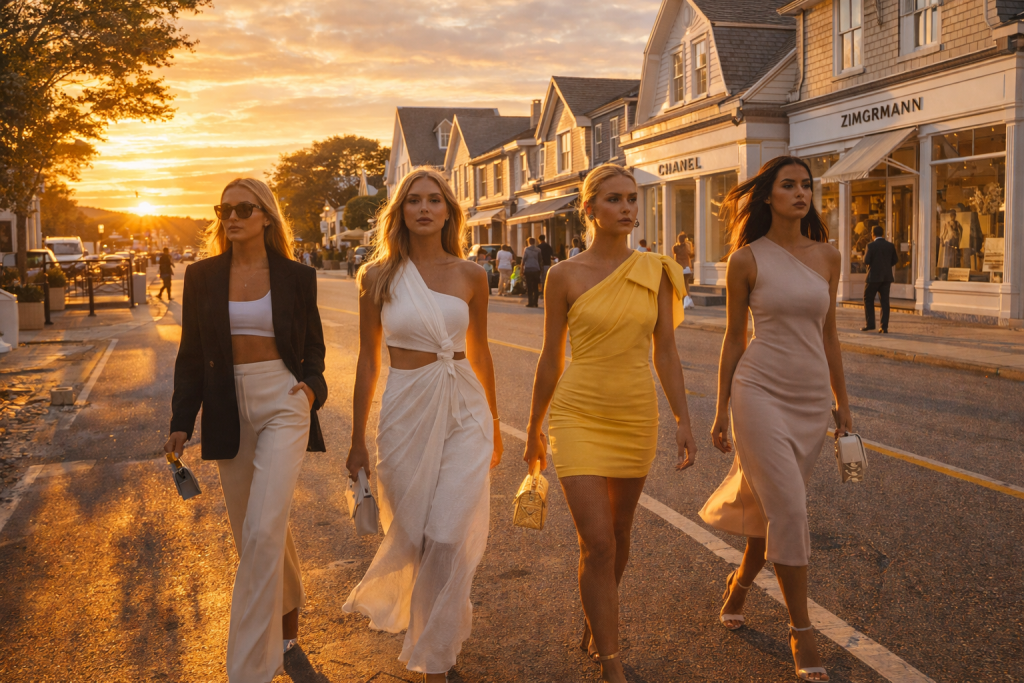
Two brands arrived at the East End in summer 2025 with money, models, and no boutique leases. One came back after eight years. One arrived as if it had always belonged, which is its own kind of confidence. Neither asked permission. Both understood that in the Hamptons, the difference between showing up and belonging is smaller than the legacy houses want you to believe — and larger than the digital-native brands usually admit.
The child who learned to recognize Parisian license plates from a roadside fruit stand made it to Montauk. Meanwhile, the two software workers who read search data in a California warehouse made it to Water Mill. Ultimately, the algorithm and the grief turned out to be the same thesis — run in parallel, arriving at the same address. The summer crowd did not notice the contradiction. They simply bought the clothes.
Explore more founders and figures shaping the Hamptons in the full archive at SocialLifeMagazine.com. If this story made you wonder whether Social Life could tell yours — that question is already worth a conversation.
Also in this series: Rebecca Hessel Cohen & LoveShackFancy · Zimmermann Net Worth · Veronica Beard Net Worth · Trish Wescoat Pound & TWP · The Full Challenger Series
Feature your brand: Contact Social Life Magazine — we connect luxury brands with the audiences that close.
The East End’s premier sporting event: Polo Hamptons — sponsorships, VIP access, and brand activations where the Hamptons actually convenes.
Get the Hamptons insider list: Subscribe to Social Life Magazine — 23 years of the East End, delivered to your door.
Support independent Hamptons journalism: Donate $5
Author

Written by
Recent Posts
7 Mindful Meal Prep Tips for Stop Food Waste Day
Rebecca Ferguson Net Worth: The Advantage of Not Being the Lead
What Makes a Dinner Party Truly Unforgettable (Hint: It’s Not the Food)
Tips for Managing Grease and Oil in Everyday Dishwashing
Austin Butler Net Worth: The Method Actor in a Post-Method World
Categories
- Art
- Articles
- Beauty & Skincare
- Celebrities
- Celebrities|Entertainment
- Celebrities|Television
- Celebrities|The Chronicles
- celebrities|the-archive
- Chronicles
- Entertainment|Culture
- Event Photos
- Events
- Fashion
- Fashion & Style
- Featured
- Food & Beverage
- Food, Spirits, Wine
- Hamptons
- Hamptons Celebrities
- Hamptons Celebrities|Celebrities|The Chronicles
- Health
- Health & Beauty
- Lifestyle
- Luxury Lifestyle
- Movies
- Press
- Profiles
- Real Estate
- Technology
- The Chronicles
- Travel
- Uncategorized
- Weddings