
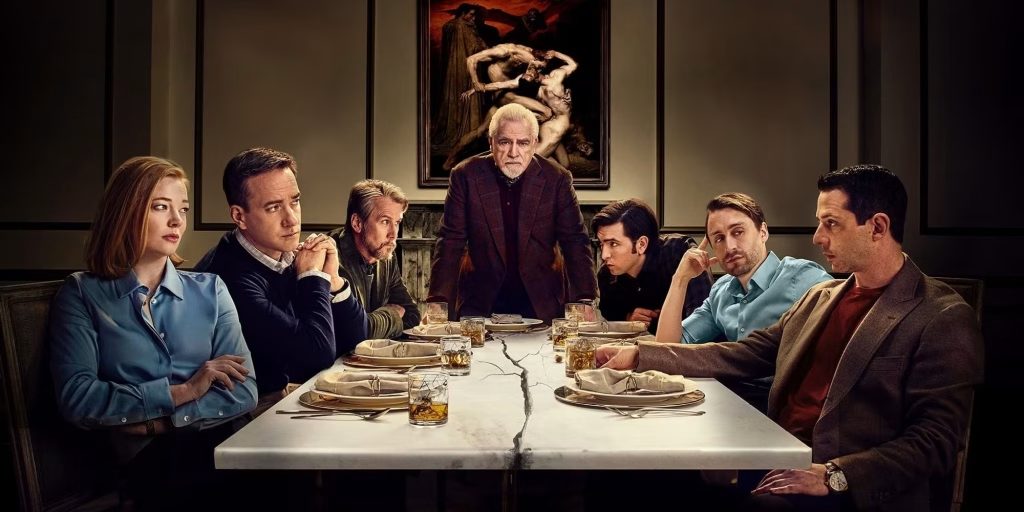
There is a dinner happening right now — not metaphorically, actually, somewhere between Southampton and East Hampton, at a table that cost more than most Americans’ cars. The guests have not discussed money directly in so long that they’ve forgotten it’s the only thing anyone discusses. At this dinner, someone faces a test. Not overtly — nobody at this table does anything overtly. A patriarch has spent forty years building something. His children grew up inside that something. They are simultaneously its most natural heirs and its most damaged products. Everyone performs a version of themselves that they believe the patriarch wants to see. Which is to say: everyone is lying. Which is to say: the dinner is, atmospherically, an episode of Succession.
The Succession TV show legacy — four seasons, 39 episodes, 13 Emmy Awards, a series finale that aired May 2023 and never stopped generating conversation — is not really a television legacy. It’s a diagnostic. Jesse Armstrong and his writers created the most accurate portrait of dynastic-wealth psychology ever committed to prestige cable. They achieved it by understanding something sociologists have tried to explain for decades: the people most damaged by inherited power are the people who were supposed to inherit it.
Why does a show about a fictional media mogul and his spectacularly broken children feel more real than the financial news it parodies? That is the question this piece intends to answer. Carefully. Without sentimentality. And with full acknowledgment that you — reading this — almost certainly recognized someone at that dinner table.
What Succession Got Right That Wall Street Never Admitted
The Show as Social Mirror (or: Why the Counterintuitive Read Is the Only Honest One)
The conventional take on Succession — and here we must pause to note that the conventional take is always, structurally, a kind of intellectual cowardice, a way of engaging with a thing while maintaining plausible deniability about having actually been affected by it — is that it’s a biting satire of the ultra-wealthy. Eat the rich. The Roys are monsters. We watch to feel superior.
This reading is not wrong, exactly. It’s just not interesting. More importantly, it’s not why you kept watching.
You kept watching because Succession is, underneath the private jets and the insults and the boardroom coups (which are also family dinners, which are also warfare conducted in the vocabulary of love), a show about the specific terror of succession anxiety. That fear — almost universal among people who have built something significant — runs like this: the thing won’t survive you. The people you raised to carry it are, through no fault anyone can cleanly trace, not quite right for the job. Not quite strong enough. Not quite free enough. Too much like you, or not enough.
The Real Dynasties Behind the Fiction
The Roy family draws from the actual architecture of dynastic media power. Rupert Murdoch’s family wages a succession drama so operatic it occasionally makes the fictional Roys look understated. Sumner Redstone spent his final years in a legal and familial war over Viacom that HBO’s writers’ room would have rejected for being too on-the-nose. Robert Maxwell’s empire collapsed the moment he left the room, and his children — who attended every table, who grew up inside the machinery of his will — couldn’t stop it.
Harvard Business Review reports that roughly 30 percent of family businesses survive into the second generation. About 12 percent make it to the third. The numbers worsen from there. Succession dramatizes exactly why. The show launched in 2018 at peak inequality optics — post-2008 wealth consolidation, pre-AI disruption, a cultural moment when the visibility of extreme wealth finally outpaced the mythology built to justify it. It arrived with the precision of a scalpel finding the exact nerve.
Nobody wins. The asset survives. The people don’t. That’s the thesis. It applies to the Roys. It applies, with uncomfortable frequency, beyond them.
The Roys and What They’re Really Saying
What follows is not a character guide. It is, or tries to be, something closer to a psychological field manual — for recognizing, at your dinner table, in your boardroom, in your own mirror on the mornings when you’re being honest with yourself, the specific kinds of damage that proximity to concentrated power produces in the people it was supposed to protect.
Logan Roy — The Patriarch Who Can’t Let Go
The Wound
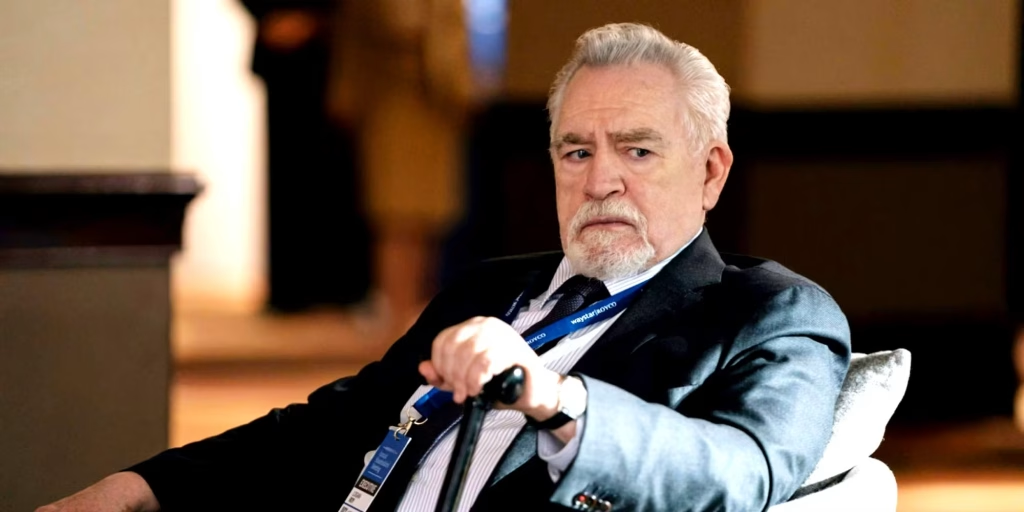
Logan Roy grew up in Dundee, Scotland, in poverty that was not the romantic, clarifying kind — the actual, narrowing kind. The kind that makes a person decide, somewhere around age eight or nine, that he will never occupy a position of not-controlling again. The show deliberately keeps the exact details vague, which is itself a comment on how origin stories get smoothed and embellished until they’re useful rather than true. From that foundation, Logan built Waystar Royco from a regional Canadian broadcaster into a global media empire. His tools: genuine strategic genius, a total willingness to do what more comfortable people declined, and a management philosophy summarized (with only slight oversimplification) as: love is weakness, weakness is death, therefore love is death.
The Play
Every test Logan administers to his children functions as a trap. This is not a flaw in the design. It is the design. He needs them to fail — needs it in the specific, unconscious way that people need the things that confirm their oldest, most load-bearing beliefs — because if one of them actually passed, he would have to let go. For Logan Roy, letting go is not retirement. It’s annihilation.
The Mirror
Logan is every founder who hired a CEO, watched that CEO succeed, and invented a reason to fire them within eighteen months. He is every father who spent his children’s childhoods building something for them, then discovered, when they were old enough to receive it, that he couldn’t open his hands. That last version — and it lands hardest in certain rooms — describes every person who told themselves that everything they did, they did for the people they love, and who could never quite explain why the people they love don’t seem to feel that way.
The Actor
Brian Cox, a career Shakespearean and therefore no stranger to kings who destroy their kingdoms from the inside, plays Logan not as a villain — the easy, dishonest choice — but as a man who has made so many brutal decisions over so many decades that the brutality has become invisible to him. Like the smell of your own house: present in every molecule and entirely imperceptible.
Cox’s signature instrument is stillness. Logan Roy never needs to raise his voice. He never needs to threaten. He simply enters the room, and the room reorganizes itself around his presence the way iron filings organize around a magnet — beautiful if you’re the magnet, quietly horrifying if you’re the filing. No other actor of Cox’s generation could have made audiences simultaneously fear Logan and grieve him. The achievement is, on reflection, almost unreasonable.
Go deeper: Brian Cox: Net Worth, Origin Story, and Where He Is Now
The Lesson
Power without succession planning is not legacy. It’s a ticking clock. The only question is who’s in the room when it goes off.
Kendall Roy — The Crown Prince of Collapse

The Wound
Kendall Roy is smart enough — and this, in the architecture of his particular tragedy, is exactly the problem — to know his father doesn’t actually believe in him. Smart enough to see the trap in every test. Smart enough to understand, on some cellular level, that the game runs rigged. What he cannot become, despite four seasons of trying, is strong enough to stop playing it. The substances (which the show handles with a realism suggesting the writers’ room had access to more than research) don’t cause Kendall’s collapses. They’re the logical response to a man who needs to feel, even temporarily, like the version of himself his father sees when he looks at him.
The Play
Each Kendall Roy comeback arrives louder and more elaborately staged than the last — the Season 2 rap performance being perhaps the most nakedly heartbreaking thing the show ever put on screen. A man performing competence so desperately that everyone in the room can see the desperation except the man performing it. People who actually succeed don’t need to announce it this much. People announcing it this loudly try to create, through sheer force of performance, the reality they cannot otherwise access.
The Mirror
Kendall is every second-generation business owner who received the title, the office, and the business cards — but not the actual transfer of confidence. Confidence doesn’t appear on any balance sheet or slot into any estate plan, and its absence arrives at precisely the moments when its presence would matter most. He is every heir who looked at what their father built and thought: I could do this. Then spent twenty years proving it to everyone except their father, which was the only proof that mattered.
The Actor
Jeremy Strong’s commitment to Kendall Roy becomes, over time, inseparable from the character. Strong reportedly stayed in character between takes in a way that unsettled his co-stars — Kieran Culkin has discussed this publicly, with a certain bemused affection. What Strong understood, and what his performance executes with a precision that rewards rewatching, is that Kendall Roy never stops performing. He performs for Logan, for the board, for himself. The meta-layer of a man performing competence is the actual drama.
The Emmy was inevitable. What was remarkable was that it took as long as it did.
Go deeper: Jeremy Strong: Net Worth, Origin Story, and Where He Is Now
The Lesson
Competence without internalized confidence is its own kind of inheritance trap. You can do the thing. You can do the thing well. And still not feel like you did the thing — which is, functionally, the same as not having done it.
Siobhan “Shiv” Roy — The Liberal Who Wanted Power More Than Principles

The Wound
Logan excluded Shiv from the line of succession before she was old enough to understand what lines of succession were. This gave her the particular advantage available only to people written off early — a kind of compensation prize for a childhood injury — the ability to watch the game from outside it. She watched long enough to understand every rule. Then she built, with considerable intelligence, a political identity around appearing to reject those rules. That may be the most sophisticated way to play a game you’ve decided you can’t win directly. The problem — and here the show performs its most exquisite cruelty — is that she can’t stop wanting to win directly.
The Play
Among the Roy siblings, Shiv carries the most political sophistication and the most reliable self-defeat. These traits are not coincidental. She knows exactly what each person in each room wants. She knows how to give it to them. Consistently, she deploys this intelligence toward the wrong goals, at precisely the moments when deploying it correctly would actually matter. This is not stupidity. It’s something closer to the opposite of stupidity: a self-awareness so complete that it loops around into self-sabotage.
The Mirror
Shiv is every woman who navigated a male-dominated industry by mastering its rules so thoroughly that she became, functionally, the industry’s most sophisticated product — then discovered, at the threshold, that the rules applied differently to her. Additionally, she is every person of any gender who spent so long pretending not to want the thing that when the thing finally arrived, they couldn’t make themselves simply take it.
The Actor
Sarah Snook — Australian, theater-trained, working inside a prestige ensemble that included some of the most decorated actors in English-language television — had to make audiences simultaneously admire and find genuinely difficult to like a single character. That is a much harder technical problem than it sounds. Snook’s specific achievement: she makes Shiv’s coldness comprehensible. At every moment, you understand exactly why she makes the calculation she makes. You understand it so completely that you feel something close to complicity.
The final season required Snook to play a woman whose entire carefully constructed exterior collapsed in real time. She executed this with a precision — never melodramatic, never explanatory, always exact — that produced one of the series’ most genuinely devastating arcs. She deserved the Emmy win. Notably, she deserved it for something so technically demanding that most viewers couldn’t fully articulate what she was doing while she did it.
Go deeper: Sarah Snook: Net Worth, Origin Story, and Where She Is Now
The Lesson
The person who says they don’t want power is often the most dangerous person in the room. And frequently the most dangerous person to themselves.
Tom Wambsgans — The Outsider Who Learned the Rules Too Well

The Wound
Tom Wambsgans arrived from Minnesota — a detail the show uses with surgical restraint, mentioned just enough to establish the class gap, never belabored — married Siobhan Roy, and spent four seasons in a state of permanent social calculation exhausting to watch and almost certainly more exhausting to perform. His wound is not poverty, exactly, or not only poverty. It’s the specific injury of being smart enough to see exactly how much distance exists between where you came from and where you’re trying to go. Being willing to do whatever it takes to close that distance. Then discovering, over time, that the distance resists the approaches you originally planned — but yields to approaches you hadn’t previously considered.
The Play
Tom is a sycophant. This is the conventional read, and it’s accurate as far as it goes — which is not very far. What Tom actually is: a man who identifies the only viable path through a room nobody built for people like him, and walks it with a consistency that the born-insiders mistake for obsequiousness. They’ve never had to think this carefully about a room they simply arrived in. The show’s twist — Tom’s betrayal of Shiv and his unlikely ascension — rewards the audience for underestimating him. It also rewards Tom for accepting that underestimation.
The Mirror
Tom is the COO who performs the work the founder finds beneath them. He is the spouse who outlasts the marriage by proving more functionally useful than the children. Furthermore, he is every person who entered a meritocratic system at a structural disadvantage and won by understanding that system better than the people it was designed for. Which is uncomfortable to watch, and should be.
The Actor
Matthew Macfadyen — previously and memorably Mr. Darcy in the 2005 Pride and Prejudice, a casting decision the show’s writers clearly had opinions about — plays Tom as a man perpetually running three social calculations ahead while appearing to run none. This is a kind of performance-within-performance that requires a specific species of technical control. His physical comedy with Nicholas Braun (the “Disgusting Brothers” dynamic ranks among the great comedic relationships in prestige television) operates in a register so different from his dramatic scenes that a less controlled actor would produce tonal whiplash.
Macfadyen produces tonal coherence instead. The comedy and the horror arrive in the same package — accurate to the experience of being Tom Wambsgans, and the show’s instruction to its audience: something can be very funny and also genuinely terrible, and the mistake is thinking you must choose.
Go deeper: Matthew Macfadyen: Net Worth, Origin Story, and Where He Is Now
The Lesson
Institutional loyalty is a form of self-erasure. Sometimes it pays out. The question — worth sitting with — is what you’ve erased by the time it does.
Roman Roy — The Saboteur Who Loved Too Much

The Wound
Roman Roy is the youngest, which in the Roy family meant he was most available for the specific Logan-inflicted damage that the older siblings partially inoculated themselves against through simple seniority. Logan mocked him, diminished him, and physically intimidated him — not, the show suggests, as performance of cruelty, but as the only vocabulary Logan possessed for something that might, in a different person, have qualified as love. Roman responded by making himself the joke before anyone else could. This is a survival strategy of considerable elegance. It works, as survival strategies do, right up until the moment it stops.
The Play
Every cutting remark Roman makes is a preemptive strike. The cruelty is the armor. What lives under the armor — and the show takes three and a half seasons to let you see it clearly, which is the correct pacing — is a person of unusual perceptiveness. He places that perceptiveness in the service of destruction, because destruction is the one currency Logan values. It also keeps people at a distance that feels like safety and functions like loneliness.
The Mirror
Roman is the family member everyone writes off as “difficult” or “the funny one” or “not serious” — who turns out, at precisely the wrong moment for everyone including themselves, to carry the clearest and most accurate read in the room. You have met this person. On certain mornings, you may be this person.
The Actor
Kieran Culkin is the most naturally gifted performer in an ensemble of genuinely exceptional performers. The most natural thing about his performance: it never looks like one. Where Strong and Snook are visibly working — and the work is magnificent — Culkin makes Roman’s specific dysfunction look effortless. Only the most technically accomplished actors can make difficult things look effortless, which requires an enormous amount of invisible effort.
His Emmy win for Season 4 technically recognizes the episode containing Roman’s eulogy — a scene in which a man who built his entire identity on not feeling anything faces the requirement to feel everything, publicly, in front of his father’s casket, and cannot. But the win also honors every earlier scene in which Culkin laid groundwork for that collapse so precisely that when it arrived it felt not like a dramatic event but like an inevitability. Roman was the only Roy the audience actually liked, which was the writers’ cruelest structural decision — and Culkin executed it with a kind of doomed grace.
Go deeper: Kieran Culkin: Net Worth, Origin Story, and Where He Is Now
The Lesson
The person everyone dismisses often sees clearest. The tragedy is that they know it, and the knowledge doesn’t help.
Greg Hirsch — The Long Con in Khakis

The Wound
Greg Hirsch, uniquely among the major characters of Succession, carries no wound in the conventional sense — which is itself a kind of wound, or at least a diagnostic. He arrives broken: alienated from his grandfather, financially dependent, professionally untethered. He departs intact in ways none of the Roys manage. The show frames this not as triumph but as a comment on what “intact” actually means when someone achieves it through the methods Greg deploys.
The Play
Incompetence as invisibility shield. Nobody neutralizes what they don’t take seriously. Greg is never taken seriously, and he weaponizes this — slowly, apparently accidentally, with a consistency that only becomes legible in retrospect — into a position of surprising durability. The show never quite answers its central question about Greg: does genuine guilelessness drive him, or does the guilelessness function as the most sophisticated performance in a show full of sophisticated performances?
The Mirror
Greg is every young person who entered a power structure with no leverage, no allies, and no particular competence — and departed with all three, assembled from proximity and patience. The mechanism isn’t admirable, exactly. It is, however, instructive.
The Actor
Nicholas Braun, at 6’7″, uses his own physical presence as a performance instrument in a way that’s easy to underestimate because it resembles simple awkwardness. Greg is always slightly too large for the room, slightly misaligned with the furniture and the social geometry of the spaces the Roys occupy. Braun plays this — the perpetual off-balance quality, the lanky disaster of a person navigating spaces built for different bodies — as simultaneously comedic and, in the later seasons, quietly menacing. The comedy and the menace live in the same physical performance. That is harder than it looks. Most things in this show are harder than they look.
Go deeper: Nicholas Braun: Net Worth, Origin Story, and Where He Is Now
The Lesson
Do not underestimate the person who appears to have no strategy. They often have the best one. The question is whether you’ve noticed by the time they use it.
The Formula Behind the Emmy Machine
The Writing
Jesse Armstrong and his writers’ room operated on a principle that most prestige television gets wrong in the attempt to get right: audiences don’t need to like characters. Audiences need to understand them. The distinction sounds small and is enormous. Likability is a comfort mechanism — a way of permitting the audience to invest emotionally while maintaining a safe distance. Understanding is more invasive. Understanding means: I see the exact logic of every decision this person makes, and I cannot fully disavow it.
Succession never asked you to root for the Roys. It asked you to recognize them. That recognition — uncomfortable, specific, occasionally nauseating — is what kept you watching. It’s also what made the ending the only honest ending available. Nobody wins. The asset survives. The people don’t. The boardroom fills with different people who will have the same conversations at different tables. The show ends not with a bang or a resolution but with a long shot of a boat, and the water, and the particular silence of something being over.
The Language of Weaponized Intimacy
The show’s dialogue operates in its own register — insult-as-endearment, love expressed exclusively through the grammar of power. The sibling dynamic (the “Disgusting Brothers” between Tom and Greg, the Roy children’s shorthand of cruelties) works with the precision of a dialect. It could only exist between people who have shared enough rooms to develop private codes for things they cannot say directly. Variety reported the series finale drew 2.9 million same-day viewers, but the show’s actual cultural footprint — its penetration into the vocabulary of anyone who has ever discussed dynastic wealth, media power, or difficult family dinners — considerably exceeds that number.
The Direction and Sound
Mark Mylod’s visual grammar for the show functions as an argument: handheld cameras in spaces that project stability and permanence, so that $100 million yachts feel claustrophobic and boardrooms feel unstable and private jets feel like coffins with wifi. The color palette runs to a greenish-grey that makes old money look slightly unwell, which is correct. Nicholas Britell’s main theme — baroque, triumphant, slightly pompous — plays, always, over scenes of defeat. This is not accidental irony. It’s the show’s thesis rendered in music: the apparatus of triumph, running continuously, over people who are losing.
Why Succession Plays Differently in the Hamptons
The Geography of Recognition
This show lands differently when you have spent time in the rooms it depicts — or rooms sufficiently adjacent to them that the texture is familiar. The Hamptons provides a particular viewing context: a geography in which the social hierarchies the show dramatizes are not metaphors but operational realities. The question of who gets invited and who does not carries actual consequences here. Management of access and the performance of relevance are skills people practice with the same seriousness that others practice their professions.
The show filmed in locations our readers recognize — or locations close enough that the difference is a matter of property values rather than atmosphere. The deeper Hamptons connection, however, is social. The Roy family’s internal power structure — who gets access to Logan, who gets tested, who gets included in the conversations that matter and who gets managed with the conversations that don’t — maps, with names changed and industries adjusted, onto every summer social dynamic worth understanding. Social Life Magazine has covered the real version of this world for 23 years: the actual families, the actual stakes, the actual dinner tables where people face tests nobody announces.
Which Seat Were You In?
The Roys are fictional. The dynamics are the documentary. If you’ve spent enough summers east of the bridge, you already know this. If you’re not sure whether you know this, you have probably been at one of those tables. The question — worth sitting with — is which seat you were in.
For editorial features, brand partnerships, or to discuss how Social Life Magazine covers the real-world version of this world, reach out directly. We are, among other things, the publication the Roys would have wanted to control.
What Succession’s Legacy Says About the Stories We Tell Ourselves
The Empire Survives. The People Don’t.
The Roy empire survives. A new name fills the CEO chair — a name, the final episode makes clear, that is not Roy. Waystar Royco continues doing what Waystar Royco does: existing. That is the only thing Logan ever actually built it to do. He didn’t build a family. He built an institution. The institution required the family to construct it. Notably, it doesn’t require the family to continue. Armstrong presents this not as tragedy but as fact, which is, on reflection, sadder than tragedy.
The Succession TV show legacy — the real one, the one people will still discuss when the Emmys collect dust in storage and the cast moves on to other projects — is the question it leaves running in the background. What are we building? Who are we building it for? What happens to both us and it when we can no longer be in the room? The show’s answer is not comforting. It is, however, honest. The thing outlives the intention. The asset outlives the relationship. The company outlives the founder. What survives is what someone built to survive — and that was never, quite, the people.
This is the Succession TV show legacy: not a lesson about what not to do, but a very precise and very expensive portrait of what we are already doing. Delivered with enough intelligence and craft and dark humor that we watched four seasons of it — and then immediately started recommending it to the people in our lives who we were, on some level, trying to tell something to. The direct way being, as always, unavailable.
Related Reading
- The It Girls of the Early 2000s: Where Are They Now
- Hamptons Hedge Fund Billionaires: Net Worth and the Philosophy Behind It
- Tinsley Mortimer’s $35M Net Worth: The Blog, the Brand, the Divorce
You already know which room this is about. The question Social Life Magazine has been asking for 23 years — in the Hamptons, in the rooms that matter, at the tables where things actually get decided — is not who’s in it. It’s what they’re really saying.
If your brand, business, or story belongs in those rooms, we’d like to talk. Editorial features, partnerships, and press inquiries start here.
To place your brand directly in front of the audience that recognizes this world from the inside, paid feature placements are available here.
82,000 readers receive the Social Life Magazine email — people who summer east of the bridge, own the homes, attend the events, and make the decisions. Join that list here.
Polo Hamptons is where the real version of this world shows up in person — sponsors, guests, and brand activations for the audience the Roys would have killed to reach. See what’s available at polohamptons.com.
Five issues a summer, 25,000 copies each, distributed between Westhampton and Montauk to the people who make the Hamptons the Hamptons. Print subscriptions here.
If this piece named something you recognized and couldn’t quite articulate, consider supporting independent luxury media. $5 keeps the lights on and the table set.
Author

Written by
Recent Posts

Ryan Gosling Net Worth: The $70M Art of Not Trying
Cillian Murphy Net Worth: The Art of Quiet Fortune

Margot Robbie Net Worth: Barbie’s $80m Power Broker

Barbenheimer Box Office: The Weekend Hollywood Faked a Comeback
Top Gun Maverick and the Extinction of the Movie Star Species
Categories
- Art
- Articles
- Beauty & Skincare
- Celebrities
- Celebrities|Entertainment
- Celebrities|Television
- Celebrities|The Chronicles
- celebrities|the-archive
- Chronicles
- Entertainment|Culture
- Event Photos
- Events
- Fashion
- Fashion & Style
- Featured
- Food & Beverage
- Food, Spirits, Wine
- Hamptons
- Hamptons Celebrities
- Hamptons Celebrities|Celebrities|The Chronicles
- Health
- Health & Beauty
- Lifestyle
- Luxury Lifestyle
- Press
- Profiles
- Real Estate
- Technology
- The Chronicles
- Travel
- Uncategorized
- Weddings