
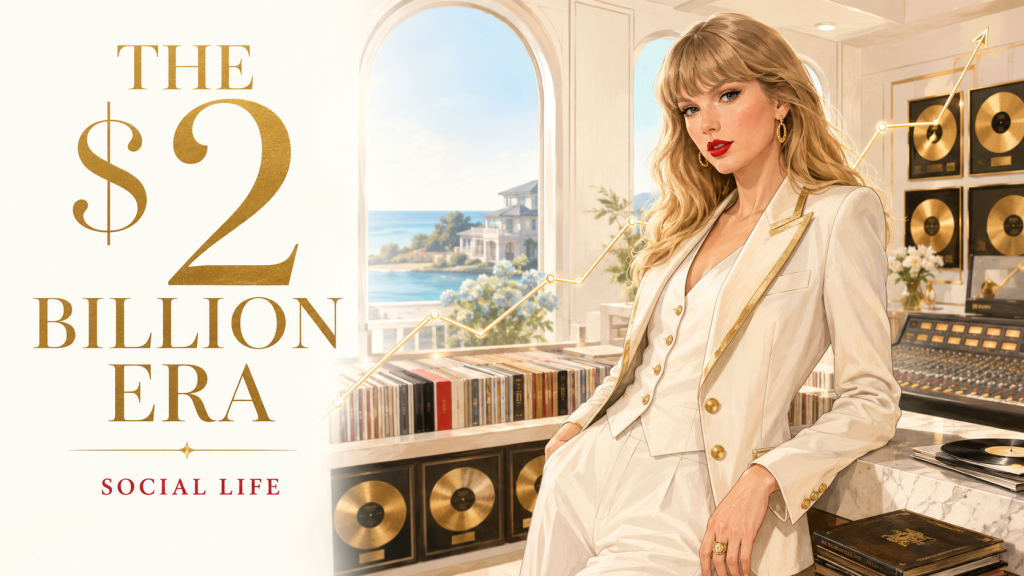
In the spring of 2026, Forbes moved Taylor Swift from $1.6 billion to $2.0 billion, past Kim Kardashian on the World’s Billionaires list. She did it without releasing a single album this year. So the Taylor Swift billionaire story now has a sequel, and the sequel outsold the original.
Social Life already keeps the full biography, the award-show arc, and the year-by-year earnings inside our complete Taylor Swift net worth profile. This piece is the companion, not the replacement. It answers one question: how does anyone add $400 million in twelve quiet months? The answer involves the best asset trade in modern music, an orange album, and a wedding at Madison Square Garden.
The $360 Million Masters Buyback Was the Trade of the Decade
Start with May 2025, because everything else in the climb depends on it. Swift bought back the master recordings of her first six albums from Shamrock Capital for a reported $360 million. Billboard reported the figure. No label fronted the money, and no outside investor took a piece.
Trace the asset’s path and the trade gets prettier. Scooter Braun’s Ithaca Holdings acquired Big Machine, masters included, for a reported $300 million in 2019. Swift called the sale her worst case scenario, then announced she would re-record everything. Shamrock later paid a reported $300 million for those recordings in 2020, buying a catalog its own creator had publicly vowed to compete against.
Compete she did. Fearless and Red arrived as Taylor’s Versions in 2021, Speak Now and 1989 followed in 2023. Each re-record pulled streams, sync licenses, and radio spins away from the originals. In effect, she spent six years lowering the market price of an asset she always intended to buy. Then she bought it. Wall Street calls that talking your book. Nashville calls it Fearless (Taylor’s Version).
What Shamrock’s Side of the Ledger Shows
To be fair, Shamrock did not lose money. The firm collected five years of royalties, then exited at a reported $60 million above its 2020 cost. But the exit price tells the real story. A generational catalog appreciated barely 20 percent, while song catalogs elsewhere traded at record multiples. The re-records capped the asset’s ceiling, and every buyer on earth knew only one bidder could remove that cap. She had built the discount herself, then collected it.
As a result, her entire recorded catalog now sits on her own balance sheet, publishing and masters together. The timing was surgical, exactly one Forbes cycle before the list crowned her at $2 billion. Our celebrity net worth methodology guide explains why owned masters count so differently than licensed royalty streams.
Eras Tour Aftermath: The Machine Kept Printing in the Dark
The tour itself closed on December 8, 2024, in Vancouver, after 149 shows and a reported $2.077 billion in gross ticket sales. No concert run had ever crossed even $1 billion before it. Yet the aftermath is where the 2026 money actually lives.
Consider the residue. The Eras Tour concert film grossed a reported $261.7 million worldwide. She self-distributed it through AMC rather than selling the rights to a studio. The official Eras Tour Book moved a reported 814,000 copies in its first two days, sold through Target. Then came The End of an Era, a Disney+ docuseries cut from footage she already owned. It arrived in December 2025 and re-monetized a tour that had been over for a year.
The tour warped whole economies while it ran. Hotel markets spiked in every host city, so much that the Federal Reserve’s Beige Book cited her Philadelphia dates in a 2023 report. Local officials renamed towns for a weekend, and resale tickets cleared four figures for months on end. That halo did not vanish when the tour ended. Instead it migrated into the film, the book, and the docuseries, each one a fresh toll booth on the same road.
Every one of those deals routed around the traditional middlemen. No studio distribution fee, no publisher holding the book rights, no production company owning the footage. Fame converted straight to margin, which is the entire lesson of the climb past $1.6 billion. For the wider field, our Music Industry Net Worth Rankings 2026 show how rare that ownership structure remains.
The Life of a Showgirl Posted Numbers Nobody Had Printed Before
October 3, 2025 gave the climb its rocket stage. The Life of a Showgirl sold more than four million units in the United States during its first week. Globally it cleared 5.5 million album-equivalent units, the biggest opening week in recorded music history. Adele’s decade-old first-week sales record for 25 fell within days.
The release weekend came with a theatrical play too. The Official Release Party of a Showgirl, an 89-minute AMC event, grossed a reported $33 million in North America. She owns the masters, the publishing, and the distribution relationships behind all of it. So the margin on every orange vinyl variant runs at rates no label artist sees.
Streaming platforms buckled on day one. Spotify logged it as the most-streamed album in a single day of 2025, and the vinyl came in enough variants to fill a display case. Collectors bought multiples, of course, which is the quiet genius of the format. A stream pays fractions of a cent. An orange pressing pays like a luxury good, because that is what it is.
Notably, she has released nothing in 2026. The catalog compounds on its own now, stream by stream, with no release date attached. That is what the buyback purchased: the right to earn while resting. A billionaire who must keep performing owns a job. A billionaire whose catalog performs for her owns an asset.
What Owning the Whole Catalog Is Actually Worth
Forbes builds its estimate from the catalog, touring income, royalties, and real estate. The catalog line is the one that changed. Before May 2025, her first six albums enriched Shamrock’s investors with every play. After the buyback, the same streams pay the same money to one woman in Tribeca.
Both versions of each album now pay her as well. A listener choosing the 2008 Fearless or the 2021 re-record pays her either way. Before the buyback, that was never true. In addition, sync licensing for films, ads, and trailers no longer requires negotiating with a third-party owner. Faster deals, fuller margins, and a higher multiple whenever anyone eventually values the estate.
Industry bankers spent 2021 through 2024 paying record multiples for song catalogs, including nine-figure exits by Springsteen and Dylan. Those artists sold their life’s work at the top. By contrast, Swift bought hers back, betting the asset’s best decade is still ahead of it.
Compare that structure with the rest of the richest female musicians of 2026 and the moat becomes obvious. Most ten-figure music fortunes lean on beauty equity or fashion licensing. Hers is the only one built almost entirely on songs she wrote, sold, fought for, and finally repurchased.
Watch Hill to Tribeca: The Quiet $150 Million in Brick
Real estate is the least dramatic line on the sheet, yet it still deserves the tour. Robb Report pegs the full portfolio around $150 million across Rhode Island, Manhattan, Beverly Hills, and Nashville. Holiday House in Watch Hill anchors it, an 11,000-square-foot mansion she bought in 2013 for $17.75 million in cash.
That house already paid for itself culturally. It hosted the famous July Fourth parties of the mid-2010s and inspired a song about Rebekah Harkness, the previous owner. In Manhattan she assembled a compound on Franklin Street in Tribeca. The duplex penthouse at 155 Franklin cost a reported $19.95 million, and the townhouse next door followed in 2017.
Add the Samuel Goldwyn estate in Beverly Hills, purchased for $25 million in 2015 and later granted landmark status. Every major property was reportedly bought without financing. No mortgages means no lender, and no lender means nobody to answer to. Since 2019, that has been the entire operating philosophy.
Nashville still holds the first purchases, including the Music Row condo she bought at 20. Notably, the whole portfolio amounts to under eight percent of the fortune. Most rich Americans store the bulk of their wealth in houses. She stores hers in copyrights, and the houses are just where the copyrights sleep.
The Kelce Merger: Two Nine-Figure Brands, One Garden Wedding
The engagement arrived in August 2025 with a caption about an English teacher and a gym teacher marrying. Beneath the folksiness sat a merger of two nine-figure operations. Kelce brought the New Heights podcast, with its reported $100 million Amazon deal. He also brought a Chiefs contract, an endorsement roster running from State Farm to Campbell’s, and a ring by New York jeweler Kindred Lubeck.
The NFL felt the merger’s power first. Her arrival at Chiefs games in 2023 generated a reported $331.5 million in brand value for the league. Ticket prices jumped, jersey sales spiked, and a generation of new viewers showed up. Since then, both sides have understood the arithmetic: her attention is a subsidy.
Neither party needed the other’s money, which is precisely the point. Billionaires do not marry for liquidity. They marry for the one asset no catalog can produce: a partner whose fame neither borrows from nor drains their own.
The Wedding Nobody Could Buy Into
Then came July 3, 2026. They married at Madison Square Garden, with Adam Sandler officiating and both wearing custom Dior by Jonathan Anderson. More than 1,000 guests attended across two nights, and the city closed the streets around the Garden.
Here is the wealth psychology. This was the most sponsored-adjacent cultural event in America, a night every luxury house on Fifth Avenue would have underwritten blind. Instead, the couple sold nothing. Phones were banned and no official wedding photos were released. In fact, the only public transaction was a reported $26 million charity donation before the ceremony.
Scarcity is the last luxury nobody can license. Once you are worth $2 billion, the flex is refusing the money. Every brand shut out of that room learned the exchange rate: intimacy withheld is worth more than intimacy sold.
How the Third Billion Gets Made
Nothing about the current number requires her to work again. Still, the machine has obvious next gears. Any future tour opens against her own attendance records, with stadium pricing she effectively sets. Meanwhile the catalog appreciates in the background, and both versions of every re-recorded album pay the same owner.
Then there is the household math. Two nine-figure brands under one roof share security costs, aviation costs, and negotiating power. Neither partner has ever needed a sponsor, so every future deal starts from no. In wealth terms, that is the strongest bargaining position American celebrity has ever produced. The reader keeping score at home should watch one metric only: whether the next Forbes list needs a bigger font.
Where the Taylor Swift Billionaire Era Ranks Among the Pop Girls
The 2026 list reshuffled the leaderboard. Swift passed Kim Kardashian, whose fortune rides largely on SKIMS equity. We break down that rivalry in our Taylor Swift versus Kim Kardashian net worth comparison. Beyoncé remains a Forbes-certified billionaire after the Cowboy Carter tour, a fortune we detail in our look at Beyoncé’s 2026 net worth.
Rihanna holds around $1.4 billion, mostly through the Fenty fortune, without an album since 2016. Swift is different in kind. She is the only member of the club whose ten figures came from music itself: writing, owning, touring, and re-owning. No shapewear, no beauty line, no liquor deal.
For the field beyond music, our Celebrity Net Worth Rankings 2026 track where she sits against actors, athletes, and moguls. Above nearly all of them, as it turns out. Her Forbes profile now files her among the rare self-made women who reached ten figures before 40, then doubled it.
Where The Conversation Continues
The climb from $1.6 billion to $2 billion is one chapter. The bigger story is the pop girl billionaires, the women converting fame into balance sheets while the old money watches. Social Life Magazine covers that world from the inside, in print and at the tables where it actually gathers. The summer issue moves through the Hamptons the way the money does, quietly and by invitation. Polo Hamptons in Bridgehampton is where half the names in this article get discussed over champagne in July. If you already know, you know. If not, the July issue is how you find out.
Author

Written by
Recent Posts

Planning an Arizona Road Trip? Practical Details to Handle Before You Leave
Short Homecoming Dresses That Feel Polished, Not Overdone
Men’s Health After 40: Important Changes to Pay Attention To
What You Need to Know About Spray Tanning

Simple Ways to Upgrade Your Summer Drink Routine
Categories
- Art
- Articles
- Business of Luxury
- Celebrities
- Culture
- Entertainment
- Events
- Faces of Summer 2026
- Fashion
- Fashion & Style
- Featured
- Finance
- Food, Spirits, Wine
- Hamptons
- Hamptons Celebrities
- Health
- Health & Beauty
- Lifestyle
- Luxury Lifestyle
- Press
- Profiles
- Real Estate
- Technology
- The Chronicles
- Travel
- Uncategorized
- Weddings