
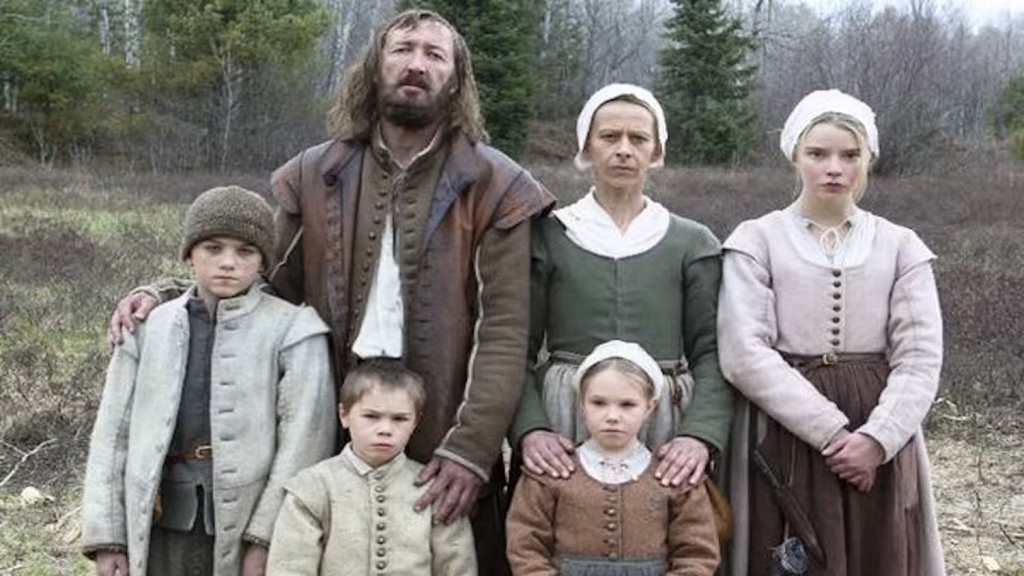
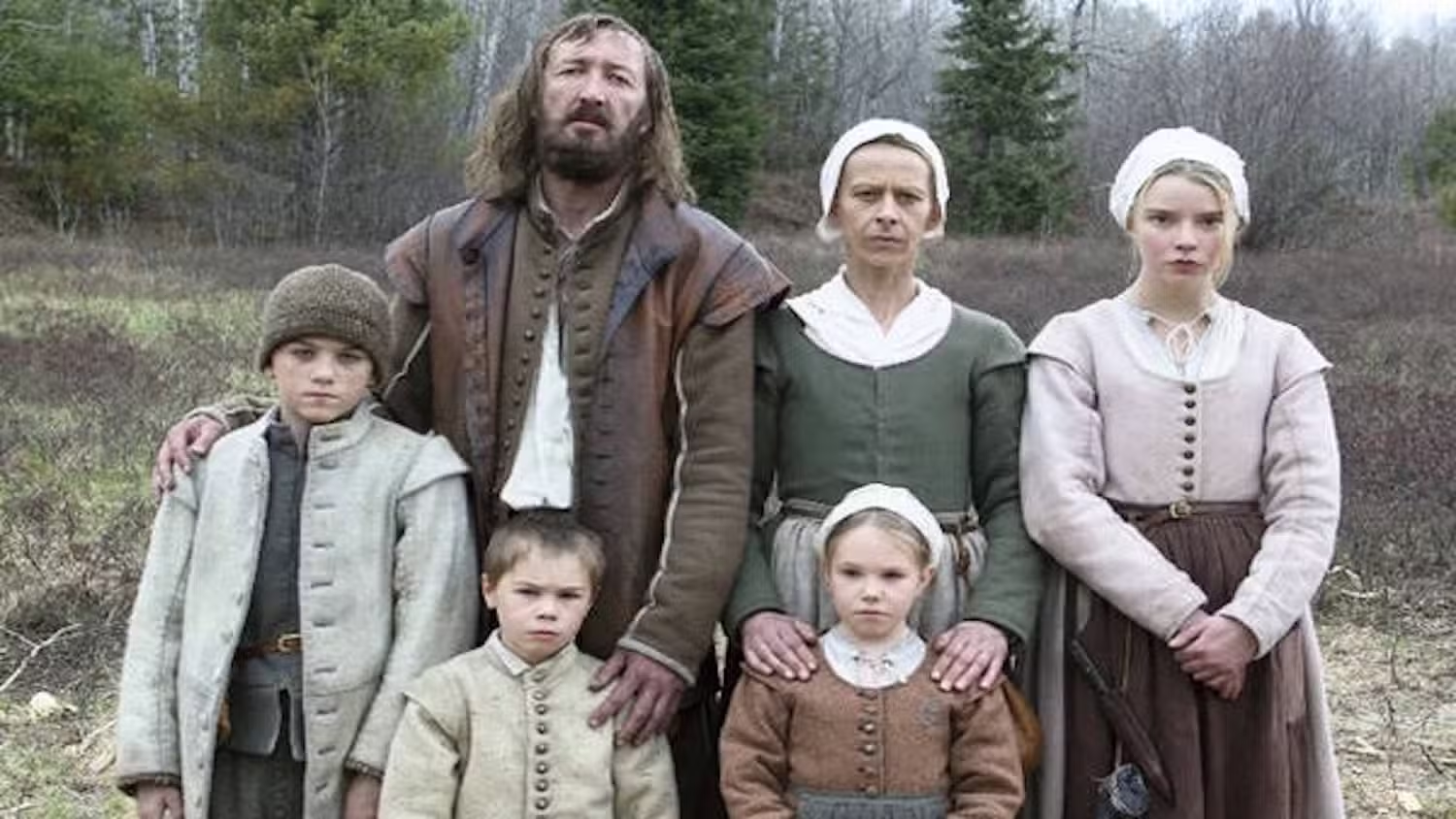
The Witch A24 cast net worth story is the most extreme example of asymmetric returns in this entire pillar. And this is a pillar where every single film produced asymmetric returns. This means calling The Witch the most extreme is saying something that should make anyone with a financial background sit up and recalculate their assumptions about how value is created in the entertainment industry. Robert Eggers made a film for $3.5 million about a Puritan family in 1630s New England being tormented by forces that may be supernatural or may be the inevitable psychological consequence of religious extremism. The film grossed $40 million worldwide. An 11x return, while simultaneously launching Anya Taylor-Joy from complete anonymity to one of the most sought-after actresses in the world.
The Period Horror Innovation
Before The Witch, period horror was a niche category that most studios avoided because costumes are expensive. Historical dialogue alienates mainstream audiences. The combination of seventeenth-century Puritan theology and supernatural terror sounds less like a commercial pitch and more like a graduate seminar that nobody would attend voluntarily. Eggers proved every one of those assumptions wrong. Not by compromising the material but by committing to it so completely that the specificity became the selling point.
The dialogue is written in period-accurate Early Modern English. The costumes were researched with academic rigor. This forest was the actual New England forest. Dark and indifferent and haunted by the particular malice that Puritan theology projected onto every natural phenomenon it could not explain. The commitment to authenticity made the horror feel historical rather than fictional. This made it scarier, which made it more commercially successful. Which made it a model that Eggers would refine through The Lighthouse and Nosferatu into a career brand so specific that it has no competitors.
Anya Taylor-Joy — The $12 Million Unknown Who Became The Queen’s Gambit
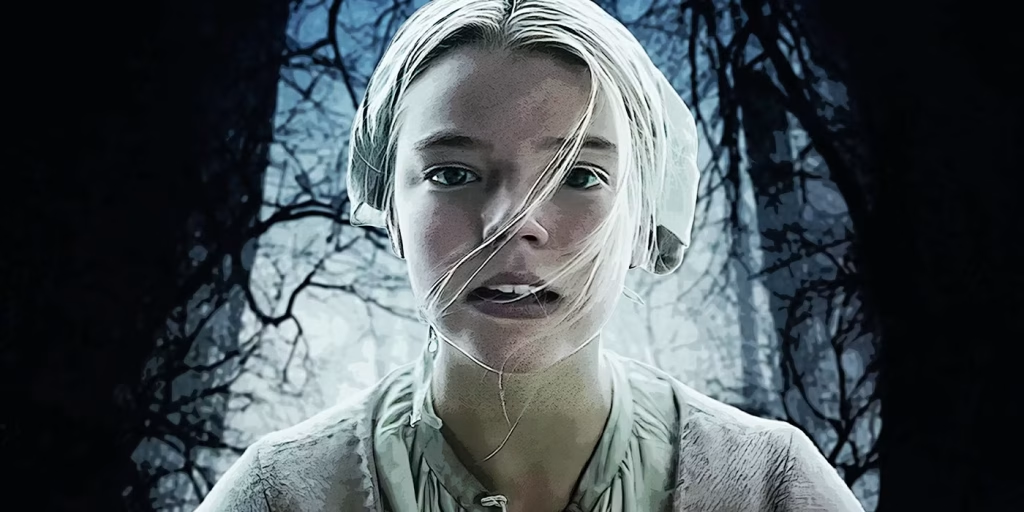
Anya Taylor-Joy’s net worth sits at an estimated $12 million. Built from a starting point of zero recognizability through a trajectory so steep that it resembles a rocket launch more than a career. She arrived in Miami to an Argentine-British father. A Spanish-British mother in 1996, raised in Buenos Aires and London. And cast in The Witch at eighteen after being discovered while walking in London. This is either the most romanticized casting story in recent memory or the most accurate. Depending on whether you believe the universe arranges these things deliberately.
Her performance as Thomasin, the eldest daughter suspected of witchcraft by her own family, required her to portray innocence, terror. Resilience, and eventual liberation with a face so distinctive that cinematographers have been photographing it obsessively ever since. The Witch paid her modestly. The Queen’s Gambit on Netflix, which broke viewership records and earned her a Golden Globe, paid substantially more. Furiosa put her in one of the most valuable franchise properties in cinema. Each role built on the foundation that The Witch established. The foundation, a $3.5 million film seen by a fraction of the audience that would later discover her. Remains the credential that serious filmmakers cite when explaining why they wanted to work with her.
For the full origin story of how a London street casting became a career worth $12 million, read our Anya Taylor-Joy net worth deep dive.
Robert Eggers — The Director Who Turned Historical Obsession Into a $5 Million Career
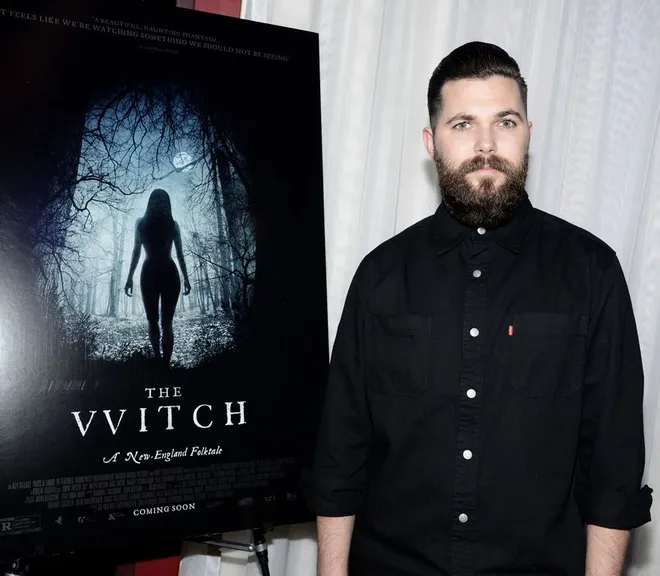
Robert Eggers’ net worth sits at an estimated $5 million. A figure that reflects the director economy rather than the actor economy. Where compensation arrives in larger but less frequent installments tied to individual projects rather than the continuous income stream that actors generate through volume. Eggers has directed four features: The Witch, The Lighthouse, The Northman, and Nosferatu. Each film has been more ambitious and more expensive than the last. Each has reinforced a brand so historically rigorous that production designers on his sets describe the experience as closer to museum curation than film production.
The Lighthouse with Robert Pattinson and Willem Dafoe cost $11 million and grossed $18 million. A modest commercial return that generated enormous critical capital. The Northman with Alexander Skarsgard cost $90 million and grossed $69 million. A commercial disappointment that nevertheless proved Eggers could operate at studio scale without compromising his vision. Nosferatu in 2024 represented his return to horror at a scale that combined The Witch’s genre intensity with The Northman’s visual ambition.
For the full origin story of the director whose historical obsession became the most distinctive brand in modern horror, read our Robert Eggers net worth deep dive.
What The Witch Built for A24
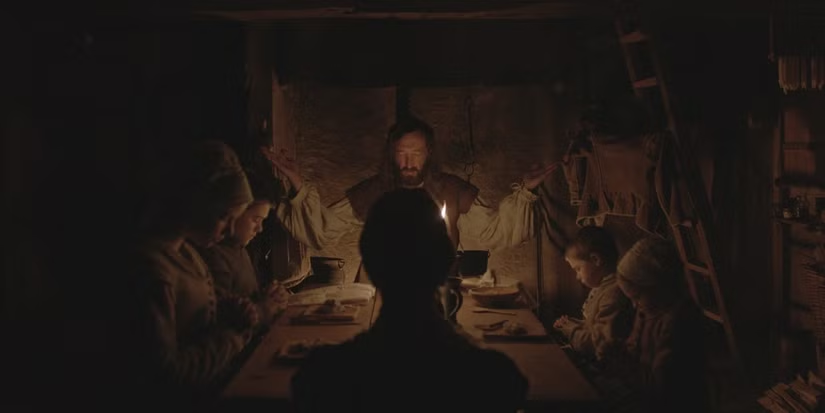
The Witch arrived in 2016, when A24 was three years old and still establishing the brand identity that would eventually make it the most culturally significant distributor of its generation. The film’s 11x box office return proved that A24 could identify commercially viable horror talent before anyone else in the market recognized it. This Taylor-Joy launch proved that A24 films could serve as star-making vehicles. And the Eggers career it initiated proved that A24 could develop directors into brands, not just distribute their individual films.
The Deeper Math
Every subsequent A24 horror film, from Hereditary to Midsommar to Talk to Me. Exists in the space that The Witch opened. The $3.5 million investment in a Puritan horror film that most studios would have dismissed created the genre template that has generated hundreds of millions of dollars in aggregate A24 revenue. That is the return on $3.5 million. That is A24’s real business model. And the cast that made it possible, the unknown actress and the obsessive director. Have both built careers that will produce value for decades. The reason is that a distributor that was barely old enough to have a track record bet on material that nobody else would touch.
What It Means Now
Explore our full A24 Genre Stars Net Worth pillar for every cast, every fortune, every origin story behind A24’s horror, sci-fi, and Oscar-winning films.
The Longer Arc

The Taylor-Joy discovery is the purest example of A24’s talent identification advantage, the advantage that makes its business model work. Traditional studios cast from lists compiled by casting directors who draw from agency submissions. This means every studio is choosing from the same pool of known quantities. A24’s model, exemplified by The Witch. Casts from a broader and more unconventional pool that includes unknowns who have been identified through less traditional channels. Taylor-Joy was spotted on a street. She had no training, no representation, and no understanding of the industry. She had a face that Robert Eggers recognized as belonging to the seventeenth century. A talent that the camera confirmed before any acting coach could have refined it.
The Market Signal
That identification advantage compounds over time. The reason is that every successful discovery reinforces A24’s reputation as the company most likely to find the next great unknown. This attracts more unknowns to audition for A24 films. Which gives A24 a larger pool to select from, which increases the probability of the next successful discovery. The flywheel turns. Taylor-Joy leads to Florence Pugh leads to Stephanie Hsu leads to Cailee Spaeny. Each unknown discovered through A24’s specific willingness to look where other companies do not.
The Endgame
The $3.5 million budget also reveals something about the economics of authenticity that applies to every film in this pillar. The Witch could not have been made for $100 million. Every reason is that the additional money would have created pressure to compromise the historical accuracy that is the film’s primary asset. A bigger budget means more stakeholders, more notes, more pressure to make the dialogue accessible to contemporary audiences. More pressure to add jump scares, more pressure to cast a recognizable name instead of an unknown. The $3.5 million budget was not a limitation. It was a moat that protected the film’s artistic integrity from the commercial pressures that would have diluted it. The undiluted film is the one that generated an 11x return and launched a career worth $12 million and counting.
The Real Calculus
The Eggers brand that The Witch established operates on a principle of competitive exclusivity that has significant economic implications for A24 and for the broader industry. No other director makes films that look, sound. Or feel like Eggers’ films. The reason: no other director is willing to invest the years of historical research that his process requires. This means Eggers has no competitors. This means he can command premium fees for a product that cannot be substituted. Which means his value to A24 appreciates with each film because each film reinforces the brand’s exclusivity. In market terms, Eggers is a monopoly provider of historically authentic genre cinema. And monopolies, even artistic ones, generate pricing power that competitive markets do not.
In Perspective
The Witch’s impact on the broader horror marketplace is also worth quantifying. Before 2016, “prestige horror” was not a recognized commercial category. After The Witch, it became one of the most profitable categories in independent cinema. That generates films like Get Out. Hereditary, Midsommar, and The Babadook that collectively earned hundreds of millions of dollars at the box office. The Witch did not create all of these films. But it created the market conditions that made them commercially viable by proving that horror audiences would support films that prioritized atmosphere. Character, and historical authenticity over jump scares and franchise continuity. That market creation is The Witch’s real return on investment. And it dwarfs the film’s own $40 million gross by an order of magnitude.
The Takeaway
The early modern English dialogue is the element that most studios would have demanded Eggers change. Every executive note would have pushed toward contemporary language. “Modern audiences won’t understand it.” “It’s alienating.” “It’s pretentious.” Eggers refused. A24 backed him. The gamble paid off because the archaic language does not alienate. It hypnotizes. Audiences who cannot parse every word still feel the weight of it. The language becomes sound design. The prayers and accusations carry menace through rhythm rather than meaning.
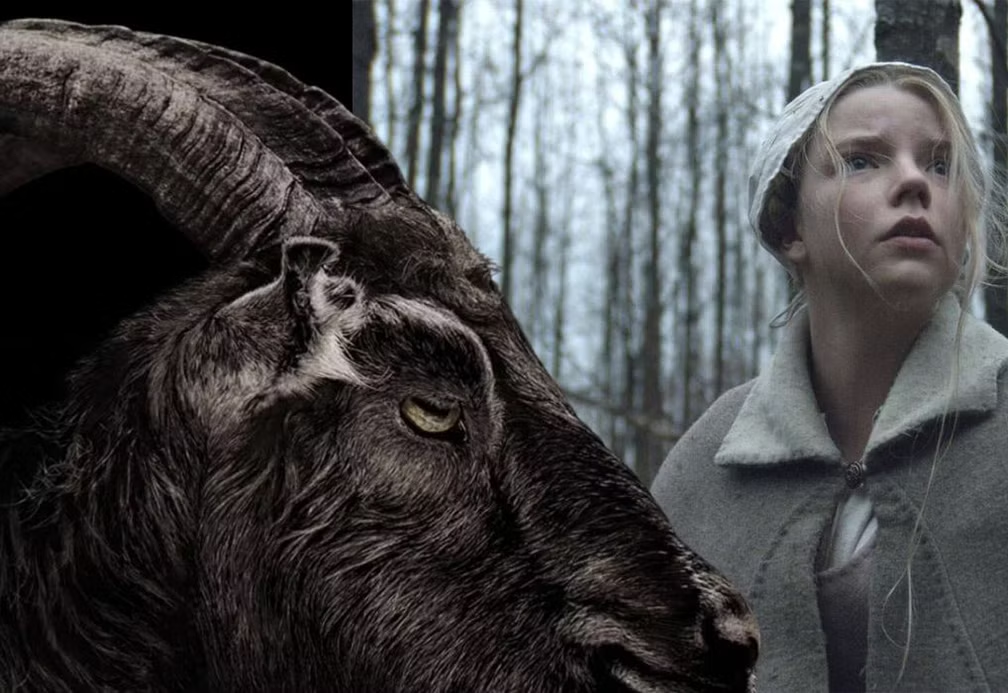
Black Phillip deserves his own paragraph because the goat became a cultural icon. A horror film’s breakout character is usually its villain or its monster. The Witch’s breakout character is a goat. Black Phillip merchandise exists. Memes exist. Fan art exists. The goat generated earned media value that no marketing team could have planned. That is the kind of cultural accident that only happens when a film is specific enough to generate obsession. Generic films generate interest. Specific films generate obsession. A24 understood this before anyone else.
The Deeper Layer
Taylor-Joy’s face in the final scene is the image that audiences cannot forget. The combination of terror and liberation. The ambiguity of whether freedom or damnation is occurring. That ambiguity is the film’s thesis delivered visually. And the face delivering it belongs to an actress who was eighteen years old, making her first film, working with a first-time director, on a budget that would not cover a single day of shooting on a Marvel set. Every number in that sentence is small. The result was enormous.
The Takeaway
The debut film phenomenon that The Witch represents has specific financial implications for A24’s talent scouting strategy. First-time directors accept lower fees. Unknown actresses accept lower fees. The entire cost structure of a debut film is compressed because nobody involved has the leverage to demand market rates. A24 exploits this compression systematically. The Witch cost $3.5 million partly because Eggers and Taylor-Joy had no prior quotes to negotiate from. That compression is not exploitation. It is the market pricing inexperience accurately. The genius is recognizing that inexperience and talent can coexist in the same person at the same budget line.
The Takeaway
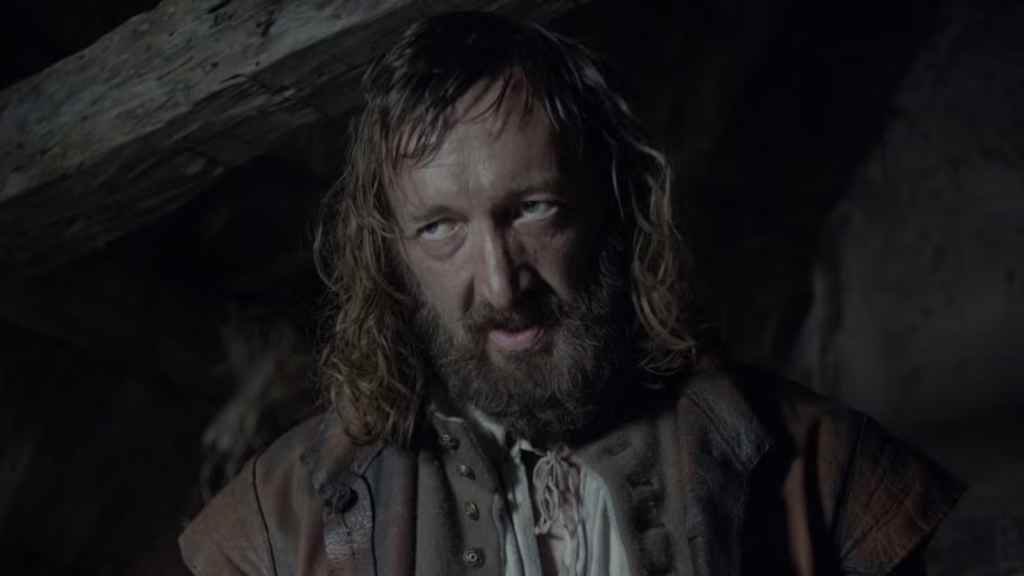
The horror community’s adoption of The Witch as a canonical text adds commercial value that extends decades beyond the theatrical window. Horror fans curate personal canons. Films that enter those canons generate rewatches, merchandise purchases, and the specific evangelism where fans insist their friends watch the film. The Witch entered the canon immediately. That canonical status generates revenue every October when horror consumption spikes. Every year the spikes arrive. Every year The Witch benefits. The compound returns on canonical horror films are effectively infinite because the audience replenishes itself generationally.
You are reading this because you already understand something most people scroll right past. The intersection of culture, money, and taste is not a Venn diagram. It is a mirror. Social Life Magazine has spent 23 years holding that mirror up to the people who shape the Hamptons, Manhattan, and the corridors between them. If you see yourself in these pages, we should talk. Reach out at sociallifemagazine.com/contact.
If your brand, your launch, or your personal story belongs in front of 82,000 affluent readers and a digital audience that keeps growing, our editorial features are built for exactly that moment. Learn more at Submit a Paid Feature.
Our email list reaches 82,000 subscribers who actually open, read, and act. If your audience is high-net-worth, culturally engaged, and based between Park Avenue and Montauk, you are already in the right place. Join the list.
Polo Hamptons returns to Bridgehampton this July with 1,200 guests, Getty Images coverage, and seven years of BMW title sponsorship behind it. If your brand belongs in that conversation, visit polohamptons.com.
A print subscription to Social Life Magazine puts 25,000 copies per issue into the boutiques, lobbies, and living rooms where decisions get made, from Westhampton to Montauk every summer and Upper East Side doorman buildings for Fall and Winter. Subscribe at sociallifemagazine.com/subscription.
If this publication has added value to your world and you want to support independent luxury journalism, you can contribute directly at our donation page.
Author

Written by
Recent Posts

Midsommar A24 Cast Net Worth — The Daylight Horror That Turned Grief Into a Career Launchpad
ZOI NOMAD & TEN11 LOUNGE MARK ONE YEAR
Room A24 Cast Net Worth — The $6 Million Captivity Drama That Set Brie Larson Free
The Witch A24 Cast Net Worth — A $3.5 Million Puritan Nightmare That Created a Queen and a King
A24 Genre Stars Net Worth — The Terrifying Fortunes Behind Horror, Sci-Fi, and Oscar Gold
Categories
- Art
- Articles
- Beauty & Skincare
- Celebrities
- Celebrities|Movies
- Celebrities|The Chronicles
- Chronicles
- Entertainment|Culture
- Event Photos
- Events
- Fashion
- Fashion & Style
- Featured
- Food & Beverage
- Food, Spirits, Wine
- Hamptons
- Hamptons Celebrities
- Hamptons Celebrities|Celebrities|The Chronicles
- Health
- Health & Beauty
- Lifestyle
- Luxury Lifestyle
- Movies
- Movies|Culture
- Movies|Hamptons Lifestyle
- Press
- Profiles
- Real Estate
- Technology
- The Chronicles
- Travel
- Uncategorized
- Weddings