
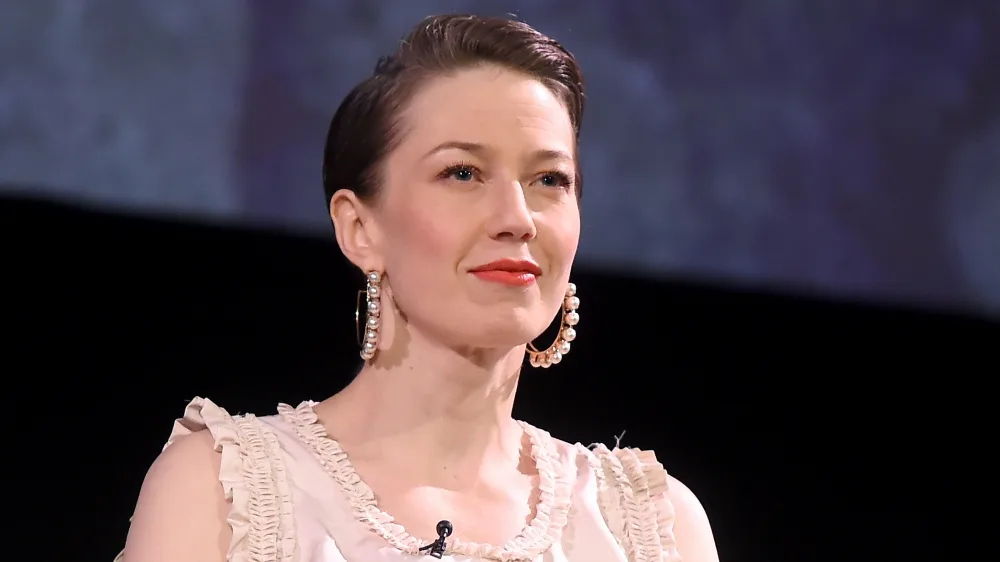
Carrie Coon net worth sits at an estimated $6 million in 2025. That number will bother you once you understand what it represents. Three Emmy nominations across three different HBO series. A Tony nomination. A Critics’ Choice win. Film credits that include Gone Girl, Widows, and Avengers: Infinity War. And the lead role on The Gilded Age, the most-watched period drama on television. Six million dollars is a comfortable life. It is not what this resume is worth on the open market. The gap between Coon’s talent and her bank account tells a specific story about what happens when an actor chooses craft over franchise. Every single time.

The Before: An ER Nurse’s Daughter in Ohio
Copley, Ohio doesn’t produce television stars. It produces people who work. Coon grew up as the middle child of five siblings. Her mother worked as an ER nurse. Her father supplied auto parts. Nothing in the biography suggests a future that includes corsets, Emmy ceremonies, or Thailand hotel suites. Furthermore, nothing in the geography suggests it either. Copley sits in Summit County, population 13,000, equidistant from nothing and nowhere.
Coon attended the University of Mount Union in Alliance, Ohio, where she studied English and Spanish. Not theater. English and Spanish. The decision to pursue acting came later, and it came through literature, not ambition. She earned her MFA in acting from the University of Wisconsin-Madison and then did what almost every serious theater actor does after graduate school: she disappeared into regional work for years. Notably, she spent four seasons with the American Players Theatre in Spring Green, Wisconsin, performing classical repertoire for audiences who drove two hours to sit on a hillside.
During this period, Coon supported herself by performing motion capture work for a video game company in Wisconsin. Consider that detail. The woman who would eventually play Bertha Russell — the most ruthless social climber in 1880s Manhattan — once wore a bodysuit covered in sensors so digital characters could walk properly across a screen. That’s not a sad backstory. That’s the foundation of someone who will do whatever it takes to stay in the room.
The Pivot: Steppenwolf Changed Everything
In 2008, Coon relocated to Chicago and began working with the Remy Bumppo Theatre Company. Two years later, Steppenwolf Theatre cast her as Honey in Edward Albee’s Who’s Afraid of Virginia Woolf? That production traveled to Washington, D.C. and then to Broadway, and Coon traveled with it. She earned a Tony Award nomination for Best Featured Actress in a Play in 2012. Critics described her performance as possessing “great fragility.” She was 31 years old. She had never appeared on a screen.
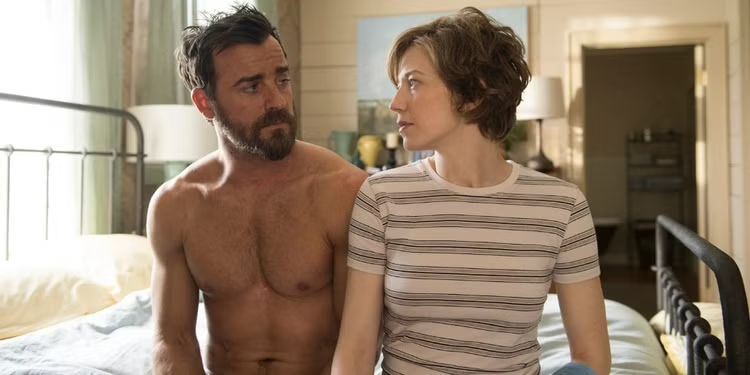
The Tony nomination opened doors that regional theater never could. Within two years, David Fincher cast her in Gone Girl as Margo Dunne, Ben Affleck’s sardonic twin sister. That same year, Damon Lindelof cast her as Nora Durst in HBO’s The Leftovers. Consequently, the trajectory shifted from theater actress with promise to screen actress with heat. However, the shift happened on Coon’s terms. She chose The Leftovers — a show that averaged fewer than a million viewers per episode — over easier, more lucrative options. The show paid almost nothing by HBO standards. It paid everything in credibility.
At Steppenwolf, Coon also met Tracy Letts, the playwright and actor who won the Pulitzer Prize for August: Osage County and a Tony Award for Best Actor for the same production of Virginia Woolf she appeared in. They married in 2013. Two Pulitzer-adjacent careers sharing one Brooklyn household. That’s not just a marriage. That’s a writers’ room with a mortgage.
The Climb: Three Emmy Nominations, Three Different Shows
The stretch from 2017 to 2025 is where Carrie Coon net worth and Carrie Coon’s reputation permanently diverged. In 2017, she earned her first Emmy nomination for Fargo Season 3, playing police chief Gloria Burgle with the kind of exhausted decency that makes you want to bring her coffee. That same year, she appeared in Steven Spielberg’s The Post and Steve McQueen’s Widows. Additionally, she voiced Proxima Midnight in Avengers: Infinity War, a role that introduced her to the largest audience she’d ever reached — even though nobody saw her face.
In 2020, she joined the cast of The Gilded Age after Amanda Peet dropped out due to scheduling conflicts. Fortune favors the prepared. Coon stepped into Bertha Russell and made the role so completely her own that imagining anyone else in the part feels like a historical error. By 2024, the show earned her a second Emmy nomination — this time for Outstanding Lead Actress in a Drama Series.

Then came The White Lotus Season 3 in early 2025. Coon played Laurie Duffy, a recently divorced Brooklyn lawyer on a girls’ trip to Thailand with two lifelong friends. She described the character as “the secret heart of the show” who “absolutely does transform.” The performance earned her a third Emmy nomination, making her one of the few actors ever nominated for three separate series within a span of years. Meanwhile, she had only 48 hours between wrapping The White Lotus in Thailand and arriving on The Gilded Age’s Long Island set to begin shooting Season 3. She showed up pale enough for 1883.
The Hamptons Connection: Bertha Russell Lives Here
The Gilded Age films on Long Island. The Russell mansion interiors are shot at stages in Bethpage, and exterior scenes use historic estates across the Island’s North Shore. That proximity to the Hamptons isn’t accidental — it’s historical. The families Julian Fellowes dramatizes in the show are the same families who built the original estates between Southampton and Montauk. Bertha Russell is loosely based on Alva Vanderbilt, a woman who clawed her way into society and then rewrote its rules.
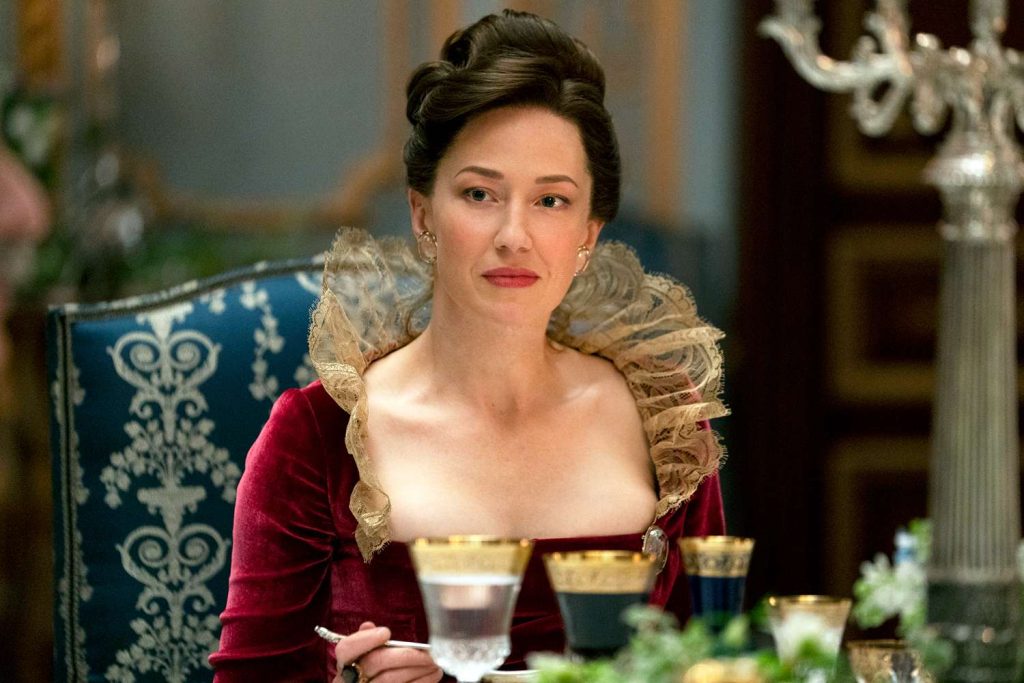
The show’s Season 3 viewership tells a specific demographic story. Premiere-night viewing grew for five consecutive weeks, with Episode 5 drawing a series-high 4 million cross-platform viewers. HBO renewed the show for a fourth season before the finale even aired. The audience for this show isn’t passive. They recognize the social architecture because they live inside a contemporary version of it.
Coon herself doesn’t live in the Hamptons. She and Letts sold their Chicago home for $3.1 million in 2023 and relocated to Brooklyn. They also spend time upstate. After the White Lotus finale aired, she told the Television Academy she’d been “at home in my sweatpants” watching the episode in her basement with her husband. No screening party. No PR event. Sweatpants and a basement. That restraint is either humility or the confidence of someone who knows the work speaks.
What Carrie Coon Net Worth Tells Us About Prestige Television
Here is the uncomfortable math. Premium cable dramas typically pay lead actors between $100,000 and $500,000 per episode, depending on the show’s budget and the actor’s leverage. The Gilded Age runs eight episodes per season. Even at the high end, that’s $4 million per season before taxes — and Coon almost certainly isn’t at the high end, because the show spends its money on costumes, sets, and an ensemble cast of 40-plus Broadway veterans. Furthermore, The White Lotus paid its ensemble on a limited-series scale, which is historically lower than ongoing drama rates.
Coon’s film work adds to the picture but doesn’t transform it. Gone Girl was a supporting role in her first year on screen. Ghostbusters: Afterlife and its sequel represent her biggest franchise paydays, but she wasn’t the lead. The Avengers roles were motion capture. By contrast, an actor with Coon’s nominations and critical reputation who had signed onto a network procedural or a streaming franchise ten years ago would be worth three to five times her current number.
She chose differently. Every time the fork appeared, Coon walked toward the smaller, sharper project. The Leftovers over a network deal. Fargo over a film franchise. The Gilded Age over whatever was paying more. The result is a net worth of $6 million and a reputation that money can’t purchase.
The Soft Landing: Broadway, Brooklyn, and What Comes Next
In December 2025, Coon returned to Broadway in her husband’s play Bug at the Samuel J. Friedman Theater. She’d performed the role at Steppenwolf before and after the pandemic. Getting it to New York took years. “It’s hard to get that kind of art made,” she told WBEZ, “because people don’t want to do political theater.” She did it anyway.
The Gilded Age Season 4 will begin production in 2026. Coon will return as Bertha Russell, a character who has become inseparable from the actress playing her — not because they share a personality, but because they share a strategy. Bertha Russell conquered New York by refusing to accept that the rules applied to her. Carrie Coon conquered television by refusing to accept that the rules were worth following.
As she told an interviewer about balancing motherhood with her career: “I feel so grateful to be doing any of it. It is not easy to succeed.” That sentence contains no self-pity. It’s a status report from someone who understands the cost and keeps paying it.
Carrie Coon net worth will continue to rise. The Gilded Age is growing, not shrinking. The White Lotus put booster rockets on her profile. Film offers are increasing. But the number will likely never match the resume, because the resume was built by someone who decided early that the work was the point. In a town that runs on leverage, Coon’s leverage is that she doesn’t need any. That’s the most expensive asset in Hollywood. And you can’t put a number on it.
Related Reading
- The Gilded Age Cast Net Worth: The Cast HBO Doesn’t Want You to Google
- Christine Baranski Net Worth: Four Decades of Broadway and Prestige TV
- Cynthia Nixon Net Worth: From Sex and the City to Political Reinvention
You know the feeling. You’re watching something unfold — a room shifting, a conversation turning, a door opening that wasn’t open before — and you realize you’re not just observing. You’re recognizing it. That’s what the best stories do. They hold up a mirror so polished you forget it’s glass. That’s what we do at Social Life Magazine. Twenty-three years of holding up that mirror to the most interesting people, places, and moments between the Shinnecock Canal and Montauk Point.
If your brand, your business, or your story belongs in front of the Hamptons’ most influential audience, we should talk. Visit sociallifemagazine.com/contact to explore editorial features, advertising partnerships, and custom brand activations with Social Life Magazine.
Ready to tell your story on your terms? Submit a Paid Feature and position yourself alongside the tastemakers, founders, and cultural architects who define the season.
Join 82,000+ readers who get our insider briefings on Hamptons lifestyle, luxury real estate, and the people shaping the conversation. Subscribe to the Social Life email list here.
Experience the Hamptons’ premier luxury sporting and social event. Polo Hamptons brings together the most discerning audience on the East End for world-class polo, brand activations, and the kind of afternoon that turns introductions into partnerships.
Never miss an issue. Subscribe to Social Life Magazine in print — five summer issues delivered to your door from Memorial Day through Labor Day, plus Fall and Winter editions distributed to Upper East Side doorman buildings.
Love what we do? Support Social Life Magazine with a $5 donation and help us keep delivering the stories, profiles, and cultural coverage that make the Hamptons worth paying attention to.
Author

Written by
Recent Posts
Christine Baranski Net Worth: Four Decades, 15 Emmy Nominations, and the Price of Being Undeniable

Morgan Spector Net Worth: The Most Terrifying Man on Television That Nobody Can Name
Cynthia Nixon Net Worth: The $20 Million Fortune That Bought the Freedom to Lose
Smart Travel Tips for a Hassle-Free Airport Commute
Carrie Coon Net Worth: The Quiet Fortune of Television’s Most Nominated Actress
Categories
- Art
- Articles
- Beauty & Skincare
- Celebrities
- Celebrities|Entertainment
- Celebrities|Television
- Celebrities|The Chronicles
- celebrities|the-archive
- Celebrities|TV Shows
- Chronicles
- Entertainment|Culture
- Event Photos
- Events
- Fashion
- Fashion & Style
- Featured
- Food & Beverage
- Food, Spirits, Wine
- Hamptons
- Hamptons Celebrities
- Hamptons Celebrities|Celebrities|The Chronicles
- Health
- Health & Beauty
- Lifestyle
- Luxury Lifestyle
- Movies
- Press
- Profiles
- Real Estate
- Technology
- The Chronicles
- Travel
- Uncategorized
- Weddings