
Celebrity AI Investments 2026: Who Is Quietly Getting Rich
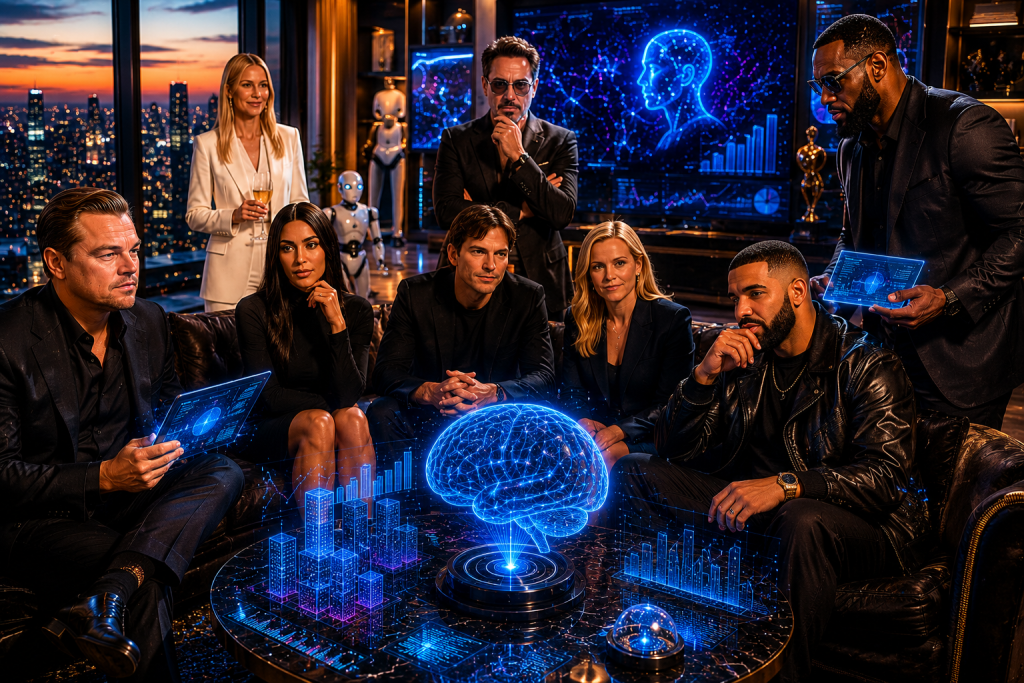
The AI billionaires on the Forbes list built the technology. A second, less visible group of wealthy individuals invested in it. Celebrity AI investments have become the quiet wealth-building strategy for a generation of entertainers, athletes, and media figures who recognized that the AI infrastructure boom would create the same kind of returns that early internet investing produced in the 1990s. The difference: this time, the investors are not just venture capitalists. They are the people whose names sell magazines.
The Quiet Bets
Ashton Kutcher’s Sound Ventures was among the earliest celebrity-affiliated funds to invest in AI infrastructure. Kim Kardashian’s SKKY Partners has allocated to AI-adjacent consumer technology. Jared Leto has backed AI startups through his Paradox venture activities. NBA players, NFL owners, and music industry executives have taken positions in AI companies at valuations that have since multiplied. The specifics of individual positions are often private. The pattern is not: celebrity capital is flowing into AI at a rate that parallels what happened with cryptocurrency between 2017 and 2021, but with fundamentally different underlying technology.
This article is part of our coverage of new status codes of AI wealth.
The Due Diligence Gap
Celebrity AI investment operates under a particular informational constraint that distinguishes it from both institutional venture capital and retail investment, and the constraint is this: celebrities possess enough capital to participate in seed and Series A rounds that are closed to the general public, but most do not possess the technical literacy to evaluate the AI models, infrastructure, or competitive dynamics that determine whether a given company will generate returns or evaporate. The gap between capital access and technical comprehension creates a dependency on advisors, fund managers, and intermediaries who translate AI capability claims into investment theses. Sound Ventures employs technical analysts who evaluate model architectures and training data quality. Most celebrity investors do not. The result is a bimodal distribution: sophisticated celebrity funds that generate institutional-grade returns, and opportunistic celebrity investments that function as expensive proximity purchases, buying adjacency to the AI narrative without the analytical infrastructure to evaluate whether the specific company justifies the price.
The Bimodal Distribution
The due diligence gap matters because it determines which celebrity AI investments will compound and which will lose value. Kutcher’s early bets on Uber and Airbnb succeeded because A-Grade Investments applied genuine analytical rigor to consumer technology markets. Whether Sound Ventures applies equivalent rigor to AI infrastructure is an open question. Leto’s Paradox investments span multiple AI categories. Whether the portfolio is diversified or unfocused depends on whether the underlying analysis is systematic or opportunistic, and that distinction is nearly impossible to evaluate from the outside.
Why Celebrity Money Follows AI Money
Celebrity investment in AI serves dual functions. Financially, early-stage AI positions offer asymmetric returns. A $500,000 investment in a seed-stage AI company that reaches a $5 billion valuation produces a 1,000x return if the position was at a $5 million valuation. These multiples are rare but not unprecedented in the AI infrastructure space. Socially, AI investment confers the status of technological fluency. In a world where AI literacy is becoming a marker of cultural relevance, claiming an investment in an AI company signals proximity to the future.
See also: Lucy Guo’s Passes platform.
The Social Proof Multiplier
There is a mechanism in celebrity AI investment that creates value independent of the technology’s performance, and understanding that mechanism is essential to understanding why AI companies actively court celebrity capital despite having access to institutional funding at lower cost. The mechanism is the social proof multiplier. When Shaquille O’Neal invests in an AI platform, the investment generates media coverage. Media coverage generates awareness. Awareness generates user acquisition. User acquisition generates revenue. Revenue justifies the valuation at which O’Neal invested. The celebrity’s participation is not merely financial. It is generative. The investment creates the conditions under which the investment becomes profitable, which is a circular logic that traditional valuation frameworks struggle to price but that consumer-facing AI companies exploit with increasing sophistication.
The Valuation Premium of Celebrity Capital
AI companies with celebrity investors raise subsequent rounds at higher valuations than comparable companies without them, not because the celebrity capital is more patient or more strategic, but because the attention the celebrity generates reduces customer acquisition costs, which improves unit economics, which justifies higher multiples. Celebrities are not investing in the company’s technology. Instead, they invest their attention into the company’s distribution, and the return on that attention investment often exceeds the return on the financial investment by an order of magnitude. This is why Passes signed O’Neal and Dunne. Not for their capital. For their eyeballs.
Lucy Guo’s Passes platform, which signed Shaquille O’Neal and Olivia Dunne, represents the intersection of celebrity and AI infrastructure. O’Neal’s participation is not charity. It is a business calculation: the creator economy is being rebuilt on AI-powered tools, and early positioning in that rebuild creates value. Whether the celebrity AI investor class generates the same returns as the founder class remains to be seen. What is certain: the money is moving, and the people moving it have names that draw attention to the category.
The Attention-to-Equity Pipeline
Celebrity investment in AI operates on a specific economic mechanism that most coverage of the phenomenon overlooks, and the mechanism is this: celebrities possess attention capital, which is the ability to direct public awareness toward a product, company, or category through the mere fact of their association with it. AI companies possess equity, which is the ability to generate financial returns through technological and commercial execution. The celebrity AI investment is a transaction that exchanges attention capital for equity. Shaquille O’Neal joining Passes is not merely an endorsement. It is a swap: O’Neal provides the attention that draws creators to the platform, and the platform provides the equity that converts O’Neal’s attention into a financial position that compounds as the platform grows.
The Hamptons as Deal Floor
On the East End, where celebrity and technology wealth share beaches, restaurants, and event spaces for twelve weeks every summer, the attention-to-equity pipeline operates with a physical immediacy that digital communication cannot replicate. A conversation at a benefit dinner between an AI founder seeking distribution and a celebrity seeking investment creates the conditions for a deal that would take six months of email introductions, due diligence calls, and term sheet negotiations to execute through traditional channels. The proximity compresses the timeline. The social context provides a vetting mechanism that due diligence reports cannot: you can learn more about a person’s character over a two-hour dinner in Sag Harbor than you can from a hundred-page data room.
The Structured Proximity of Polo Hamptons
Polo Hamptons on July 18 and 25 at 900 Lumber Lane in Bridgehampton is the structured version of this proximity. Finance, technology, media, and entertainment share a field, share a table, and share the kind of unstructured social time that produces introductions no algorithm could engineer. The celebrity AI investment is often born in spaces exactly like this: where the founder sees the celebrity’s distribution reach and the celebrity sees the founder’s equity trajectory, and both recognize that a partnership creates value neither could generate independently.
For related coverage, explore AI money reshaping the East End.
Historical Precedent and the AI Acceleration
This mechanism is not new. Celebrity investment in technology has existed since Ashton Kutcher’s A-Grade Investments backed Uber, Airbnb, and Spotify in the early 2010s. What is new is the scale of the attention-to-equity exchange in the AI economy, where valuations are higher, growth rates are faster, and the gap between early-stage entry and billion-dollar valuation is compressed into years rather than decades. A celebrity who invested $500,000 in an AI infrastructure company at a $5 million seed valuation in 2022 could, if the company reached Scale AI’s $29 billion valuation, see a return of nearly 3,000x. Those multiples are not typical. They are also not unprecedented in the AI infrastructure space, and the mere possibility of them is enough to attract celebrity capital at a rate that exceeds any previous technology cycle.
The Compressed Multiple
The Deeper Read
The cultural implication is significant for the East End, where celebrity and finance have historically occupied adjacent but distinct social territories. That benefit gala brings them together for an evening. The AI investment portfolio makes them business partners permanently. When a hedge fund manager and a professional athlete both hold equity in the same AI company, the relationship transcends the social transactionality of the charity circuit and enters the structural permanence of the cap table. Polo Hamptons, where finance and entertainment converge on a polo field in Bridgehampton, is the physical manifestation of this convergence. The guest list is not organized by industry. It is organized by shared interest in the technologies that are reshaping every industry simultaneously.
Where the Conversation Continues
If your brand, property, event, or company belongs in this conversation, reach us through our contact page. For premium editorial visibility, explore our paid feature submission process. Subscribe at sociallifemagazine.com/enflyer. Polo Hamptons returns July 18 and 25. BMW is title sponsor. Details at polohamptons.com. Subscribe at sociallifemagazine.com/subscription.
Author

Written by
Recent Posts

AI for personal finance: where PennyGuard fits
How to Pick a Homecoming Dress for Your Body Type (and Feel Amazing in It)

World Cup Injury Attorney for Vancouver Events
What a 3-Carat Engagement Ring Actually Costs in 2026: The Real Numbers
The Skincare Habits That Make a Real Difference Over Time
Categories
- Art
- Articles
- Business of Luxury
- Celebrities
- Culture
- Entertainment
- Events
- Faces of Summer 2026
- Fashion
- Fashion & Style
- Featured
- Finance
- Food, Spirits, Wine
- Hamptons
- Hamptons Celebrities
- Health
- Health & Beauty
- Lifestyle
- Luxury Lifestyle
- Press
- Profiles
- Real Estate
- Technology
- The Chronicles
- Travel
- Uncategorized
- Weddings