
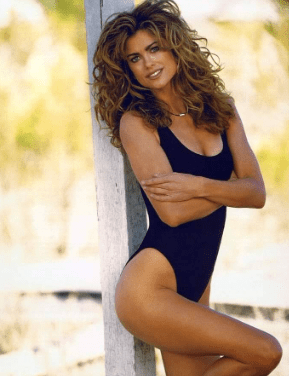
In 1993, Kathy Ireland was a Sports Illustrated swimsuit cover model whose agents were already warning her about declining bookings. By 2015, Forbes named her the wealthiest former supermodel in the world. The transformation didn’t happen through acting, television, or marrying well. It happened because Ireland understood something Warren Buffett taught her in a single conversation: own the brand, don’t rent your face.
Today, her net worth exceeds $500 million. Her company, Kathy Ireland Worldwide, generates over $2.6 billion in annual retail sales. She didn’t transition from model to mogul. She built an entirely different kind of empire, one that most people have never heard of because she never needed publicity to make money.

The Myth: Just Another Sports Illustrated Model
The cultural memory of Kathy Ireland centers on beach photographs. Three Sports Illustrated swimsuit covers. The girl-next-door aesthetic that made her briefly one of America’s most recognized faces. This image is accurate and completely misleading.
The Modeling Career as Research Phase
While other models viewed their careers as the destination, Ireland treated hers as market research. She observed how brands used her image to sell products. She noticed that her appearance fees, while substantial, represented a fraction of the value her face generated for licensees. The math bothered her.
By 1993, she had appeared on more than 100 magazine covers. The exposure had commercial value that extended far beyond what she personally captured. Someone was making money from Kathy Ireland. Increasingly, she wondered why it wasn’t Kathy Ireland.
The Warren Buffett Meeting
The leverage moment came through an introduction to Warren Buffett arranged through mutual business connections. Ireland asked Buffett directly: How do you build wealth that lasts? His answer reshaped her career. Buffett explained the difference between endorsing and owning. Endorsements pay once. Ownership compounds forever.
According to Forbes, Ireland credits this conversation with fundamentally changing her business strategy. She stopped seeking endorsement deals and started building a licensing empire.

The Leverage Moment: Socks Changed Everything
In 1993, Ireland launched Kathy Ireland Worldwide with a single product: socks. The choice seemed absurd. She could have started with swimwear, leveraging her Sports Illustrated associations. Instead, she chose the most unglamorous product imaginable.
The Logic of Socks
The sock launch wasn’t arbitrary. Ireland had identified several strategic advantages. Socks had low price points, reducing consumer risk. They required frequent repurchasing, creating recurring revenue. They weren’t fashion-dependent, meaning her brand wouldn’t age out of relevance. Most importantly, the sock market had no celebrity competitors.
Within three years, she had sold 100 million pairs. The success demonstrated something crucial to potential retail partners: Ireland could move product at scale. The socks weren’t about socks. They were about proving a business model.
The Kmart Partnership
Her exclusive deal with Kmart, beginning in 1993, provided distribution infrastructure that most celebrity brands couldn’t access. While other models sought department store prestige, Ireland sought volume. Kmart customers bought her socks, then her sheets, then her home furnishings. Each category validated the next.
The Kmart relationship lasted over two decades. When critics dismissed her for associating with a discount retailer, Ireland focused on the sales figures. Prestige was a vanity metric. Revenue was real.

The Compounding Effect: Category Expansion
Ireland’s genius wasn’t the sock launch. It was understanding how initial success could compound across categories.
From Socks to Furniture
After establishing credibility in basics, she moved into home furnishings. Furniture represented higher margins and larger transaction values. Retailers who knew her socks sold accepted her furniture lines. Consumers who trusted her bedding trusted her couches.
By 2000, Kathy Ireland Worldwide had expanded into 15 product categories. Each category reinforced the others. A customer who bought Ireland-branded sheets in Kmart encountered Ireland-branded window treatments on the next aisle. The brand ecosystem encouraged multiple purchases.
The Real Estate Pivot
Her move into branded residential developments demonstrated strategic sophistication that surprised industry observers. Kathy Ireland Home developments partner with builders to create neighborhoods designed around her lifestyle brand. Homebuyers don’t just purchase Ireland-branded furniture. They purchase Ireland-branded homes filled with Ireland-branded products.
According to Bloomberg, this vertical integration strategy mirrors approaches used by luxury hospitality brands. Ireland applied five-star hotel economics to middle-market residential housing.
The Empire Architecture: What Ireland Actually Owns
Understanding Ireland’s net worth requires understanding licensing economics. She doesn’t manufacture products. She licenses her brand to manufacturers who produce, distribute, and sell. Her company handles brand management and quality control. The licensees handle capital investment and inventory risk.

The Licensing Model
Kathy Ireland Worldwide maintains licensing agreements across numerous categories: furniture, bedding, flooring, lighting, window treatments, craft supplies, skin care, jewelry, and more. Each agreement typically includes minimum guarantees plus royalty percentages on sales.
When Ireland says her company generates $2.6 billion in annual retail sales, she means her licensees sell that volume of product bearing her brand. Her personal revenue represents the royalty percentage of those sales, plus licensing fees and minimum guarantees.
This structure explains how one person can generate such enormous commercial activity without manufacturing a single product. She built a brand, then rented it to people who know how to make things.
Global Expansion
Her licensing agreements span international markets that most American celebrities cannot access. Manufacturing partners in Asia produce Ireland-branded products for distribution in regions where her modeling career generated no recognition. The brand travels even where the name recognition doesn’t.
For comparison, Cindy Crawford’s Meaningful Beauty followed a similar licensing approach but focused on a single category rather than Ireland’s diversification strategy.
The Hamptons Connection: The Empire You Don’t See
Ireland’s relationship with Hamptons culture is instructive precisely because it’s invisible. Unlike models who maintain relevance through social appearances, Ireland built wealth that doesn’t require her presence at events. She doesn’t need the Hamptons circuit because her business model doesn’t depend on staying famous.
The Anti-Celebrity Strategy
Her deliberate distance from celebrity culture served strategic purposes. Fashion and entertainment industries require constant visibility maintenance. Licensing businesses don’t. Ireland could focus on product development, partner relationships, and category expansion while her peers competed for magazine covers.
This invisibility extended to investor relations. Her privately held company doesn’t require public reporting. Competitors and imitators couldn’t study her financials or replicate her playbook. The opacity was strategic.

What Her Absence Teaches Hamptons Aspirants
For Social Life readers, Ireland’s story offers a counterintuitive lesson. The wealthiest former supermodel in history built her fortune by avoiding the social capital accumulation that defines Hamptons culture. She chose scale over scene.
Events documented by Social Life Magazine feature celebrities whose visibility maintains their market value. Ireland proved visibility was optional. Some empires don’t need witnesses.

The Brand Machine’s Ongoing Operation
At 61, Ireland continues expanding her licensing portfolio while delegating daily operations. The business she built in the 1990s now operates largely independently of her personal involvement. That was always the point. She wanted wealth that didn’t require her labor.
Her recent ventures include healthcare furniture lines designed for medical facilities. The expansion into B2B markets demonstrates ongoing strategic evolution. Consumers buy her products in Kmart. Hospitals buy her furniture for patient rooms. The brand stretches across contexts that would have seemed impossible in 1993.
The model who posed for Sports Illustrated covers couldn’t have imagined building a $500 million empire through sock sales. Then again, Ireland never thought like a model. She thought like Warren Buffett told her to think: like an owner.
Her net worth reflects something more sophisticated than model entrepreneurship. It reflects a fundamental understanding that images have value, that value can be packaged and licensed, and that licensing can compound in ways that modeling fees never could. She didn’t leverage fame into business. She replaced fame with business entirely.
Readers interested in models who chose different paths should examine Tyra Banks’s media mogul strategy.
Related Articles
- Cindy Crawford Net Worth 2025: The Original Brand Machine
- Tyra Banks Net Worth 2025: The Model Who Became a Media Mogul
- Heidi Klum Net Worth 2025: Project Runway and the Art of Television Equity
For features and advertising inquiries, visit sociallifemagazine.com/contact. Experience luxury events at Polo Hamptons. Subscribe to our print edition or join our email list for insider access to Hamptons lifestyle coverage.
Author

Written by
Recent Posts
The Real Reason Smart, Motivated People Don’t Follow Through
Simple Eating Habits That Boost Your Wellness
When to Seek Professional Support for Persistent Mental Health Symptoms
Creative Strategies Couples Use to Pay for Their Big Day
How International SEO Helps Brands Succeed Across Borders
Categories
- 2025 Social Life Events
- Access to Digital + Physical Magazine
- Art
- Articles
- Beauty & Skincare
- Beauty & Wellness
- Business Strategy
- Celebrities
- Chronicles
- Design History
- Design History|Hamptons
- Design Process
- Design Trends
- Event Photos
- Events
- Family
- Fashion
- Fashion & Style
- Featured
- Food & Beverage
- Food, Spirits, Wine
- Hamptons
- Hamptons Celebrities
- Hamptons Design
- Health
- Health & Beauty
- Home & Design
- Home & Living
- Lifestyle
- Luxury Home Design|Design Process
- Luxury Home Design|Design Trends
- Luxury Home Design|Hamptons Design
- Luxury Home Design|Interior Design
- Luxury Lifestyle
- Luxury Living
- Luxury Living|Design Process
- Luxury Living|Hamptons
- Luxury Living|Hamptons Design
- Press
- Profiles
- Real Estate
- Technology
- The Chronicles
- Travel
- Trending
- Uncategorized
- Weddings
- Wellness