
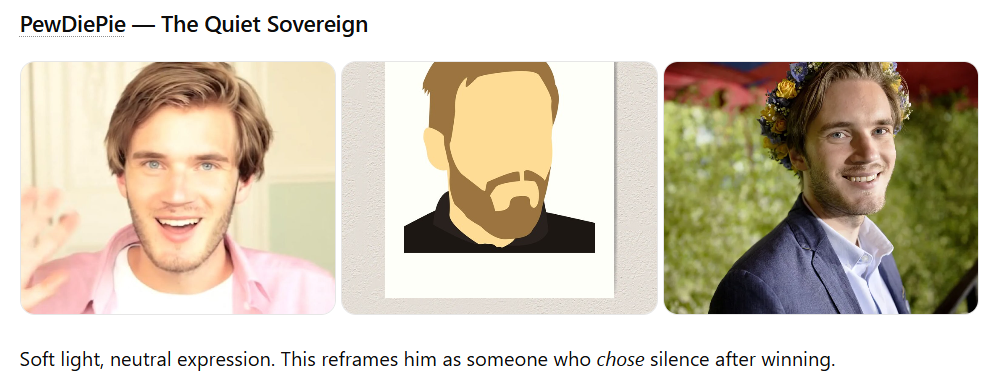
Felix Kjellberg didn’t just build the largest YouTube channel in history. He built it twice. First, through gaming commentary that defined an entire genre. Then, through personality-driven content that transcended gaming entirely. Both times, he made it look accidental. It wasn’t.
PewDiePie’s net worth in 2026 sits at approximately $40 million. The figure seems modest compared to younger creators like MrBeast or Logan Paul. That’s intentional. Kjellberg chose wealth preservation over wealth maximization. He chose quality of life over growth metrics. The decision reveals something about creator economics that raw numbers miss.
Understanding PewDiePie’s fortune requires understanding what he didn’t do. The opportunities he declined. The deals he rejected. The expansion he avoided. His wealth reflects choices as much as achievements.
The Numbers That Made YouTube History
Before context, the raw statistics.
PewDiePie’s main channel has 111 million subscribers. For years, it was the most-subscribed channel on YouTube. He uploaded over 4,500 videos generating more than 29 billion views. At peak production, he posted daily. The cumulative ad revenue from that catalog exceeds $100 million.
His peak earning years, 2014-2019, saw annual income between $12-15 million. Forbes consistently ranked him among the highest-paid YouTubers. His 2019 earnings of $13 million placed him seventh on their list during a year he faced significant controversy.
Those numbers have declined substantially. Current annual YouTube earnings likely fall between $2-5 million, reflecting reduced upload frequency and advertiser caution around his content. The decline was voluntary. He could have maintained peak production. He chose not to.
The Semi-Retirement Strategy
PewDiePie effectively retired from full-time content creation in 2020.
He announced a break from YouTube, moved from the UK to Japan with his wife Marzia, and reduced uploads from daily to weekly to sporadic. Current content consists primarily of commentary videos, reaction content, and occasional gaming, produced with minimal crew and no elaborate production.
The financial math still works. His back catalog generates millions in annual passive income. Old videos continue accumulating views. The subscriber base, while no longer growing significantly, provides baseline viewership for anything he posts. His cost of living in Japan, while comfortable, doesn’t require peak earning.
The strategy resembles what financial advisors call a “barista FIRE” approach. Maintain enough active income to cover lifestyle expenses while letting accumulated assets compound. Kjellberg just happened to achieve it through YouTube rather than traditional investing.
Brand Deals and Sponsorship Revenue
PewDiePie’s approach to sponsorships diverged sharply from creator industry norms.
He famously mocked sponsored content, creating parody segments that acknowledged the transactional nature of influencer marketing. This ironic distance actually made his endorsements more valuable. When PewDiePie promoted something, audiences knew he wasn’t desperate for money. The selectivity created authenticity that mainstream influencers couldn’t replicate.
His limited sponsorship deals commanded premium rates. A dedicated segment cost brands $500,000 to $1 million. He took perhaps 10-20 such deals annually at peak, generating $5-10 million beyond ad revenue. The current rate is lower, with only occasional sponsorships for products he genuinely uses.
G FUEL, the gaming energy drink brand, maintained a long-term partnership that reportedly paid seven figures annually. That deal ended in 2022 amid broader sponsorship pullbacks from his content. Current brand partnerships are minimal and likely represent less than $1 million in annual income.
The Merchandise Empire
PewDiePie merchandise generated significant revenue during his peak years.
The “Bro Fist” branding appeared on clothing, accessories, and novelty items sold through his own store and partnerships with companies like Represent. Peak merchandise revenue likely reached $3-5 million annually. His “Tsuki” fashion brand with Marzia added another revenue stream focused on higher-end streetwear.
Current merchandise sales are minimal. The stores remain operational but aren’t actively promoted. The business model required content momentum he no longer maintains. Unlike MrBeast or Logan Paul, Kjellberg didn’t transition merchandise success into broader consumer product ventures.
This represents either a missed opportunity or a conscious choice, depending on perspective. The infrastructure existed to build a lifestyle brand. He decided producing content was enough.
The Controversies and Their Financial Impact
PewDiePie’s career included multiple controversies that affected his commercial value.
In 2017, Disney’s Maker Studios dropped him after he included anti-Semitic jokes and Nazi imagery in videos. The Wall Street Journal investigation that prompted the split cost him his network deal and YouTube’s original programming support. In 2019, he used a racial slur during a live stream, triggering another sponsor exodus.
Each controversy reduced his advertiser pool. Brands willing to work with him became increasingly niche. The premium he could command decreased. His choice to continue making edgy content rather than sanitizing for sponsors was itself a financial decision, trading revenue for creative freedom.
The long-term impact is difficult to quantify. Had he maintained Disney’s backing and avoided controversy, his peak earning potential might have exceeded $30 million annually. Against that hypothetical, his actual earnings represent tens of millions in foregone income.
Whether that trade-off was worth it depends on values that resist financial analysis.
Real Estate and Investment Holdings
PewDiePie’s real estate holdings reflect his international lifestyle.
He purchased a house in Brighton, UK, for approximately $1 million in 2013. That property was sold when he relocated. His current residence in Japan is more modest than his UK home, though property values in desirable Tokyo neighborhoods remain substantial. Estimated real estate holdings total $5-10 million across properties.
Investment portfolio details aren’t publicly disclosed. Swedish tax records, before his UK and Japan relocations, suggested typical wealthy-individual holdings in stocks and bonds. His stated approach emphasizes simplicity over optimization, consistent with his overall lifestyle philosophy.
The absence of disclosed venture investments distinguishes him from American creators who actively deploy capital. Kjellberg appears to prefer traditional wealth preservation over entrepreneurial wealth creation beyond YouTube.
The Marzia Factor
PewDiePie’s wife, Marzia Kjellberg (née Bisognin), maintains her own business ventures.
She previously ran a successful YouTube channel with 7 million subscribers before retiring from content creation in 2018. Her current focus is Mai, a pottery and home goods brand she founded in Japan. The business generates revenue independently of Felix’s career.
Combined household net worth likely exceeds $50 million when accounting for Marzia’s assets. The couple’s lifestyle, while comfortable, appears designed around experiences rather than display. Their Japanese relocation prioritized cultural interest over financial optimization.
Passive Income Streams
PewDiePie’s back catalog represents an annuity that requires no ongoing work.
Videos posted years ago continue generating views. A 2012 video might receive 100,000 views monthly, generating $500-1,000 in ad revenue. Multiply that across 4,500 videos, and the catalog likely produces $2-4 million annually with zero new content creation.
This passive income is the reward for a decade of daily uploads. The compound effect of an enormous catalog means Kjellberg could stop creating entirely and maintain upper-middle-class income indefinitely. Few creators have built comparable back catalogs because few maintained his consistency for so long.
The model resembles music royalties more than typical creator economics. Like a musician whose songs generate streaming income decades after recording, PewDiePie’s videos generate ad income indefinitely. The asset is the archive itself.
Comparing PewDiePie to Newer Creators
Raw net worth comparisons miss important context.
MrBeast’s $500 million to $1 billion dwarfs PewDiePie’s $40 million. But MrBeast works constantly, employs over 100 people, and faces pressure to grow indefinitely. His wealth is mostly illiquid equity dependent on business performance.
PewDiePie’s $40 million is largely liquid. He has no employees. He posts when he wants. His income exceeds his expenses without effort. By quality-of-life metrics, his position might be preferable to someone worth ten times more.
The comparison that matters is with his peer cohort. Other creators who started on YouTube in 2010 mostly burned out, faded away, or never achieved escape velocity. PewDiePie’s longevity and wealth accumulation exceed virtually all early YouTube stars. He won the game before the new players changed the rules.
The Japan Relocation
PewDiePie’s move to Japan reflected personal rather than financial motivations.
Japan’s tax rates aren’t particularly favorable for wealthy individuals. The country offers lifestyle benefits, cultural experiences, and privacy that Sweden and the UK couldn’t provide. For someone whose net worth was already established, lifestyle optimization trumped tax optimization.
The relocation does provide creative content angles. His commentary on Japanese culture, technology, and daily life attracts viewers curious about his new home. The exotic setting differentiates his current content from pure gaming commentary.
From a brand perspective, Japan-based content carries different sponsorship potential. Japanese companies seeking English-language exposure might pay premiums for his audience. Whether he pursues this opportunity remains to be seen.
Legacy and Influence on Creator Economy
PewDiePie’s impact on YouTube economics exceeds his personal wealth.
He proved gaming commentary could support a full-time career. Personality, as he demonstrated, could transcend content category. Subscriber scale creates leverage against platforms. Every creator negotiating with YouTube benefits from precedents he established.
His “Subscribe to PewDiePie” campaign during the race against T-Series brought attention to platform dynamics. The competition between individual creator and corporate entity highlighted tensions that still shape YouTube’s relationship with creators.
The controversies also established precedents, for better or worse. Brands learned that creator risk differs from traditional celebrity risk. Platforms learned that their biggest stars might also be their biggest liabilities. The advertising industry’s complicated relationship with influencer marketing traces partly to the Kjellberg precedents.
What PewDiePie’s Wealth Reveals
PewDiePie’s net worth is the result of choosing enough.
He could have built production infrastructure like MrBeast. Consumer products like Logan Paul’s were another option. Sponsorship volume could have been maximized. Puerto Rico offered tax optimization. Every choice would have increased his net worth.
Instead, he chose a comfortable life with moderate ongoing work. His wealth enables that choice. The $40 million isn’t the goal. It’s the tool that purchased freedom.
For younger creators chasing maximum scale, PewDiePie offers a different model. Sustainable careers might look like his. Accumulate assets during peak years. Reduce output as lifestyle priorities shift. Let the catalog generate passive income. Enjoy the result.
The model doesn’t work for everyone. It requires the decade of grind that built his subscriber base. Living below accumulated means is essential. Accepting that others will pass you on leaderboards you once topped comes with the territory.
But for those who can accept those conditions, PewDiePie demonstrates that creator wealth can fund a good life, not just an impressive net worth statement.
The Bottom Line on PewDiePie’s Net Worth 2026
PewDiePie’s net worth in 2026 is approximately $40 million, with the majority in liquid assets and passive income streams.
The figure represents a conscious choice to prioritize lifestyle over growth. His semi-retirement from content creation means the wealth will grow slowly through investment returns rather than new earnings. Barring major investments or business ventures, his net worth will likely remain in the $40-60 million range indefinitely.
What makes his position enviable isn’t the number. It’s the freedom the number enables. He posts when he wants. Location is his choice. Time goes to interests rather than obligations. The wealth serves his life rather than demanding he serve it.
That outcome is rarer than the billion-dollar valuations that dominate creator economy headlines. For most people, it’s also more achievable and more desirable.
PewDiePie won the old game. He doesn’t need to play the new one.
Related Articles
- MrBeast Net Worth 2026: Inside the $1 Billion Creator Empire
- Markiplier Net Worth 2026: Gaming Creator to Production Company Owner
- The New Millionaires: How Digital Creators Build Generational Wealth
- Ad Revenue vs. Equity: Why the Richest Creators Stopped Making Content
Sources
- Forbes Highest-Paid YouTubers List (Historical)
- Social Blade Analytics
- Swedish Tax Records (Historical)
- YouTube Creator Revenue Reporting
Author

Written by
Recent Posts

Midsommar A24 Cast Net Worth — The Daylight Horror That Turned Grief Into a Career Launchpad
ZOI NOMAD & TEN11 LOUNGE MARK ONE YEAR

Room A24 Cast Net Worth — The $6 Million Captivity Drama That Set Brie Larson Free

The Witch A24 Cast Net Worth — A $3.5 Million Puritan Nightmare That Created a Queen and a King

A24 Genre Stars Net Worth — The Terrifying Fortunes Behind Horror, Sci-Fi, and Oscar Gold
Categories
- Art
- Articles
- Beauty & Skincare
- Celebrities
- Celebrities|Movies
- Celebrities|The Chronicles
- Chronicles
- Entertainment|Culture
- Event Photos
- Events
- Fashion
- Fashion & Style
- Featured
- Food & Beverage
- Food, Spirits, Wine
- Hamptons
- Hamptons Celebrities
- Hamptons Celebrities|Celebrities|The Chronicles
- Health
- Health & Beauty
- Lifestyle
- Luxury Lifestyle
- Movies
- Movies|Culture
- Movies|Hamptons Lifestyle
- Press
- Profiles
- Real Estate
- Technology
- The Chronicles
- Travel
- Uncategorized
- Weddings