
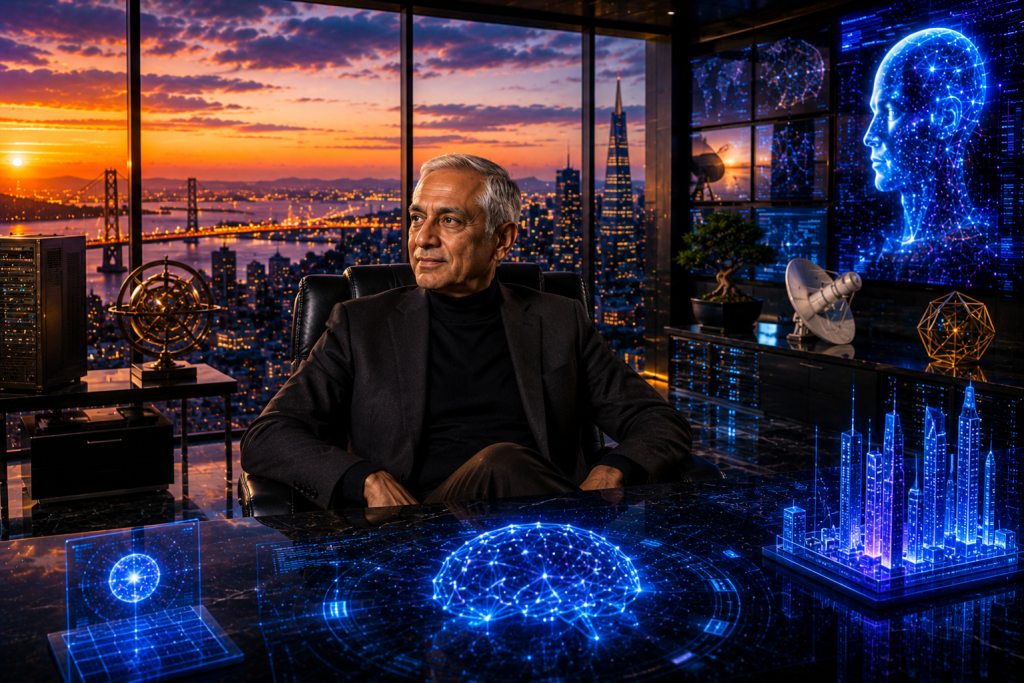
Vinod Khosla Net Worth 2026: From Sun Microsystems to AI Kingmaker
Vinod Khosla net worth 2026 is estimated at $13.4 billion, built from a career that spans the founding of Sun Microsystems, the creation of one of Silicon Valley’s most prescient venture capital firms, and a single $50 million bet on OpenAI that may be worth billions. Khosla Ventures manages over $15 billion in assets across more than 1,500 investments. The firm was the first institutional investor in OpenAI, wiring $50 million at a $1 billion valuation in 2019. OpenAI’s latest valuation exceeds $730 billion. The return on that check, if Khosla’s reported 5% stake has not been diluted, is measured in orders of magnitude. He is the Pivot in the AI billionaires story: the clean-energy investor who saw the AI wave before the AI wave had a name.
Before AI: Sun Microsystems and the Climate Detour
Khosla was born on January 28, 1955, in Pune, India. He earned a B.Tech from IIT Delhi, a master’s from Carnegie Mellon, and an MBA from Stanford. In 1982, he co-founded Sun Microsystems, the company that built the servers powering the early internet. Sun went public in 1986 and eventually reached a market capitalization exceeding $200 billion before Oracle acquired it in 2010. Khosla left Sun early and founded Khosla Ventures in 2004 with a thesis centered on clean energy and climate technology.
For over a decade, Khosla was the most prominent climate-tech investor in Silicon Valley. He backed Commonwealth Fusion Systems (nuclear fusion), Impossible Foods (plant-based protein), and dozens of other companies building alternatives to fossil fuels. Then he saw something bigger. In 2019, after Elon Musk balked at continued OpenAI funding, Khosla stepped in as the first institutional investor, writing a $50 million check at a $1 billion valuation. Fortune reported the backstory: Khosla viewed the investment as “both an ideological bet on democratizing AI and a geopolitical hedge” against Chinese AI dominance.
The OpenAI Bet: $50 Million to Billions
Khosla’s $50 million investment in OpenAI at a $1 billion valuation purchased approximately 5% of the company. OpenAI has since raised $110 billion at a $780 billion valuation. If Khosla’s stake has not been diluted (and even with dilution, the returns are extraordinary), that original check is now worth tens of billions of dollars. The return multiple, potentially exceeding 100x on a $50 million investment, ranks among the most successful venture bets in history, alongside his 2,500x return on Juniper Networks.
Khosla Ventures has since expanded its AI portfolio dramatically. Fund XIII closed at $3.5 billion in 2024 with specific mandates around nuclear fusion, humanoid robots, and AI infrastructure. The firm has over 1,500 investments and 196 documented exits through early 2026. Forbes ranked Khosla #10 on its 250 Greatest American Innovators list in 2026. He also backed DoorDash ($72 billion IPO), Instacart ($11 billion IPO), Stripe, Square, Affirm, and Rocket Lab.
See also: Dario Amodei’s safety-first fortune.
80% of Jobs Gone by 2030
Khosla’s public views on AI are bold even by Silicon Valley standards. He believes AI will be capable of performing 80% of all jobs by 2030. “What happens when all labor is free?” he asked on Fortune’s Titans and Disruptors podcast. “$15 trillion of U.S. GDP is labor, and that $15 trillion will mostly go away. That’s a hugely deflationary economy. But the abundance of goods and services will be very, very large.” He predicts that by 2040, “$30,000, or maybe even $10,000, will buy much more than you can buy if you have a $100,000 income today.”
These are not the predictions of a detached futurist. They are the investment thesis of a man managing $15 billion in capital who is actively deploying it into the companies building the technology he describes. When Khosla says AI will eliminate 80% of jobs, he is both warning and investing. The positions are not contradictory. They are complementary: if the prediction is correct, the companies he funded will be the ones doing the eliminating.
The Insider Angle: The Original AI Bet
Khosla lives in Menlo Park. His wife Neeru co-founded CK-12, a nonprofit offering free educational materials. His firm operates from Silicon Valley with a team that evaluates “science experiments” rather than business plans. The willingness to fund technology that does not yet work, and to wait years for the market to catch up, is the defining characteristic of Khosla’s approach. The firm funded fusion energy before fusion was viable, backed OpenAI before ChatGPT existed, and invested in Rocket Lab before private space launches were routine.
For the investor class of the AI economy, Khosla represents the long game. Son deploys capital at maximum scale. Andreessen deploys capital with maximum infrastructure. Khosla deploys capital with maximum patience. He put $50 million into OpenAI and waited five years for the market to recognize what he already knew. That patience, applied to a $15 billion portfolio with over 1,500 investments, is the most powerful compounding engine in venture capital.
The Deeper Read
Khosla Ventures’ Fund XIII, at $3.5 billion, includes mandates that read like a science fiction table of contents: nuclear fusion, humanoid robots, AI infrastructure, autonomous systems. Its thesis is that the most valuable companies of the next decade will emerge from technologies that most investors currently consider pre-commercial. Commonwealth Fusion Systems, one of Khosla’s portfolio companies, is building a fusion reactor. Khosla invested when fusion energy was widely considered thirty years away from commercial viability. Khosla believed it was closer to ten. Whether he is right will not be known for several years, but the willingness to deploy $3.5 billion into categories that most institutional investors will not touch until the technology is proven is the defining characteristic of his approach and the reason his returns, when they arrive, tend to be measured in multiples rather than percentages.
The Discipline of Waiting for the World to Agree With You
Khosla’s $50 million check to OpenAI in 2019 is, at current valuations, one of the most successful venture investments in history. But the check itself is less instructive than the five years between writing it and collecting the return, because those five years required a specific psychological discipline that is fundamentally different from the discipline required to identify the opportunity. Identifying the opportunity required intelligence, pattern recognition, and the technical literacy to understand why large language models trained on internet-scale data would produce emergent capabilities that nobody, including the researchers building them, fully predicted. That is hard. But waiting five years for the market to recognize what you recognized before anyone else, while watching your thesis unfold in real time and resisting the urge to sell at every intermediate valuation that would have represented a spectacular return, is a different kind of hard. That difficulty produces the difference between a 10x return and a 100x return, and it is the kind of hard that most investors, regardless of intelligence or conviction, cannot sustain.
Continued
The discipline is especially difficult because the intermediate milestones create their own gravitational pull. When your $50 million turns into $500 million, the temptation to crystallize the return is not merely financial. It is psychological. A 10x return in three years validates every decision you made. It provides the psychic income of being right. This funds the next fund. It generates the carried interest that pays for the house in Menlo Park and the endowment at Stanford and the life that successful venture capitalists are supposed to live. Holding through that temptation, watching the $500 million become $5 billion and knowing that it could also become $50 million if the thesis is wrong, requires the kind of conviction that borders on religious faith, and Khosla, who grew up in Pune, India, and came to America with the specific ambition of building companies that change how the world works, has that conviction in abundance.
The Deeper Read
His prediction that AI will eliminate 80% of jobs by 2030 is not a fear. It is a business plan. When Khosla says “$15 trillion of U.S. GDP is labor, and that $15 trillion will mostly go away,” he is describing the total addressable market for the companies in his portfolio. Each eliminated job is a customer acquired, each automated task is revenue generated, each displaced worker is evidence that the thesis is correct and the $50 million check was the best $50 million he ever spent. That prediction is unsettling precisely because it is not speculative. It is the inevitable conclusion of the technologies Khosla has funded, deployed by the companies Khosla has backed, running on the infrastructure Khosla has invested in. He is not predicting the future. He is describing the portfolio.
Where the Conversation Continues
You are reading this because the person who made the first institutional bet on OpenAI is the same person predicting that AI will eliminate 80% of jobs. Understanding who funds the revolution is understanding who profits from its consequences.
If your brand, property, event, or company belongs in this conversation, reach us through our contact page. For premium editorial visibility, explore our paid feature submission process. Subscribe at sociallifemagazine.com/enflyer. Polo Hamptons returns July 18 and 25 at 900 Lumber Lane, Bridgehampton. BMW is the title sponsor. Details at polohamptons.com. Subscribe at sociallifemagazine.com/subscription.
Author

Written by
Recent Posts

Powerful Strategies to Stay Ahead in a Fast-Moving Real Estate Market
How Latino Players Have Helped Shape Modern Basketball Culture
10 Best Designer iPhone 18 Pro Cases to Choose From
AI for personal finance: where PennyGuard fits
How to Pick a Homecoming Dress for Your Body Type (and Feel Amazing in It)
Categories
- Art
- Articles
- Business of Luxury
- Celebrities
- Culture
- Entertainment
- Events
- Faces of Summer 2026
- Fashion
- Fashion & Style
- Featured
- Finance
- Food, Spirits, Wine
- Hamptons
- Hamptons Celebrities
- Health
- Health & Beauty
- Lifestyle
- Luxury Lifestyle
- Press
- Profiles
- Real Estate
- Technology
- The Chronicles
- Travel
- Uncategorized
- Weddings