
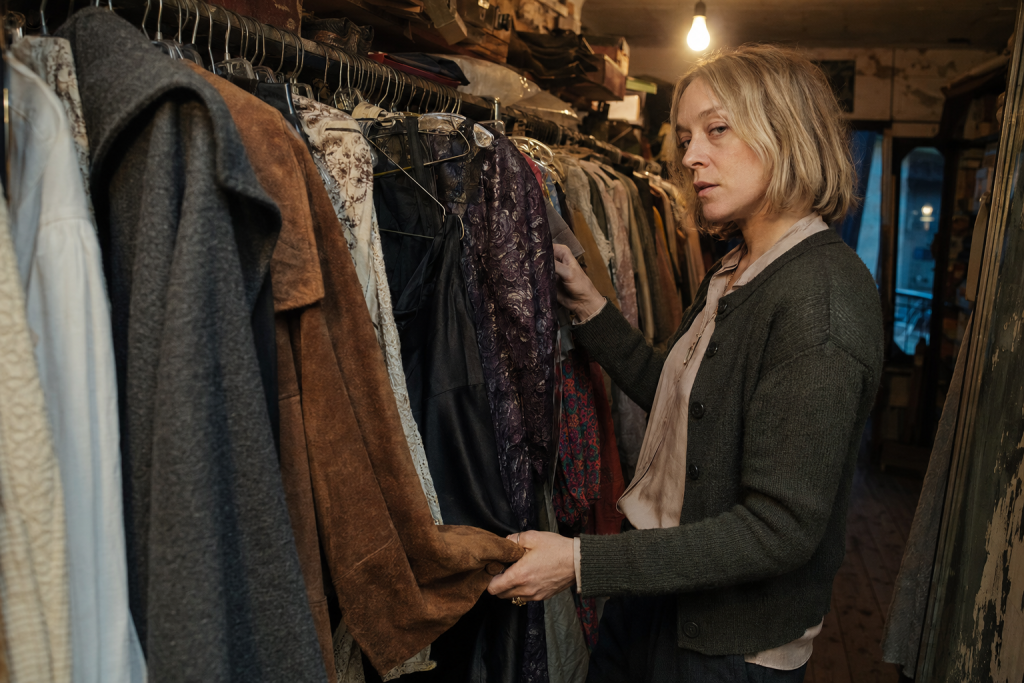
Chloë Sevigny style gets filed under quiet luxury, and the filing is wrong. Quiet luxury is a spending strategy for people who arrived recently. What she has been doing since 1995 is something else entirely.
She plays Tatum in The Five Star Weekend, the year-rounder, the friend who was there before the money. Casting her in that role is the single most legible decision in the series.
The economics of being early
Sevigny was profiled as the coolest girl in New York while still a teenager. Kids arrived in 1995, an Oscar nomination followed for Boys Don’t Cry, and the trajectory pointed straight at a conventional career.
She declined it repeatedly. Instead of the studio ladder, she took the harder catalogue: independent film, difficult directors, and television that took years to be recognized as good.
Cultural capital versus the other kind
Here is the framework, without the academic vocabulary. Some people accumulate money, and some accumulate standing. The two convert into each other, though the exchange rate is brutal and moves in one direction.
Convert standing into money too fast and you destroy the standing. Everybody has watched a downtown figure take the wrong campaign and evaporate.
Sevigny has converted at a deliberately unimpressive rate for thirty years. Because the conversion stayed slow, the underlying asset kept appreciating, which is why she is still castable as the only authentic person in a room.
Why that makes her the right Tatum
Tatum is the character who cannot be bought and knows it. She lives on the island in February. She was not impressed by the invitation.
An actress who spent three decades declining conversion plays that without effort. Any actress who had taken the money in 1999 would have had to perform it, and the audience would have felt the performance.
Our chapter on year-rounders argues Tatum is the first honest local character in a decade of summer colony television. The casting is half the reason it works.
What her wardrobe is actually saying
People describe her clothes as strange, which misreads the intent. The clothes are not strange. They are unpurchasable, which is different.
A look assembled from vintage, from a designer’s third collection, and from something a friend made cannot be replicated by spending money. That is precisely the point, since anything replicable by spending is not a status signal at all.
The difference from quiet luxury
Quiet luxury says: I have enough money that I no longer need a logo. It is still a statement about money, just a politer one.
Her version says something harder. It says the money was never the organizing principle, and that taste came from a scene rather than a budget.
New money can buy quiet luxury on a Tuesday. Nobody can buy having been at the right party in 1994, which is the whole reason the second signal outranks the first.
What the East End reader should take from it
Every summer colony contains people executing both strategies at once. Some are buying standing with money, and a smaller group is holding standing they acquired before the money arrived.
The second group is quieter, older, and considerably harder to impress. They are also the ones whose approval the first group is actually seeking, which is the engine underneath every seating chart out here.
Where The Conversation Continues
This piece belongs to Summer People, a twelve-chapter book on The Five Star Weekend, Nantucket, and the economics of belonging. All of it is live now.
The chapter on costume design reads all four women through their clothes, and the class ladder in that house is steeper than the dialogue admits.
Author

Written by
Recent Posts
How to Pick a Homecoming Dress for Your Body Type and Feel Amazing in It
How to Prepare a Home for Sale When Major Repairs Are Not Affordable
From Everyday Comfort to Personal Style: My SHEIN Slipper Habit
5 Best Mitsubishi Heat Pump Companies in Seattle
Tech Gadgets as Modern Corporate Gifts: Useful Ideas for Employees and Clients
Categories
- Art
- Articles
- Business of Luxury
- Celebrities
- Culture
- Entertainment
- Events
- Faces of Summer 2026
- Fashion
- Fashion & Style
- Featured
- Finance
- Food, Spirits, Wine
- Hamptons
- Hamptons Celebrities
- Health
- Health & Beauty
- Lifestyle
- Luxury Lifestyle
- Press
- Profiles
- Real Estate
- Technology
- The Chronicles
- Travel
- Uncategorized
- Weddings