
Everything in this book has been building toward one observation, so here it is without ceremony.
The five-star weekend is not a plot device. It is a format, and formats can be run.
What the format actually is
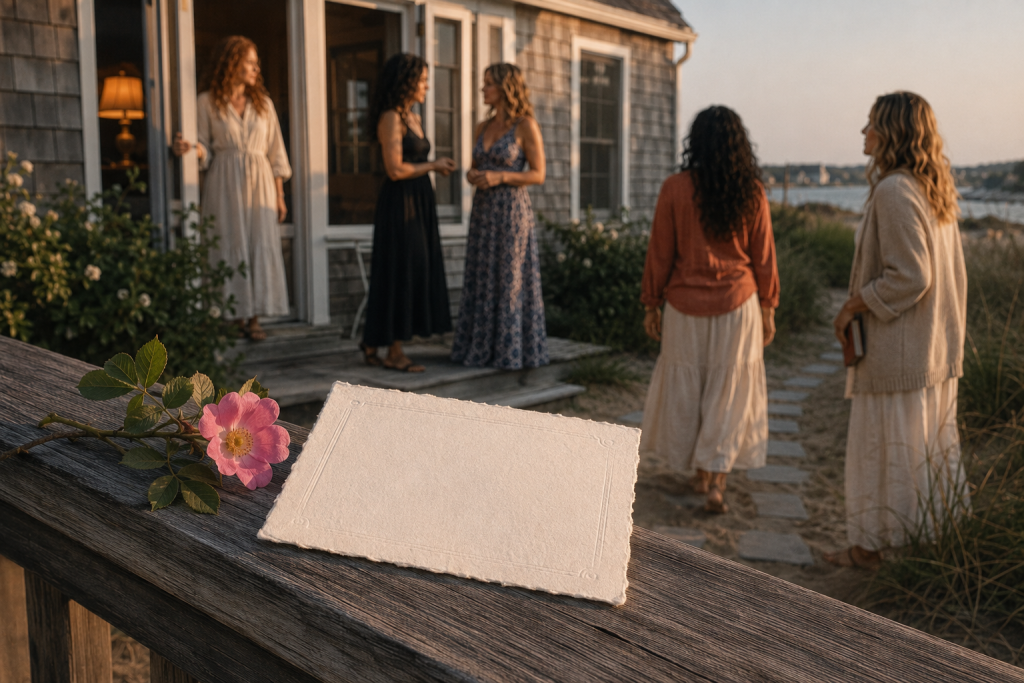
One woman invites one friend from each chapter of her life. Childhood. Early adulthood. The professional years. The current life, whoever that is now.
Four guests, one host, three days. That is the entire specification, and it fits on an index card.
Because the structure is so simple, it travels. It works in a rented house in Amagansett as well as it works on a bluff in ‘Sconset. Notably, it does not require wealth. It requires a host willing to make a list and defend it.
Why it produces something a dinner party cannot
A dinner party is horizontal. Everyone comes from roughly the same current chapter, which is why the conversation stays pleasant and forgettable.
The five-chapter format is vertical. You put a woman’s whole timeline in one kitchen and let the versions of her meet each other. The childhood friend remembers who she was before the money. The professional friend has never seen her cook.
Something happens in that room that cannot be scheduled. The show dramatized it as betrayal, because television needs a body. In real life it usually arrives as recognition, which is better and harder to film.
The East End has the houses and none of the ritual
Chapter five made the case that the Hamptons lacks a mechanism for forced intimacy. There is no ferry, no genuine distance, no cost to leaving early. Everything here is optional, and optional experiences do not become traditions.
A weekend with a fixed guest list and a fixed shape fixes that. Because the invitation is finite, it means something. Because it recurs annually, it compounds.
Traditions are simply formats that survived their first awkward year.
How Social Life is running it
Beginning next season, this magazine will host an annual East End edition of the format at its Sag Harbor guest house. One host each year. Four guests, drawn from four chapters of her life. Three days, documented properly, published in print and online.
The house has been chosen for a reason. It is walkable to the village, it is private enough for honest conversation, and it photographs like the set in chapter four while actually existing.
Each year’s host will be a woman who built something here. Founders, operators, restaurateurs, physicians, gallerists. The requirement is not fame. Rather, it is a real life with real chapters in it.
What a brand gets, and what it does not
Let us be direct, since everyone reading this section already knows why it exists.
A partner brand receives presence inside a documented weekend, editorial coverage in the print issue and online, distribution to an email audience of 82,000, and photography it can use for a year. The guest house becomes an activation space rather than a backdrop.
What a partner does not get is control of the guest list. The list is editorial, it is not for sale, and that constraint is the only reason the whole thing has any value. A weekend you can buy your way into is a party. A weekend you cannot is a story.
The categories that fit
Spirits and wine belong here, especially anything poured before six. Beauty and longevity fit naturally, because four women in a house talk about their bodies with an honesty no focus group will ever reproduce. Hospitality, transport, outdoor furniture, and kitchen equipment all have obvious homes inside a documented weekend.
Financial services fit better than people expect. Every conversation in that house eventually becomes a conversation about money, since the chapters of a woman’s life are also her balance sheet.
What does not fit: anything that needs the room to look like an advertisement. If it cannot survive being photographed casually, it is the wrong partner.
Epilogue: The Shorter List
The last thing Hollis Shaw does in the finale is not romantic. She forgives a woman, banishes her, keeps her daughter, and walks a beach with a man she knew at seventeen.
What she really does is shorten her list.
That is the ending, and it is the reason a show about four women in a house became the biggest thing on its platform. Everyone watching understood the move, because everyone watching has been considering it.
What the summer colonies are actually for
People believe they buy houses on the water for the water. They do not. They buy for the guest rooms, and the guest rooms are for the list.
A Nantucket median of $3,675,000 and a Hamptons median of $2.5 million are, read correctly, the price of controlling who is in the room. Every other feature is negotiable.
Understood that way, the two islands stop being rivals and become the same argument at different volumes. One sells scarcity, the other sells scale, but both sell the same thing underneath.
One last note for the year-rounders
Tatum ends the season with a diagnosis and a plan, surrounded by women who did not exist in her life on Friday.
She is also still going to be there in February, when the ferries thin out and the summer people become an abstraction. That is the deal, and nobody has yet built a status system that pays her properly for it.
Any place that figures that out will outlast the ones that did not.
Where The Conversation Continues
Social Life publishes the East End edition of this format every season, in print and online. Hosts are selected editorially, and the guest lists are not for sale.
Brands interested in the weekend, the guest house, or the print issue should reach out early. Partner categories are limited to one per season by design, since exclusivity that is shared is not exclusivity.
Everyone else, come find us on the lawn in July. Bring the friend from your second chapter.
Author

Written by
Recent Posts
How to Pick a Homecoming Dress for Your Body Type and Feel Amazing in It
How to Prepare a Home for Sale When Major Repairs Are Not Affordable
From Everyday Comfort to Personal Style: My SHEIN Slipper Habit
5 Best Mitsubishi Heat Pump Companies in Seattle
Tech Gadgets as Modern Corporate Gifts: Useful Ideas for Employees and Clients
Categories
- Art
- Articles
- Business of Luxury
- Celebrities
- Culture
- Entertainment
- Events
- Faces of Summer 2026
- Fashion
- Fashion & Style
- Featured
- Finance
- Food, Spirits, Wine
- Hamptons
- Hamptons Celebrities
- Health
- Health & Beauty
- Lifestyle
- Luxury Lifestyle
- Press
- Profiles
- Real Estate
- Technology
- The Chronicles
- Travel
- Uncategorized
- Weddings