
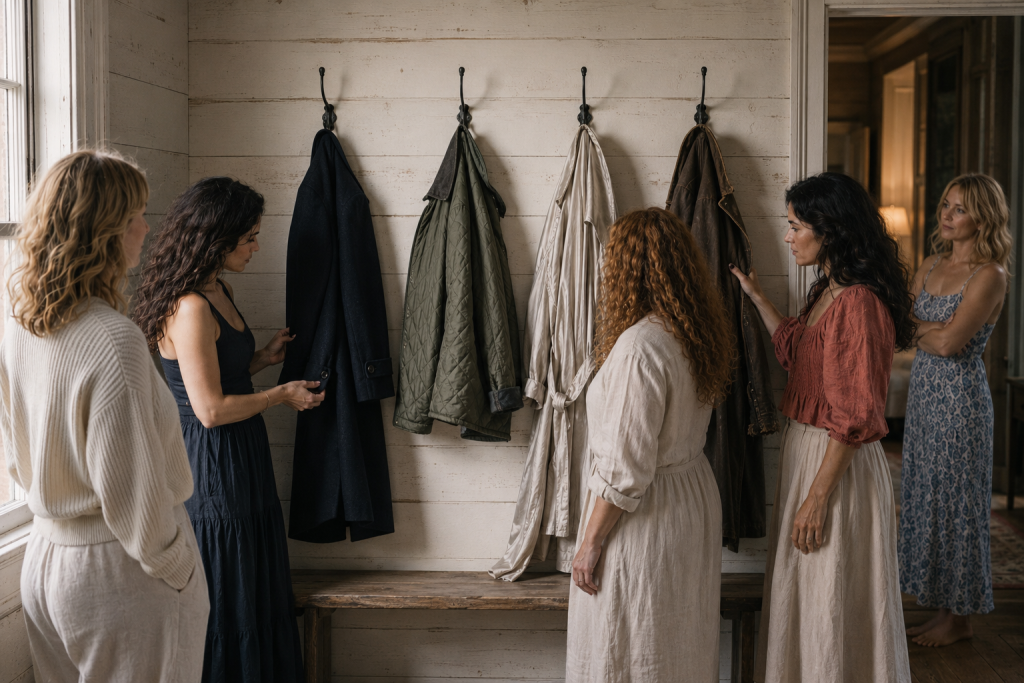
Costume in this show is not decoration. Instead, it is the class diagram, and it does more expository work than the dialogue.
Four women arrive at one house from four different economies. Nobody explains the hierarchy, because the clothes already did.
Dru-Ann dresses for a room she is no longer in
A canceled sports agent has a wardrobe built for negotiation. Sharp, expensive, structurally armored, calibrated for conference rooms and courtside seats. None of it works on sand.
Watch how her silhouette softens across the season. As her professional identity collapses, the tailoring loosens, and by the finale she is dressed like someone about to start her own agency rather than defend someone else’s. That is character development delivered entirely through shoulders.
Brooke dresses for approval
The mom friend arrives overdressed, which is the single most accurate detail in the series. Brooke has clearly bought new things for this weekend. She has clearly thought about them too much.
Overdressing is the tell of someone who suspects she was invited out of loyalty rather than desire. Anyone who has watched a woman arrive at a Bridgehampton lunch in a full look while everyone else is in linen has seen this exact anxiety.
Because she leaves her husband by the end, the wardrobe gets to resolve. Her last looks are simpler, and simpler reads as free.
Gigi dresses like a rendering
Hollis has never met Gigi in person. So Gigi arrives dressed the way an internet friendship looks: flawless, unplaceable, and impossible to date to any particular income.
Nothing she wears carries a regional signal. There is no Nantucket in it, no Chicago, no suburb. Of course that is the point, since a woman with no verifiable past also has no verifiable closet.
Symbolic capital with no backing looks fantastic and photographs beautifully. Then it turns out she was sleeping with the husband.
Tatum dresses for February
The year-rounder wears clothes that have jobs. Layers that come off in a kitchen, shoes that work on a boat ramp, outerwear chosen for a month when nobody is looking.
Her wardrobe is the only one in the house that would function in a real winter. That is the quiet argument of the whole show, delivered in fleece.
Why nobody wears a logo
Count the visible brand marks across eight episodes. There are almost none, and the omission is deliberate rather than a licensing problem.
Logos are a shortcut for a character who needs to announce something. None of these women needs to announce anything, because the house has already sorted them and they have already sorted each other.
Specifically, that is what separates a summer colony from a nightclub. In a room where everyone knows the provenance of everyone else, a label is redundant information. Wearing one signals that you think the room needs help, which is the only genuine faux pas left.
The host dresses down, always
Hollis is the wealthiest person in the house and the most casually dressed. That is not humility. It is a status move so old it has become invisible.
Whoever owns the house does not need the clothes to argue on her behalf. The building already made the argument at the door. So the host wears something soft, something washed, something that says she was not thinking about it.
She was thinking about it. Every woman arriving at that house understood the message within ninety seconds, and the show trusts you to understand it without a line of dialogue.
How to buy the weekend on the East End
Skip the impulse to shop the show literally, because the show is not selling labels. It is selling registers.
For the Hollis register, look for weight and drape rather than logo. Sag Harbor’s Main Street and the smaller Amagansett shops do this better than the Southampton flagships, which are calibrated for a different customer.
For the Tatum register, buy something with a warranty. Notably, the year-rounders on the East End dress almost identically to the year-rounders on Nantucket, and neither group is shopping the show.
Author

Written by
Recent Posts
How to Reduce Frown Lines: Treatments, Habits, and Long-Term Strategies
French Heritage Society
The Rise of Premium Supplement Brands
Manocha Bespoke
5 Ways To Make Money From Items You Already Own
Categories
- Art
- Articles
- Business of Luxury
- Celebrities
- Culture
- Entertainment
- Events
- Faces of Summer 2026
- Fashion
- Fashion & Style
- Featured
- Finance
- Food, Spirits, Wine
- Hamptons
- Hamptons Celebrities
- Health
- Health & Beauty
- Lifestyle
- Luxury Lifestyle
- Press
- Profiles
- Real Estate
- Technology
- The Chronicles
- Travel
- Uncategorized
- Weddings