
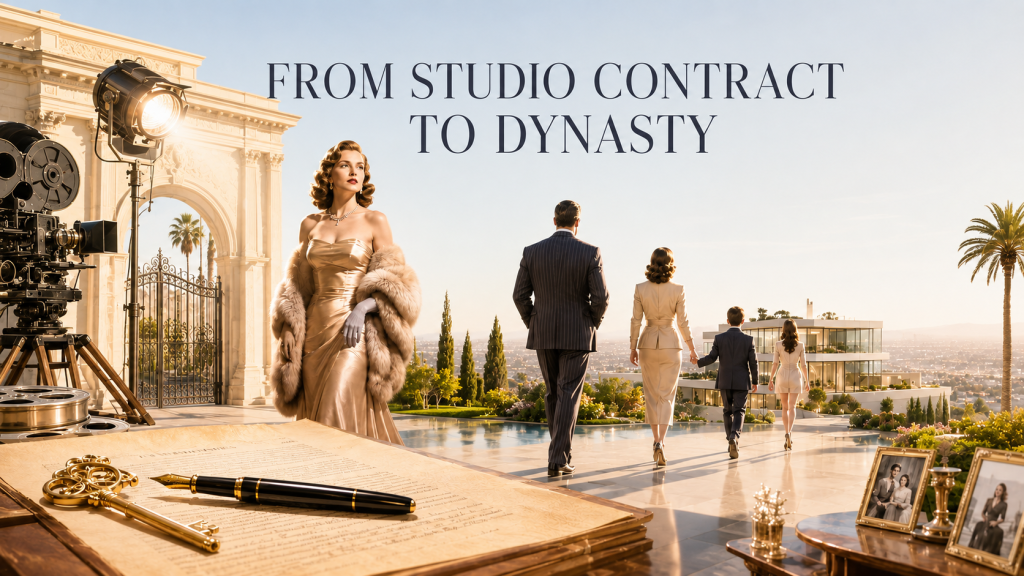
The complete arc becomes visible only in retrospect. Still, a young actor signs the early contracts and takes the highest available fees. He uses the first wave of capital to fund a life that still needs external validation. The car is new. The watch is current. Conversations still turn to the number. The house is chosen partly for how it photographs. This phase is rational. It builds the initial stack of economic and symbolic capital. It proves the bet is working.
Then, at some point that is rarely announced, the priorities flip. Ownership begins to matter more than the next quote. Discretion begins to matter more than the next cover. The same person who once needed the industry to confirm status starts treating the industry as one input among several. The car ages. Still, the watch becomes quieter or inherited. The house is held. The conversation about money largely stops. This is the transition from performance to position.
The full arc from studio contract to dynasty is visible only in retrospect, yet it follows a clear sequence.
That transition is the through-line of the entire Hollywood Status Codes cluster. It is also the practical expression of the patterns visible in the Movie Star Legends Net Worth data. Most careers never complete it. The ones that do are the ones whose names still carry weight long after the premiere cycle has moved on. Their balance sheets still compound.
From Studio Contract to Dynasty: The Three Stages
In the early and peak years the external signals are additive. Visible cars appear. Visible watches appear. Visible money talk appears. Houses that photograph well appear. However, clubs and events that look good on a résumé appear. The actor is still building recognition capital and converting it into economic capital as efficiently as possible. The industry rewards the performance of arrival because the performance itself is part of what the industry sells.
There is nothing incorrect about this phase. It is the necessary foundation. However, without the heat, the leverage, and the first substantial capital, there is nothing to convert into ownership. The error is not entering the performance phase. The error is remaining in it after the conditions that made it rational have changed.
Stage Two: The Inflection
The inflection is the ownership move. Backend points appear. A production company appears. First-look deals appear. In fact, equity in the projects that use the name and the face appears. The actor begins to trade some of the pure fee for structural participation in the upside. This is the moment at which the career stops being purely a series of employment contracts. It begins to become a portfolio of assets.
The timing of the inflection matters. Stars who make it while they still have maximum leverage are able to negotiate from strength. Even so, stars who wait until the heat has already begun to cool often find that the ownership opportunities have narrowed. Leverage is highest at the peak. That is when the conversion is most advantageous.
Full treatment of this mechanism: The Ownership Move That Separates $100M Actors from $500M+ Moguls.
Stage Three: The Quiet Phase
Once the ownership structures are in place, the external signals often shift. In fact, the same house is held for decades. The watch is inherited or deliberately understated. Money talk becomes rare in social settings. The private rooms that still matter are used for access and information rather than for display. The actor has exited the conversation about arrival. They have entered the quieter condition of already having a position.
This phase aligns with the old-money side of the larger status system. In fact, the need to prove has been replaced by the ability to assume. The performance of status has become optional. What remains is the substance: owned assets, residual relationships, and the freedom to choose projects for reasons other than survival or proof.
Why Most Careers Do Not Complete the Arc
The performance phase is seductive and self-reinforcing. The industry continues to reward the visible signals. Still, the lifestyle that they built on the high fees creates its own pressure to keep generating them. The psychological identity of being a star who is still “in it” can be difficult to release. Many careers remain in a prolonged performance phase until the industry’s demand curve declines and the options narrow.
Completing the arc requires a deliberate decision to optimize for a different scoreboard while the original scoreboard is still lighting up. That decision is psychologically harder than it looks from the outside. It means declining certain kinds of attention and certain kinds of deals in favor of quieter, more structural gains. People who make it are the ones who can see the half-life of fame clearly enough to act before it becomes obvious to everyone else.
The Dynasty Outcome
The real end state is not simply a larger net worth. Even so, it is a position that can persist beyond the individual’s active performing years. In the strongest cases it persists beyond the individual entirely. Owned libraries, production entities, real estate held across decades, and social capital that does not depend on current heat are the materials of a small dynasty. They are built during the inflection and protected during the quiet phase.
Names that appear in the upper tiers of the long-term net-worth records are disproportionately the ones who completed this sequence. In fact, they used the performance phase to generate capital. They used the inflection to convert it into ownership. Yet they used the quiet phase to protect and compound what they owned. The codes described across this cluster—the car, the watch, the off-duty uniform, the refusal to discuss money, the held house—are the visible surface of that deeper sequence.
Reading the Arc in Real Time
Because the full arc is clearest in retrospect, the practical skill is learning to read its stages while they are still happening. The actor who is still aggressively updating every external signal is likely still in the performance phase. The actor who has begun to trade fee for ownership is at the inflection. Still, the actor whose external signals have gone quiet while the underlying assets continue to grow is in the later stage. These observations are not moral judgments. They are diagnostic tools for understanding where a career sits on the only scoreboard that still matters after the lights go down.
The CassWorld Take
A reader who has just traced the full arc from studio contract to quiet ownership is already seeing fame as a temporary platform rather than a permanent identity. That shift is the opening for any brand founder, fund manager, or creative director who recognizes these codes as the real operating system of prestige and wants to be considered for an editorial feature in Social Life Magazine’s print or digital ecosystem — reach the team via the editorial contact page or go directly to Submit a Paid Feature. The same room is reached weekly by the 82,000-reader email list (sign up here), in person at Polo Hamptons 2026, and in print through a subscription; those who want to keep the signal clean can support independent luxury journalism here. Written by CassWorld. Cass Almendral is Head of Business Development at Social Life Magazine and Co-Founder of Polo Hamptons. Reach editorial at [email protected].
Continue the Hollywood Status Codes Cluster
Author

Written by
Recent Posts
The Two-House Year: What Seasonal Residents Learn After the First Season
Trade Show Booth Decisions: What to Rent, What to Build, and What to Skip
Find Your Ideal Solar Battery Size in Minutes

How to Explore Rome Comfortably Between Check-In and Departure

Beyond the Beauty Template: Why Modern Cosmetic Surgery Is Moving Beyond the One-Size-Fits-All Face
Categories
- Art
- Articles
- Business of Luxury
- Celebrities
- Culture
- Entertainment
- Events
- Faces of Summer 2026
- Fashion
- Fashion & Style
- Featured
- Finance
- Food, Spirits, Wine
- Hamptons
- Hamptons Celebrities
- Health
- Health & Beauty
- Lifestyle
- Luxury Lifestyle
- Press
- Profiles
- Real Estate
- Technology
- The Chronicles
- Travel
- Uncategorized
- Weddings