
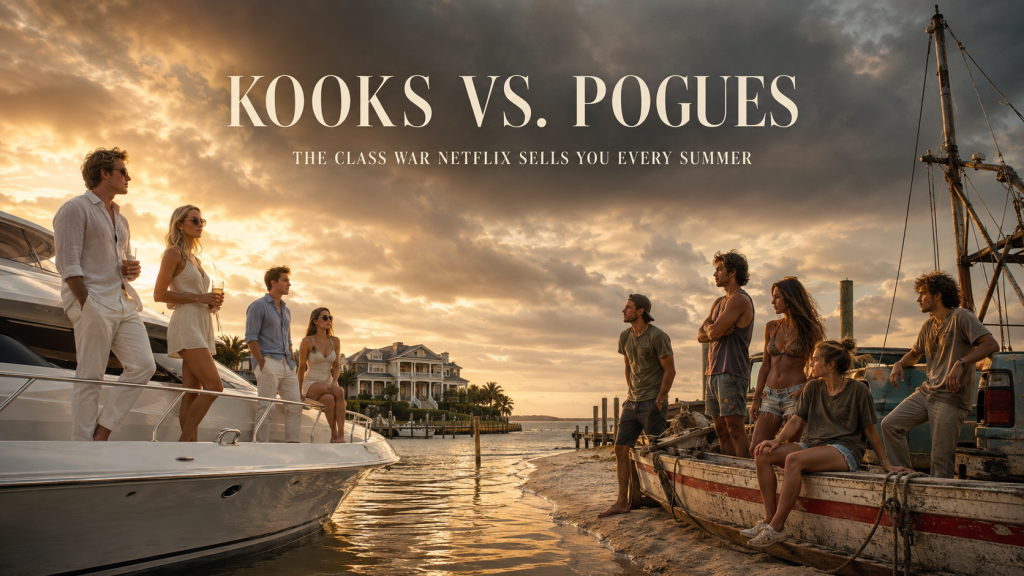
The first thing Outer Banks tells you is the map. One island, two sides, split by a bridge and a bank balance. Figure Eight sits on the money side, where the houses have names and the boats have crews. The Cut sits on the other, where the same families have worked the same water for a century without owning a foot of shoreline. Netflix calls this Kooks vs Pogues, and it has sold the division four times already.
On August 20, 2026, it sells the division one last time. The fifth and final season drops all at once, which means the whole conversation compresses into about ten days. Season four pulled 8.8 million views in its debut window and 1.4 billion minutes watched on its second half. The finale will be bigger, because endings always are.
Here is what almost nobody says out loud about the show. Kooks vs Pogues is not a teen rivalry with a treasure map attached. It is a working model of how American coastal wealth actually behaves, and it is remarkably accurate. The names change by region. The mechanics do not.
If you have ever watched a Sagaponack contract close over a property the seller’s grandfather bought for the price of a used car, you already know this story. Netflix just moved it four hundred miles south and gave everyone better hair.
What Kooks vs Pogues Actually Means
Both words are real, and both predate the show by decades. “Kook” comes out of surf culture, where it describes someone who buys the whole kit and cannot ride. It is an insult about performance, specifically about paying for belonging you have not earned in the water.
“Pogue” has a rougher lineage. Military slang used it for personnel who never saw combat, and coastal Carolina picked it up as a term for locals who stayed put. Neither word started as a class marker. Both became one, and Kooks vs Pogues welded them together.
The show’s genius, and it is genius, was collapsing two separate insults into a single map. Kooks are people who bought in. Pogues are people who were already there. That distinction has nothing to do with income and everything to do with sequence, which is the part most shows about money get wrong.
Because sequence is the actual currency. A Kook family can hold more assets than a Pogue family will see in four generations and still lose every argument about who belongs. Belonging is the one thing on the island that money buys slowly, if at all.
Notice that the show never lets a Pogue simply get rich and cross over. Season after season, the treasure keeps almost arriving. That is not lazy plotting. That is the most honest thing about the entire series.
The Map Is the Whole Argument
Figure Eight and The Cut are separated by a bridge, and the show shoots that bridge like a border crossing. Kids move across it constantly. Nothing they carry across changes their standing on the other side. Kooks vs Pogues is settled before anyone speaks.
Real coastlines do this with more subtlety and the same result. On the East End of Long Island, the divide runs between the ocean-side lanes and the year-round hamlets a few miles inland. Further Lane and Meadow Lane hold the summer capital. Springs holds the people who make the summer function.
Locals out there have a word for the old families, and it is not a joke word. Bonackers descend from the settlers around Accabonac Harbor, and they have fished those waters since the seventeenth century. Some of them watched their family’s baymen licenses become worthless while the land around them repriced by a factor of a thousand.
That is the Pogue story exactly. Not poverty, but displacement inside a place your family named. The Cut is fictional. Springs is not, and neither is Hatteras, and neither is the stretch of Montauk where the commercial fleet still ties up two hundred yards from a hotel charging peak-season rates.
Once you see the pattern, the show stops looking like a fantasy. It starts looking like documentary footage with a better budget.
Figure Eight Does Not Exist. The Money Does.
There is no Figure Eight in the Outer Banks. The name borrows from Figure Eight Island near Wilmington, a private barrier island with no public access and roughly five hundred homes. Access runs through a single guarded bridge, which is about as literal a class metaphor as geography ever provides. Kooks vs Pogues borrowed the bridge and kept the meaning.
The real Outer Banks operates differently. Corolla, Duck and Southern Shores hold the high end, and oceanfront trades there in the low seven figures rather than the low eight. Dare County occupancy and meals revenue ran essentially flat in 2025 against 2024, which tells you the market matured rather than exploded.
Still, the show’s core claim survives the fact-check. A family can own the view and rent the labor indefinitely. Corolla’s oceanfront rows are largely second homes and rental inventory, held by people who arrive for eight weeks and leave the other forty-four to someone else.
Compare that to Sagaponack, where the median has run several multiples higher and the same structural relationship applies. Different zeros, identical architecture of ownership. Anyone weighing a coastal second home should read both markets against each other, because the price gap is enormous and the social mechanics are nearly identical.
We break that comparison down in detail in our side-by-side on the two coastlines and in the acquisition math from Corolla to Sagaponack.
What the Show Gets Wrong About the Real Outer Banks
Fairness demands a correction here, because the actual Outer Banks is not a barrier island aristocracy. Dare County holds roughly thirty-eight thousand year-round residents, and that number multiplies several times over in July. There is no guarded enclave, no dynasty row, no equivalent of Figure Eight’s single bridge. Kooks vs Pogues compressed a messier reality into a cleaner one.
What exists instead is a rental economy. A large share of the housing stock along Corolla, Duck and Nags Head is investment inventory, bought to be booked rather than lived in. The owners are frequently from Richmond, Raleigh or Northern Virginia, and they are affluent rather than dynastic.
So the real friction is not aristocracy against fishermen. It is workforce housing. Teachers, nurses and restaurant staff have been priced out of the towns they serve, which is the same squeeze playing out in Montauk and on Nantucket and everywhere else the summer economy outgrew the winter one.
That version is less cinematic, but it is more useful. Old money is not the pressure on most American coastlines. Absentee capital is, and absentee capital does not need a gate or a family name to reshape a town.
The show swapped a housing crisis for a dynasty, because dynasties photograph better. Still, the emotional truth survives the substitution. Someone owns the view, someone cleans it, and the second group increasingly cannot afford to sleep near it.
The Treasure Is an Inheritance Story
Five seasons of gold, and the Pogues never keep it. Critics read that as a writers’ room stalling. Read it instead as the show’s central thesis, stated over and over in increasingly expensive locations.
The Royal Merchant, the cross, the Blue Crown. Each object is old money in its purest form, which is to say money nobody currently alive did anything to deserve. The Pogues do not want to earn a fortune. They want to intercept one, which is the quiet engine under Kooks vs Pogues.
That is a very specific fantasy, and it is the dominant one of the moment. A generation that watched wages stall against asset prices did not conclude that work pays. It concluded that inheritance pays, and that the only route in is to find a claim nobody filed.
Ward Cameron’s entire posture depends on this. His money is new, his manners are studied, and his rage arrives whenever someone treats him like a man who bought a chair rather than one who was born in it. He is not a villain because he is rich. Every serious character on the show is rich, or trying.
He is a villain because he is self-made, and the show quietly agrees with the island that self-made is a kind of forgery. That is a harsher position than most prestige dramas will take out loud.
Rafe Cameron and the Rage of the Second Generation
Rafe is the most accurate portrait of second-generation wealth currently on television, and it is not close. He has access to everything and standing in nothing, and Kooks vs Pogues gives him nowhere to put that. His father’s fortune is recent enough that Rafe can feel the seam.
Family office professionals know this profile intimately. The first generation builds and the second generation inherits a problem: a life that requires no work and confers no legitimacy. Some second generations solve it by getting serious. Some solve it by getting loud. Rafe gets violent, which is the dramatic version of the same failure.
What makes the character land is that his cruelty is always status-seeking, never profitable. He is not trying to make money. He is trying to be someone whose money is not a question.
Drew Starkey has since built the most interesting career of anyone in the cast, largely by playing the opposite register in Luca Guadagnino’s Queer and moving through the fashion world with a fluency the role never asked for. The villain out-earned the hero. There is a lesson in that for anyone still confusing visibility with value.
We go deeper on both in the anatomy of inherited rage and what Starkey is actually worth in 2026.
Sarah Cameron Crosses the Line and Pays for It
Sarah is the only character who genuinely changes sides, and the show punishes her for it constantly. Her wardrobe alone does more class work than most scripts manage in a season. Nothing she wears has a visible logo, because it does not need one. Kooks vs Pogues is legible in fabric before it is legible in dialogue.
That is the tell of money that has settled. Loud labels announce arrival. Quiet ones assume it, which is why the entire quiet luxury conversation of the last three years was really a conversation about who feels secure enough to skip the branding.
When Sarah moves to The Cut, her clothes do not change much, and that is deliberate. She reads as a Kook in a Pogue setting because the signal is not the garment. It is the posture, the teeth, the assumption that a door will open.
Madelyn Cline has since been named Revlon’s global brand ambassador, which is its own commentary on how the industry reads her. Legacy beauty did not hire a Netflix face for reach alone. It hired the specific aspirational register that Sarah Cameron made legible to about forty million households.
The wardrobe breakdown lives in our read on Kook girl style, and the deal math sits in the Revlon analysis.
Kiara Chose Down, and That Is the Rarest Move on the Island
Kiara Carrera is the character most people misread. Her parents own The Wreck, a working restaurant that made real money, and they sent her to the private school on the Kook side. By every conventional measure she was on the way up.
She went back down on purpose. That choice is far stranger than anything Sarah does, because downward movement in a class system is almost always involuntary. Kiara volunteers.
Her father’s reaction is the honest part. Mike Carrera worked for the ascent and cannot understand a daughter who treats it as a betrayal of where they came from. That argument happens in real families constantly, usually one generation after the money arrives.
Notably, the show never lets her fully belong on either side. The Pogues tease her for the tuition. The Kooks remember her father served them. She occupies the specific loneliness of the first generation to move. Kooks vs Pogues has no category for her, which is exactly the position almost every new-money family in the Hamptons has occupied at some point.
Kiara is, in other words, the character the newly successful actually resemble. Not Sarah, who was born into it, and not John B, who has nothing. She is the one holding a foot on each side of a bridge that was designed to be crossed once.
Pope Heyward and the Merit Trap
Pope does everything correctly. He studies, he works his father’s boat, he applies for the scholarship, and he presents himself to a committee of people who already have what he is asking for. The show lets him lose anyway.
That sequence is the sharpest thing in season one. Merit is presented as the legitimate route across the bridge, then quietly revealed as a route that requires permission from the people on the other side. Anyone who has sat for an admissions or membership interview understands the mechanic. Kooks vs Pogues does not reward effort, since effort was never the barrier.
Then season two does something genuinely bold with him. Pope turns out to be a descendant of Denmark Tanny, a formerly enslaved man who survived the Royal Merchant, bought his freedom and acquired substantial land on the island.
Read that carefully. The one Pogue with a legitimate ancestral property claim is Black, and the claim was erased rather than sold. The show is arguing that the island’s oldest fortune was stolen from the family now living on its poor side.
Networks rarely put that argument inside a summer treasure hunt. Outer Banks did, in episode after episode, while most viewers were watching the boats.
The Pogue Fantasy Costs More Than It Looks
Here is where the show flatters its audience, and it is worth naming. Being a Pogue looks free. Sun, boats, a house with no adults, a summer that never files a tax return. Kooks vs Pogues makes the poorer side look like the freer one.
But that life is not free. It is the most expensive aesthetic in America to reproduce, which is why the people reproducing it are almost never the people born into it. The truck is vintage. The tee shirt is thrifted, then replaced with a two-hundred-dollar version of the same thrifted tee.
Anyone who has spent a July on the East End has watched this happen in real time. The dress code at the best parties trends aggressively downward, because the only people who can afford to look like they do not care are the ones nobody could mistake for not caring.
Of course, the hair alone is a maintenance schedule. Sun-bleached, salt-textured, apparently unbothered, and running a four-figure annual appointment calendar. The skin is a harder problem, since salt air and reflected UV do measurable damage that no wardrobe fixes.
Nobody on the show has sun damage. Everyone on a real coast does. We cover the actual cost of both in the hair breakdown and the coastal skin problem nobody films.
Why the Show Never Filmed in the Outer Banks
Five seasons set in North Carolina, and the production has never really worked there. Charleston did the heavy lifting for the first three seasons, with James Island, Johns Island and Kiawah standing in for both sides of the divide. Season four added Wilmington and a Moroccan stretch through Essaouira and Ouarzazate. The final season shot largely in Beaufort County.
Tax credits explain part of it and logistics explain the rest. South Carolina’s incentives have been friendlier, and Charleston offers marsh, mansion and working waterfront inside a thirty-minute drive.
The substitution is thematically perfect in a way the producers may not have intended. A show about people who cannot afford the place they are from was filmed somewhere cheaper than the place it depicts. The Outer Banks got the branding. Charleston got the payroll. Kooks vs Pogues, running offscreen and for real money.
That gap has consequences on the ground. Dare County absorbed years of search traffic and location-scouting tourism for scenes shot two states away, while Kiawah quietly became a destination for viewers who could not name it.
The full location map, including which houses you can actually book, sits in our rental guide and the Charleston breakdown.
Kooks vs Pogues Runs on Every Coastline
Swap the names and the system holds anywhere the water is worth something. Nantucket runs it between the summer households and the year-round trades. Palm Beach runs it across a bridge, with the island on one side and West Palm on the other, which is the Figure Eight arrangement almost to the letter.
The East End version is simply the most expensive edition of the same publication. Meadow Lane sits behind gates and dune grass. Springs sits behind nothing, and its residents built most of what Meadow Lane sits inside.
What every version shares is the timing rule. Money that arrived recently is visible, and money that arrived long ago is not, and the entire social apparatus of a summer colony exists to enforce that distinction without anyone ever stating it.
Newcomers usually misread the assignment. They assume the barrier is price, so they solve for price. But the barrier is time, and time does not take a wire transfer.
Palm Beach makes the geometry unmissable. The Intracoastal separates the island from West Palm, and for decades the people who staffed the island crossed that water twice a day. Bridges, again, doing the work that fences would make too obvious.
Nantucket runs a subtler edition, where the divide is less about address than about which month you arrive. Year-rounders call the rest of them washashores, and the term survives regardless of how long a washashore has owned the house.
That is the actual reason Kooks vs Pogues resonated far past its target demographic. Millions of people watching recognized a system they were currently losing to, dressed up as a treasure hunt.
Why Netflix Renewed a Class War Five Times
Follow the business logic and the show’s longevity stops being mysterious. Outer Banks is cheap relative to its returns. There are no marquee salaries, no effects budget, and the locations are marsh, water and houses that already exist.
First-season Netflix leads in this tier have historically earned somewhere between twenty and forty thousand dollars an episode. Chase Stokes was overdrawn by thirty-six dollars and living in his car before he booked John B. The platform bought a franchise at development pricing.
More importantly, the premise never expires. A treasure hunt resolves, but a class system does not, and a class system regenerates conflict for free in every episode. Writers never have to invent a reason for these characters to be at odds, because Kooks vs Pogues does it on the map alone.
The audience math worked too. Season four opened at 8.8 million views and held the top spot, then posted 1.4 billion minutes on its back half. Earlier seasons had already cleared two billion minutes in a single week.
Those are prestige-drama numbers on a young-adult budget. Netflix did not renew a teen show five times. It renewed a permanent argument, and permanent arguments are the cheapest content ever made. The full pay structure sits in our breakdown of what Netflix actually pays.
How to Read a Room on Either Side of the Bridge
Strip the plot away and the show is a field guide. Every scene runs on tells, and the same tells operate at a Bridgehampton lawn party or a Southampton dinner with the seating already decided.
The first tell is volume. New arrivals explain what things cost, and established money never does, because pricing an object announces that the price was considered.
Second, watch what people do with staff. Ward performs warmth at the help and expects credit for it. Old families are neutral, occasionally curt, and never theatrical, since the relationship is old enough to require no performance.
Third, listen for the origin story. Anyone who volunteers how they made it is telling you the money is recent enough to still be a story. Families three generations in do not have an origin story. They have a house.
Fourth, and most reliably, notice who apologizes for the weather. Hosts who feel provisional about their place will apologize for rain, traffic, the caterer and the state of the lawn. People who are secure let the afternoon be whatever it is.
None of this is about money, which is exactly the point Kooks vs Pogues keeps making. Every tell measures time rather than balance. That is why writing a larger check never solves it, and why the fastest route in has always been to stop auditioning.
What the Final Season Has to Answer
Season five inherits a wreck. JJ is dead, killed in Morocco at the end of season four, and the group has lost the Blue Crown. Chandler Groff is circling, Dalia and the Corsairs are hunting, and the Pogues have been pushed into an alliance with Rafe.
That alliance is the whole tell. Netflix has spent five years arguing that Kooks vs Pogues is a line nobody crosses. Now the ending requires crossing it.
So the finale has exactly one real question, and it is not who survives. It is whether the money finally changes hands, and whether changing hands changes anything. If the Pogues end up rich and accepted, the show says the system is permeable. If they end up rich and still outside, it says something considerably darker and considerably more accurate.
Given four seasons of evidence, bet on darker. This show has been unusually honest about how belonging works, and honesty rarely gets sentimental in the last hour.
We will break the ending down in our finale analysis, and the wider fantasy in the Pogue fantasy.
Where The Conversation Continues
Social Life Magazine covers the version of this that does not end after ten episodes. The bridges are real, the lanes have names, and Kooks vs Pogues has been running on the East End since long before Netflix put a camera on it.
Our summer readership sits on the money side of that map, in Sagaponack and Southampton and Sag Harbor, and they read us precisely because we describe the system rather than flatter it. That is the audience luxury brands ask us for by name.
The final season lands August 20. The cultural window closes about ten days later, and category exclusivity on our coastal property and beauty packages closes before it opens.
If your brand belongs in that conversation, the door is open now. After the twentieth, it is your competitor in the story instead.
Author

Written by
Recent Posts
How to Pick a Homecoming Dress for Your Body Type and Feel Amazing in It
How to Prepare a Home for Sale When Major Repairs Are Not Affordable
From Everyday Comfort to Personal Style: My SHEIN Slipper Habit
5 Best Mitsubishi Heat Pump Companies in Seattle
Tech Gadgets as Modern Corporate Gifts: Useful Ideas for Employees and Clients
Categories
- Art
- Articles
- Business of Luxury
- Celebrities
- Culture
- Entertainment
- Events
- Faces of Summer 2026
- Fashion
- Fashion & Style
- Featured
- Finance
- Food, Spirits, Wine
- Hamptons
- Hamptons Celebrities
- Health
- Health & Beauty
- Lifestyle
- Luxury Lifestyle
- Press
- Profiles
- Real Estate
- Technology
- The Chronicles
- Travel
- Uncategorized
- Weddings