
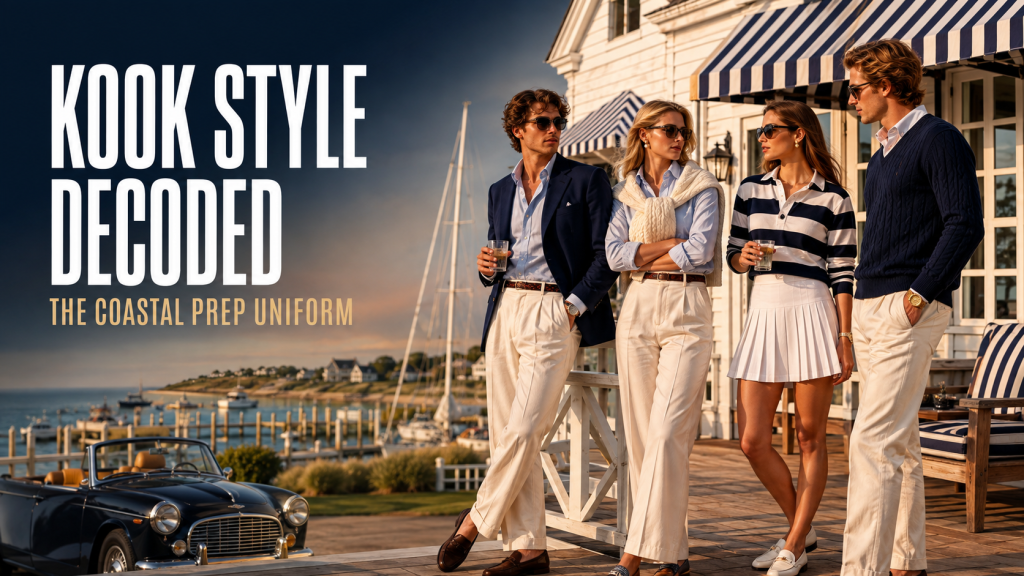
A pair of Sperry Top-Siders costs about $110 new. The ones that matter cost the same, but they were bought in 2016 and have been in salt water ever since. That single object explains kook style better than any lookbook, and it explains why the aspirational version never lands.
Paul Sperry cut grooves into a rubber sole in 1935 after watching his dog hold a wet deck. Ninety years later the shoe is essentially unchanged, which is the point. Nothing in this uniform gets redesigned, because redesign would imply the first version was wrong.
Netflix put the whole system on camera for five seasons. When the final ten episodes of Outer Banks drop on August 20, 2026, several million people will screenshot a linen shirt and go hunting for it. Most of them will buy the wrong one.
Here is what they miss. The uniform has rules, price points and tells, and every one of them is doing precise class work. No garment in kook style carries a visible logo, since a logo answers a question nobody on that side of the bridge is asking.
So treat this as a decode rather than a shopping list. What the pieces actually are, what they honestly cost, and why a version assembled in one afternoon reads as counterfeit to exactly the people it was meant to impress.
What Kook Style Is Actually Signaling
Start with the negative space. There are no logos, no visible hardware, no contrast stitching and no season. Nothing can be dated to a particular year, which is deliberate rather than accidental.
A visible logo does one job. It tells a stranger the price of an object without the wearer having to say it. That is genuinely useful when a room does not already know who you are.
On Figure Eight, the room knows. So the garment stops working as a price tag and starts working as camouflage, and the signal moves off the clothing entirely.
Watch where it goes instead. Posture, first: shoulders back, no hurry, a body that has never had to make itself smaller. Teeth, second, because orthodontics at eleven runs about $6,000 and shows for the next sixty years.
Then the third tell, which is the real one. It is the assumption that a door will open. Kooks do not check whether they are allowed in, and the walking in is itself the credential.
Clothes only have to stay out of the way of that. Anything loud would compete with it, and competing would suggest the door might actually be locked.
So the uniform stays quiet on purpose. Not modest, since modesty implies restraint, and there is nothing restrained about a $900 linen shirt. Just quiet, which is a different thing.
Read correctly, kook style is a set of instructions for not being looked at twice. That is a luxury in itself, and it is the only one being sold here.
The Boat Shoe and Everything Descended From It
The Sperry Authentic Original runs around $110 and has barely moved since 1935. Its lineage matters more than its construction, because a garment with a function story survives cycles that kill decorative ones.
Function is the alibi. It lets an expensive object look unfussy, and it gives the wearer something to say that is not about money.
Boat shoes get worn without socks, which is less a style choice than a maintenance problem accepted in advance. They also get destroyed on purpose, by water, then never replaced on any sensible schedule.
Descendants run in two directions. Downward: the Tretorn Nylite, the flattened Jack Purcell, a Blundstone for shoulder season. Upward: the unlined driving loafer, and eventually a $600 Belgian shoe that will never touch a boat.
Rainbow sandals are permitted, since a Rainbow takes two full summers to mold to a foot and cannot be faked. Anything stamped from a single piece of foam reads as parking lot instead.
Notice the rule underneath all of it. Every acceptable shoe either performs work or has visibly stopped performing work after years of doing it. Nothing enters the rotation new and stays clean for long.
Kook style treats footwear as a timeline rather than a purchase. The shoe is not showing you money. It is showing you how long the money has been sitting there.
Unstructured Linen and the Cotton Nobody Notices
The linen shirt is the load-bearing piece, and the tell sits in the shoulder. No pad, no canvas, no structure at all. It hangs off a body like something borrowed from a larger relative.
Loro Piana sells that shirt around $900. A version at $60 exists and photographs identically. In person the gap is immediate, because cheap linen wrinkles hard and good linen wrinkles soft.
That is the whole trick of the fabric. Both shirts wrinkle. Only one of them looks better for it, and the costume department on this show understood the distinction precisely.
Cotton follows identical logic. Nantucket Reds from Murray’s Toggery Shop run about $95 and arrive a dull brick color. They fade toward salmon across three or four summers, and the fade is the actual product.
Nobody wears a new pair in public if it can be avoided. Buying them is only the beginning of owning them, which sounds absurd until you have stood on that dock.
Add an oxford button-down worn soft, the collar rolling rather than lying flat. Add a $34.95 Boat and Tote from Maine, monogrammed sometime in the nineties, handles gone gray.
Individually these objects announce nothing at all. Together they announce one thing loudly, and that thing is duration.
Fabric is where kook style does its quietest work. Nobody will compliment the shirt, yet everybody will register how long it has been in the family.
Sun-Faded Beats Distressed Every Time
Here is the distinction that separates the real article from the costume. Sun-faded is not distressed. They sit adjacent on a rack and mean opposite things.
Distressing gets applied. A factory sands a knee, and the wear pattern is chosen by a designer who never met the wearer. Everybody reads it correctly, including people who could not explain how.
Sun fade is earned, and it is asymmetrical. One shoulder goes lighter than the other because of where the sun sat on a particular boat on particular afternoons. Salt eats collars first. Hems go before knees.
Look closely at the fade on a genuinely old navy polo. It runs uneven, slightly blotchy, heaviest across the back. No mill has printed that convincingly, though several have tried since 2019.
Kook style depends completely on this difference. The uniform is not signaling wealth, which anyone can buy. It signals time spent in one place, which nobody can.
So the aspirational shopper hits a wall almost immediately. There is no product for elapsed years. You can buy the fabric, the fit and the exact reference image, then still read wrong from forty feet away.
People born into it understand this, which is why the wardrobe rotates so slowly. Replacing a faded piece resets a clock that nobody wants reset.
The Watch Is Old Rather Than Expensive
Wrists catch new money faster than anything else. The classic error is buying the largest available watch, in steel, with a ceramic bezel, this year.
Kook style runs the other direction entirely. A 34mm Rolex Oyster Perpetual from the seventies, inherited, running slow. A Cartier Tank on a cracked leather strap. Frequently just a Timex on a grosgrain band, because a $50 watch on the right wrist cannot be argued with.
The governing rule is legibility rather than value. A watch that needs explaining has failed. A watch that somebody’s grandfather also owned has already worked.
Jewelry obeys the same code. Signet ring worn smooth, engraving mostly gone. Pearls that belonged to a specific dead person. A gold chain thin enough to disappear in photographs.
What gets excluded is more instructive than what gets included. Anything with a current advertising campaign attached is out. Anything sold in an airport is out, although the airport itself is perfectly fine.
Ward Cameron wears correct pieces and still reads wrong, which is the sharpest costume decision in the series. His watch is right. His relationship to the watch is not, because he knows precisely what it cost.
That gap is the entire show compressed into one accessory.
Sarah Cameron Is the Reference Image
Every search for this look eventually arrives at one character. Sarah Cameron wears maybe nine repeated pieces across five seasons, and the repetition is the whole argument.
Her closet is small, soft and almost entirely unbranded. One white tank. Cutoffs that used to be jeans. A single linen overshirt doing every job a jacket would otherwise do.
When she leaves Figure Eight for The Cut, the wardrobe barely moves. That is a costume department making a claim out loud, namely that her standing was never located in the fabric.
We take the closet apart piece by piece in our read on how Sarah actually dresses, because it rewards a slower look than a screenshot allows.
The commercial consequence arrived right on schedule. Madelyn Cline became Revlon’s global brand ambassador, and a heritage beauty house does not buy reach alone. It buys the specific register a character made legible to forty million households.
The math behind that contract sits in our breakdown of the Revlon deal, which doubles as an education in what a face is worth.
Kook style is why both things happened. A character became shorthand, then the shorthand got sold back to the audience at a considerable markup.
What the Aspirational Buyer Gets Wrong
The failure is remarkably consistent, and it happens at checkout. Everything gets bought at once, from one store, in a single season.
A matched set reads as costume instantly. Real closets assemble by accident across fifteen years, which produces mismatched shades of navy and hem lengths that are slightly wrong.
Second error: buying the expensive version of the cheap thing. A $400 white tee is a tell, since the grammar depends on some items being genuinely disposable.
Third comes fit direction. Aspirational shoppers buy things tailored, yet the uniform runs a half size loose, because clothes that fit perfectly suggest somebody made an appointment.
Fourth, and worst, is the new sneaker. One clean white sneaker under otherwise correct clothing collapses the outfit completely, and it remains the most common error people carry into a store.
Then there is matching. Belt matching shoes matching bag comes from a different class script altogether, and it announces that somebody was taught the rules rather than raised inside them.
Kook style cannot be assembled in an afternoon. It can be started in an afternoon, then left alone for four years, which is the part almost nobody is willing to do.
What Kook Style Actually Costs
Run real numbers, since the show implies a smaller figure than the truth. This wardrobe is not cheap, although the expense hides in upkeep rather than purchase.
Entry math looks almost reasonable. Boat shoes at $110, Reds at $95, an oxford around $140, a Boat and Tote at $34.95. Call it under $600 for the visible core.
Then the invisible costs begin. A Barbour Bedale runs about $400 and wants rewaxing every other year. Linen lands anywhere from $200 to $900, depending on how honest the buyer is being. A vintage watch runs $80 or $9,000.
Hair is a separate budget line entirely. Sun-lightened, salt-textured, apparently unbothered hair costs four figures annually in gloss, tone and cut, which we price out in the beach hair breakdown.
Skin is the expensive one nobody films. Sand and water both reflect UV straight back at a face. UVA reaches the dermis and takes collagen with it, while UVB damages DNA nearer the surface, and the bill arrives fifteen years later. We cover it in the coastal skin problem.
Total it honestly and kook style costs less in clothes than in maintenance. The garments are cheap. The body wearing them is the ongoing expense.
Why Coastal Prep Survived Every Cycle Since 1960
Fashion has tried to kill this look roughly every eight years since 1960. It outlasted logomania, grunge, streetwear, normcore and the entire quiet luxury conversation of the last three years.
Survival has a mechanism, and nostalgia is not it. The uniform is built from garments that were solving problems before they were selling anything: deck grip, sun cover, salt tolerance, heat.
Function-first clothing ages differently. It cannot look dated, because it never looked current. Ralph Lauren grasped that in 1967, starting with ties, and built a multibillion-dollar company on the insight.
Then consider the customer. That buyer does not chase cycles, since chasing implies a person could be left behind. He buys the same shirt for forty years and considers the matter settled.
Every revival brings new brands in at the entry point. Vineyard Vines started in 1998 selling ties out of a Jeep. Rowing Blazers arrived in 2017 with a rugby shirt and a wink. Both worked, yet neither disturbed the core.
New entrants sell access to kook style at the shallow end. The deep end stays exactly where it was, unbothered, buying from the same three places it always did.
Ultimately the look persists because the structure underneath it persists, which is the argument we make at length in our piece on the class war.
Clothes cannot outlive the thing they encode. Kook style will be here in 2040, unchanged, because the bridge will be here too.
Where The Conversation Continues
Social Life Magazine covers this uniform where it actually lives. On Meadow Lane, in Sag Harbor, at the club with no listed phone number. Not as costume, but as a working dress code.
Our readers are the founders who just closed on the house and want the rules. Also the beauty brands that need a Hamptons address, and the buyers who price kook style professionally.
The final season lands August 20, and our style coverage runs through September. Category exclusivity on the package is open now.
If your brand belongs in that conversation, the door is open. After the twentieth, it is your competitor in the story instead.
Start the conversation with Social Life Magazine
Related reading: how the Pogue look became quiet luxury, and what the cast is actually worth.
Author

Written by
Recent Posts
How to Pick a Homecoming Dress for Your Body Type and Feel Amazing in It
How to Prepare a Home for Sale When Major Repairs Are Not Affordable
From Everyday Comfort to Personal Style: My SHEIN Slipper Habit
5 Best Mitsubishi Heat Pump Companies in Seattle
Tech Gadgets as Modern Corporate Gifts: Useful Ideas for Employees and Clients
Categories
- Art
- Articles
- Business of Luxury
- Celebrities
- Culture
- Entertainment
- Events
- Faces of Summer 2026
- Fashion
- Fashion & Style
- Featured
- Finance
- Food, Spirits, Wine
- Hamptons
- Hamptons Celebrities
- Health
- Health & Beauty
- Lifestyle
- Luxury Lifestyle
- Press
- Profiles
- Real Estate
- Technology
- The Chronicles
- Travel
- Uncategorized
- Weddings