
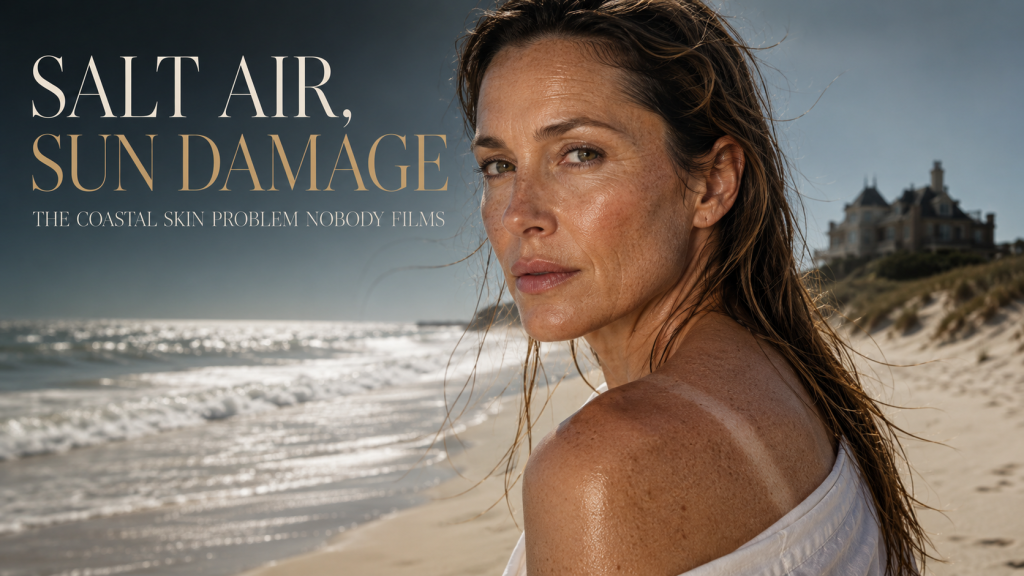
Five seasons of Outer Banks, roughly fifty hours of television shot on open water, and not one character has a sunspot. No melasma. No broken capillaries across the cheeks. Nobody even squints into the glare. That gap is the subject here, because salt air skin damage is the most reliable thing a coastline does to a human face.
Real coastal skin looks different. Spend twenty summers on a boat and the evidence collects on the left cheek, the nose, the tops of the ears and the chest. Freckles that stop behaving like freckles. A texture that reads as weathered rather than simply older.
The Outer Banks version of this is not exotic. It is the same physics running in Southampton, on Nantucket, and on every dock in Sag Harbor. Sun, sand, water and wind, applied for three decades to people who were mostly thinking about something else.
Production controls all of it on screen. There are shade tents between setups, reapplication handled by a department that does nothing else, and a colour grade that quietly lifts every face half a stop. Nobody films the cost, so the audience assumes there is not one.
There is one. Salt air skin damage is measurable, it is cumulative, and it tends to surface fifteen years after the afternoon that caused it. Here is the mechanism, then the treatment ladder with real prices attached.
Nobody on the Show Has Sun Damage
Watch the boat scenes with a clinical eye and the illusion falls apart quickly. Six leads, five seasons, full sun on open water. Not one of them carries the mottled pigment that shows up on anyone who actually lives that way.
The reason is banal. Film production treats sun as a lighting problem rather than a health one, so the cast sits under shade between setups. Reapplication happens on a schedule, because continuity hates a burn.
Then the colour grade finishes the job. Modern post-production can lift redness, even out blotchiness and warm a face without anyone noticing the correction. What reaches the screen is a coastline with the consequences edited out.
Real coasts do not offer that service. Salt air skin damage accumulates on the people who work the docks, run the charters and raise children eight blocks from the ocean. It is visible by forty and unmistakable by fifty-five.
None of this is a complaint about the show. It is a note about what the show trains an audience to expect from their own faces, which is a coastal life with no receipt attached.
The receipt exists. We took the wider version of that argument apart in our read on the show’s class system.
What Salt Air Skin Damage Does in the Dermis
Start with UVA, since it does the work nobody feels. UVA is the longer wavelength, so it passes the epidermis and reaches the dermis, where collagen and elastin actually live.
Down there it triggers enzymes that break collagen apart faster than skin rebuilds it. Repeat that across a few thousand afternoons and the scaffolding thins. Skin that has lost dermal collagen sits differently, creases earlier and stops springing back.
UVA also degrades elastin into a disorganised mass, a change dermatologists call solar elastosis. That is the leathery, faintly yellow quality on a face that spent decades outdoors. It is not dryness, and no moisturiser reverses it.
Two details make this worse at the beach. UVA levels hold relatively steady through the day, so a four o’clock sail is not a safe window. UVA also passes through window glass and thin cloud, which is why the drive home counts.
So the engine behind salt air skin damage is not the burn. Burns are UVB. The slow structural loss is UVA, and almost nobody notices it happening, since collagen breaking down produces no sensation at all.
That silence is the whole problem. People respond to pain, and this particular process never sends any.
UVB, DNA, and the Lesion a Medspa Should Not Touch
UVB is the shorter wavelength and it stops higher up, inside the epidermis. Its damage is genetic rather than structural. UVB energy creates bonding errors in the DNA of skin cells, and the cell either repairs them or it does not.
Most of the time repair works. But repair is imperfect, and errors accumulate, which is the accepted pathway toward actinic keratoses and skin cancers. A sunburn is only the visible edge of a much larger event.
UVB peaks between ten and four, and it runs far stronger in summer and at lower latitudes. It is also the wavelength that SPF labelling was originally built around, which is why the number alone was never enough.
Here is the line credibility requires. A medspa is not the right room for a changing mole, a spot that bleeds, a sore that will not heal, or any lesion shifting in size, colour or border.
That is a dermatologist’s appointment, ideally a board-certified one, and it belongs before any cosmetic plan starts. Good practitioners refer out constantly. Ask a clinic what it does when it sees something suspicious, because the answer tells you a great deal.
Salt air skin damage is a cosmetic category. Diagnosis is a separate job, done by a separate professional, and no laser makes that distinction disappear.
Sand and Water Reflect UV Straight Back at You
Almost everyone applies sunscreen as though light only arrives from above. On a beach that assumption is wrong twice over.
Dry sand reflects a meaningful share of incoming ultraviolet back upward, and open water reflects more, especially when the surface is flat and the sun sits low. Sea foam is more reflective still. So a body on the sand takes a second dose from underneath.
Look at where the damage actually lands on people who boat. Under the jaw. The nose from below. Lower lip, eyelids, inner forearms, the backs of the calves. All the surfaces a top-down application politely skips.
Shade helps less than people assume, for the same reason. An umbrella blocks the direct beam while the sand keeps throwing ultraviolet sideways underneath it. Sitting in shade on a bright beach is a partial measure rather than a solution.
Wind adds the last complication. It dries the film of sunscreen, moves sand across it, and encourages the constant face-touching that removes whatever survived.
This is the part of salt air skin damage that surprises people most. They were not careless. Rather, they were using a product built for one geometry of light while standing inside a different one.
Salt, Wind, and the Barrier You Keep Stripping
The outer layer of skin works like mortar between bricks. Ceramides, cholesterol and fatty acids hold the cells together and keep water inside. That barrier is the difference between comfortable skin and reactive skin.
Salt water pulls moisture out of the top layer by simple osmosis. Then it dries on the surface and leaves crystals that draw out more. Wind speeds the evaporation, so the loss keeps running long after anyone has left the water.
Dermatology has a name for the running total, transepidermal water loss. A compromised barrier loses more of it, which shows up as tightness, flaking, stinging and a face that suddenly reacts to products it tolerated for years.
Salt air skin damage is not only a light problem, then. A broken barrier lets irritants in faster and inflames more easily. Inflammation drives pigment production, so stripped skin makes existing brown patches darker. Everything compounds.
Most people finish the day with a hot shower and a foaming cleanser, which removes whatever lipids survived. The next morning they reach for an acid or a scrub, because the skin feels rough.
That loop is worth breaking first, since barrier repair is the cheapest rung on the ladder and it makes every later treatment work better.
Why Coastal Skin Ages on a Delay
Sun damage is never billed in the season it is incurred. That single fact explains most of the confusion around salt air skin damage, and most of the misattribution that follows it.
A summer of exposure produces a tan, maybe a burn, and then apparently nothing. The structural loss underneath is real, yet it sits below the threshold of visibility for years. Pigment cells hold their instructions quietly.
Then a person turns thirty-eight and the record surfaces. Brown patches across the cheekbones. A crosshatch at the outer eye. Broken vessels around the nostrils. Skin that looks fine at rest and creased in photographs.
Almost everyone files this under age. It is not age, or at least not mostly. Compare the inner upper arm to the outer forearm on the same person, because that difference is entirely exposure history.
Researchers generally attribute the majority of visible facial ageing to ultraviolet exposure rather than to chronological time. Whichever estimate you trust, the direction is settled, and the delay is the cruel part.
So the twenty-two-year-old on the bow is not getting away with it. She is buying on credit. Legacy beauty understands that market precisely, which is roughly what Revlon purchased in the Madelyn Cline ambassador deal.
The Home Tier, and the Reapplication Nobody Actually Does
Every practitioner starts here, because in-office work on an unprotected face is money set on fire. Daily broad-spectrum SPF 30 or higher is the first line against salt air skin damage.
Mineral formulas using zinc oxide or titanium dioxide sit on the surface, cover a wide range of wavelengths, and irritate less on stripped skin. Expect $15 to $60 a bottle. Price tracks texture far more closely than performance.
Quantity is where the plan collapses. Face and neck need roughly a quarter teaspoon, which is considerably more than most people use. Reapplication every two hours is the label instruction, and on a boat almost nobody manages it.
Be honest about that. A hat with a real brim, a rash guard, and sitting out the eleven-to-three window do more than a second bottle nobody opens.
Barrier repair comes next, and it is cheap. A ceramide and niacinamide moisturiser runs $18 to $80, applied twice daily, especially after salt exposure.
Then retinoids, the one home ingredient with serious evidence behind it for collagen. Over-the-counter retinol runs $25 to $70. Prescription tretinoin through a dermatologist costs $20 to $50 a month. Both take twelve weeks to show anything and six to twelve months to matter.
The hair half of the same bill sits in what that sun-bleached hair actually costs, and the full category runs through the Kook beauty economy.
The In-Office Tier, Priced Honestly
Everything below treats the appearance of accumulated damage. Nothing below is a cure, and any practitioner worth booking says so first.
Superficial chemical peels, using glycolic or salicylic acid, run $150 to $300 a session in a coastal or metro market. Practitioners generally recommend four to six of them. Downtime is light flaking for three to five days.
Medium-depth TCA peels reach further into texture and pigment, at $400 to $800, with seven to ten days of visible peeling. Fewer sessions, considerably more recovery.
IPL and BBL are the standard answer for the two signatures of salt air skin damage, brown pigment and broken vessels. Budget $350 to $700 a session, three to five sessions, spaced three to four weeks apart. Treated spots darken, then shed over about a week.
Fractional resurfacing goes after texture and deeper pigment. Non-ablative devices run $900 to $1,500 a session across three sessions, with three to seven days of redness. Ablative fractional CO2 is the aggressive option at $2,000 to $4,000, with seven to fourteen days of genuine downtime.
Microneedling sits lower, at $300 to $600 across three to six sessions. Adding radiofrequency raises it to $800 to $1,500 a session, usually three, and targets laxity as well as texture.
What the Consultation Settles Before Anyone Books
None of those numbers mean much until somebody examines the actual face. Results vary widely, and any clinic promising a specific outcome is selling rather than treating.
Skin tone comes first. Light-based devices work on the contrast between pigment and surrounding skin, so IPL carries real risk on deeper skin tones and on anyone currently tanned. Good practitioners refuse to treat a fresh tan, and the refusal is a signal of competence.
Season matters too. Most of this work gets scheduled between October and March, because treated skin is photosensitive and August on the water undoes it. Booking a laser series in June is a common and expensive mistake.
History matters as well, since no two salt air skin damage cases arrive the same way. Melasma behaves differently from sun spots and can worsen with heat. Cold sores, isotretinoin use, pregnancy and certain medications all change the plan.
Then the real budget. A first series usually lands between $1,200 and $4,000, with maintenance of one or two sessions a year afterward. Consultations run $50 to $250, frequently credited toward treatment.
Ask for before-and-after photographs of patients with your skin type, shot in the same light. Ask who operates the device, and what happens if the result disappoints.
Where The Conversation Continues
Social Life Magazine covers salt air skin damage the way our readers actually encounter it, on the East End, in season, with a price attached. We report the ladder rather than the promise.
Our readers are the founders who just bought on the water, the aesthetics practices building a coastal book of business, and the beauty brands that want a Hamptons address to mean something.
The final season lands August 20, and our beauty coverage runs through September. Category exclusivity on the package is open now.
If your practice belongs in that conversation, the door is open. After the twentieth, it is your competitor in the story instead.
Start the conversation with Social Life Magazine
Related reading: the wardrobe running the same trick, and the annual salon calendar behind the beach hair.
Author

Written by
Recent Posts
How to Pick a Homecoming Dress for Your Body Type and Feel Amazing in It
How to Prepare a Home for Sale When Major Repairs Are Not Affordable
From Everyday Comfort to Personal Style: My SHEIN Slipper Habit
5 Best Mitsubishi Heat Pump Companies in Seattle
Tech Gadgets as Modern Corporate Gifts: Useful Ideas for Employees and Clients
Categories
- Art
- Articles
- Business of Luxury
- Celebrities
- Culture
- Entertainment
- Events
- Faces of Summer 2026
- Fashion
- Fashion & Style
- Featured
- Finance
- Food, Spirits, Wine
- Hamptons
- Hamptons Celebrities
- Health
- Health & Beauty
- Lifestyle
- Luxury Lifestyle
- Press
- Profiles
- Real Estate
- Technology
- The Chronicles
- Travel
- Uncategorized
- Weddings