
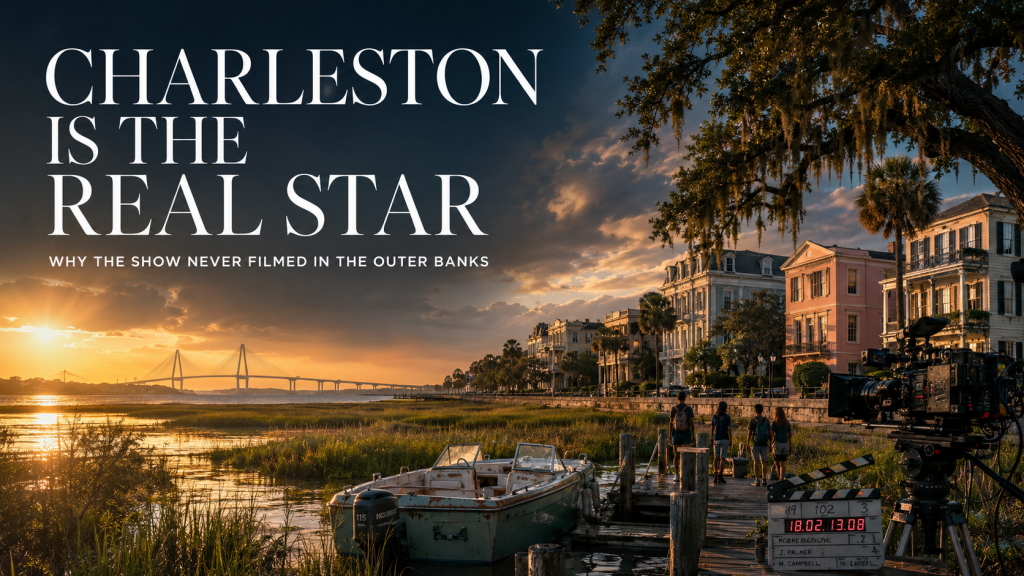
Five seasons named after a North Carolina coastline, and not one frame shot on it. Anyone asking where is Outer Banks filmed gets an answer that arrives like a correction. Charleston, South Carolina did nearly all of it, and the barrier islands south of the city did the rest.
Kiawah played the money. Johns Island and Wadmalaw played the marsh. Downtown Charleston filled in the texture, and the two worlds sat fifteen minutes apart, so a crew could shoot both sides of a class border before lunch.
Season four added Wilmington, North Carolina and two locations in Morocco. Season five relocated to Beaufort County, South Carolina, with cameras rolling from May 2025. Dare County, the actual Outer Banks, never appeared at all.
None of this came from a scout falling in love with a tidal creek. It came from two state legislatures writing very different checks, and from producers who read both documents carefully before signing anything.
The final season lands August 20, 2026. Here is the map, the money underneath it, and what the whole arrangement cost the coastline that got the name and nothing else.
The question of where is Outer Banks filmed has a tidy answer and an untidy one. Charleston is the tidy answer. The untidy one runs through two state budgets and about a decade of policy.
Where Is Outer Banks Filmed, Season by Season
Start with the record, since it settles the argument fast.
Seasons one through three ran out of greater Charleston. James Island, Johns Island, Kiawah and Wadmalaw carried nearly every exterior in the show.
Season four kept that base but added Wilmington, which is at least the correct state. It then left the country entirely for Essaouira and Ouarzazate.
Season five moved south to Beaufort County, home to Hilton Head, Bluffton and the town of Beaufort itself. Production began there in May 2025.
So the honest answer to where is Outer Banks filmed spans two states and one continent the script never mentions. North Carolina’s actual barrier islands are absent from all of it.
Viewers work this out eventually, usually after booking a flight into Norfolk. The Chateau is not there. Neither is the Cut, nor the marina, nor a single dock the production ever used.
That distance between title and location is unusual at this scale. Most shows at least touch the place on the card once, for a montage.
This one never bothered, because the arithmetic never justified the trip.
Fans still make the drive to Nags Head every summer looking for the Chateau. Nobody ever built it there, or anywhere else.
South Carolina Wrote the Better Check
Here is the mechanism, stated plainly.
South Carolina rebates 25 percent of wages paid to state residents. Non-resident wages come back at 20 percent. Qualifying spending with in-state suppliers earns up to 30 percent.
The program carries a $1 million minimum in-state spend, which screens out small productions and rewards exactly the kind of multi-season series that parks a crew somewhere for years.
A rebate has one property that matters more than its headline rate. It is predictable.
A studio underwriting five seasons can put that number in a model before a single location agreement gets signed. The finance department treats it as a known quantity, not a hope.
Add the supplier rebate and the incentive reaches past payroll into lumber, catering, fuel and equipment rental. Local vendors get pulled into the qualifying spend, which is the point of writing it that way.
Charleston then supplied the second half of the pitch. Marsh, working waterfront, gated oceanfront and antebellum streets all sit inside a thirty-minute radius.
Cheap money plus compressed geography is close to unbeatable. Ask where is Outer Banks filmed and you are really asking which state made the math work.
Notably, the incentive was not designed for this show. It was designed for any production willing to spend seven figures locally, and this one simply qualified for five years running.
What North Carolina Gave Up in 2014
North Carolina used to win these fights. Wilmington ran a working film economy for decades, and the state had a refundable credit that productions could bank on.
Then the legislature gutted it in 2014 and replaced it with a grant program. That program now runs somewhere near $31 million a year.
The dollar figure is not really the problem, although it is modest. The instrument is the problem.
A grant is discretionary and capped. Somebody reviews the application, somebody decides, and the pool empties when it empties.
A rebate is formulaic and open-ended. Spend the money, meet the threshold, receive the percentage.
No studio builds a five-year production plan around a discretionary award it might not receive. So productions stopped planning around North Carolina.
Wilmington kept working, mostly on shorter projects and on shows already rooted there. The long-form series money went south and largely stayed south.
Which is how a show carrying a North Carolina place name in its title ended up as a South Carolina employer. Policy is invisible until it shows up in a credit roll.
Anyone searching where is Outer Banks filmed is really reading the result of a single 2014 vote in Raleigh. The vote had nothing to do with television at the time.
Kiawah Played the Kook Side
Now the geography itself, location by location.
Kiawah Island supplied the wealth. It is a genuine private resort island south of Charleston, with a gate, oceanfront homes and a serious rental market attached.
Almost no set dressing was required. The production needed a place that reads as inherited money at a glance, and Kiawah reads that way without being asked.
Beachwalker Park at the western end stays open to the public, which is the one way in for anyone not booked on the island.
Rental rates on Kiawah climb hard in July and drop meaningfully by October. The shoulder months are the sane time to visit, and the light is better anyway.
The irony sits right there in the casting. Figure Eight is fictional, but Kiawah is real, gated, and priced accordingly, so the show borrowed an actual exclusion to depict an invented one.
Ask where is Outer Banks filmed on the Kook side and the answer is a resort island with a guardhouse and a golf calendar.
Dare County has no equivalent. Its barrier islands run narrow, with one highway serving everyone, so there is no gate to shoot even if a location manager wanted one.
The show needed a fence. South Carolina had one already built.
Johns Island, Wadmalaw and the Cut
The other half of the class divide came from the working islands.
Johns Island and Wadmalaw provided the marsh, the boat ramps, the shrimp docks and the live oaks. Those became the Cut, and they carried most of the show’s atmosphere.
Wadmalaw in particular stayed rural while Charleston grew around it. Tidal creeks, small farms and unpaved drives are still ordinary there.
That authenticity is not free, though. Rural islands inside a growing metro get bought eventually, and Wadmalaw is already fielding offers it did not field in 2019.
James Island filled in neighborhoods and roadside businesses. Downtown Charleston appeared constantly as texture, usually without announcing itself.
Historic streets, steeples and the waterfront show up in every season. Most viewers registered them as generic Southern coast rather than as a specific city.
Because Kiawah sits about fifteen minutes from Johns Island, a first unit could film a mansion and a fish house on the same call sheet. That efficiency saved real money across five seasons.
So the answer to where is Outer Banks filmed is not one place. It is a tight cluster of them, chosen for adjacency as much as for looks.
Anyone who wants to actually stand in these locations should read our guide to what you can book and roughly what it costs.
Season Four Left the Country
The fourth season expanded the map in two directions at once.
Wilmington joined the production, which finally put some North Carolina in the frame. The city has been a film town since the mid-1980s and still holds crew, stages and vendors.
There is a small joke buried in that choice. Three miles north of Wrightsville Beach sits the real Figure Eight Island, private, roughly five hundred homes, one guarded bridge, no public access.
The show borrowed that name in 2020 and finally worked near it in 2024. Even then, the actual island stayed out of the picture.
Morocco carried the back half of the season. Essaouira supplied the coastal medina, while Ouarzazate handled the desert sequences.
Ouarzazate has been a production town since Lawrence of Arabia, with standing sets and a local crew base built over sixty years.
Rudy Pankow’s JJ died in those Moroccan episodes, which gave the location its weight. So the most emotionally consequential geography in the series sits about four thousand miles from the title.
For one season, at least, where is Outer Banks filmed had an answer with a passport stamp attached.
Wilmington still handled the domestic half of that year. So the fourth season split its budget across a film town, a foreign co-production and the original Charleston base.
Beaufort County Finished It
The final season moved roughly an hour south of the original base.
Beaufort County covers Hilton Head Island, Bluffton and the town of Beaufort. Cameras rolled there from May 2025 through the back half of the year.
The scenery barely changes. Marsh, oak, tidal water and low light are the same materials Charleston offered, with different street names attached.
The town of Beaufort is the most photogenic of the three, all antebellum architecture and waterfront. Productions have used it for decades, and the county knows how to host one.
Locals clocked the trucks well before any announcement. Crew housing, road closures and catering tents are hard to hide in a town that size.
Hilton Head brings the deepest rental and hotel inventory in the county. Bluffton offers a quieter base and better restaurants than its size suggests.
Anyone planning a trip after the finale should aim there rather than at Charleston. The most-searched answer to where is Outer Banks filmed will shift south the week the last season drops.
Notably, the state kept the production for a fifth consecutive season. That is the incentive doing precisely what it was designed to do, which is retain a show rather than merely attract one.
The Branding Went North, the Payroll Stayed South
Here is the part worth sitting with.
Dare County received five seasons of global name recognition. It did not receive the crew hotels, the location fees, the lumber orders or the catering invoices.
Charleston got those. So did Beaufort County, and so did every vendor inside the qualifying spend radius.
The tourism split the same way. Visitors chasing locations end up at Kiawah and Johns Island, because that is where the scenes actually exist.
Dare County occupancy and meals revenues ran essentially flat in 2025 against 2024. Five seasons of worldwide branding produced no visible surge in either line.
Flat is a strange result for a place whose name trended globally four separate times. It suggests the branding and the visitation came apart somewhere between the search bar and the booking.
Part of the break is literal. Somebody types where is Outer Banks filmed, learns the answer is South Carolina, and books Charleston instead of Nags Head.
Dare County holds about thirty-eight thousand year-round residents and a hundred miles of shoreline. It kept every one of them and gained no production payroll at all.
We break that mechanism down in our analysis of how screen attention moves coastal property, and the underlying market sits in our look at what the real Outer Banks costs.
The Accidental Poetry of the Arrangement
Every good production story eventually turns into a joke about itself. This one is unusually clean.
The show is about people who cannot afford the place they are from. Pogues work the marina, clean the boats and watch the Kooks own the water they grew up on.
That series was filmed somewhere cheaper than the place it depicts, for reasons of cost.
Nobody planned the symmetry. Studios chase rebates, and a rebate is simply the difference between two states’ willingness to pay for jobs.
Still, the shape is exact. A production about displacement displaced itself, then sent the name north and kept the wages south.
There is a second layer under that. The fictional Pogues lose their coastline to buyers with better financing, while the real coastline lost a production to a state with better financing.
Both stories end the same way. Somebody with a spreadsheet decides where value lands, and the people already standing there find out afterward.
The class analysis underneath the whole series runs in our piece on what the show is actually arguing.
So the next time someone asks where is Outer Banks filmed, the short answer is Charleston. The longer answer is a tax code, and the longest answer is a question about which coastlines get paid for being looked at.
Where The Conversation Continues
Social Life Magazine covers coastal markets the way the money actually moves through them. Who films where, who books what, and which places convert attention into revenue.
Our readers own on the East End and shop elsewhere for the second house. They want the incentive math and the occupancy data, not a drone shot.
Where is Outer Banks filmed turned out to be a real estate question wearing a trivia costume. Those are the ones we like.
The final season lands August 20, and our coastal property coverage runs through September. Category exclusivity on the package is open now.
If your brokerage belongs in that conversation, the door is open. After the twentieth, it is your competitor in the story instead.
Start the conversation with Social Life Magazine
Related reading: two coastlines priced side by side and the second-home math from Corolla to Sagaponack.
Author

Written by
Recent Posts
How to Pick a Homecoming Dress for Your Body Type and Feel Amazing in It
How to Prepare a Home for Sale When Major Repairs Are Not Affordable
From Everyday Comfort to Personal Style: My SHEIN Slipper Habit
5 Best Mitsubishi Heat Pump Companies in Seattle
Tech Gadgets as Modern Corporate Gifts: Useful Ideas for Employees and Clients
Categories
- Art
- Articles
- Business of Luxury
- Celebrities
- Culture
- Entertainment
- Events
- Faces of Summer 2026
- Fashion
- Fashion & Style
- Featured
- Finance
- Food, Spirits, Wine
- Hamptons
- Hamptons Celebrities
- Health
- Health & Beauty
- Lifestyle
- Luxury Lifestyle
- Press
- Profiles
- Real Estate
- Technology
- The Chronicles
- Travel
- Uncategorized
- Weddings