
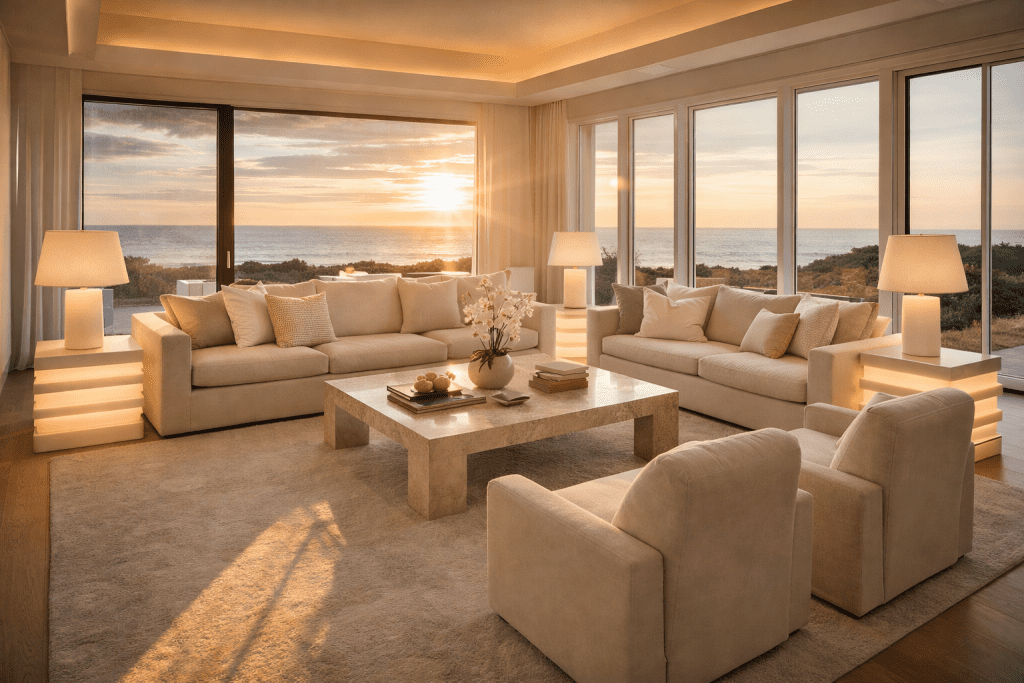
By David Hornung, Co-Founder & Principal Designer, D&J Concepts
Steve Chase never called it luxury lighting design. He called it the soul of the room. In his Palm Springs studio, where David Hornung trained before founding D&J Concepts, Chase demonstrated a principle most designers acknowledge intellectually but few practice. Light is not something you add to a completed room. Light is the medium through which the room exists. In fact, every material selection, every color choice, and every furniture placement succeeds or fails based on how light reaches it. Chase designed rooms from the light backward, and that methodology transformed Hornung’s entire approach to residential design.
The lesson arrived during Hornung’s first major project under Chase’s supervision. A Palm Springs living room, already beautiful in drawings, came alive when Chase adjusted the lighting plan. He removed half the fixtures the junior designer had specified and repositioned the remainder. The room looked better with fewer lights because each remaining fixture served a specific spatial purpose rather than contributing to general illumination. “You’re lighting a room,” Chase told Hornung. “I’m sculpting with light. Those are different professions.”
The Three-System Principle
Chase organized every room’s luxury lighting design around three independent systems, a framework D&J Concepts has refined but never abandoned. The first system provides ambient illumination, the baseline light level that allows the room to function. The second provides task illumination at specific locations where activities demand accuracy. Finally, the third provides accent illumination: directional light highlighting architectural features, art, and material textures.
Each system operates on independent dimming circuits. As a result, the homeowner controls a matrix of lighting possibilities through programmed scenes. A single room might contain six to twelve fixtures serving three different systems, each adjustable independently. The morning scene brightens task lighting at the kitchen island while keeping accent lighting off. The evening scene dims ambient light, raises accent lighting on art, and sets task lighting at the bar to cocktail-appropriate warmth.
Interior Design Magazine’s coverage of Chase’s work consistently highlighted his lighting as the element that distinguished his interiors from contemporaries who matched his material quality. Chase’s rooms had an atmosphere that photographs captured but competitors could not replicate. That atmosphere originated in the lighting infrastructure, the least visible and most consequential element of the design.
Color Temperature as Emotional Architecture
Chase obsessed over color temperature decades before the lighting industry provided the precise control that contemporary technology enables. He understood that warm light at 2700 Kelvin creates intimacy, while cooler light at 3500 Kelvin creates alertness. Most designers of that era selected bulbs from a hardware store and hoped for the best. Chase, by contrast, specified color temperature for every fixture in every room. He called it the “emotional architecture” of the home.
D&J Concepts extends Chase’s principle through tunable LED systems that allow color temperature adjustment throughout the day. Morning light in the kitchen shifts to 3000K for energizing meal preparation. Evening light in the living room settles to 2400K for intimate conversation. Bedroom light follows circadian rhythms, gradually warming as the evening progresses to support natural sleep preparation. Harvard Business Review has published extensively on how light quality affects cognitive performance and sleep quality, validating what Chase intuited through design practice decades before the science confirmed it.
The Lutron and Crestron systems that D&J Concepts specifies for Hamptons homes provide the control infrastructure that makes tunable luxury lighting design practical. Keypad scenes, mobile app control, and astronomical time-clock programming automate the transitions that Chase managed manually through dimmer adjustments. The technology has evolved enormously. The principle has not changed at all.
Art Lighting: The Detail That Separates Amateurs
Chase considered art lighting the single most revealing indicator of design quality. A well-lit painting commands a room. A poorly lit painting merely occupies wall space. Remarkably, the difference between the two conditions costs perhaps $2,000 in fixtures and wiring, which is trivial in a luxury renovation budget, yet the majority of even high-end homes fail this test.
Proper art lighting requires three considerations. First, light angle: fixtures positioned at 30 degrees from the wall surface eliminate glare while providing even illumination across the canvas. Second, color rendering: a CRI (Color Rendering Index) above 95 ensures that the painting appears as the artist intended rather than through the color distortion that lower-quality light sources produce. Third, UV filtration: valuable art requires light sources that emit minimal ultraviolet radiation to prevent fading over decades of exposure.
D&J Concepts specifies art lighting positions during the Visual Clarity phase, when the client’s collection is mapped against the architectural plan. Additionally, lighting infrastructure for future acquisitions is roughed in with flexible track or recessed adjustable fixtures. This foresight costs perhaps 15 percent more during construction. However, it prevents the wall damage and electrical rework that retrofit art lighting inevitably requires.
Exterior Lighting: The First and Last Impression
Chase extended his lighting principles to exterior spaces, understanding that the approach to a home creates expectations that the interior must then satisfy. Landscape lighting that merely illuminates paths and facades misses the opportunity to create anticipation and drama before the front door opens.
D&J Concepts designs exterior lighting as a sequence of experiences. Driveway lighting guides arrival while concealing its source. Landscape uplighting creates shadow patterns that add visual complexity to the approach. Entry lighting creates a warm threshold between the nighttime exterior and the home’s interior. Each element is calibrated so that the transition from car to front door feels like entering rather than merely arriving.
Architectural Digest’s evening photography of Hamptons properties reveals which homes treat exterior lighting as design and which treat it as utility. The distinction is immediately visible and permanently affects how visitors perceive the home, regardless of what the interior contains.
The Infrastructure Investment
Lighting infrastructure represents approximately 8 to 12 percent of a luxury renovation budget when designed to Chase’s standard. That investment purchases wire, switching, fixtures, control systems, and programming. The fixtures themselves are replaceable over the home’s life. The wire, switching, and control infrastructure are effectively permanent. Investing adequately in infrastructure during construction enables decades of lighting evolution without opening walls or ceilings.
D&J Concepts specifies more circuits than current designs require, anticipating future lighting additions that clients cannot predict during the design phase. A living room that needs six circuits today may need ten in five years when the art collection expands or the furniture arrangement evolves. Running those additional circuits during construction costs perhaps $1,500. Running them after the walls are closed costs $15,000 or more. This forward-planning reflects Chase’s fundamental insight: luxury lighting design is infrastructure, not decoration, and infrastructure deserves the investment that permanence demands.
Chase died too young to see the LED revolution transform his field. But every principle he articulated, every lesson Hornung absorbed in that Palm Springs studio, remains valid. The light sources have changed. The philosophy has not. Light remains the soul of the room, and designing from the light backward remains the methodology that produces interiors people remember.
Start Your Design Conversation
D&J Concepts brings 25 years of luxury residential design experience to every project. The Method of Visual Clarity ensures your vision is resolved before construction begins. Contact Social Life Magazine for features, advertising, or partnership inquiries. Visit polohamptons.com for event tickets and sponsorship opportunities.
Subscribe to Social Life Magazine for ongoing design intelligence. Join our email list for exclusive content. Support independent Hamptons journalism with a $5 contribution.
Read more: Materials, Brands & Budget Intelligence and Steve Chase: The Mentor Behind Visual Clarity.
David Hornung co-founded D&J Concepts in 2001 after training under Interior Design Hall of Fame inductee Steve Chase in Los Angeles. From Southampton headquarters, D&J serves clients across the Hamptons, Manhattan, Palm Beach, and Southern California. A member of the Society of Design Administration, Hornung brings 25 years of luxury residential design experience to every project. Discover the Visual Clarity Method at dandjconcepts.com.
Author

Written by
Recent Posts

Light as Architecture: Steve Chase’s Lesson

Arthur Elrod to AI: How Design Process Evolved

Why the Best Interiors Look Like Elle Decor

Sand, Light, Restraint: 25 East End Years

Designer vs. Decorator vs. Architect: A Guide
Categories
- 2025 Social Life Events
- Access to Digital + Physical Magazine
- Art
- Articles
- Beauty & Skincare
- Beauty & Wellness
- Business Strategy
- Celebrities
- Chronicles
- Design History
- Design History|Hamptons
- Design Process
- Design Process|Luxury Living
- Design Trends
- Event Photos
- Events
- Family
- Fashion
- Fashion & Style
- Featured
- Food & Beverage
- Food, Spirits, Wine
- Hamptons
- Hamptons Celebrities
- Hamptons Design
- Hamptons Design|Design Process
- Hamptons Design|Luxury Living
- Health
- Health & Beauty
- Home & Design
- Home & Living
- Lifestyle
- Luxury Home Design|Design Process
- Luxury Home Design|Design Trends
- Luxury Home Design|Hamptons Design
- Luxury Home Design|Interior Design
- Luxury Lifestyle
- Luxury Living
- Luxury Living|Design Process
- Luxury Living|Hamptons
- Luxury Living|Hamptons Design
- Press
- Profiles
- Real Estate
- Technology
- The Chronicles
- Travel
- Trending
- Uncategorized
- Weddings
- Wellness