
By David Hornung, Co-Founder & Principal Designer, D&J Concepts
A $5 million luxury renovation contains approximately 4,000 individual decisions. Material selections, fixture specifications, hardware finishes, lighting positions, paint colors, millwork profiles, stone slabs, appliance models, plumbing configurations, electrical layouts, HVAC zones, and window specifications. Each decision affects others. A stone floor selection influences baseboard profiles, which influence millwork color, which influences wall finish, which influences lighting color temperature. Making these decisions sequentially during construction is not a design process. It is improvisation at $1,500 per square foot. Proper luxury renovation planning resolves these cascading decisions before demolition begins.
The Farrell Building project taught D&J Concepts this lesson definitively. Early in the firm’s history, a developer partnership required staging multiple units simultaneously. Making design decisions in the field, under construction timelines, produced results that were adequate but never excellent. The experience led directly to the development of the Method of Visual Clarity, which resolves every material and spatial decision through magazine-quality presentations before a single wall is opened.
The Cost of Improvisation
McKinsey’s construction industry research demonstrates that projects with comprehensive pre-construction planning complete 20 to 25 percent faster and 15 to 20 percent under budget compared to projects that resolve design decisions during construction. At the luxury level, these percentages translate to six-figure savings. A $5 million renovation that runs 20 percent over budget due to mid-stream changes costs $1 million in unnecessary spending.
Change orders are the primary mechanism through which improvisation destroys budgets. Each change order involves demolishing completed work, re-procuring materials, rescheduling trades, and extending timelines. A single stone selection change after installation can cost $40,000 to $80,000 when accounting for demolition, material procurement, installation, and the cascading delays that ripple through the construction schedule.
Worse than cost overruns is the quality degradation that accompanies rushed decisions. When a client discovers mid-construction that their bathroom tile selection does not work with their vanity stone, the replacement choice is constrained by what is available within the construction timeline rather than what is optimal for the room. Luxury renovation planning prevents this scenario entirely by presenting all materials in context before ordering begins.
What Visual Clarity Delivers
Traditional design presentations show clients individual elements: a stone sample here, a fabric swatch there, a floor plan with furniture outlines. The client must mentally assemble these fragments into a coherent room. Some clients have this spatial imagination. Most do not. The gap between what clients imagine and what designers intend is the source of nearly every luxury renovation dispute.
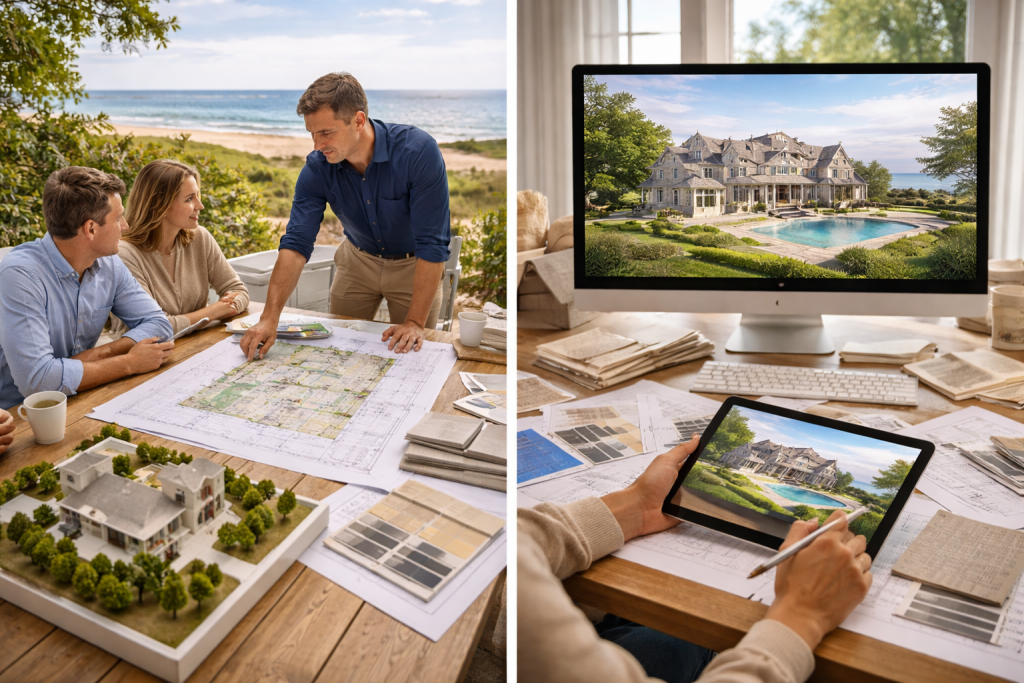
Visual Clarity presentations eliminate this gap. Clients see their rooms rendered at magazine quality, with specified materials applied to actual surfaces, furniture positioned according to the floor plan, and light falling through windows at the correct angle for their home’s orientation. The experience is closer to walking through the completed room than to reviewing design samples.
Steve Chase pioneered elements of this approach in the 1970s, when he served champagne at client presentations to create an emotional context for design reveals. His insight was that the presentation experience shapes client perception as much as the design content. D&J Concepts evolved Chase’s philosophy by adding visual precision to emotional impact. Clients still experience a reveal moment, but that moment is grounded in accurate representation rather than aspirational suggestion.
The Pre-Construction Checklist
Comprehensive luxury renovation planning addresses five categories before construction begins. First, spatial planning: every room’s layout, furniture placement, traffic patterns, and sight lines resolved through floor plans and three-dimensional views. Second, material specifications: every surface material selected, sourced, and confirmed available within the project timeline. Third, mechanical coordination: HVAC, plumbing, and electrical layouts confirmed by engineering consultants and reconciled with the design intent.
Fourth, procurement scheduling: lead times for every custom item mapped against the construction timeline, with critical-path items ordered before demolition begins. Fifth, contingency planning: alternative specifications identified for long-lead items, ensuring that supply chain disruptions do not force rushed substitutions.
Bain & Company’s project management frameworks emphasize that comprehensive planning creates flexibility rather than rigidity. When every decision is resolved in advance, the project team can accommodate unexpected conditions without losing design integrity. Contrast this with projects where unresolved design decisions leave the team perpetually improvising, each field decision constraining future options.
The Farrell Building Lesson
D&J Concepts’ partnership with the Farrell Building development in Southampton provided the laboratory for Visual Clarity’s development. Multiple units required simultaneous design attention, and the developer’s timeline demanded efficiency that traditional design processes could not deliver.
The solution was creating comprehensive visual presentations for each unit before construction began. Every material selection, furniture placement, and finish specification was resolved and presented to the developer for approval in a single comprehensive review. Construction proceeded without design-driven delays, and the completed units achieved a consistency of quality that attracted premium pricing.
That experience codified what David Hornung had observed throughout his career: the quality of a finished room is determined before construction begins, not during it. Rooms designed through comprehensive pre-construction planning achieve a coherence that improvised rooms cannot replicate, regardless of budget. The materials might be identical, but the relationships between materials, the proportions, the sight lines, and the spatial narratives differ fundamentally.
The Seasonal Factor
Hamptons construction follows seasonal rhythms that mainland projects do not face. Summer months bring traffic congestion that delays material deliveries and extends trade commute times. Fall hurricanes can halt exterior work for weeks. Winter conditions limit concrete pours, exterior painting, and landscaping installation. Spring brings permit backlogs as every homeowner who waited through winter submits simultaneously.
Luxury renovation planning must account for these seasonal constraints with specificity that generic project management cannot provide. D&J Concepts sequences construction phases to align with seasonal opportunities: foundation and structural work during fall and winter when trade availability peaks, mechanical installation during early spring, and finishing work timed so that homeowners can occupy for summer use.
Material procurement follows its own seasonal calendar. Italian stone quarries reduce production during August. European millwork shops observe longer holiday shutdowns than American counterparts. Custom lighting fixtures from European manufacturers carry lead times that extend by four to six weeks during peak order periods. Comprehensive luxury renovation planning maps these procurement windows against the construction sequence, ensuring that materials arrive when the project is ready to receive them rather than requiring costly storage or delaying subsequent phases.
Projects that begin design development in January of one year can typically achieve summer occupancy the following year. Projects that begin in June often miss two summers, arriving at completion 24 months later. The six-month difference in start date produces a twelve-month difference in occupancy timeline, which is why D&J Concepts encourages clients to initiate the planning process during fall or early winter.
Planning Your $5M+ Renovation
Luxury renovation planning at the $5M+ level requires three to six months of design development before construction begins. This investment in time produces returns that are measurable in both dollars saved and quality achieved. The Method of Visual Clarity structures this pre-construction phase into defined stages with clear deliverables, ensuring that the planning process itself runs efficiently.
Clients who resist the pre-construction investment, eager to see demolition begin, consistently regret that urgency. Those who embrace the planning phase arrive at construction start with confidence that every decision has been tested, every material has been confirmed, and every potential conflict has been resolved. Construction becomes execution rather than exploration. And the finished home reflects a coherence that only comprehensive luxury renovation planning can deliver.
Start Your Design Conversation
D&J Concepts brings 25 years of luxury residential design experience to every project. The Method of Visual Clarity ensures your vision is resolved before construction begins. Contact Social Life Magazine for features, advertising, or partnership inquiries. Visit polohamptons.com for event tickets and sponsorship opportunities.
Subscribe to Social Life Magazine for ongoing design intelligence. Join our email list for exclusive content. Support independent Hamptons journalism with a $5 contribution.
Read more: The Visual Clarity Method in Luxury Design and Why $15M Homes Need Visual Clarity First.
David Hornung co-founded D&J Concepts in 2001 after training under Interior Design Hall of Fame inductee Steve Chase in Los Angeles. From Southampton headquarters, D&J serves clients across the Hamptons, Manhattan, Palm Beach, and Southern California. A member of the Society of Design Administration, Hornung brings 25 years of luxury residential design experience to every project. Discover the Visual Clarity Method at dandjconcepts.com.
Author

Written by
Recent Posts

It Girls of the Early 2000s: The Women Who Ruled It All
What Austin Dermatologists Know About Achieving Healthy Skin
Best Organic Green Coffee Bean Sources in 2026 for Home Roasting
How Can Gas Fireplaces Elevate Urban Living in Utah
Stand Out in the City with Professional Poster Printing in NYC
Categories
- 2025 Social Life Events
- Access to Digital + Physical Magazine
- Art
- Articles
- Beauty & Skincare
- Beauty & Wellness
- Business Strategy
- Celebrities
- Celebrities|The Chronicles
- Chronicles
- Design History
- Design History|Design Trends
- Design History|Hamptons
- Design Process
- Design Process|Luxury Living
- Design Trends
- Design Trends|Hamptons
- Event Photos
- Events
- Family
- Fashion
- Fashion & Style
- Featured
- Food & Beverage
- Food, Spirits, Wine
- Hamptons
- Hamptons Celebrities
- Hamptons Design
- Hamptons Design|Design Process
- Hamptons Design|Luxury Living
- Hamptons|Luxury Living
- Health
- Health & Beauty
- Home & Design
- Home & Living
- Lifestyle
- Luxury Home Design|Design Process
- Luxury Home Design|Design Trends
- Luxury Home Design|Hamptons Design
- Luxury Home Design|Interior Design
- Luxury Lifestyle
- Luxury Living
- Luxury Living|Design Process
- Luxury Living|Hamptons
- Luxury Living|Hamptons Design
- Press
- Profiles
- Real Estate
- Technology
- The Chronicles
- Travel
- Trending
- Uncategorized
- Weddings
- Wellness