
By the Editors · Entertainment & Culture · The Jack Mercer Files
There is a moment near the beginning of The Summer He Knew — the new short story by debut author James Blackwood — when a ten-year-old boy named Aaron Cross sits down at a summer camp breakfast table, uninvited, and informs the narrator that the orange juice is definitely not real orange juice, and that she should be aware of this before committing to a second glass.
She has already had a second glass.
It is, on paper, a small moment. The kind of thing that could easily be forgettable — a quirky kid at a summer camp, a mildly comic exchange over breakfast. But Blackwood does something with it that sets the tone for everything that follows: Aaron pulls out a notebook and announces that he has been documenting the orange juice, the sausages, the cereal, and the loose handhold on the climbing wall that nobody has reported because everyone wants to see what happens.
This is Aaron Cross. He notices things other people don’t. He has been timing the light across the lake since the first night of camp. Every clear night. Fifteen seconds. Always exactly fifteen seconds.
And that — a boy with a stopwatch and a notebook — is where one of the most quietly gripping short stories of the year begins.
“Beautiful doesn’t require a notebook.”
— Aaron Cross, in The Summer He Knew
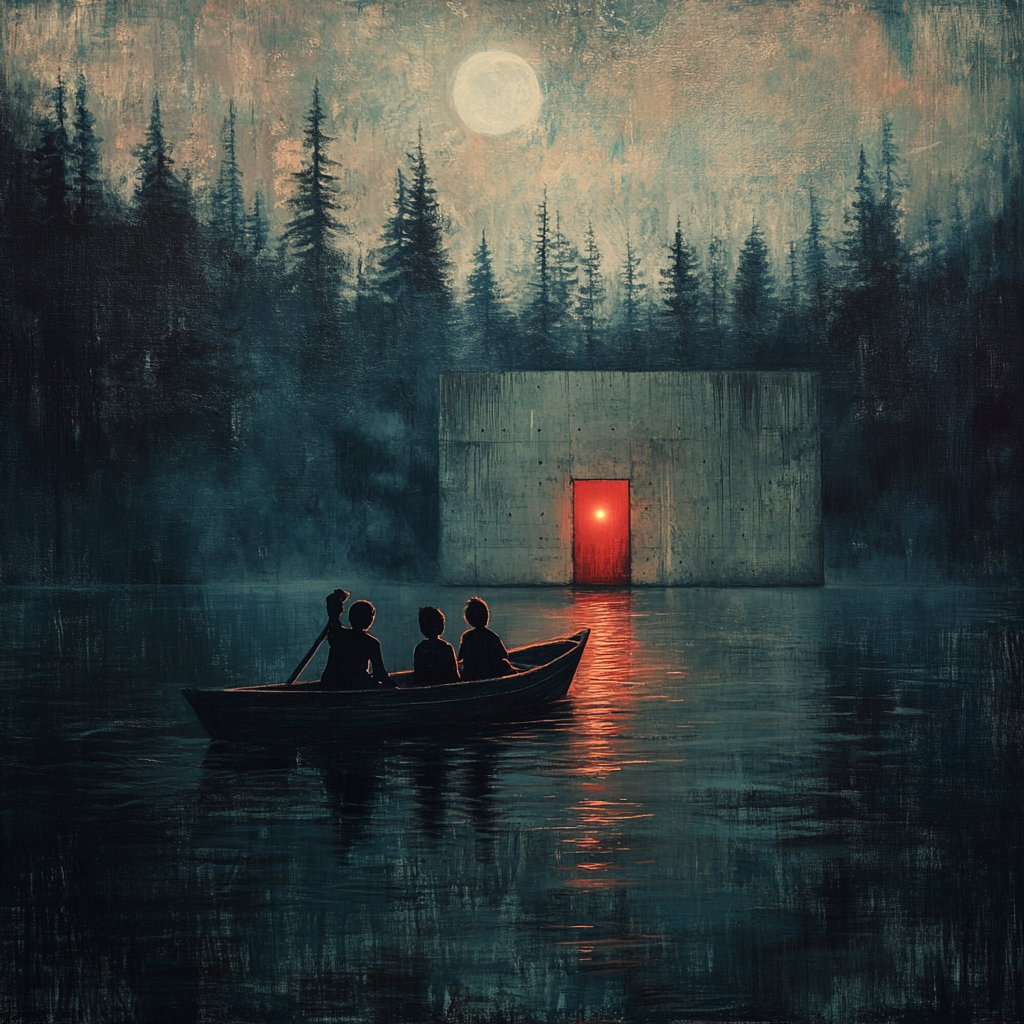
A Summer Camp. A Building Across the Lake. A Red Door Nobody Opens.
Set in the summer and autumn of 2001, The Summer He Knew is the prequel to Blackwood’s debut novel The Fifth Witness. It follows Victoria St. Clair, ten years old, as she arrives at Lake Aldren Summer Camp and falls into an unlikely alliance with Aaron, the methodical boy with the stopwatch; Daniel, who reads people the way Aaron reads patterns; and Rachel, who arrives two weeks late, says almost nothing, and promptly corrects Aaron’s maps with a precision he finds immediately impressive.
What begins as an account of an unusual summer friendship becomes something stranger and more unsettling when the four children notice a building on the far shore of the lake — and realize that someone has been watching them notice it. Aaron’s notebook disappears for two days and reappears with a single correction: a map, adjusted by forty meters, in a hand that isn’t his. A figure stands at the tree line. Letters, after camp ends, begin to arrive.
And then there is the red door.
Aaron finds it on the building’s side — functional red, the red of fire safety equipment, with a handle rather than a lock. He puts his hand on it. He holds it there long enough for the reader to understand that he can feel something behind it. Then he lets go.
I want to understand why this door opens before I use it.
That line is the story’s center of gravity. It tells you everything about Aaron Cross — and it creates the kind of anticipatory dread that lingers long after the final page.
Literary Fiction That Happens to Be a Thriller
What distinguishes Blackwood’s work from the crowded thriller marketplace is the quality of the prose itself. This is not genre fiction dressed up in literary clothing — it is genuinely literary fiction that happens to be about a conspiracy. The difference matters. Where a conventional thriller would push harder on plot mechanics, Blackwood holds his ground on observation, atmosphere, and the emotional logic of exceptional children navigating a world that is larger and more dangerous than they have been told.
The four children feel real in the specific way that matters: not because they are realistically average, but because their particular exceptionalism is rendered with precision and warmth. Aaron is not a quirky plot device. He is a person with a specific relationship to evidence, to instinct, to the discomfort of knowing something before you can prove it. His frustration with his own certainty — preferring evidence to instinct, finding it uncomfortable when instinct arrives first — is one of the most quietly moving character notes in recent short fiction.
Victoria’s narration carries the story’s emotional weight with intelligence and restraint. She understands, looking back, things she couldn’t have understood at ten. The gap between what she knew then and what she knows now is where the story lives.
“This is the summer I’ll go back to for the rest of my life. Not October. Not the building. This.”
— Victoria St. Clair, in The Summer He Knew
The Beginning of Something Larger
The Summer He Knew is designed as the entry point to The Jack Mercer Files — a planned seven-book literary conspiracy series that begins with The Fifth Witness. The short story ends three days before October 17, 2001, when something happens at the building across the lake that neither the reader nor the narrator has been permitted to see yet. That restraint is deliberate, and it works: what Blackwood withholds creates more tension than any conventional thriller reveal could produce.
The series tagline — Some secrets survive the people who keep them — earns its weight here. By the time you reach the final pages, with a small brass key in Victoria’s hand and three days on the clock, you understand exactly what she means when she reflects that Aaron didn’t build just a correspondence or a plan or a collection of evidence.
He built a we.
For readers who prefer their thrillers to ask harder questions — about memory, about what we owe the people who trusted us, about whether truth is something to be pursued or survived — The Summer He Knew is essential reading. And if the prequel is any indication, the novel that follows it will be worth every page.
The Summer He Knew by James Blackwood is available now on Amazon Kindle.
Read it here →
The first novel in the series, The Fifth Witness, follows.
Author

Written by
Recent Posts
Unlocking the Berkshires
Dalia Forman Design

Alberto Luzzi
How to Pick a Homecoming Dress for Your Body Type and Feel Amazing in It
How to Prepare a Home for Sale When Major Repairs Are Not Affordable
Categories
- Art
- Articles
- Business of Luxury
- Celebrities
- Culture
- Entertainment
- Events
- Faces of Summer 2026
- Fashion
- Fashion & Style
- Featured
- Finance
- Food, Spirits, Wine
- Hamptons
- Hamptons Celebrities
- Health
- Health & Beauty
- Lifestyle
- Luxury Lifestyle
- Press
- Profiles
- Real Estate
- Technology
- The Chronicles
- Travel
- Uncategorized
- Weddings