
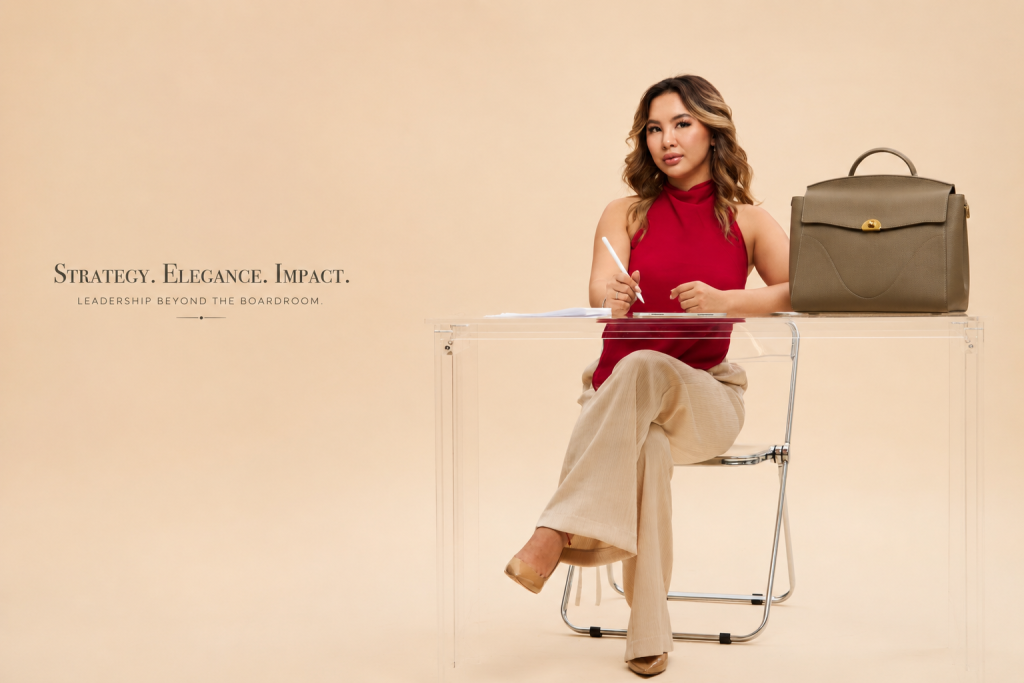
The floor of JFK is not where luxury brands are supposed to begin. Yet that is exactly where Tiffany Zhou, co-founder and creative director of OLEADA, found hers. Her bag strap snapped mid-terminal, and everything a woman in finance carries hit the tile at once. Laptop, documents, chargers, shoes, makeup, an entire working day scattered in public. She remembers the feeling in a precise sequence: embarrassment first, then irritation, then clarity. “I did not see a brand,” she says. “I saw a failure.”
But the failure was not hers. The failure belonged to an industry that still designs for a woman who no longer exists. Zhou was expected to hold everything together, and the object built to support her could not even hold itself together. She calls it design bias. Because the creative directors and decision-makers of legacy fashion houses have historically been men, the idea of what a woman needs gets filtered through someone else’s imagination.
She did not see the whole company in that moment. Instead, she saw the problem, which for a founder is sometimes enough. “You don’t always see the castle,” Zhou says. “Sometimes you just see the crack in the wall.”
This is not a glossy founder profile. In fact, it is the opposite. This is the story of the founder who nearly erased her own brand at its hottest moment, and what she learned on the way back.
Leaving Private Equity to Sell Handbags
Zhou’s exit from finance did not land well at home. Her father is a serial entrepreneur. Her uncle is a seasoned investment banker. Both delivered the same verdict: “I can’t believe you quit your job and threw away four degrees just to sell handbags.”
Her early investors, mostly men, ran a softer version of the same script. Women already have Dior, Hermès, and Chanel, they argued, so why does the world need another bag? Zhou eventually found the sentence that ended the debate: “We are the female version of Tumi.” Suddenly the category made sense to them, because Tumi is not decoration. It is equipment.
That reframe carries the whole thesis. A handbag for a working woman is not an accessory. It hauls her work, her ambition, her emergency kit, and sometimes her entire life between 8 a.m. and midnight. It is intimate and strategic at the same time, which is a combination legacy luxury rarely engineers for.
There was also a quieter reason for the jump. In private equity, Zhou watched women work three times as hard to reach rooms their male peers entered naturally. She decided the structural problem would not fix itself within a generation or two. So she stopped waiting for the room to change and started building her own. “It may look like I left power,” she says. “But I was moving closer to the kind of power I actually wanted.”
An Engineer’s Brain in a Designer’s Category
Zhou trained as an engineer and never attended design school, a gap she treats as an advantage. “I engineered the bag more than I designed the bag,” she says. Her process runs on product-development methodology: understand the user, isolate the real problem, prototype, test, iterate, repeat.
To an engineer, a bag is a system. Not leather, lining, and hardware, but weight distribution, movement, material performance, and body ergonomics. Where does the strap dig into the shoulder? Why does the laptop tilt the whole bag sideways? What forces a woman to carry three bags through one day? And why does something beautiful become annoying by lunchtime?
Because she was never trained to worship form for its own sake, Zhou holds beauty to a standard most designers would find rude: beauty has to work. Wavia, her bestseller, has been upgraded roughly ten times in three years, since she never treated the first launch as the final answer. Customer feedback flows back into the product the way user data flows back into software.
Her design philosophy compresses into one line that should be laminated and handed out at fashion week. “A good bag should not ask for attention. It should give you back attention.”
The Marina Bucket: When Winning Almost Killed the Brand
Here is where the story earns its keep. The Marina Bucket sold three months of inventory in one month. Clients put money down and waited a full quarter for a bag from a company barely anyone had heard of. For a founder, that kind of velocity is intoxicating, and Zhou admits her brain started whispering dangerous things.
She had just closed her second funding round, part of $1.5 million raised in a category ruled by century-old houses. Confidence was high. Maybe too high, by her own accounting. So she did what winning founders do: she chased the win. A big Los Angeles shoot followed, with three models, pastel colorways, and genuinely fabulous imagery. On paper, it looked like growth.
In reality, it shifted the boat. The pastels did not sell. Worse, existing customers got confused, and a few asked whether OLEADA was pivoting into resort bags. Zhou considers confusion more dangerous than rejection, because a customer who rejects you at least knows what you are. A confused customer means you have diluted your own meaning.
“This is one of my biggest mistakes so far,” she says, with zero spin. Commercial momentum had pulled her away from the customer’s core reason for believing in the brand. The lesson cost real money, and she can recite it cold.
A Bestseller Is Not a Brand
The sentence that came out of the wreckage deserves its own section, because every founder reading this has either lived it or is about to. “A bestseller is not a brand.”
A bestseller proves you touched demand. A brand tells the customer exactly who you are, why you exist, and why they should keep believing past one product. Confuse the two, and expansion stops being growth. “Expansion does not grow a brand if your customer does not know exactly who you are,” Zhou says. “It erases it.”
The recovery was discipline, not drama. She pulled the brand back to the woman it was built for and sharpened everything around her. Even the slogan evolved, from the broader lifestyle sentiment of “Live as your heart desires” to the exact phrasing “Live Freely. Lead Authentically.” The shift matters to her because the order matters. You realize your own life first, and authentic leadership follows. “Leadership does not always begin with a title,” she says. “It begins with how clearly you live.”
That refocus extends to brand architecture. AnyWear by OLEADA, her travel-oriented line, operates as its own world rather than another product under the umbrella. It serves a different movement pattern and a different purchase psychology, especially as work, travel, gender codes, and career paths turn fluid. Friends running eight-figure apparel brands told her two brands was inefficient. She disagreed, with better logic than they had.
Practical Luxury: The Framework
Ask Zhou whether quiet luxury is the new status symbol and she will politely rebuild your question. Quiet luxury is a cultural reference point, she says, but what OLEADA builds is practical luxury, and the distinction is ownable.
Her model splits luxury into two premiums. First comes the utility premium, generated by technology, material, and design. Then comes the brand premium, which itself has two layers. There is the feeling, meaning how the object makes you feel when you carry it. And there is the being, meaning what the object says about who you are becoming. The best luxury delivers both. It works beautifully and it carries meaning.
For busy, successful people, the utility half is not optional. They do not have unlimited hours to manage their appearance, which is precisely why quiet luxury caught on. The logo size was never the point. The point is that the product works for people who already have enough going on.
Zhou’s version lands harder. “I want the bag to work for the woman who carries it, not the other way around. You are not the safeguard of the bag. The bag works for you.” Nobody with real money wants to babysit an expensive object. What people with taste and resources notice, she argues, is not loudness. It is intention.
The Birkin Inversion
The Birkin origin story is luxury folklore. Jane Birkin sat next to Hermès chief Jean-Louis Dumas on a flight in the mid-1980s and complained she could not find a bag that worked for her life as a young mother. So Dumas designed one for her, and the rest is a waitlist.
Zhou is not claiming to be the next Birkin, and she would wince at the framing. The more interesting point is structural. The Birkin was designed for a woman who needed a bag for her life. OLEADA was designed by the woman who needed it herself. Birkin had to ask a man to build her bag. Zhou built her own, and she operates as the model, the designer, the manufacturer, and the marketer in one body. “With AI I literally feel like I can become five people,” she says. That is the modern shift, compressed into a single seat assignment.
The tastemakers noticed without being paid to. Maye Musk, Susan Rockefeller, Pauline Brown, and Fern Mallis all arrived organically, which is the only way arrivals like that mean anything. Women who have seen everything do not respond to another logo. They responded to a point of view: a woman’s life is complex, powerful, mobile, and worthy of better design. “If you maintain your integrity, stay decent, and keep doing the work,” Zhou says, “powerful long-term relationships will eventually gravitate toward you.”
Eighty Countries, One Tension
OLEADA now sells in more than eighty countries, and Zhou has watched the same customer surface everywhere. A woman in Singapore styles the bag differently than a woman on the Upper East Side. A customer in Taipei cares about different details than one in London. Yet underneath, the emotional need barely changes.
She wants to move through many identities in one day without losing herself. Executive, founder, mother, daughter, traveler, host, friend. Old luxury, Zhou argues, often wants to freeze a woman into an image. The modern woman is not frozen. She is moving. Across cultures, customers keep asking for the same thing in different languages: design for the whole version of me.
Even the buy-back program, rare in luxury, feeds this thesis. Sustainability is part of it, of course, but Zhou also treats returned bags as field research. A carried bag has a life. Where did it soften? Which parts absorbed the most movement? What does the wear pattern say about her commute, her travel, her habits? No focus group produces that data. Designing for a second life also changes the first one, because you build with more humility when you know the object may come back to you. Modern luxury, in her view, cannot only be about extraction. It has to be about stewardship.
Why NoMad Is the Zip Code
OLEADA’s next physical move is a showroom in NoMad, and the location is an argument, not an accident. Zhou walked all over Manhattan thinking about where the brand belongs, and after five years of world-building she reached a verdict. “If Ralph Lauren is the Upper East Side, Aimé Leon Dore is Queens, and The Row is Tribeca, then OLEADA is absolutely Flatiron and NoMad.”
The neighborhood is full of founders, designers, investors, and operators. People who care deeply about aesthetics but still prioritize function and efficiency. People who appreciate quality of life without needing to perform it. NoMad has beauty without preciousness, ambition without stiffness, and taste that still moves. That, she says, is very OLEADA.
A flagship would be meaningful someday, but she measures arrival differently. Arrival is when the bag becomes part of a woman’s daily architecture. When she carries it to a board meeting, a flight, a school pickup, a new chapter. When she tells another woman, this is the bag you need for the life you are building. “I don’t want OLEADA to arrive as a logo,” Zhou says. “I want it to arrive as a companion.”
The emotional core stays simple, and she returns to it like a compass. Every woman who carries the bag should feel like she can handle her day. In a category built on being admired from a distance, that might be the most radical position of the summer.
Related Reading
Explore more from the Faces of Summer 2026 founder series, and see how the East End’s money actually dresses in our quiet luxury and old money field guide.
Where The Conversation Continues
There is a particular kind of reader who makes it to the end of a founder confession, and you are that reader. You noticed that the Marina Bucket story is not really about handbags. It is about every business that ever chased a win into a wall, possibly including one you know intimately.
Social Life Magazine has spent 23 years in the rooms where these stories get told first. If your brand belongs in one of them, start the conversation with our editorial team.
Founders and brands with a story worth telling can also submit a paid feature and step directly into the July issue instead of watching a competitor do it.
Our email list reaches 82,000 readers who summer where you want your brand to summer. Join the list and read what they read.
Every July, the people in this article’s target market sit under the same tents in Bridgehampton. Polo Hamptons is the party that is actually a meeting. Sponsorships and VIP tables are how you get a seat.
The print edition lives on coffee tables from Further Lane to Fifth Avenue. Subscribe and put it on yours.
And if you simply enjoyed the read, independent Hamptons journalism runs on more than rosé. A five-dollar tip keeps the stories coming.
Author

Written by
Recent Posts
Periorbital Biorevitalization: Top Methods for Combating Dark Circles

Why a Natural-Looking Hairline Matters More Than a Perfect Haircut

Melanotan 2 and the Regulatory Grey Zone: What Research Buyers Should Understand
Discovering the Elegance and Durability of Slate Roof Tiles
Montauk Calls Itself The End Of The Road But Ushuaia Actually Is
Categories
- Art
- Articles
- Business of Luxury
- Celebrities
- Culture
- Entertainment
- Events
- Faces of Summer 2026
- Fashion
- Fashion & Style
- Featured
- Finance
- Food, Spirits, Wine
- Hamptons
- Hamptons Celebrities
- Health
- Health & Beauty
- Lifestyle
- Luxury Lifestyle
- Press
- Profiles
- Real Estate
- Technology
- The Chronicles
- Travel
- Uncategorized
- Weddings