
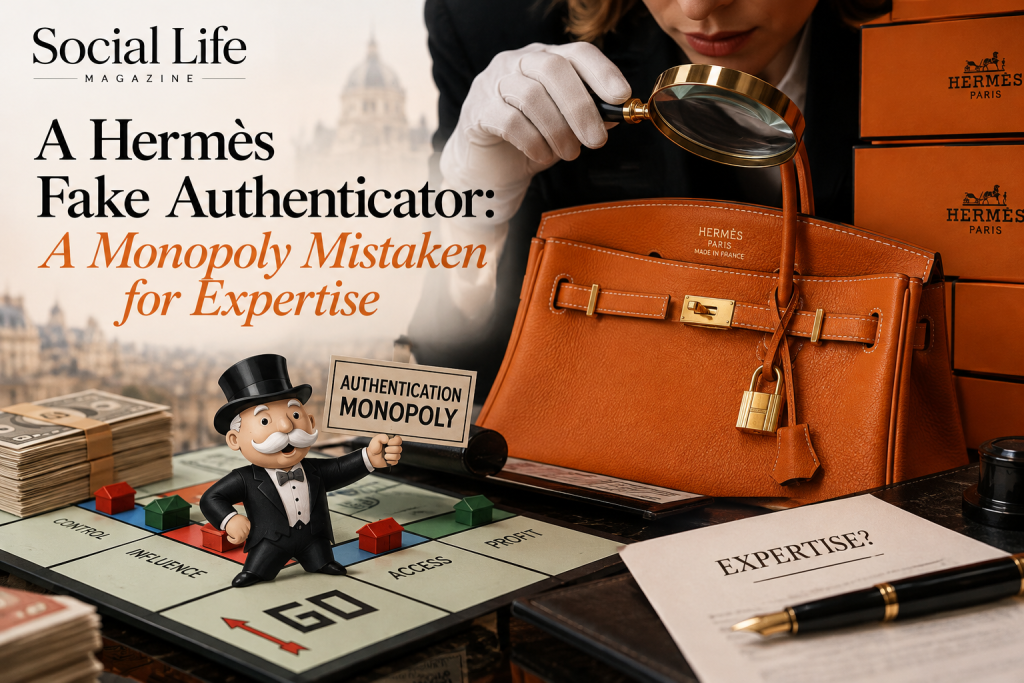
The invitation said Milanese Chic. On October 7, 2026, the Teatro alla Scala Association of America held its annual benefit, The Next Act, at The New York Historical. Federica Lombardi and Freddie de Tommaso sang. Tickets ran from $1,500 to $15,000. At dinner I sat next to Dimity Giles, the Hermès Fake authenticator.
She told me Hermès’ own experts cannot tell whether a bag is real, but she could. She certifies Hermès handbags from photographs. Her certificates, she says, have been accepted by eBay, PayPal, and the Los Angeles Police Department. She is seventy-four and has never touched a bag she has certified.
The Dinner Table That Revealed the Demand
One woman at the table had bought her bag at the Hermès boutique for $15,000. She knew it was real because she bought it from Hermès. She was annoyed at the three other women whose bags she could not verify. Those bags cost about $6,000 each.
That is the demand side of the gatekeeper economy. The $15,000 buyer paid for certainty she could not check herself. The $6,000 buyers paid for hope. Neither group could tell the difference. Dimity’s business exists because nobody at that table — and nobody in the market — can.
Why the Copies Create More Demand for the Real Thing
The three $6,500 bags did not steal the $15,000 sale. They created the conditions for the next one.
A bag like this is not bought for use. It is bought so other people can see that you got one. Once the copies look the same, the signal fails. The woman who paid boutique is not angry because the other bags are ugly. She is angry because she cannot tell. Her purchase has failed at the only job she hired it for. So she needs a new proof. A receipt. A story about the store. A certificate. Another bag, rarer, that the copies have not caught yet.
Researchers have measured the loop. A 2012 study in Marketing Letters found that the presence of luxury fakes raised what people would pay for the real brand, but only when the brand was already famous. A 2026 study in Marketing Science, built on millions of counterfeit purchases, found the demand is U-shaped. Poorer buyers and richer buyers both buy fakes more than the middle. The richer ones buy the expensive fakes of Hermès and Chanel, especially the icons.
The copies are free advertising. A $6,000 Birkin on a table teaches everyone in the room what a Birkin is. Most of those people will never buy one. A few will. When the resale market feels full of fakes, some buyers stop hunting used bags and go back to the boutique. Hermès does not have to police the copies. The copies push the serious buyer back to the store.
The Monopoly Hermès Keeps Open on Purpose
She founded bababebi in October 2011 after a twenty-year career in international banking. Before banking, she served in Australia’s diplomatic corps. She holds a BA and an LLB from the University of Melbourne. Her eye was trained on the PurseForum, where she authenticated over ten thousand handbags. She is the only service dedicated exclusively to Hermès. That is not a ranking. That is a category of one.
Hermès’ own policy states it cannot guarantee or verify items purchased outside its official channels. It issues no authenticity cards — any card presented as one is itself a red flag. The brand that makes the bags has no stake in whether the resale market works. That vacuum is what Dimity fills — and it is why her monopoly exists.
Every Hermès bag carries a blind stamp — a date code and artisan number pressed into the leather — plus a clochette and keys. But it is a stamp, not a database. There is no public registry anyone can query, and the stamp can be copied. The reason is deliberate. Hermès sells scarcity as the product. A verifiable registry would make every bag checkable, which would kill the mystique and the markup. If every bag could be scanned like a car, the $500 copy would be obvious and the signal would be cheap again. The brand profits from buyers not being able to check.
The vacuum Dimity fills is not a gap Hermès forgot to close. It is a gap Hermès keeps open on purpose. The uncertainty is the product.
Photo-Only Method, Authority Without Proof
Her method is public. Clients submit large, focused photographs in natural light. She compares them against her own reference library of authentic and counterfeit details. The certificate states that the item is “Authentic” or “Not Authentic” in bababebi’s opinion. Since May 2019 every certificate carries a unique QR code. The standard service is photos only. No refund of fees is given if satisfactory pictures cannot be provided.
An authority is someone whose word settles a question without needing to show the work. You do not ask a judge to prove the law. You accept the ruling because of who issued it. Dimity’s certificates work on authority, not method. The photos and the library are the visible part. The judgment is the invisible part, and that is what the market pays for.
The gap between a method and an authority is the whole story. A method is a set of steps anyone can follow and check. An authority is a person whose verdict stands because of who gave it. Dimity’s process is public. But the judgment itself — why this photo says fake and that one says real — is never shown.
The Contradictions the Market Ignores
She stands behind her judgments. But they are not always correct. A Trustpilot reviewer named Amanda Baker wrote in May 2025 that she bought a bag at Hermès Paris and Dimity called it fake. The buyer backed out. Baker then sold the same bag on eBay with Dimity’s certificate attached, and a second buyer had Dimity authenticate it and got “real.” Another reviewer, Michelle U., wrote in February 2023 that she had a Birkin certified authentic, used it for two years, then paid over $300 for a fresh certificate to resell. This time Dimity called it fake. Same bag. Same authenticator. Two years apart.
The method explains the contradictions. She works from photos, not the physical bag. Lighting, angle, and resolution can shift a verdict. But the method also explains why the contradictions never cost her the business. There is no appeals court above her, because she is the court. No audit, because nobody has the standing to demand one. No published error rate, because she has never released one.
The industry’s own best numbers suggest single-digit error is the floor, not the ceiling. Entrupy’s 2026 State of the Fake report found that even its AI system, trained on over ninety million reference images, returned “unidentified” on 8.1 percent of luxury submissions. Dimity’s error rate is unknown. The market pays for it anyway.
The Vig and the Slot Machine
The certificate is not a price premium. There is no published study of the same Hermès bag sold with a bababebi certificate and without one. Resale guides price Birkins and Kellys by size, leather, color, condition, and papers. They do not list her name.
What the market does price is paperwork. Original box, dust bag, lock, keys, clochette, and receipt are said to add about 5 to 15 percent. Her opinion sits in that bucket. It reduces buyer fear. It does not create a price tier of its own.
The fee is small against the bag. Collectors report roughly $65 to $150 for a basic email opinion, and over $300 for a fuller certificate. On a $20,000 Birkin that is 1 to 2 percent. Buyers treat it as cheap insurance. Without it, many private buyers walk.
The real price effect is the negative verdict. A “not authentic” certificate can kill the sale. A positive certificate mostly restores the bag to the ordinary resale price for that model. A negative one can take a private sale to zero.
She is the house in a casino. She collects her vig whether the bag is real or fake — a few hundred dollars per opinion, no refunds, no appeals. And the game has no appeals, because she is the court.
The arbitrage is brutal. A fake bag costs $6,000. A bag that clears as real sells for $10,000 or more. So a buyer pays $300 per attempt, and the expected value of one “real” verdict pays for dozens of failures. The same photos can be resubmitted, another $300 paid, and the verdict can flip — because the method cannot tell the difference. The Trustpilot Birkin reversal is exactly that pattern.
The only way to win is to keep paying. That is not a market. That is a slot machine with one dealer.
The Pattern: Monopoly Mistaken for Expertise
The market names the monopoly, then mistakes it for expertise. Nobody has ever published her error rate. No independent audit exists. Her certificates, she says, have been accepted by eBay, PayPal, and the Los Angeles Police Department — not because anyone independently verified her, but because she is the only one offering. The market’s trust is built on reputation and the absence of proof, not on proof itself.
She is not unique. Maureen Downey did it in wine. The art world had its own version: the authentication boards for Warhol and Basquiat. They collapsed under lawsuits. Dimity is not unique. She is one of a kind. The wine and art gatekeepers were killed by accountability. Hers survives because there is none.
It Dies With Her
I compared her to Anna Wintour. She said Wintour has terrible style, that she dresses like an old lady. Then I asked whether the business could survive her. She said, “It’s just me. I don’t need anyone to succeed me. It dies with me.”
The three women at the dinner table, with their bags they could not verify, are the proof. They paid $6,000 for a look, and they would pay $300 for a verdict they cannot check. The woman who paid $15,000 would pay it too, because without a verdict her bag has stopped working. The copies enlarged the real market. Then they enlarged the market for the person who claims she can sort them.
The gatekeeper economy is not a scam on top of a working system. It is the system.
She guards a gate she has never walked through. The gate is worth more than what is behind it. The business dies with her.
Author

Written by
Recent Posts

Galina Breslav: From Pension Fund to Executive Presence
Hermès Fake Authenticator: A Monopoly Mistaken for Expertise
A Real Gift: How La Scala Found Its Community in New York Through the Teatro alla Scala Association of America (TASAA)

He Sold His Company, Got Everything He Wanted, but Lost His Purpose

OUT OF LINE
Categories
- Art
- Articles
- Business of Luxury
- Celebrities
- Culture
- Entertainment
- Events
- Faces of Summer 2026
- Fashion
- Fashion & Style
- Featured
- Finance
- Food, Spirits, Wine
- Hamptons
- Hamptons Celebrities
- Health
- Health & Beauty
- Lifestyle
- Luxury Lifestyle
- Press
- Profiles
- Real Estate
- Technology
- The Chronicles
- Travel
- Uncategorized
- Weddings