
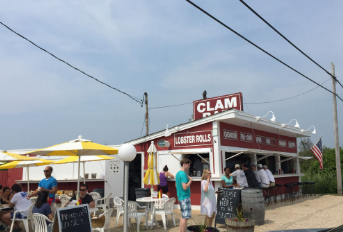
The Roadside Landmark Where Summer Begins
Drive the Napeague Stretch heading east and you’ll understand something essential about the Hamptons. The manicured hedgerows disappear. The ocean threatens from one side, salt marsh whispers from the other. Somewhere between Amagansett and Montauk, on a narrow thread of land that nearly washed away in 1938, sits a red-and-white roadside shack with a parking lot that signals summer has officially started. The Clam Bar at Napeague has marked this threshold for 44 years, attracting everyone from sunburned families to hedge fund managers who’ve just closed deals worth more than the entire property. The yellow umbrellas go up. The lobster rolls come out. Summer in the Hamptons begins.
Where Land Nearly Ended Forever
The Clam Bar occupies one of Long Island’s most geologically precarious addresses. Napeague—from the Montaukett word meaning “land overflowed by the sea”—is exactly what it sounds like. At the end of the last ice age, Montauk was an island. Ocean currents spent thousands of years filling the gap with sand, creating the narrow isthmus that now connects the fishing village to the mainland. During the Great Hurricane of 1938, the ocean met the bay and Montauk briefly became an island again. The land where you’re eating your lobster roll was underwater.
This geological fragility gives the Clam Bar its strange magic. The restaurant sits at 2025 Montauk Highway, technically in Amagansett, on a stretch so exposed that waves from Atlantic storms can still wash over the road. Napeague State Park flanks both sides, preserving the walking dunes and maritime pine forests that give the area its windswept, end-of-the-world atmosphere. There’s nothing between you and the ocean here—no estates, no boutiques, no pretense. Just sand, sky, and the smell of frying clams.
From Stamp Collecting to Seafood Empire
The Clam Bar’s origin story belongs in a novel. Richard “Dick” Ehrlich was a professional philatelist who spent his career traveling the world, buying and selling stamp collections. By 38, he’d made enough money to retire. In 1980, he acquired the Clam Bar—then a modest roadside stand—and transformed it into something between an institution and a religion. Ehrlich understood that location wasn’t just about geography; it was about psychology. He positioned his seafood shack precisely where travelers make a mental transition, leaving the Hamptons’ social performance behind and entering Montauk’s wilder territory.
Ehrlich’s instincts proved prescient. The Clam Bar became a mandatory stop, its parking lot packed with Range Rovers and pickup trucks alike. He worked with local fishermen, sourcing seafood from boats that docked nearby. The menu stayed simple: lobster rolls, fried clams, New England chowder. When he bought the Seafood Barge on the North Fork in 1994, The New York Times awarded it three stars—the first such recognition for a casual seafood restaurant in the region. Ehrlich had quietly become one of Long Island’s most influential restaurateurs while most people still thought of him as the guy who ran that shack on the highway.
The Clam Bar at Napeague: Third Generation Rising
Dick Ehrlich passed away in 2014, leaving the Clam Bar at Napeague to his widow, Betsy Flinn. For nearly a decade, she maintained its essential character. Then, in 2022, Kelly Piccinnini—Betsy’s daughter and a former server at the restaurant—purchased the property with her husband, John, a real estate attorney who eventually left his law practice to run operations full-time. The transition marked the first ownership change in the Clam Bar’s history, yet it stayed in the family.
Kelly grew up on the North Fork and spent summers working the Clam Bar’s front-of-house. John lived the Hamptons weekender life before becoming a convert to year-round East Hampton residency. Together, they’ve brought fresh energy without abandoning the fundamentals. They hired a new chef, expanded the raw bar program, introduced healthier alternatives alongside the fried classics, and launched a catering operation that now services open houses and private events across the East End. During peak season, the restaurant serves over 1,000 people daily.
The Famous Lobster Roll and Beyond
The Clam Bar at Napeague built its reputation on the lobster roll, and for good reason. The classic cold preparation arrives on a signature checkered red-and-white napkin, generously packed with claw and knuckle meat dressed just enough to let the lobster shine. The hot version, drenched in garlicky butter, attracts purists who believe warm lobster is the only honest way. Both divide loyalists, which is exactly how a legendary dish should operate.
Beyond the headline attraction, the menu delivers New England clam chowder thick enough to stand a spoon in, tuna poke nachos that acknowledge the century’s changed tastes, steamed local clams, and oysters on the half shell with mignonette and cocktail sauce. The fried clam strips and fish & chips remain the fried-food standards that summer demands. Newer additions include a lobster BLT that layers bacon and arugula between the butter-grilled bun, and a two-pound Montauk lobster for those who want the full theatrical experience. The Lobster Surf & Turf—a ciabatta roll layered with sliced filet medallions alongside steamed lobster meat and baby arugula tossed in lemon vinaigrette—represents the kitchen’s more ambitious side.
The Shuck Truck: Bringing Napeague Home
For 2025, the Piccinninis introduced the “Shuck Truck,” a refurbished 1966 Citroën H Van that extends the Clam Bar experience to private events. John spent months sourcing and locally restoring the vintage vehicle, ensuring its retro aesthetic matched the restaurant’s roadside authenticity. The truck isn’t outfitted for food preparation—it functions as a mobile raw bar and display, bringing live-shucked clams and oysters, shrimp cocktail, and curated wines and cocktails to backyard parties, wedding welcome gatherings, and beachfront clambakes.
The Shuck Truck concept emerged from customer feedback. Guests repeatedly mentioned that they visited not just for the food, but for the atmosphere, the staff, the music—the complete Clam Bar vibe. Now that vibe travels. Packages feature local alcohol options including Wölffer rosé, Montauk Summer Ale, and Wavechaser IPA. The Piccinninis’ two young children are already helping greet guests, suggesting another generation may someday inherit the operation.
The Social Geography of Casual
What makes the Clam Bar at Napeague remarkable isn’t the quality of the lobster roll—though it’s excellent—but what the restaurant represents in the Hamptons social ecosystem. This is the rare establishment where billionaires in $300 board shorts share picnic tables with local contractors on lunch break. The outdoor seating, yellow umbrellas, paper trays, and port-a-potties enforce a certain democratic casualness. You can’t buy your way to a better table because there are no better tables.
The restaurant operates first-come, first-served, no reservations. Waits of 20-30 minutes during peak season are common; the savvy arrive by 11:30 when doors open or after 3:00 when the lunch rush subsides. Bug spray is provided because this is beach dining without the resort infrastructure—mosquitoes at dusk are part of the deal. These minor inconveniences function as filters, separating those who understand roadside authenticity from those who demand something more controlled.
Catering to the Hamptons Real Estate Industrial Complex
The Piccinninis recognized that the Clam Bar brand extended beyond the Napeague location. Their catering arm now offers real estate bundles specifically designed for open houses: 60 mini lobster rolls with potato chips, accompaniments, and optional Acqua Panna and Pellegrino, starting at $295. Upgrade packages add white wine selections. The logic is straightforward—nothing sells a Hamptons property like the smell of lobster and the implication of casual luxury.
Clambake packages serve 2-5 guests or scale up for larger events, featuring 1¼ pound lobsters with steamers, mussels, corn, and potatoes. The Seacuterie Board—smoked seafood, tartare, seasonal crudité, and antipasti—nods to the charcuterie trend while staying on-brand. All catering orders require three days advance notice. The Piccinninis have essentially built a second business that leverages the Clam Bar’s cultural capital across the entire East End.
The Napeague Stretch: Gateway Psychology
Understanding the Clam Bar at Napeague requires understanding its location within the Hamptons’ mental geography. The Napeague Stretch is a liminal space—neither fully Hamptons nor fully Montauk, a seven-mile transition zone where pretense drops away. One side offers Atlantic Ocean views; the other reveals Napeague Harbor’s salt marshes. The Mackay Radio Tower, a remnant of 1920s transatlantic communications, stands as a sentinel. The Art Barge—a retired World War II vessel that’s housed a MoMA-affiliated art institute since 1955—bobs in the harbor.
This is where the careful social performance of East Hampton dissolves into something rawer. Surfers heading to Ditch Plains pass investment bankers returning from Montauk after closing-dinner celebrations. The Clam Bar sits at this crossroads, offering permission to put on flip-flops and get butter on your chin. It’s the first real restaurant heading east from Amagansett and the last significant stop before Montauk’s wilder territory. That geographical accident has become the foundation of a 44-year-old empire.
Year-Round East End, Not Seasonal Performance
The Clam Bar operates seasonally—typically April through early fall, weather permitting—but the Piccinnini family lives year-round in East Hampton’s Northwest Woods. This distinction matters. They’re not summer operators extracting value from seasonal crowds; they’re community members whose kids attend local schools, whose neighbors are other year-rounders, whose commitment to the East End extends beyond the Memorial Day to Labor Day window. This orientation shapes everything from staffing decisions to supplier relationships.
John’s departure from his law practice to run the restaurant full-time signals the family’s investment in the Clam Bar’s future. Kelly focuses on the growing catering operation and Shuck Truck bookings. The children help with service when school allows. There’s an intentional multi-generational quality to the operation that echoes Dick Ehrlich’s original vision—the Clam Bar as a “jumping-off point in life for young people,” a place where employees learn the restaurant business while building connections that shape careers.
Contact and Essential Details
The Clam Bar at Napeague
2025 Montauk Highway
Amagansett, NY 11930
Phone: (631) 267-6348
Hours: Open daily at 11:30 AM, weather permitting, April through fall. Lunch and dinner service. Takeout available.
Reservations: No reservations accepted. First-come, first-served seating.
Catering: Orders must be placed three days in advance. Real estate bundles, clambake packages, and Shuck Truck private event bookings available. Visit clambarcatering.com or email catering@clambarhamptons.com.
Good to Know: All seating is outdoors. Bug spray provided. Portable restrooms. Payment by cash and card. Peak waits 20-30 minutes. Parking available in adjacent lots and along highway shoulder. Arrive early or mid-afternoon to avoid lines.
The Test of Authenticity
The Hamptons contains multitudes: white-glove galas and pickup volleyball, trust fund fortunes and working fishing boats, $50 million estates and $30 lobster rolls. The Clam Bar at Napeague occupies the rare space where all these realities intersect without friction. You can arrive by helicopter charter or Honda Civic. You’ll wait the same line, sit at the same tables, eat from the same paper trays.
Forty-four years after a stamp collector took a chance on a roadside stand, the Clam Bar remains what it always was: a threshold marker, a seasonal ritual, a place where the Hamptons’ elaborate social theater pauses for butter-dripped fingers and cold beer. The Piccinninis understand their inheritance. They’re stewards of something larger than a restaurant—they’re guardians of a particular kind of permission. The permission to be casual in a place that rarely allows it.
For more on navigating the Hamptons’ culinary landscape, explore our Best of the Hamptons 2026 insider guide, or discover what awaits at the end of the road in our Guide to Montauk Restaurants.
Author

Written by
Recent Posts

Cynthia Erivo Net Worth: The Voice That Was Always There
Inside Out 2, Wicked, and the Emotional Blockbuster That Ate 2024
7 Mindful Meal Prep Tips for Stop Food Waste Day

Rebecca Ferguson Net Worth: The Advantage of Not Being the Lead
What Makes a Dinner Party Truly Unforgettable (Hint: It’s Not the Food)
Categories
- Art
- Articles
- Beauty & Skincare
- Celebrities
- Celebrities|Entertainment
- Celebrities|Television
- Celebrities|The Chronicles
- celebrities|the-archive
- Chronicles
- Entertainment|Culture
- Event Photos
- Events
- Fashion
- Fashion & Style
- Featured
- Food & Beverage
- Food, Spirits, Wine
- Hamptons
- Hamptons Celebrities
- Hamptons Celebrities|Celebrities|The Chronicles
- Health
- Health & Beauty
- Lifestyle
- Luxury Lifestyle
- Movies
- Press
- Profiles
- Real Estate
- Technology
- The Chronicles
- Travel
- Uncategorized
- Weddings