
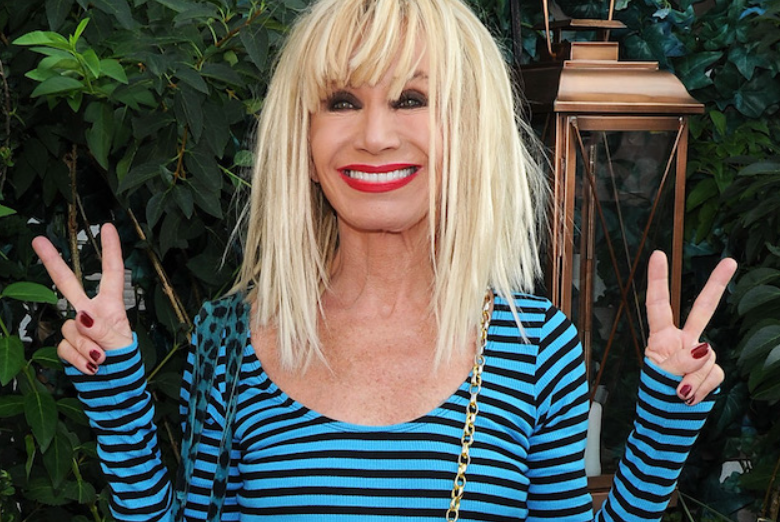
She’s eighty-two years old, and she still does the splits.
At the end of every fashion show for the past two decades, Betsey Johnson has cartwheeled down the runway and dropped into a full split—a move she started at sixty-four because, she says, she wanted to prove she still could. The audience always gasps. They’ve been gasping since 1965, when a Connecticut cheerleader showed up at a Manhattan boutique with dresses made from shower curtains and car interiors.
Between then and now: three husbands (including a Velvet Underground musician), two bankruptcies, one breast cancer diagnosis, open heart surgery, a $48.8 million debt, and a hot pink trailer in Malibu’s most exclusive mobile home park. The Betsey Johnson net worth currently sits around $50 million—or $15 million, depending on who’s counting. Both numbers tell the same story: a woman who built an empire, lost it, rebuilt it, and kept doing cartwheels the entire time.
Betsey Johnson Net Worth: The Numbers Behind the Tulle
Estimates of the Betsey Johnson net worth range dramatically, from $15 million to $50 million. The discrepancy reflects her complicated financial history. In 2010, Steve Madden Ltd. acquired her brand’s intellectual property for $27.6 million after absorbing a $48.8 million debt. Two years later, Betsey Johnson LLC filed for Chapter 11 bankruptcy, closing all sixty-three freestanding stores.
However, the bankruptcy didn’t touch Johnson herself—only the licensing company that operated her retail locations. She remained creative director of her brand, now owned by Steve Madden, with fifteen active licensing agreements covering everything from dresses to fragrances. The moderately priced Betsey Johnson label, sold at Macy’s and other department stores, continues to generate revenue. Meanwhile, her real estate moves have proven surprisingly savvy.
Her East Hampton property, purchased for $695,000, sold for $1.5 million in 2015. Her Malibu mobile home, bought for under $2 million in 2016, sold for $1.95 million three years later. She also maintains Betseyvilla in Mexico, available on Airbnb, because of course she does. The woman who once made dresses from New York Yankees uniforms was never going to let a little thing like bankruptcy define her net worth.
The Wound: Norman Rockwell Meets Hot Pink
Terryville, Connecticut. Population: 5,000. A farming community outside Hartford where nothing suggested fashion, rebellion, or the Factory scene that would later consume Betsey Johnson’s twenties.
“I was just born into a lovely family, great parents, farmland-kind-of-offshoot little suburb of Hartford,” Johnson told NPR in 2020. “And growing up was really wonderful.”
Interestingly, this is the strange thing about Betsey Johnson’s origin story: there’s no obvious wound. Her father, John “Chick” Johnson, was a mechanical engineer. Meanwhile, her mother, Lena, worked as a high school guidance counselor. Together, they raised three children in what Johnson describes as “a very WASPy Protestant family”—structured, practical, and utterly conventional.
Nevertheless, the wound was there. It just wasn’t trauma—it was boredom. In particular, the constrictive normalcy of 1950s Connecticut, where girls became secretaries or nurses or wives, where creativity meant choosing a color scheme for your kitchen. As a result, Johnson took dance classes obsessively, up to five per week, not because she wanted to be a dancer but because she loved the costumes. At age four, she made her first garment: an apron with a doggy print.
“What I tried to do was a combination of dance and art,” she later recalled. Essentially, the costumes offered escape from a world that expected her to be quiet and beige. Instead, she would become the woman who dyed everything hot pink.
The Chip: From Cheerleader to Youthquake
Johnson graduated from high school in 1960—a cheerleader, predictably, with the kind of boundless energy that made her exhausting to be around. Initially, she enrolled at Pratt Institute to study art, then transferred to Syracuse University, where she graduated Phi Beta Kappa and magna cum laude with degrees in art and design. Additionally, she joined Alpha Xi Delta sorority, which should have prepared her for a conventional life.
Then she won a magazine contest, and everything changed.
In 1964, Mademoiselle selected Johnson as a guest editor through its summer scholarship program. Consequently, the gig introduced her to New York’s fashion world, and within a year she’d landed the in-house designer position at Paraphernalia, a Manhattan boutique that would become ground zero for the Youthquake movement. Diana Vreeland, then editor of Vogue, had coined the term to describe young people seizing control of culture from their parents’ generation. Soon, Johnson was about to become its avatar.
At Paraphernalia, she made dresses from shower curtains (“You’d spray with Windex rather than dry-clean”), car interior lining, pinstriped wool from old Yankees uniforms. Furthermore, she used vinyl whenever possible, incorporated neon dyes and puffed sleeves, created what she called “the first era of throwaway clothes.” Typically, women would enter the boutique in their day clothes, buy an outfit for that night, and essentially discard it tomorrow.
The store’s windows featured go-go dancers grooving to rock music. Meanwhile, the clientele included Twiggy, Penelope Tree, and Julie Christie. Then, one night in 1966, Andy Warhol’s band played a set among the mannequins.
The Rise: When the Factory Met Fashion
The Velvet Underground performed at Paraphernalia as part of Andy Warhol’s multimedia happenings—chrome and glass and go-go dancers and the most dangerous band in America. At the time, Johnson was twenty-four, making clothes that matched their aesthetic perfectly: dark, strange, and impossible to ignore.
“They called from the Factory and Andy had to do a shoot with Edie Sedgwick,” Johnson remembered. “Edie wanted to wear silver. They knew I was making silver.”
That introduction pulled Johnson into Warhol’s orbit. Immediately, she began designing costumes for the Underground, using velvet and studs and her signature obsessive detailing. Before long, Edie Sedgwick became her fitting model and house model at Betsey Bunky Nini, the boutique Johnson opened on the Upper East Side in 1969. Lou Reed, she later noted, told her she “cut a good crotch”—the only compliment he ever paid her.
Initially, Sterling Morrison, the band’s guitarist, caught her eye. “I don’t know how I ended up going out with Sterling,” she admitted. However, everything changed when she met John Cale, the Welsh avant-garde musician who played viola with his hands on fire and asked her to make a costume that could survive the flames.
Johnson fell instantly in love. “I realized that I really loved John,” she said simply.
A Wedding at City Hall
They married at New York City Hall in April 1968. Remarkably, the judge initially refused to perform the ceremony because Johnson wore a pantsuit. Without hesitation, she removed the pants and returned in a miniskirt. Warhol attended and took photographs. Meanwhile, Ladies’ Home Journal had planned to shoot the wedding, but Cale contracted hepatitis and turned yellow the day before the invitations went out. “Mail ’em anyway,” he said from his hospital bed.
Unfortunately, the marriage lasted only three years—long enough to contribute to the Velvet Underground’s dissolution. As a result, Lou Reed and Cale’s partnership never recovered from the domestic intrusion. “Our career paths were so divergent that we actually lived in completely different worlds,” Cale later wrote. “Betsey seemed able to pass in and out of my world with ease, but I could not negotiate hers.”
The Tell: Bankruptcy, Cancer, and the Cartwheel
After the Warhol years, Johnson took control of Alley Cat, a fashion label popular with rock musicians. Her debut collection sold $5 million in volume. Subsequently, in September 1971, she won the Coty Fashion Critics’ Award, becoming the youngest designer ever to receive the honor. Everything suggested an uninterrupted ascent.
Then the seventies happened. Her fan base grew up, got jobs, and stopped buying neon. As a result, interest in Johnson’s bright designs faltered. By mid-decade, her career had stalled entirely.
Punk rock saved her. In 1978, revived by the New Wave movement, Johnson partnered with ex-model Chantal Bacon to launch the Betsey Johnson label. Together, they opened their first store in SoHo when everyone else was doing earth-toned Annie Hall minimalism. “We wanted to make clothes for us and our friends—the kind of stuff we were wearing at Mudd Club,” Bacon explained. “We were doing a lot of pink and black striped Lycra.”
The partnership lasted three decades. By 2011, Betsey Johnson had sixty-five stores worldwide, locations in London, Toronto, and Tokyo, and a reputation as fashion’s eternal wild child. Along the way, she married two more times—Jeffrey Oliviere in 1981, Brian Reynolds in 1997—and had a daughter, Lulu, in 1975 with Clark Murray.
The Implant That Saved Her Life
In 2000, at age fifty-eight, Johnson was diagnosed with breast cancer. Strangely, she discovered the lump by accident: one of her saline implants had deflated overnight, revealing a tumor hidden behind it. She told no one except Lulu, scheduled radiation treatments at 6 a.m. before work, and hosted her company Christmas party thirty minutes after receiving the diagnosis. “My biggest fear was that people were gonna think I was going to die,” she later told Bustle. “That I wasn’t going to pay my bills. That I’m not going to design.”
After a lumpectomy and thirty-four days of radiation, she was cancer-free. Only then did she go public, becoming an advocate for breast cancer awareness and designing accessories featuring the survivor’s emblem.
The $48.8 Million Collapse
The financial collapse came next. In 2010, Steve Madden Ltd. acquired Betsey Johnson’s $48.8 million debt for $27.6 million, taking ownership of the brand’s intellectual property. Two years later, Betsey Johnson LLC filed for Chapter 11 bankruptcy, shuttering all sixty-three stores. Remarkably, Johnson herself remained creative director.
Her resilience in the years that followed became legendary. She celebrated forty years in fashion with a retrospective show featuring Cyndi Lauper at age seventy. Two years later, she competed on Dancing with the Stars. Then, at seventy-six, after three “baby seizures” in one year, she underwent open-heart surgery—and attended a gala just three weeks later.
“My aorta is the size of a 300-pound guy, but the walls are very thin,” she explained. They had to use a saw.
The Hamptons Connection: From East Hampton to Paradise Cove
For years, Johnson maintained property in East Hampton, the obligatory status marker for New York fashion success. Originally, she purchased the home for $695,000 and sold it in 2015 for $1.5 million—a solid return that funded her next move.
In 2016, however, Johnson did something unprecedented: she sold everything and moved into a trailer.
Paradise Cove Mobile Home Park in Malibu isn’t your standard trailer park. In fact, the New York Times once called it “America’s most glamorous trailer park,” and residents have included Matthew McConaughey, Minnie Driver, Pamela Anderson, and Stevie Nicks. Additionally, the community offers 24-hour guard-gated entry, a tennis court, a clubhouse, and access to one of California’s most beautiful beaches. Consequently, homes routinely sell for over $1 million.
Johnson bought hers for just under $2 million and immediately painted it pink. Specifically, she added a hot pink exterior, leopard print furniture, and what she called a “secret garden-style pergola-covered outdoor living room” with a clawfoot soaking tub among the banana trees. Meanwhile, the master bedroom, dubbed “The Yellow Room,” featured mustard walls, a mustard ceiling, and a mustard rug. Ultimately, the whole property looked exactly like a Betsey Johnson dress turned into architecture.
She sold it in 2019 for $1.95 million, just before her heart surgery. Subsequently, she moved into another trailer nearby—a three-bedroom colonial-style mobile home she covered in vintage wallpaper, including a rose pattern that matched the wallpaper in her Connecticut childhood home.
Today, at eighty-two, Johnson lives in Point Dume with views of the Pacific and the mountains. Her daughter Lulu helps run the business, while the Steve Madden-owned brand continues to produce moderately priced dresses, accessories, and footwear sold at department stores nationwide.
What the Betsey Johnson Net Worth Really Represents
Ultimately, the numbers—$15 million or $50 million, bankruptcy or billions in lifetime sales—miss the point of Betsey Johnson’s fortune. This is a woman who made shower curtain dresses for Edie Sedgwick, married into the Velvet Underground, built an empire, lost it to debt, survived cancer and heart surgery, and ended up in a pink trailer doing yoga at dawn.
Throughout it all, she never stopped doing cartwheels. At sixty-four, she added the move to her runway shows because people doubted she could still pull it off. “I split all the time,” she told Newsday in 2020, “but I will only do a cartwheel on grass these days because of wobbly runways and slippery floors.”
The cheerleader from Terryville, Connecticut—the girl who made a doggy-print apron at age four because her world was too beige—turned rebellion into revenue and survived everything the fashion industry threw at her. Three marriages. Two bankruptcies. One bout of cancer. Open heart surgery. The collapse of retail. A pandemic.
And still, she painted her trailer pink and kept going.
That’s what the Betsey Johnson net worth really represents: not the $50 million in accumulated assets, but the refusal to stop moving. Indeed, the cartwheel at the end of every show isn’t just branding. Rather, it’s a statement of survival from a woman who learned early that the only way out of a conventional life is through sheer, relentless, hot-pink force of will.
Discover more profiles of fashion icons and Hamptons society in The Archive.
For partnership opportunities, advertising inquiries, or to be featured in Social Life Magazine, contact our team. Join us at Polo Hamptons, where society and spectacle converge.
- Related Articles:
- Pharell Williams Net Worth 2025: The Boy Who Saw Colors in the Projects
- Vera Wang Net Worth 2025: From Top Failures to Fashion Empire
- Calvin Klein Net Worth 2025: The Bronx Boy Who Built a $75m Hamptons Fortress
- Tory Burch Net Worth 2025: Tomboy Builds a Billion Dollar Empire
- Reed Krakoff Net Worth 2025: Architect of American Luxury
Author

Written by
Recent Posts

Robert Eggers Net Worth — He Made a $3.5 Million Film in Puritan English and Hollywood Listened
Brie Larson Net Worth — A $6 Million Indie Film Won Her an Oscar. Marvel Paid Her the Rest.

Jacob Tremblay Net Worth — He Was Nine Years Old and Already Better Than Most Adults in the Room

Toni Collette Net Worth — She Gained 40 Pounds for Her First Role and Never Stopped Transforming
Dept of Smiles: Creating Confident, Healthy Smiles Through Modern Dental Care
Categories
- Art
- Articles
- Beauty & Skincare
- Celebrities
- Celebrities|Movies
- Celebrities|The Chronicles
- Chronicles
- Entertainment|Culture
- Event Photos
- Events
- Fashion
- Fashion & Style
- Featured
- Food & Beverage
- Food, Spirits, Wine
- Hamptons
- Hamptons Celebrities
- Hamptons Celebrities|Celebrities|The Chronicles
- Health
- Health & Beauty
- Lifestyle
- Luxury Lifestyle
- Movies
- Movies|Culture
- Movies|Hamptons Lifestyle
- Press
- Profiles
- Real Estate
- Technology
- The Chronicles
- Travel
- Uncategorized
- Weddings