
The first contract Derek Jeter ever signed was worth nothing. No money. No guarantees. Just eighteen handwritten clauses from his father: no arguing, no alcohol, no drugs, respect girls, meet curfew. Every year before school started, young Derek sat at the kitchen table in Kalamazoo, Michigan, and signed his name to a piece of paper that determined whether he could play baseball that season.
“I was always afraid of disappointing my parents,” Jeter later admitted. “To this day, it’s something that’s in the back of my mind. Every time I do something, I try to think, how would my parents react to it?” He was forty-two years old when he said this—five World Series rings, 3,465 hits, fourteen All-Star selections behind him. Nevertheless, the fear of disappointing his parents remained.
Derek Jeter’s net worth stands at approximately $200 million, built across two decades as the captain of the New York Yankees, $265 million in baseball salary, $150 million in endorsements, and a portfolio of business ventures that transformed athletic fame into lasting wealth. However, every dollar traces back to that kitchen table, where a substance abuse counselor and an accountant taught their son that discipline precedes dreams.

The Wound: Between Two Worlds in Kalamazoo
Derek Sanderson Jeter was born on June 26, 1974, in Pequannock Township, New Jersey, less than thirty miles from Yankee Stadium. His parents had met in Frankfurt, Germany, while serving in the United States Army. Charles Jeter, African-American, would earn a PhD and become a substance abuse counselor. Dorothy Connors, of Irish-German descent, would become an accountant. They were married in Tennessee, where Charles played shortstop at Fisk University.
When Derek was four, the family moved to Kalamazoo, Michigan, so Charles could pursue graduate studies at Western Michigan University. The relocation placed Derek in a predominantly white Midwestern city, raised by a biracial couple in an era when such families still drew stares. His parents prepared him early for what he would face.
The Contract That Built Character
“My dad, both of them, I guess, are kind of strict,” Jeter recalled. “So we had to sign these contracts. It covered curfews, work ethic, goals, and grade point average.” Specifically, the eighteen clauses included expectations about study habits, early curfew times, and absolute prohibitions on alcohol and drugs. Violation meant no sports—no baseball, no basketball, nothing.
His sister Sharlee found the arrangement frustrating. “I always tried to negotiate,” she said. “But Derek just sat there and nodded. It was hard having this older brother who did everything he was supposed to do.” Additionally, Derek’s curfew was always earlier than his friends’, even the night before games. He didn’t argue. He simply signed and obeyed.
The contracts weren’t just about behavior. Dorothy Jeter banned the word “can’t” from their household vocabulary. “We weren’t allowed to use the word can’t—’I can’t do this, can’t do that,'” Derek remembered. “My mom would say, ‘What? No.’ She’s always positive.” Consequently, the boy who couldn’t say “can’t” grew up believing anything was possible—including playing shortstop for the New York Yankees.

The Chip on His Shoulder
Every summer, Derek and Sharlee traveled to New Jersey to stay with their maternal grandparents, Sonny and Dot Connors. There, Grandma Dot took Derek to Yankee Stadium, where he fell in love with the team that would define his life. His favorite player was Dave Winfield, the towering outfielder who made the game look effortless.
In 1985, three days before his eleventh birthday, Derek attended a game at Tiger Stadium in Detroit. Afterward, he obtained Dave Winfield’s autograph. That night, he made a promise to his parents: “One day, you’re gonna go to Tiger Stadium and see me play.”
The Dream Becomes Concrete
“I went to sleep that night knowing what I wanted to do with my life,” Jeter later said. “I had great dreams about it. And I’m not sure if I’ve woken up since.” Remarkably, the eleven-year-old’s certainty never wavered. Teachers suggested he needed “a real goal.” Guidance counselors pointed out the astronomical odds. His parents simply told him to set his goals high and work hard for them.
At Kalamazoo Central High School, Jeter became a phenomenon. As a junior, he batted .557 with seven home runs and 34 RBIs. His senior year was even better: .508 average, four home runs, 23 RBIs, 21 walks, and one strikeout in 23 games. He got on base 63.7% of the time. His coach, Don Zomer, would later joke about that single strikeout: “I can tell you, it was a bad call.”
The accolades poured in: 1992 High School Player of the Year from the American Baseball Coaches Association, Gatorade High School Player of the Year, USA Today’s High School Player of the Year. He graduated with a 3.82 GPA while wearing a gold chain with the Yankees emblem around his neck. For a school project on the Middle Ages, he designed a coat of arms showing himself in a Yankees uniform, holding a baseball bat.
The Rise: From $800,000 to Monument Park
The Houston Astros held the first pick in the 1992 MLB Draft. They selected Phil Nevin. Yankees scout Dick Groch had spent months watching Jeter at camps and games across the Midwest. When team officials worried that Jeter might choose college over professional baseball, Groch made his case with a single sentence: “The only place Derek Jeter’s going is to Cooperstown.”
The Yankees selected Jeter sixth overall and signed him for $800,000. His parents allowed him to accept only because the contract included provisions for completing his education. Jeter enrolled at the University of Michigan that fall but left in 1993 as he rose through the minor leagues.
The Valley Before the Peak
His first professional game was a disaster. Jeter went 0-for-7 with five strikeouts against the Gulf Coast League. He finished that rookie season batting .202, barely above the Mendoza Line—the threshold of embarrassment in professional baseball. Homesick and frustrated, he racked up $400-per-month phone bills calling his parents daily.
But the contracts had taught him something essential: failure is temporary; quitting is permanent. By 1994, Jeter was hitting .344 with 50 stolen bases, earning Minor League Player of the Year honors from Baseball America and The Sporting News. On May 29, 1995, he made his major league debut against the Seattle Mariners. He was twenty years old.
The following year, new manager Joe Torre made Jeter the starting shortstop on Opening Day. He batted .314 with 10 home runs and won the American League Rookie of the Year unanimously. More importantly, he helped the Yankees win their first World Series in eighteen years. The boy from Kalamazoo had fulfilled his childhood promise.
The Dynasty: Five Rings and Counting
What followed was unprecedented in modern baseball. World Series championships in 1996, 1998, 1999, 2000, and 2009. Fourteen All-Star selections. Five Gold Gloves. Five Silver Slugger Awards. The Yankees never missed the playoffs for eleven consecutive seasons. And at the center of it all stood Derek Jeter, named team captain in 2003—only the eleventh in franchise history.
His defining moments became baseball legend. “The Flip” in the 2001 ALDS, when he sprinted across the diamond to relay an errant throw and nail Jeremy Giambi at home plate. “Mr. November,” when he hit a walk-off home run in the tenth inning of Game 4 of the 2001 World Series, just past midnight on November 1. The dive into the stands in 2004, when he caught a foul ball and emerged bloody but triumphant.
The Contracts That Paid
In 2001, Jeter signed a ten-year, $189 million contract to remain with the Yankees—at the time, the second-largest contract in sports history, trailing only his teammate Alex Rodriguez. By career’s end, his baseball salary totaled $265 million, making him the second-highest-paid player in MLB history behind Rodriguez.
But the endorsements matched his salary. Nike’s Jordan brand. Gatorade. Ford. Visa. Movado watches. During his peak years, Jeter earned an additional $9-12 million annually from corporate partnerships. His clean-cut image and consistent performance made him one of the most marketable athletes in sports. Total career earnings from endorsements exceeded $150 million.
When he retired after the 2014 season, Jeter had accumulated over $415 million in career earnings. He drove home the game-winning run in his final at-bat at Yankee Stadium, because of course he did. The kid who signed contracts at his kitchen table had become the ultimate closer.
The Tell: What the Money Reveals
Derek Jeter’s $200 million net worth reflects both his extraordinary earnings and his strategic approach to wealth. Unlike many athletes who burn through fortunes, Jeter invested thoughtfully and built businesses that extended his brand beyond baseball.
In 2014, he co-founded The Players’ Tribune, a media platform allowing athletes to tell their own stories without journalistic filtering. The company was acquired by Minute Media in 2019 for an estimated $50 million, validating Jeter’s vision of athlete-controlled media. He also launched Jeter Publishing, a book imprint focused on children’s literature and sports stories.
From Player to Owner
In 2017, Jeter joined a group of investors led by Bruce Sherman to purchase the Miami Marlins for $1.2 billion. He contributed $25 million for a 4% stake and became CEO, responsible for daily operations. The role tested his reputation—cost-cutting moves and player trades drew criticism from fans accustomed to his winning aura.
By February 2022, Jeter had parted ways with the Marlins, selling his stake back to partners at a $1.12 billion valuation. His $25 million investment returned $44.8 million—a profit, but hardly the championship experience he’d known as a player. Nevertheless, the five years in ownership demonstrated his willingness to take risks beyond the playing field.
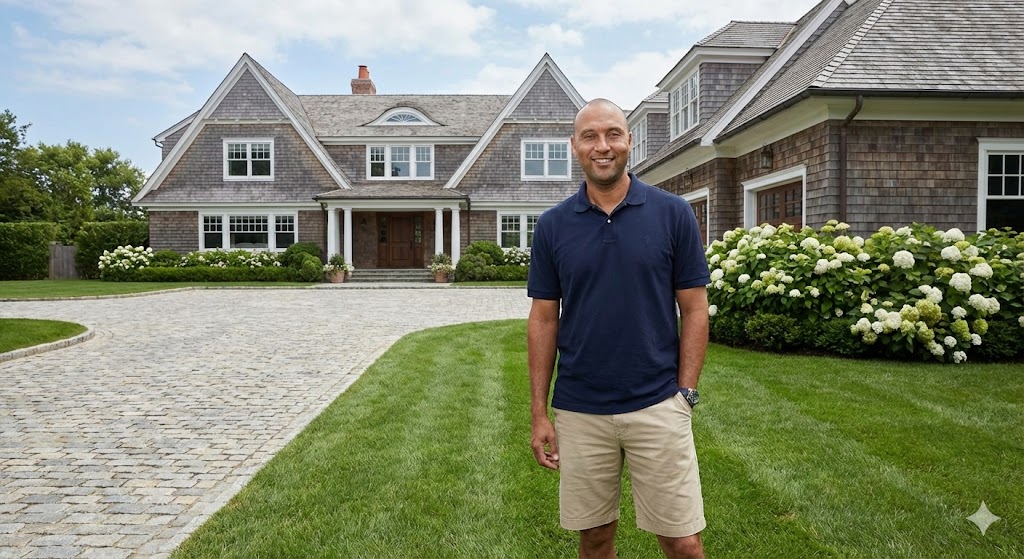
His real estate portfolio reflects a mogul’s ambition. In 2011, he built a custom 22,000-square-foot waterfront mansion in Tampa by combining three lots. Dubbed “St. Jetersburg,” it features seven bedrooms and a memorabilia room. Tom Brady famously rented it for $75,000 per month. Jeter sold the property in 2021 for $22.5 million. Additionally, he owns a $16.6 million waterfront estate in Miami and previously owned a penthouse in Trump World Tower that sold for $15.5 million.
The Hamptons and the Legacy
While Jeter’s primary residences have been in Tampa and Miami, his connection to the Northeast remains strong. His grandparents’ home in New Jersey—where he spent summers falling in love with the Yankees—anchored his identity long before he became the Captain. In 2005, he purchased a 4-acre lakefront property in Greenwood, New York, restoring land that had belonged to his grandfather.
The property represented something beyond investment: roots, family, the place where Grandma Dot first took him to Yankee Stadium. He listed it for $14.75 million in 2018, later putting it up for auction with a $6.5 million starting price. The sale closed a chapter, but the connection to the region that shaped his fandom endures.
The Foundation of Giving
In 1996, after his first full season with the Yankees, Jeter established the Turn 2 Foundation. The organization promotes healthy lifestyles and encourages young people to “turn away from drugs and alcohol and turn toward healthy choices.” His father’s career as a substance abuse counselor directly inspired the mission.
The foundation has donated over $35 million to programs in New York, Kalamazoo, and Tampa. In 2019, Jeter gave $3.2 million specifically to renovate the baseball and softball complex at Kalamazoo Public Schools—the fields where his journey began. Today, his parents serve as foundation officers: Charles as Vice President, Dorothy as Treasurer, and Sharlee as President.
Still That Kid, Still Becoming
In 2020, Derek Jeter was elected to the Baseball Hall of Fame in his first year of eligibility. He received 396 of 397 possible votes—99.7%—the second-highest percentage in MLB history behind his teammate Mariano Rivera and the highest ever for a position player. The single dissenting vote became a national controversy; Jeter handled it with characteristic grace.
In 2023, he joined Fox Sports as a studio analyst for MLB coverage, returning to the game in a new capacity. In May 2025, he received an honorary Doctor of Laws degree from the University of Michigan—the college he briefly attended before the Yankees called—and delivered the spring commencement address.
The Lesson in the Numbers
Consider what Derek Jeter’s $200 million represents. First, it represents twenty years of excellence at the highest level of professional baseball. Second, it represents the discipline instilled by parents who understood that character precedes talent. Third, it represents the compound interest of doing things right—signing the contracts, respecting the curfews, never using the word “can’t.”
His sister once complained about growing up with an older brother who “did everything he was supposed to do.” However, that perfect compliance wasn’t weakness—it was strategy. Derek Jeter understood from childhood that rules create frameworks for success. The contracts his parents made him sign weren’t punishment. They were preparation.
Charles and Dorothy Jeter raised their son in a biracial household in 1970s and ’80s America, teaching him to navigate challenges with discipline rather than defiance. They couldn’t give him privilege. Instead, they gave him something more valuable: the understanding that success isn’t an accident. It’s earned, one signed contract at a time.
The boy who promised his parents he’d play at Tiger Stadium did exactly that—and then exceeded every expectation anyone ever held for him except his own. Five championships. Hall of Fame. $200 million. And still, at the back of his mind, the fear of disappointing his parents. That fear was his secret weapon all along.
Interested in profiles of athletes who transformed discipline into dynasties? Contact Social Life Magazine for features, partnerships, and advertising inquiries. Discover exclusive Hamptons events at Polo Hamptons. Subscribe to our newsletter for insider access to the stories behind extraordinary success.
Related Reading:
Support independent journalism covering the intersection of sports, discipline, and wealth. Donate $5 to help us continue telling these stories.
Author

Written by
Recent Posts

From Artist to Atelier
Stress Relief Tips That Fit Into Any Busy Lifestyle
How to Choose the Best Mattress and Pillow for Better Sleep
7 Practical Ideas For Styling Comfortable And Functional Interiors
What To Know When Reviewing Living And Support For Seniors
Categories
- Art
- Articles
- Beauty & Skincare
- Celebrities
- Celebrities|The Chronicles
- Chronicles
- Event Photos
- Events
- Fashion
- Fashion & Style
- Featured
- Food & Beverage
- Food, Spirits, Wine
- Hamptons
- Hamptons Celebrities
- Health
- Health & Beauty
- Lifestyle
- Luxury Lifestyle
- Press
- Profiles
- Real Estate
- Technology
- The Chronicles
- Travel
- Uncategorized
- Weddings