
Ina Garten was thirteen years old when her father looked at her and said the words that would echo through her entire life: “Nobody will ever love you.” She stood there in their Stamford, Connecticut house, a straight-A student who did everything right, and heard her father—a surgeon, a man of precision—deliver his diagnosis. Nobody will ever want to marry you.
Today, at 77 years old, Ina Garten’s net worth stands at approximately $60 million. She’s built a culinary empire spanning 13 bestselling cookbooks, a Food Network show that’s run for over two decades, and a brand synonymous with warmth, generosity, and the radical idea that feeding people is an act of love. Meanwhile, when strangers approach her on the street and whisper “Ina, I love you,” she still thinks about what her father said. It’s her private cosmic joke—the cruelest prediction, spectacularly wrong.
However, the wound never fully heals. It just transforms into something else. In Ina’s case, it became a $60 million empire built entirely on the very thing she was told she’d never receive.
The Wound: A House Without Warmth
Ina Rosenberg was born February 2, 1948, in Brooklyn, New York, to Charles and Florence Rosenberg. Her father was an otolaryngology surgeon—successful, handsome, respected in his field. Her mother had trained as a dietitian. On paper, they were a respectable Jewish family who would soon move to Stamford, Connecticut, where Charles could build his practice.
In reality, the Rosenberg household was a place of terror and emotional starvation. Charles had a violent temper that could erupt without warning. “When he got angry, which was often, anything could happen,” Ina wrote in her 2024 memoir, “Be Ready When the Luck Happens.” Specifically, he would hit her or pull her around by her hair. She lived in constant fear. “I literally remember thinking he would kill me if I did something,” she told People magazine.
A Mother Who Couldn’t Connect
Florence, meanwhile, was emotionally absent in a different way. As a trained dietitian, she approached food with clinical detachment rather than joy. Consequently, there were no carbohydrates allowed at the dinner table, no fat, no comfort food. Even peanut butter and jelly sandwiches were forbidden. “It was broiled chicken, canned peas—it was never about flavor or feeling good or treating yourself,” Ina recalled.
More devastating than the dietary restrictions was the emotional void. “She would do the things that she knew a mother should do,” Ina explained. “She would take me to museums, she would get food on the table. But none of it was done with joy or warmth or ‘I see you and I think this will make you feel good.'”
The result? Young Ina spent most of her childhood locked in her bedroom with the door closed. “It was just protection,” she said. “It was just to keep myself safe.”
The Chip: Finding What Was Missing
There was one exception to the coldness: her paternal grandmother, Bessie Rosenberg. Originally from Russia and Poland, Bessie spoke only Yiddish when she arrived in America. Unlike Florence’s clinical approach to nutrition, Bessie was “always cooking, and like all good cooks, she was happiest when she was feeding people.”
Every other Sunday, Bessie and her husband Morris would drive from Brooklyn to Connecticut, their car loaded with Jewish delicacies. “I think they thought we didn’t have food in Connecticut,” Ina later joked. But what they really brought was something the Rosenberg house desperately lacked: warmth delivered through food.
The Boy Who Saw Her
Then came Jeffrey. Ina was fifteen years old, visiting her brother at Dartmouth College, when she met Jeffrey Garten. He was a college freshman, serious and intellectual. Something clicked. By the time she was sixteen, they were dating. By twenty, she was ready to marry him—despite her parents’ objections.
When Jeffrey called the Rosenbergs to signal his intentions, her parents drove to Syracuse University, where Ina was studying. Florence walked into the room and said, “I think this is a terrible idea.” For the first time in her life, Ina pushed back. “I know you don’t think this is a good idea,” she told her mother. “And for the first time, I’m really sorry to tell you this, but I don’t care. I’m doing this.”
What Jeffrey offered was the opposite of everything she’d known. “He just took total delight in me,” Ina said. “He made me feel so smart and funny and thoughtful and wonderful.” Furthermore, he told her something no one in her family ever had: she should figure out what she wanted to do with her life. “If you don’t, you won’t be happy,” he said. She was stunned. “It never occurred to me that I would do anything.”
The Rise: From Nuclear Policy to Roast Chicken
After marrying in 1968, Ina took an unconventional path. While Jeffrey served in the Army, she got her pilot’s license. Subsequently, they traveled through France on $5 a day, igniting her love of French cuisine. When they moved to Washington, D.C., she landed a job at the White House Office of Management and Budget, eventually working as a nuclear policy analyst for Presidents Ford and Carter.
On the side, she was flipping houses—buying rundown properties, renovating them, and selling for profit. Additionally, she was teaching herself to cook, working through Julia Child’s cookbooks while hosting elaborate dinner parties.
The Ad That Changed Everything
One day in 1978, while reading the New York Times, she spotted a small ad: a specialty food store for sale in the Hamptons called the Barefoot Contessa. The name came from the 1954 Ava Gardner film. Without any experience in retail or the food business, Ina made a lowball offer. Within 24 hours, it was accepted.
“I just trusted that if the store had good ‘bones,’ I could figure it all out,” she said. She was thirty years old, leaving a prestigious government job to sell cheese in Westhampton Beach. Her parents thought she was crazy.
Over the next two decades, she transformed the tiny shop into a 3,000-square-foot food emporium. The key was making it feel like a party: music cranked up, coffee brewing, ribs on the barbecue, the screen door slamming like a summer house. Celebrity clientele followed—Steven Spielberg, Lauren Bacall, Martha Stewart. By 1996, she was ready to sell and pivot to something new.
The Cookbooks and Television Empire
Her first cookbook, “The Barefoot Contessa Cookbook,” became one of the bestsellers of 1999. The Food Network came calling in 2002, and “Barefoot Contessa” became one of the channel’s longest-running and highest-rated shows. Remarkably, the formula was simple: elegant but accessible food, prepared in her beautiful East Hampton kitchen, with an emphasis on feeding the people you love.
Today, Ina Garten’s net worth of $60 million reflects thirteen cookbooks (with over 14 million copies sold), multiple Daytime Emmy Awards, a product line with Stonewall Kitchen, and real estate holdings in East Hampton, Manhattan, and Paris. Her husband Jeffrey, a former Undersecretary of Commerce and dean of Yale School of Management, adds his own considerable wealth to their combined fortune.
The Tell: The Voice That Never Leaves
Despite the success, the critical voice persisted. “I came to realize that the critical voice in my head was actually my parents’ voice, not mine,” Ina wrote. “It’s really hard to separate yourself from that voice, but I started telling myself, ‘That’s what my mother would have said. Everything you’ve done has come out better than you could have imagined, so listen to your own voice.'”
The abuse also shaped her most personal decision. When asked why she and Jeffrey never had children, Ina was direct: “I had such a horrible childhood with my parents, with emotional and sometimes physical abuse, I couldn’t understand why anyone would want to recreate that family.” She thought that’s what all home life with children was. “It never occurred to me that other people’s lives were different because that was my experience.”
The Reconciliation She Never Got
By the time her parents died, Ina had “separated from them so much” that their passing didn’t have an enormous impact. “When they each died, I didn’t really lose much,” she admitted. However, one moment stands out: at a book party, her father apologized. “It meant everything to me,” she said.
Her mother never acknowledged what had happened. “My mother and I never had anything,” Ina told Hoda Kotb. The woman who built an empire on warmth and generosity never received those things from the person who should have given them first.
The Hamptons Connection: Building the Opposite of What She Knew
In the mid-1990s, Ina and Jeffrey purchased a shingled farmhouse in East Hampton on a 37,026-square-foot lot. Unlike the Stamford house where she hid in her bedroom, this would be a place designed entirely around connection, warmth, and feeding people.
The property has expanded over the years. In 2006, when the vacant lot next door finally came up for sale, Ina exercised a right-of-first-refusal she’d negotiated decades earlier. On that land, she built “the Barn”—a 2,000-square-foot structure that houses her famous test kitchen and serves as the set for her television show.
A Kitchen Built on Love
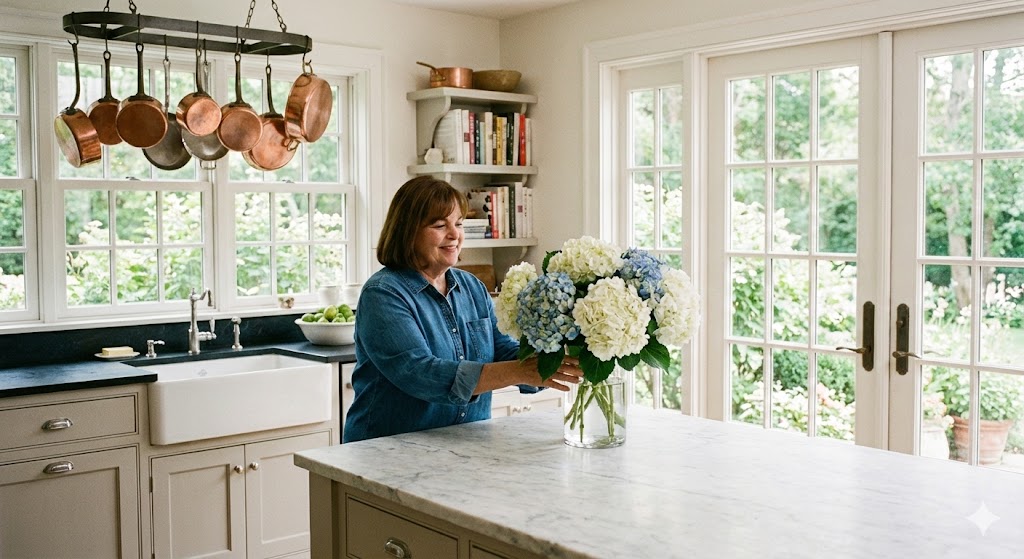
Everything about the space reflects what she never had growing up. Two Sub-Zero refrigerators. An eight-burner Viking stove. Belgian stone countertops. A 17th-century Italian cabinet for china. Floor-to-ceiling windows overlooking gardens she tends herself. The neutral colors—cream, beige, soft whites—create warmth without trying too hard. “I hate design that tries too hard,” she told The New York Times. “Anything that looks like design, that says, ‘Aren’t I fabulous,’ is totally without style.”
In 2023, she renovated her home kitchen for the first time in 27 years, adding her dream pantry and a Lacanche stove. The garden provides fresh ingredients for her recipes. The space is designed for one purpose: making people feel loved through food.
Consider what she built. The girl whose mother served broiled chicken and canned peas with clinical detachment now teaches millions how to make perfect roast chicken with good butter and fresh herbs. The child who wasn’t allowed comfort food created “Modern Comfort Food.” The woman told she’d never be loved became famous for her catchphrase: “How easy is that?”
The Fortune Behind the Contessa
Ina Garten’s net worth comes from multiple revenue streams that she’s cultivated over four decades:
First, her cookbook deals are among the most lucrative in publishing history. According to Publishers Weekly, her contracts are worth millions per book, with royalties continuing long after publication. Thirteen books and counting, with over 14 million copies sold worldwide.
Second, “Barefoot Contessa” ran on Food Network from 2002 to 2021, making it one of the channel’s longest-tenured shows. Her current series, “Be My Guest,” debuted in 2022 on Food Network and streams on Max. These contracts generate significant annual income.
Third, the Barefoot Contessa Pantry line—launched in partnership with Stonewall Kitchen—includes premium cake mixes, sauces, and marinades sold in high-end retailers like Williams Sonoma and Sur La Table.
Finally, real estate contributes substantially to her portfolio. Beyond the East Hampton compound, she owns a Manhattan apartment purchased for $4.65 million and reportedly has a residence in Paris. The East Hampton property alone is valued at nearly $4 million, though its true worth to her is incalculable.
Still That Girl, Still Proving Him Wrong
During the COVID-19 lockdown, Ina posted a video on Instagram showing how to make a Cosmopolitan. Not a regular Cosmo—a massive pitcher of Cosmos. She was wearing her signature denim shirt, minimal makeup, completely at ease. “You never know who’s stopping by,” she said with a wink. The video went viral. Millions watched this 72-year-old woman cheerfully make an enormous cocktail in her beautiful kitchen, radiating exactly the kind of warmth her childhood never contained.
That’s the cosmic joke at the heart of Ina Garten’s story. Her father said nobody would ever love her. Now strangers approach her on the street to whisper “I love you.” Her mother served food without joy. Now she’s built a $60 million empire teaching people that cooking for others is an act of love. She hid in her bedroom to stay safe. Now she opens her home to millions through her show.
The Promise She Keeps Every Day
“The food we enjoy most connects to our deepest memories of when we felt happy, comfortable, nurtured,” she wrote. Then she added, in parentheses: “(definitely not my childhood).”
That parenthetical contains everything. The wound is right there, acknowledged but not dwelt upon. And the empire she built? It exists precisely because she refused to let the wound define her. Instead, she made it her mission to give others what she never received.
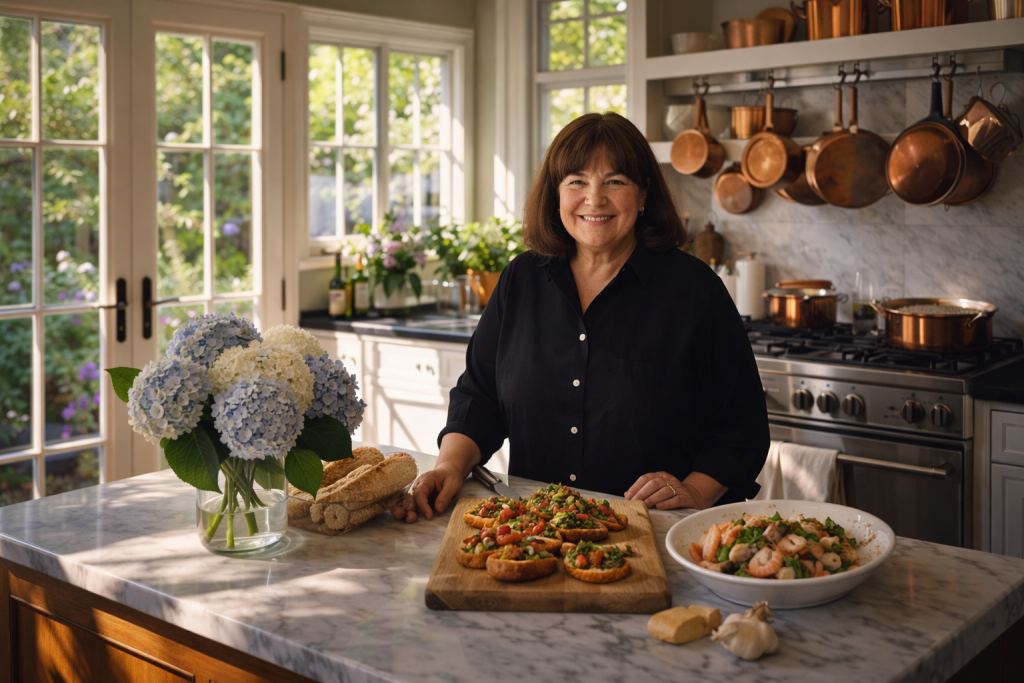
When Ina Garten stands in her East Hampton kitchen, sunlight streaming through the windows, fresh hydrangeas on the counter, teaching someone how to make a simple roast chicken, she’s doing something her mother never did. She’s saying: I see you. I think this will make you feel good. That’s what her whole world is about now.
The girl who was told nobody would love her became the woman who teaches millions how to express love. The house in East Hampton, the barn, the garden, the cookbooks, the show—it’s all one long answer to a cruel prediction made sixty years ago in a cold Connecticut house.
How easy is that? Not easy at all. But she made it look that way.
For more insider stories on Hamptons celebrities and exclusive coverage of the East End’s most fascinating residents, explore our archive. Want to see where the stories happen? Join us at Polo Hamptons for an unforgettable afternoon of sport, style, and social connection. Contact us for features, partnerships, and advertising inquiries.
Related Reading:
Author

Written by
Recent Posts

Aaron Paul Net Worth — His Character Was Supposed to Die in Season One. Instead He Made $30 Million.

Bryan Cranston Net Worth. He Played a Sitcom Dad for Seven Years. Then He Became the Most Dangerous Man on Television.
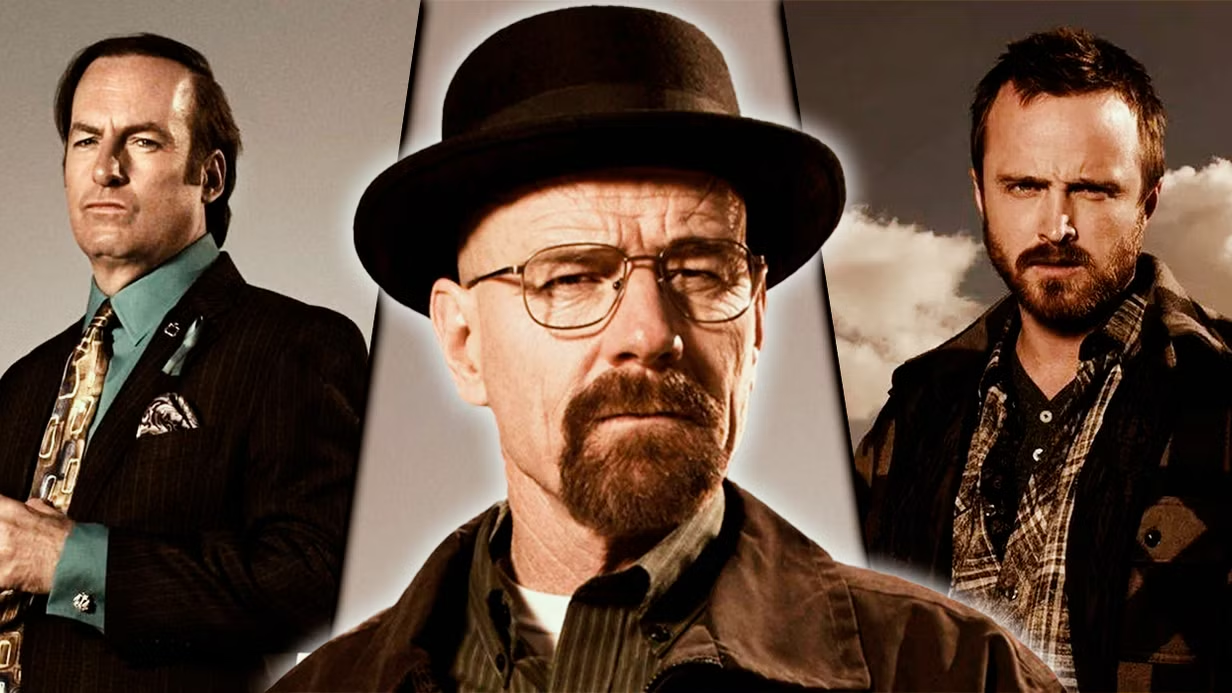
Breaking Bad Cast Net Worth. $130 Million Cooked in Five Seasons of Perfect Television

Cailee Spaeny Net Worth — From Springfield, Missouri to A24 and Alien in Three Years Flat

Wagner Moura Net Worth — He Learned Spanish to Play Escobar. Then He Learned English to Take Hollywood.
Categories
- Art
- Articles
- Beauty & Skincare
- Celebrities
- Celebrities|Movies
- Celebrities|The Chronicles
- Chronicles
- Entertainment|Culture
- Event Photos
- Events
- Fashion
- Fashion & Style
- Featured
- Food & Beverage
- Food, Spirits, Wine
- Hamptons
- Hamptons Celebrities
- Hamptons Celebrities|Celebrities|The Chronicles
- Health
- Health & Beauty
- Lifestyle
- Luxury Lifestyle
- Movies|Culture
- Movies|Hamptons Lifestyle
- Press
- Profiles
- Real Estate
- Technology
- The Chronicles
- Travel
- TV
- Uncategorized
- Weddings