
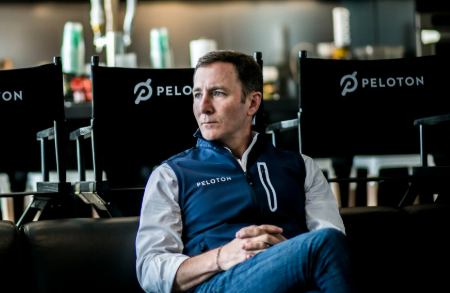
The kid who worked night shifts at a Skittles factory built a $50 billion fitness empire, became the pandemic’s richest CEO, then watched 87% of his fortune evaporate in 18 months.
“I’ve lost all my money,” Foley told the New York Post in 2024. “I’ve had to sell almost everything in my life.”
Today, John Foley’s net worth sits around $100 million—give or take, depending on which fire sale closed most recently. That sounds rich until you realize he lost approximately $1.7 billion in under two years. His current occupation? Selling custom rugs online.
This is the story nobody in the Hamptons wants to hear. Because it could happen to any of them.
The Wound: Night Shifts at the Skittles Factory
John Foley wasn’t born into the world of Further Lane estate sales. He arrived in 1971, Houston, Texas, then grew up in Key Largo, Florida, attending public schools while the children of privilege prepared for boarding academies and legacy admissions.
To pay for college at Georgia Tech, Foley worked the graveyard shift at a Mars Inc. factory. While other students slept, he manufactured Skittles, learning manufacturing processes that would later prove crucial to building hardware at scale. The experience left marks. When Foley eventually made it to Harvard Business School, he carried a chip about pedigree that never quite dissolved.
“I was always intimidated by Ivy League kids,” Foley admitted to Time. “Goldman Sachs, McKinsey, Blackstone, KKR. Harvard Business School more often than not is children of privilege. It’s a lot of people who have played their cards well, or had their parents help them play their cards well.”
The factory kid learned something at Harvard, though. Not that the privileged class was smarter—he discovered they weren’t. The revelation unlocked dangerous confidence. If these people could build empires, so could he.
“I came out of it with the confidence to think that no one’s really that much inherently smarter or better than the next person,” he said. “It comes down to hunger and humility.”
Hunger he had in excess. Humility would come later, at a price.
The Chip: 5,000 Rejections and the Blindspot of Silicon Valley
After Harvard, Foley climbed the corporate ladder conventionally—Mars Inc., Citysearch, Evite, and eventually president of e-commerce at Barnes & Noble. Those titles impressed at cocktail parties, but they didn’t scratch the itch. The Skittles-factory survivor wanted to build something of his own.
Inspiration struck during 2011, when Foley and his wife Jill, both boutique fitness addicts, found themselves unable to book classes at convenient times while juggling careers and two young children. The solution seemed obvious: bring the SoulCycle experience into people’s homes via connected technology.
Venture capitalists disagreed. Violently.
“I pitched approximately 400 institutions and got 400 ‘no thank-yous,'” Foley recalled on NPR’s “How I Built This.” The rejection tour lasted four years. By his estimate, he pitched three times per day, approaching between 5,000 and 6,000 potential investors before securing meaningful funding. One hundred angel investors eventually provided the first $10 million—after thousands refused.
The Valley’s Blind Spot
Geography and pattern recognition killed most conversations before they started. Silicon Valley couldn’t see what was happening in New York City with boutique fitness. “I would go out there and they would say, ‘There’s two types of biking out here, John: mountain biking and road biking,'” he told NPR. “They just didn’t see what was happening, and it was a blind spot for them.”
Worse, Peloton created a new category. VCs wanted comparable data, market research, proof that someone else had done this first. “They look for what’s called pattern recognition,” Foley explained, “and there wasn’t a pattern in what we were doing.”
During those lean years, Foley personally cleaned the office bathrooms because he couldn’t afford support staff. Engineers came first. Janitors could wait. Between pitch meetings, the founder scrubbed toilets, accumulating rejection emails like frequent flyer miles.
That kind of desperation forges something in a person. When everyone tells you no for four consecutive years, “yes” eventually sounds like vindication—and vindication sometimes sounds like permission.
The Rise: From $307,000 Kickstarter to $50 Billion Empire
Peloton launched via Kickstarter in 2013, raising $307,000. The first bikes shipped in 2014 at $1,995 each, mocked by industry observers as overpriced vanity equipment for coastal elites. Those observers weren’t entirely wrong about the demographic, just the business model.
Foley understood something traditional fitness companies missed: the product wasn’t the bike. The product was the subscription, the community, the parasocial relationship with charismatic instructors broadcasting from a sleek Manhattan studio. McKinsey would later call it “fitness as a service.” Foley called it obvious.
The numbers proved him right. By 2019, Peloton went public. By 2020, the pandemic arrived, and suddenly everyone needed exactly what Foley had spent eight years building. Sales surged 250%. Stock rose over 400%. Market cap hit $50 billion.
John Foley—the kid from Key Largo who’d worked the Skittles graveyard shift, who’d been rejected 5,000 times, who’d cleaned his own office bathrooms—was suddenly worth $1.9 billion. He appeared on the Bloomberg Billionaires Index. He purchased the Further Lane estate. Jerry Seinfeld became his neighbor.
The Hamptons welcomed him. Further Lane doesn’t ask where you came from. It asks what you can pay.
The Fall: Mr. Big Dies on a Peloton
The collapse happened fast. Too fast for anyone except short-sellers to profit.
As pandemic restrictions eased in 2021, Peloton’s executive team made a fatal assumption: the surge represented permanent behavioral change rather than temporary circumstance. The company invested $400 million in a new factory. They hired thousands of employees. Leadership projected growth that required people to never return to gyms.
People returned to gyms.
November 2021 brought the first alarm: first-quarter earnings forecasted sales $1 billion short of projections from just three months earlier. Peloton shares dropped 35% in a single day. But the symbolic kill shot came from an unlikely assassin: HBO.
On December 9, 2021, the “Sex and the City” reboot “And Just Like That…” premiered with Mr. Big—the beloved character played by Chris Noth—suffering a fatal heart attack immediately after an intense Peloton workout. Stock prices cratered further. The PR team scrambled to produce an ad featuring Noth to salvage the situation.
Then multiple women accused Noth of sexual assault. Peloton pulled the ad. The news cycle turned merciless.
Everything Collapsing at Once
“We were coming out of Covid. The stock was getting crushed. There was a leaker telling the press about pending layoffs. We had an activist investor demanding my firing,” Foley recalled. “And then the Mr. Big thing happens… it was brutal. All of a sudden, we were just being trolled… everything was collapsing.”
By February 2022, Foley stepped down as CEO. Barry McCarthy, the former CFO of Netflix and Spotify, took over. But the damage was structural. Peloton’s Tread treadmill had already been recalled after killing a child. Trust evaporated. Layoffs hit 2,800 employees. The factory investment became worthless. Market cap plunged from $50 billion toward $1.8 billion—a 96% destruction of value.
In October 2022, Goldman Sachs issued Foley a margin call on personal loans. He had pledged Peloton holdings originally worth $300 million as collateral. That collateral was now nearly worthless. The bank wanted its money.
By September 2022, Foley resigned as executive chairman entirely. Bloomberg calculated his net worth had fallen 87% from its peak. The paper billionaire discovered that paper burns.
The Tell: “I’ve Had to Sell Almost Everything in My Life”
The Further Lane estate—purchased December 2021 for $55 million—sold May 2023 for $51 million. A $4 million haircut plus carrying costs, closing costs, and the psychic toll of admitting defeat.
Next went the Manhattan townhouse at 66 Morton Street in the West Village—purchased in 2018 for $15.5 million—sold July 2024 for $35.5 million. At least that one appreciated, providing actual liquidity when everything else collapsed.
An earlier East Hampton property on Koala Lane—purchased 2016 for $2.9 million—sold January 2022 for approximately $4.7 million. Small victories against massive losses.
Foley now estimates his net worth somewhere around $100-225 million, depending on how you count Ernesta equity and remaining Peloton shares. Rich by normal standards. Broke by his 2021 standards.
“My family took it well,” he told the Post about the forced downsizing. “My wife’s super supportive. My kids are probably better for it, if we’re keeping it real.”
There’s a phrase—”probably better for it”—that suggests more processing still required. The children watched their father go from neighbor-to-Seinfeld to selling rugs. That’s either a character-building lesson or a trauma, depending on age and interpretation.
The Hamptons Connection: What Further Lane Teaches About Paper Wealth
John Foley still spends summer weekends in the Hamptons. He just does it differently now—downsized twice, as he puts it, though specific current addresses remain private. The man who once owned oceanfront footage measured in hundreds of feet now presumably rents, or stays with friends, or occupies something considerably more modest.
The Hamptons are filled with people like pre-fall Foley. Founders whose net worth exists almost entirely in unvested stock options. Executives whose lifestyle floats on margin loans against concentrated equity positions. Families living in $30 million homes financed by assets that could halve in value during a single bad earnings call.
Further Lane doesn’t discriminate between paper wealth and liquid wealth. It only asks if you can close. The neighborhood collected Foley’s $55 million in December 2021 and collected someone else’s $51 million in May 2023. Neither the house nor the neighbors particularly care about continuity of ownership.
The Lesson Nobody Wants to Hear
What Foley learned—what all the Hamptons paper billionaires should learn—is that concentrated stock positions are not wealth. They’re lottery tickets with expiration dates. When the margin call arrives, Goldman Sachs doesn’t negotiate.
“At one point I had a lot of money on paper,” Foley acknowledged. “Not actually in the bank, unfortunately.”
Ben Francis, the founder of Gymshark who was named Britain’s youngest billionaire, understood this instinctively: “None of it is real. It’s all on paper. That’s why I think it’s important that no individual should ever pin their self-worth on things like wealth, net worth, or anything financial.”
Easy to say when you’re young and ascendant. Harder to internalize when you’re 53, selling custom rugs, and explaining to your teenagers why they no longer live on Further Lane.
The Comeback: Ernesta and the Rug Business
Within a year of leaving Peloton, Foley raised $25 million in venture capital for Ernesta, a direct-to-consumer custom rug company. The founding team includes Hisao Kushi and Yony Feng—both Peloton co-founders—suggesting either deep loyalty or limited employment options for executives from a 96%-crashed company.
Foley projects Ernesta could generate $500 million in free cash flow by 2030. That’s ambitious for a rug company, but Foley has confounded expectations before. The man once cleaned toilets between pitch meetings. He can probably sell rugs.
“I’m working hard so that I can try to make money again… because I don’t have much left,” Foley told reporters. “And so I’m hungry and humble.”
There’s that word again: hungry. The Skittles factory never really left him. Neither did the 5,000 rejections. When you’ve climbed that far from that little, losing billions hurts—but it doesn’t erase the climb.
“I think, potentially, the best days of John Foley are ahead of me,” he insists. “I love a good underdog story.”
The Hamptons will be watching. Further Lane always takes reservations.
More Hamptons Wealth Stories: Want to understand how the East End’s biggest fortunes were built—and sometimes lost? Explore our archive of net worth profiles and wealth analysis.
Join the Conversation: For invitations to exclusive Polo Hamptons events where founders, family offices, and dealmakers actually connect, visit our events page.
Never Miss a Story: Subscribe to our newsletter for weekly insights on Hamptons real estate, wealth preservation, and the social dynamics that drive East End business.
Related Reading:
Author

Written by
Recent Posts
Behind the Scenes of Weddings Involving Long-Distance Relationships
Why Karaoke Is the Ultimate Entertainment Choice for a Hen Party
Easy Recipes That Feed A Crowd Without The Stress
The Influence Of Social Media On Interior Style Trends
Where Can You Find the Best Made-to-Measure Bespoke Suits in NYC
Categories
- Art
- Articles
- Beauty & Skincare
- Celebrities
- Celebrities|Movies
- Celebrities|The Chronicles
- Chronicles
- Entertainment|Culture
- Event Photos
- Events
- Fashion
- Fashion & Style
- Featured
- Food & Beverage
- Food, Spirits, Wine
- Hamptons
- Hamptons Celebrities
- Hamptons Celebrities|Celebrities|The Chronicles
- Health
- Health & Beauty
- Lifestyle
- Luxury Lifestyle
- Movies|Culture
- Movies|Hamptons Lifestyle
- Press
- Profiles
- Real Estate
- Technology
- The Chronicles
- Travel
- Uncategorized
- Weddings