
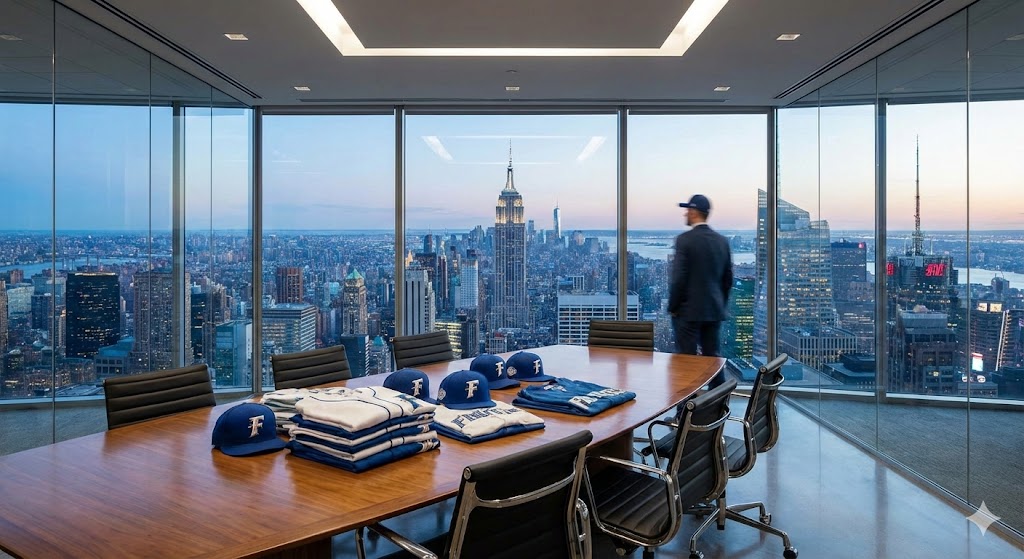
Michael Rubin was sixteen years old, standing in a Pennsylvania courtroom, watching a judge approve his debt settlement. He owed $120,000. His ski shop had failed. His father Ken, a veterinarian who’d co-signed the lease, had to write a $37,000 check to make the creditors go away. The condition? Michael had to promise to go to college.
That check came with something heavier than debt. It came with the look on his father’s face. The silence in the car ride home. The unspoken question: What kind of kid loses everything before he can legally vote?
Michael Rubin’s net worth now sits at approximately $11.5 billion, according to Forbes. He owns Fanatics, the $31 billion sports merchandise empire, and throws the most exclusive Fourth of July party in the Hamptons, where Beyoncé and Jay-Z mingle with Tom Brady at his $50 million Bridgehampton compound. He co-founded REFORM Alliance with Meek Mill to reshape criminal justice, and bought the White Party from Diddy and made it his own.
But somewhere inside the man who helicopters celebrities into the Hamptons is still a kid in a courtroom, learning what failure tastes like while his father watches.

The Wound: A Basement in Lafayette Hill
Michael Gary Rubin was born July 21, 1972, in Lafayette Hill, Pennsylvania, to parents who represented everything stable. His mother Paulette was a psychiatrist. His father Ken was a veterinarian. The family was Jewish, middle-class, Main Line adjacent. The kind of upbringing that produces doctors, lawyers, accountants.
Michael wanted something else.
At eight years old, he was selling vegetable seeds door-to-door. By twelve, he’d converted his parents’ basement into a ski-tuning shop. “I was a terrible athlete,” he later admitted at the Wharton Sports Business Summit. “The only sport I was good at was skiing.” So he did what he’d do for the rest of his life: if he couldn’t play the game, he’d find a way to own it.
At fourteen, using $2,500 from his bar mitzvah gifts and a lease his father reluctantly signed, Rubin opened Mike’s Ski and Sport in Conshohocken. First year revenue: $125,000. For a high school freshman.
Then came the winter without snow.
By sixteen, Rubin had $200,000 in bills, $100,000 in inventory that wouldn’t move, and a Porsche he’d bought with money he no longer had. His mother, the psychiatrist, was not happy about the car. His father, the veterinarian, was about to learn what co-signing a lease for a teenager actually meant.
“I tell that story to show that growth comes from failure,” Rubin said years later. What he didn’t say: the shame of watching your father clean up your mess doesn’t disappear when you become a billionaire. It just finds new ways to drive you.
The Chip: A Promise Kept Sideways
Rubin kept his promise. He enrolled at Villanova University. He lasted one semester.
The exit wasn’t failure this time. It was opportunity. While still technically a student, Rubin found $200,000 worth of overstock athletic equipment at a massive discount. He borrowed $17,000 from a friend, bought the lot, flipped it for $75,000 profit. The lesson crystallized: other people’s messes were his opportunities.
He used the proceeds to start KPR Sports—named after his parents’ initials, Ken, Paulette, Rubin—a kind of permanent tribute to the people who’d bailed him out. The company bought and sold overstock athletic merchandise. By 21, KPR hit $1 million in annual sales. By 23, $50 million.
In 1998, at 26, Rubin created Global Sports Incorporated, later renamed GSI Commerce. When an analyst asked him about “this Internet thing,” Rubin initially dismissed it. “Screw these Internet people,” he thought. “They lose a lot of money.”
Then Sports Authority and other major accounts told him e-commerce was the future. Rubin, who’d learned at sixteen that ignoring reality doesn’t make it disappear, pivoted hard.
GSI became the behind-the-scenes engine powering e-commerce for major retailers. By 2011, it was worth enough that eBay came calling.
The Rise: The $2.4 Billion Chess Move
In 2011, eBay acquired GSI Commerce for $2.4 billion. Rubin, who owned nearly 10% of the company, personally pocketed around $150 million. He was 38 years old. He could have retired to a beach somewhere and never thought about inventory again.
Instead, he played chess while everyone else played checkers.
eBay wanted GSI’s fulfillment operations to compete with Amazon. They had no interest in the consumer-facing businesses. So Rubin negotiated to buy back three subsidiaries at fire-sale prices: a flash-sale fashion site called Rue La La, a shipping membership program called ShopRunner, and a small sports merchandise operation called Fanatics.
The Fanatics buyback price: approximately $300 million for what GSI had acquired for $277 million just months earlier. Essentially a wash.
Today, Fanatics is valued at $31 billion. Rubin owns roughly 33% of it.
“The original vision was Zappos for licensed sports,” Rubin explained to Fast Company. “I was terrified that Amazon and Alibaba would kill everyone. So we radically changed the vision into v-commerce—vertically integrated commerce.” Instead of just selling jerseys, Fanatics would design them, manufacture them, and sell them directly. Cut out every middleman. Own the whole chain.
He secured exclusive licensing deals with the NFL, NBA, MLB, and NHL. Acquired Topps for $500 million to dominate trading cards. Launched Fanatics Sportsbook to enter gambling. Created Fanatics Fest, drawing 200,000 fans to New York City.
The kid who went bankrupt selling skis now controls how America buys its team jerseys.
The Tell: Two Americas, One Awakening
For years, Rubin and rapper Meek Mill had the same argument. “Meek would say, ‘Michael, there are two Americas,'” Rubin recalled. “I’d be like, ‘Bro, what are you talking about?'”
Then, in November 2017, Rubin sat in a Philadelphia courtroom watching his friend get sentenced to two to four years in prison. The crime? Doing wheelies on a dirt bike—a technical parole violation from a decade-old case. The prosecutor and probation officer both recommended no prison time. The judge sent him anyway.
“He called me after the sentencing to say ‘I told you so. Two Americas.’ He was right and I was dead wrong,” Rubin later admitted. “Meek taught me so much about a world that I didn’t understand at all.”
The guy who’d learned failure in a courtroom at sixteen suddenly saw something different in a courtroom at forty-five. Rubin visited Meek in prison fifteen times. He mobilized Jay-Z, Robert Kraft, and Roc Nation for the #FreeMeek campaign. When Meek was released in April 2018, Rubin picked him up in a helicopter and flew him directly to a 76ers playoff game.
The Launch
In January 2019, they launched REFORM Alliance with $50 million in pledges. The mission: change probation and parole laws that trap millions in the system. To date, REFORM has passed 22 laws in 12 states, impacting over 850,000 people.
“For me, I think failing is great, because if you fail fast and you learn how to fail, you can use that to build your next success,” Rubin said at Fast Company’s Innovation Festival, Meek sitting beside him. Then he added the truth: “That’s great for mainstream America. It doesn’t work that way for poor people. It doesn’t work that way for people who grew up in Meek’s environment.”
“People like me get to grow up and fail and learn. People who grow up like Meek should get that opportunity, too.”
The tell is in the word “should.” Michael Rubin failed at sixteen and his father wrote a check. Meek Mill made similar mistakes and nearly lost years of his life. The difference isn’t character. It’s circumstance. And Rubin, for all his billions, can’t forget that.
The Hamptons Connection: Buying the Scene
In 2020, Michael Rubin paid $50.15 million for an 8,000-square-foot oceanfront estate on Dune Road in Bridgehampton. The property sits on two acres with views of the Atlantic that cost more per foot than most Americans’ houses.
He also owns a $43.5 million penthouse in Manhattan’s West Village—7,750 square feet with a rooftop pool, screening room, and nearly 5,000 square feet of outdoor terrace.
But Rubin didn’t just buy Hamptons real estate. He bought the Hamptons social calendar.
His annual Fourth of July White Party has become the event of the summer, eclipsing even Diddy’s legendary Labor Day gatherings. Guest lists read like the Met Gala: Beyoncé, Jay-Z, Kim Kardashian, Tom Brady, Leonardo DiCaprio, Drake, Travis Scott. Custom Travis Scott x Nike Air Jordans in the gift bags. Fireworks launched from barges in the Atlantic. Performances by Lil Wayne, Mary J. Blige, Megan Thee Stallion.
Cars line Jobs Lane and Mecox Road for hours. Helicopters descend like a private air force. The Hamptons, which prides itself on discretion, becomes a paparazzi staging ground for one night.
“We make a joke that it’s 400 of our closest friends coming over to catch up,” said his fiancée, model Camille Fishel, to the New York Times.
But there’s something else happening at the White Party. The guest list isn’t just celebrities. It’s deal flow. Every person at that party represents relationships, opportunities, leverage. Michael Rubin didn’t become a billionaire by accident. He became one by understanding that social capital converts to economic capital—that the right room, the right moment, the right introduction is worth more than any spreadsheet.
The party is business dressed as pleasure. The Hamptons compound is a stage set for influence. And the kid who went bankrupt at sixteen is now the one deciding who gets invited.
What Michael Rubin’s Net Worth Really Means
The Michael Rubin net worth figure—$11.5 billion according to Bloomberg, $10.6 billion by Forbes’ more conservative estimate—represents something specific. About 33% of Fanatics at its $31 billion valuation accounts for roughly $10 billion. The rest comes from his stake in Rue Gilt Groupe, real estate, cash from the eBay sale, and various investments.
Unlike tech billionaires whose wealth fluctuates with stock prices, Rubin’s fortune is anchored in private equity. Fanatics isn’t publicly traded. His wealth doesn’t swing with quarterly earnings calls. He can think in decades, not news cycles.
The money enables scale. The All In Challenge during COVID-19 raised over $60 million for food insecurity. The REFORM Alliance gala in Atlantic City raised $24 million in a single night. When LA wildfires devastated communities in 2025, Rubin organized Fanatics partnerships with 18 LA sports teams within 24 hours, donating 100% of merchandise proceeds.
But the money also reveals something about the man. He could have any lifestyle. He chose the one with the most influence.
The Bottom Line
Michael Rubin’s net worth of $11.5 billion tells the story of a kid who failed early enough to learn what failure actually costs—and who had parents positioned to teach him that lesson without destroying him.
The bankruptcy at sixteen wasn’t the wound. The wound was the look on his father’s face. The drive that built Fanatics, that throws the White Party, that mobilizes billionaires for criminal justice reform—that’s all the same energy. It’s the energy of someone still proving something to a father who believed in him anyway.
The Bridgehampton compound isn’t where Michael Rubin goes to relax. It’s where he goes to show what he built with the second chance his father bought him. And now, through REFORM Alliance, he’s trying to buy that same second chance for people whose fathers couldn’t write the check.
The Hamptons don’t heal wounds. But they do make excellent stages for proving you were worth the investment.
Want more insider access to Hamptons luxury lifestyle? Subscribe to Social Life Magazine for exclusive features on the people and properties that define East End living.
Experience the season’s most exclusive gatherings at Polo Hamptons.
Related Articles:
Jerry Seinfeld Net Worth: Inside Comedy’s Richest Fortune
Author
Written by
Recent Posts
Behind the Scenes of Weddings Involving Long-Distance Relationships
Why Karaoke Is the Ultimate Entertainment Choice for a Hen Party
Easy Recipes That Feed A Crowd Without The Stress
The Influence Of Social Media On Interior Style Trends
Where Can You Find the Best Made-to-Measure Bespoke Suits in NYC
Categories
- Art
- Articles
- Beauty & Skincare
- Celebrities
- Celebrities|Movies
- Celebrities|The Chronicles
- Chronicles
- Entertainment|Culture
- Event Photos
- Events
- Fashion
- Fashion & Style
- Featured
- Food & Beverage
- Food, Spirits, Wine
- Hamptons
- Hamptons Celebrities
- Hamptons Celebrities|Celebrities|The Chronicles
- Health
- Health & Beauty
- Lifestyle
- Luxury Lifestyle
- Movies|Culture
- Movies|Hamptons Lifestyle
- Press
- Profiles
- Real Estate
- Technology
- The Chronicles
- Travel
- Uncategorized
- Weddings