
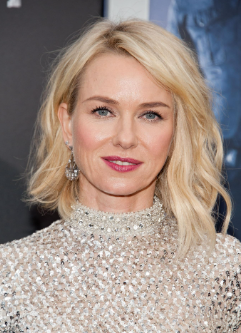
The fourteen-year-old girl stood in a Sydney casting office wearing a swimsuit, waiting. For two hours, she’d been waiting while photographers decided if she was pretty enough. Next to her stood another teenager, also in a swimsuit, also waiting. Neither girl booked the job. However, the second girl—Nicole Kidman—offered to pay for a taxi home, even though it was twenty minutes out of her way and cost an extra fifteen dollars.
“She was like the sister I’d never had,” Naomi Watts would say decades later. That taxi ride was the beginning of a friendship that would outlast marriages, children, and every Hollywood storm imaginable.
Today, Naomi Watts’ net worth stands at approximately $35 million. She’s earned two Academy Award nominations, starred in films that grossed over a billion dollars combined, and married for the first time at fifty-four. Along the way, however, she spent a decade flunking auditions so badly that her agent told her she was “making people uncomfortable.” In fact, she packed her bags to go home multiple times. Then David Lynch looked at her photograph and changed everything.
Some careers are built on talent alone. Others require something more painful: the willingness to fail until you can’t fail anymore.
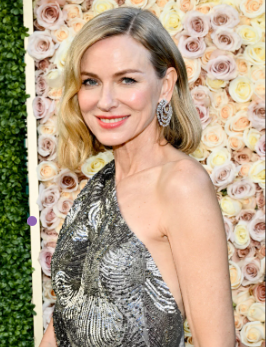
The Wound: A Father Lost, A Life Uprooted
Naomi Ellen Watts was born September 28, 1968, in Shoreham, Kent, England. Her mother, Myfanwy “Miv” Roberts, was a Welsh antiques dealer and costume designer. Her father, Peter Watts, worked as the road manager and sound engineer for Pink Floyd. If you’ve listened to The Dark Side of the Moon, you’ve heard him—Peter provided the maniacal laughter on “Brain Damage,” one of rock’s most haunting tracks.
The Day Everything Changed
Unfortunately, the marriage didn’t last. Naomi’s parents divorced when she was four, and they briefly reunited before separating again. Then, in August 1976, when Naomi was nearly eight years old, her father was found dead in a flat in Notting Hill, London. An apparent heroin overdose was the cause. He was only thirty-one.
The Photographs She Never Had
“You’ve got to understand, I’ve got maybe three photos of my dad, and maybe two memories,” Watts told The Guardian decades later. “And all of the photos of him are either out of focus or he’s a tiny speck in the background.” Recently, however, a Pink Floyd fan approached her with an envelope. Inside was a photograph of her father, smiling clearly at the camera. Remarkably, it was the first time—at age forty-eight—that she had ever seen his face that way. She cried.
When Peter died, he hadn’t saved any money, and Miv had none either. As a gesture of kindness, Pink Floyd gave the family a few thousand dollars to help them get by—not a trust fund, just support from her father’s former colleagues. Subsequently, Miv moved her children to Llanfawr Farm in Wales to live with her parents.
Nine Schools, Nine Selves
What followed was a childhood of constant movement. Naomi attended nine different schools across England—Kent, Cambridge, Norfolk, Suffolk, Wales—and each move required reinvention. “A lot of new schools, a lot of reinventing myself,” she has said. “‘How do I get into that group? How do I get accepted? Who should I be? Who do you want me to be?'”
At Welsh medium school in Anglesey, for instance, she took Welsh lessons while everyone else took English. Additionally, she learned to pick up regional accents instantly—a survival skill that would later become professional currency. “There was quite a lot of sadness in my childhood,” she has acknowledged, “but no lack of love.”
When Naomi was fourteen, her mother remarried and moved the family to Sydney, Australia. Initially, Naomi strongly objected—she didn’t want another upheaval, another school, another identity to construct. Nevertheless, she went anyway, and in Sydney, she finally found something worth holding onto.
The Chip: The Girl in the Taxi
The audition that introduced Naomi to Nicole Kidman didn’t launch either girl’s career. Instead, it was just another cattle call—two teenagers in bathing suits, photographers deciding who was “right.” Neither got picked. However, while they waited, they talked about movies they loved, friends they had in common, parents, schools, parties, boyfriends. Teenage stuff.
When it ended, Naomi realized she’d missed her bus. Without hesitation, Kidman offered to pay for a taxi, going twenty minutes out of her way to drop Naomi home. It was a small kindness from a teenager who had nothing to gain. Remarkably, forty years later, Kidman was still the person Watts called when her life fell apart.
The Decade Under the Radar
Watts dropped out of high school and took odd jobs—papergirl, department store marketing, assistant fashion editor at a magazine. Eventually, a friend convinced her to join a weekend drama workshop, and the experience reminded her how much she wanted to act. She quit her job the following Monday.
Her first screen credit came in 1986 with a small role in the Australian film For Love Alone. Afterward, she went to Japan to model and had a miserable experience. “It was after that that I made the decision that I didn’t want to be in front of the camera ever again,” she admitted. Meanwhile, Nicole Kidman’s career was ascending rapidly. Their friendship remained, but their trajectories diverged.
For a decade, Kidman repeated the same message to Watts: “One thing, Nay, one thing will change everything, I swear. Just hang in there.” Watts held on, barely. In 1991, both women starred in the Australian coming-of-age film Flirting—the job that solidified their friendship. Soon after, Watts took small roles in Australian films, then moved to Los Angeles in 1993 to try her luck in Hollywood.
The Years of No
What followed was brutal. Tank Girl (1995). Children of the Corn IV. Made-for-TV movies. Commercials. Auditions—five, sometimes ten a day—driving across town for parts she never got. By the late 1990s, as a result, Watts was broke, desperate, and alienating casting directors with her intensity.
“I was not getting hired, I was getting quite poor feedback, and it was tough. On the verge of being evicted, her agent delivered the devastating verdict: “You’re too intense. You’re making people uncomfortable.”
Multiple times, literally and metaphorically, she packed her bags to go home to Australia. Each time, however, something small would lure her back. Then came a phone call that changed everything.
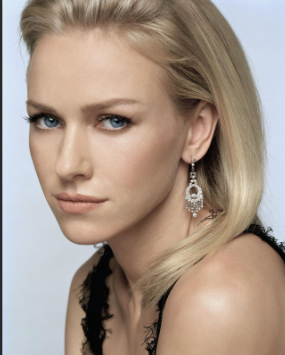
The Rise: The Man Who Saw Her
Watts was visiting New York to see a play with her mother and brother when her agent called. David Lynch was casting a television pilot and wanted to meet her. Unfortunately, the timing was terrible—she’d just spent money she couldn’t afford on plane tickets and theater tickets. Nevertheless, she flew back to Los Angeles.
Lynch’s audition process was unlike anything she’d experienced. “He sat me down and just looked me in the eyes and asked me questions,” Watts remembered. “Most of the time I was like, ‘How do I get out of your way? How do I speed this up?’ Because I’m sure I’m not right.” By then, she’d internalized a decade of rejection: not funny enough, not sexy enough, too old, too intense, too everything.
The Veneers Come Off
Lynch, however, saw something different. He later explained his casting philosophy: “I never have them audition a scene ever. I like to talk to people or see them talking, and then I get a feeling about them.” In Watts, he saw “a tremendous talent… a beautiful soul, an intelligence—possibilities for a lot of different roles.”
When ABC rejected the pilot, Lynch transformed it into Mulholland Drive (2001), a surreal neo-noir masterpiece about Hollywood dreams and nightmares. In the film, Watts played dual roles: Betty Elms, a bright-eyed ingenue arriving in Los Angeles with stars in her eyes, and Diane Selwyn, a bitter, broken woman destroyed by the industry’s cruelty.
The role required everything—comedy, tragedy, sexuality, rage, madness. During one particularly difficult scene, for example, Watts told Lynch she couldn’t continue. Instead of cutting, he kept the cameras rolling and soothed her with his voice until she found her way through. “That’s why it was easy to give things that were sometimes incredibly hard,” she said.
The Standing Ovation
When Mulholland Drive premiered in 2001, critics were stunned. The actress nobody had heard of had delivered one of the decade’s most celebrated performances. As a result, Lynch won Best Director at Cannes, and Watts became a star overnight—at thirty-three, after fifteen years of trying.
Suddenly, Naomi Watts’ phone started ringing with offers from directors who’d never known she existed. Gore Verbinski cast her in The Ring (2002), which grossed over $249 million worldwide. Similarly, Alejandro González Iñárritu cast her in 21 Grams (2003), earning her first Academy Award nomination. Peter Jackson chose her for King Kong (2005), and David Cronenberg put her in Eastern Promises (2007).
Remarkably, the girl who’d been told she made people uncomfortable was now working with cinema’s most demanding auteurs.
The Tell: What the Wound Became
In 2012, J.A. Bayona cast Watts as Maria Bennett in The Impossible, based on the true story of a family caught in the 2004 Indian Ocean tsunami. This demanding role required her to spend months in water tanks, performing scenes of drowning, injury, and desperate survival. As a result, it earned her a second Oscar nomination.
Consider what draws Watts to her roles. She consistently plays women in crisis—grieving mothers, survivors, people pushed to psychological extremes. Consequently, the characters who made her famous are defined by loss and reinvention, by the need to become someone else in order to survive.
The Pattern She Recognizes
“I lost my father very young, and then we moved around a lot,” Watts has reflected. “My mom was trying to find her feet. Several different schools and counties in the UK, then moving countries. So that concept of having to reshape myself.” In essence, the constant reinvention of her childhood became the foundation of her craft. A girl who learned to adapt to nine different schools ultimately became a woman who could become anyone on screen.
The Ongoing Work
Watts has been open about seeking professional help during periods of crisis. “I’ve definitely done periods of time in a therapist’s office,” she has shared. “Got some proper help at points of crisis.” Even now, the work continues.
In January 2025, when David Lynch died at seventy-eight, Watts posted a tribute that captured their relationship: “My heart is broken. My Buddy Dave… He put me on the map. The world I’d been trying to break into for ten plus years, flunking auditions left and right. Finally, I sat in front of a curious man, beaming with light.”
The Hamptons Connection: Finding Solid Ground
For someone who spent her childhood without a stable home, Naomi Watts’ relationship with the Hamptons represents something essential: permanence.
In 2007, Watts and her then-partner Liev Schreiber purchased a shingle-style cottage in Amagansett Lanes for $4.3 million. The 6,100-square-foot property featured six bedrooms, seven and a half bathrooms, a bluestone fireplace, vaulted ceilings, and a gunite pool with a pool house. Moreover, it was walking distance to town and a brief bike ride to the beach.
The Family She Built
Watts and Schreiber raised their sons there—Alexander “Sasha,” born in 2007, and Kai, born in 2008. Over time, they became fixtures of the East End, spotted at local restaurants and fundraisers. “I wanted my children to have a sense of identity based around being in one place,” Watts has said—a philosophy born from a childhood of constant displacement.
In 2016, after eleven years together, Watts and Schreiber announced their separation. Subsequently, they listed the Amagansett house for $5.85 million and purchased a new property in Montauk for $5.4 million—a 3,500-square-foot home on Surfside Avenue with ocean views, four bedrooms, and a heated pool.
Despite the separation, however, Watts and Schreiber remained committed co-parents. The Hamptons stayed central to their family life, with both maintaining homes in the area. When Schreiber later starred opposite Nicole Kidman in The Perfect Couple, Kidman checked with Watts first. “We always check in; we’re besties,” Watts said.
The Second Act of Love
In 2017, while filming the Netflix series Gypsy, Watts reconnected with actor Billy Crudup. They’d met briefly in 2009 at a Broadway benefit but hadn’t stayed in touch. Interestingly, playing husband and wife on screen, they fell in love off screen.
For five years, they kept the relationship private. Then, in June 2023, Watts announced their marriage with an Instagram photo on the steps of a Manhattan courthouse. “Hitched!” she wrote. She was fifty-four years old—her first wedding, his first wedding. The flowers came from a bodega. A year later, they celebrated with a second ceremony in Mexico City, surrounded by family.
The Fortune Behind the Fighter
Naomi Watts’ net worth of $35 million represents three decades of work, starting with roles that paid almost nothing and building to paydays that matched her talent. Specifically, the money comes from multiple streams cultivated across an unusually resilient career.
Her blockbuster work provides the financial foundation. For instance, The Ring franchise grossed nearly $500 million worldwide, while King Kong earned over $550 million globally. Additionally, films like The Impossible, Birdman, and the Divergent series added substantially to her earnings.
Television and Beyond
In recent years, Watts has embraced television’s new golden age. For example, she starred in and executive produced the Netflix series Gypsy. Subsequently, Ryan Murphy cast her in The Watcher (2022) and Feud: Capote vs. The Swans (2024), for which she earned an Emmy nomination for her portrayal of Babe Paley. Currently, she stars in Murphy’s legal drama All’s Fair, with a role as Jackie Kennedy in American Love Story coming in 2026.
Brand partnerships have also supplemented her acting income. Watts has served as an ambassador for Pantene and other luxury brands. Beyond acting, she’s launched Stripes, a wellness brand focused on menopause—thereby turning her own experience with this life transition into an entrepreneurial venture.
Strategic Real Estate
Her real estate portfolio reflects smart choices over time. She purchased the Amagansett property at $4.3 million and later listed it at $5.85 million. Meanwhile, the Montauk home cost $5.4 million. Additionally, she owns properties in Manhattan and Los Angeles, including a Brentwood home that once rented for $20,000 per month.
Still That Girl, Still Becoming
In October 2025, Naomi Watts received a star on the Hollywood Walk of Fame. Her husband Billy Crudup, her son Sasha, and Ryan Murphy were among those who celebrated with her. Understandably, the moment wasn’t lost on the woman who’d spent a decade being told she’d never make it.
“I have all kinds of imposter syndrome,” she admitted at the ceremony. “I’ve always felt like I’m supposed to struggle, I’m supposed to keep proving myself, and this sort of just came out of the blue.”
The Distance Traveled
Consider what Naomi Watts has become. The girl who lost her father at seven now helps other women navigate major life transitions through her wellness brand. Meanwhile, the teenager who moved nine times before fourteen built a permanent home for her children in the Hamptons. And the actress who flunked auditions for a decade has worked with Lynch, Iñárritu, Jackson, Cronenberg, and Murphy.
That friendship with Nicole Kidman—born in a casting office over forty years ago—remains intact. They still support each other publicly and still check in before making professional decisions that might affect the other. When Watts married, naturally, Kidman was there. “It was deeply memorable,” Kidman said. “A first wedding for both of them, isn’t that crazy?”
Naomi Watts’ net worth isn’t just $35 million in bank accounts and real estate. Rather, it’s the distance traveled from a fatherless girl in Wales to a Walk of Fame star in Hollywood—from sharing a taxi with a stranger to sharing a life with a family she built, from being told she made people uncomfortable to making them feel everything.
Her agent was wrong. That discomfort she caused wasn’t a weakness—instead, it was intensity, and intensity is just passion that hasn’t found its purpose yet. David Lynch saw it, and the roles she plays demand it. Ultimately, the girl who reinvented herself at nine different schools learned something essential: becoming is a lifelong practice, not a destination.
For more insider stories on Hamptons celebrities and exclusive coverage of the East End’s most fascinating residents, explore our archive. Want to experience where the stars play? Join us at Polo Hamptons for an unforgettable afternoon of sport, style, and social connection. Contact us for features, partnerships, and advertising inquiries.
Related Reading:
Author

Written by
Recent Posts
Behind the Scenes of Weddings Involving Long-Distance Relationships
Why Karaoke Is the Ultimate Entertainment Choice for a Hen Party
Easy Recipes That Feed A Crowd Without The Stress
The Influence Of Social Media On Interior Style Trends
Where Can You Find the Best Made-to-Measure Bespoke Suits in NYC
Categories
- Art
- Articles
- Beauty & Skincare
- Celebrities
- Celebrities|Movies
- Celebrities|The Chronicles
- Chronicles
- Entertainment|Culture
- Event Photos
- Events
- Fashion
- Fashion & Style
- Featured
- Food & Beverage
- Food, Spirits, Wine
- Hamptons
- Hamptons Celebrities
- Hamptons Celebrities|Celebrities|The Chronicles
- Health
- Health & Beauty
- Lifestyle
- Luxury Lifestyle
- Movies|Culture
- Movies|Hamptons Lifestyle
- Press
- Profiles
- Real Estate
- Technology
- The Chronicles
- Travel
- Uncategorized
- Weddings