
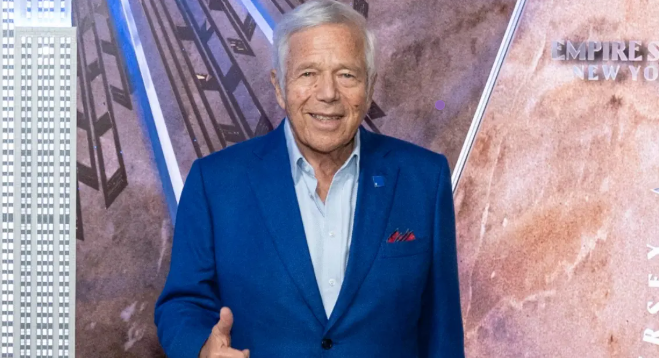
The boy couldn’t carry money on Saturdays. His father forbade it—the Sabbath was sacred, and commerce violated its sanctity. So young Robert Kraft relied on friends to cover his admission to double features at the Coolidge Corner Theatre in Brookline, Massachusetts. He couldn’t play high school sports either. Hebrew studies after school and Sabbath observance took priority over touchdowns.
His father, Harry Kraft, wanted him to become a rabbi. Instead, the boy who spent Saturdays studying Torah would one day own the most successful football franchise in NFL history. Nevertheless, the lessons from those Sabbath discussions—about legacy, about values, about the weight of a good name—would shape every business decision he ever made.
Robert Kraft’s net worth stands at approximately $11.8 billion, built across eight decades of relentless ambition, strategic patience, and a willingness to break his own financial rules when passion demanded it. His fortune represents paper mills and packaging plants, real estate developments and private equity stakes. However, at its core, it represents one audacious bet: paying $172 million for a failing football team that nobody else wanted to keep in New England.
The Wound: A Dress Manufacturer’s Son in Coolidge Corner
Robert Kenneth Kraft was born on June 5, 1941, in Brookline, Massachusetts. His grandfather, Louis Krafchinsky, had emigrated from Poland and established the family in Boston’s Jewish community. During the anti-Semitism surge of the 1930s, Harry Kraft shortened the family name and built a modest life running Crown Dress Co. in Boston’s Chinatown.
The Krafts lived in rented flats—first on Fuller Street, then Powell Street—in Brookline’s Coolidge Corner neighborhood. Harry never got rich manufacturing dresses. Consequently, he invested everything in something more valuable: his son’s character. He led services at Congregation Kehillath Israel, taught Hebrew to neighborhood children, and raised Robert in the traditions of Modern Orthodox Judaism.
The Weight of a Good Name
“When you go to bed at night, you ask yourself, ‘Is everyone who has come in contact with me today richer for having had that experience?'” This was Harry Kraft’s guiding principle, repeated so often that Robert would eventually pass it to his own four sons. The philosophy wasn’t about money. Instead, it was about legacy—about building a name worth inheriting.
Robert became president of the youth congregation at Kehillath Israel, presiding over Saturday services for as many as 700 young people. His friends remember Harry as “a towering figure, an inspiration to the Jewish children he tutored.” When Harry Kraft died in 1975, he left his son an “ethical will”—not money, but instructions for living a worthy life.
“Bob took great pride in the esteem in which his father was held,” noted Jonathan Sarna, a professor of American Jewish history at Brandeis University who took Hebrew lessons from Harry Kraft. “Bob cares deeply about his good name and about the way he is viewed not only by the community but by his own children.”
The Chip on His Shoulder
At Brookline High School, Kraft was senior class president in 1959. He joined the French Club and the concert choir. He was chairman of the junior prom. But he couldn’t play football—Hebrew studies and Sabbath observance made that impossible. The boy who loved the sport could only watch.
Columbia University offered a scholarship. There, finally, Kraft could play. He joined Zeta Beta Tau Fraternity and became running back and safety on the school’s freshman and lightweight football teams. Subsequently, he served as class president again. The pattern was emerging: Robert Kraft didn’t just participate. He led.
The Woman at the Deli
On February 2, 1962, Kraft walked into a delicatessen in Boston’s Back Bay. Inside, he met Myra Hiatt, a Brandeis University student whose father, Jacob Hiatt, had fled Lithuania in 1935 as the Nazis rose to power. Hiatt’s parents, sisters, and brother remained behind. They perished in the Holocaust.
Jacob Hiatt survived, settled in Worcester, and built the Rand-Whitney Group into a successful packaging company. His daughter Myra shared Robert’s deep Jewish roots and his commitment to giving back. They married in June 1963. Robert graduated from Columbia that same year, then earned his MBA from Harvard Business School in 1965.
The marriage would last forty-eight years. Together, they would donate over $400 million to causes spanning education, healthcare, and Jewish organizations. They raised four sons who would eventually run the Kraft Group. And Myra would become the picture of health—reading four books a week, weighing 98 pounds, exercising daily—until ovarian cancer took her in 2011 at age sixty-eight.
The Rise: From Paper to Power
After Harvard Business School, Kraft went to work at Rand-Whitney Group, his father-in-law’s packaging company. Within three years, he acquired the majority share through a leveraged buyout. In 1972, he founded International Forest Products, a trader of physical paper commodities. The Kraft Group was taking shape.
His first sports venture came in 1974 when he and several partners purchased the Boston Lobsters of World Team Tennis. They spent heavily to lure top players, including Martina Navratilova. However, the league folded in 1978, taking the Lobsters with it. The loss stung, but it planted a seed. Kraft wanted to own a sports team—specifically, the one he’d watched since childhood.
The Long Game Begins
By 1985, Kraft had been a New England Patriots season ticket holder for fourteen years. The team was terrible—perpetually losing, perpetually threatening to leave town. Most investors saw liability. Kraft saw opportunity. That year, he bought a 10-year option on the land surrounding Sullivan Stadium in Foxborough. The purchase seemed foolish: the parking lots generated only $700,000 annually, meaning Kraft would spend $27 million to generate $7 million over a decade.
But the land wasn’t the point. By controlling the parking lots, Kraft prevented Patriots owner Billy Sullivan from holding non-Patriot events while races occurred at the adjacent horse track. Additionally, it was the first step in a chess match that would take nine years to complete.
Sullivan’s family was reeling from a disastrous investment: they had pledged Sullivan Stadium as collateral for The Jacksons’ 1984 Victory Tour, which lost millions. By 1988, the stadium was in bankruptcy. Kraft outbid competitors to purchase it for $22 million—a seemingly worthless asset attached to a seemingly worthless team. However, the purchase included the stadium’s lease to the Patriots, which ran through 2001.
The Audacious Bet: Buying the Patriots
Victor Kiam bought controlling interest in the Patriots in 1988. He and Sullivan immediately tried to move the team to Jacksonville. But Kraft held the trump card: that stadium lease included an operating covenant requiring the Patriots to remain in Foxborough. Breaking it wouldn’t just trigger civil penalties—under Massachusetts law, the repercussions could be criminal.
Kiam’s financial troubles forced him to sell the Patriots to James Orthwein in 1992. Orthwein, a St. Louis native and member of the Anheuser-Busch family, had designs on moving the team to Missouri. He was already planning to rename them the St. Louis Stallions. But Kraft still held that lease.
The Moment of Truth
In 1994, Orthwein offered Kraft $75 million to buy out the remaining years on the stadium lease—three times what Kraft had paid for the entire stadium. It was free money. Take the cash, let the Patriots leave, and walk away rich.
Kraft refused. Instead, he made a counteroffer: $172 million for outright ownership of the Patriots. It was the highest price ever paid for an NFL franchise at the time. Orthwein, exhausted by the legal complexities, accepted. Even Stan Kroenke (who would later own the Los Angeles Rams) offered $200 million, but Kraft’s control of the stadium made his bid impossible to reject.
“My objective in buying the Patriots is to help bring a championship to New England,” Kraft said that day. The team had won just 19 games in the previous five seasons. They had never won a Super Bowl. Critics thought he was insane.
Kraft still keeps a Victory Tour poster in his office—the Michael Jackson concert that bankrupted the Sullivans and set in motion the events that allowed him to buy the team. “I broke every one of my financial rules,” he later admitted. Remarkably, he still believes he “overpaid” for the franchise.
The Dynasty: Six Rings and Counting
The first year under Kraft’s ownership, the Patriots won 10 games and made the playoffs for the first time in eight years. It was the first sellout season in franchise history. Every home game—preseason, regular season, playoffs—has sold out ever since.
In 1996, the Patriots reached the Super Bowl, losing to Green Bay. Then came the decision that transformed good fortune into dynasty. On January 27, 2000, Kraft traded a first-round draft pick to the New York Jets for the rights to hire Bill Belichick as head coach. The trade was widely mocked. That same year, the Patriots drafted a quarterback named Tom Brady in the sixth round.
The Championship Years
What followed was unprecedented in professional football. Six Super Bowl championships: 2001, 2003, 2004, 2014, 2016, 2018. Nine AFC Championship appearances. Nineteen division titles in 27 years of ownership. Fourteen seasons with 12 or more wins, compared to zero such seasons in the franchise’s entire history before Kraft. The Patriots became the most successful dynasty in modern NFL history.
In 2002, Kraft financed a $350 million stadium—now Gillette Stadium—with 83 percent private funding, a rarity in an era when owners typically demanded public subsidies. Subsequently, in 2007, he developed Patriot Place, a $375 million shopping and entertainment complex adjacent to the stadium. The dress manufacturer’s son had built his own town.
The team he purchased for $172 million is now valued at approximately $9 billion. In September 2025, Kraft sold an 8 percent stake at that valuation, confirming the Patriots’ status among the most valuable franchises in sports.
The Tell: What the Money Reveals
Robert Kraft’s $11.8 billion net worth breaks down across several categories. The New England Patriots represent the largest component, valued at roughly $9 billion. The Kraft Group’s paper and packaging businesses—including Rand-Whitney and International Forest Products—generate over $2 billion in annual sales across 90 countries.
His real estate portfolio exceeds $130 million, featuring a $43 million Hamptons mansion, two Palm Beach estates worth over $65 million combined, and a Brookline residence valued at approximately $20 million. Additionally, he owns the New England Revolution of Major League Soccer, valued at $530 million.
The Philanthropy of a Rabbi’s Son
The Kraft family has donated over $400 million to charitable causes. They funded Kraft Family Stadium for American football in Jerusalem and established the Kraft Family Israel Football League. They pledged $20 million to improve healthcare access in New England communities. In 2019, Kraft launched the Foundation to Combat Antisemitism with a pledge of $50 million.
The giving reflects Harry Kraft’s teaching: wealth means nothing without a good name. In 2020, during the COVID-19 pandemic, Kraft used the Patriots’ team plane to fly 1.2 million N95 masks from China to hospitals in Massachusetts and New York. The gesture made headlines. For Kraft, it was simply what his father would have expected.
The Hamptons and Beyond
While Kraft’s primary residence remains in Brookline—the same neighborhood where he grew up in rented apartments—his real estate portfolio extends to the most exclusive enclaves in America. His $43 million Hamptons estate provides the kind of privacy and prestige befitting a billionaire owner of an NFL dynasty.
The property reflects Kraft’s evolution from working-class Brookline to the upper echelons of American wealth. Still, friends say he remains the same person who couldn’t carry money on Saturdays, who learned leadership presiding over youth services at Kehillath Israel. The fortune changed his circumstances. It didn’t change his values.
The Second Chapter
When Myra died in 2011, Kraft was devastated. “I sort of feel robbed,” he said. “Our plan was that she was going to outlive me by 30 years.” His children worried they might lose him too. The 2011 Patriots season was dedicated to Myra, with players wearing “MHK” patches on their jerseys.
“I’m blessed with four great children and eight grandchildren,” Kraft said. “But you go home, and you go home alone, and no one’s there. It’s just really sad.” For a year, he struggled. Then, gradually, he emerged.
In October 2022, Kraft married Dr. Dana Blumberg, an ophthalmologist 33 years his junior. Elton John performed at the wedding. Tom Brady attended. “I had a tremendous first wife,” Kraft said. “I never believed I would get married again, then I met a woman who was just off the charts, and she made me very happy.”
Still That Boy, Still Becoming
At 84, Robert Kraft remains chairman and CEO of the Kraft Group and the New England Patriots. His four sons—Jonathan, Daniel, Joshua, and David—have been integrated into various aspects of the family business, from packaging operations to sports management. Succession planning is underway, but Kraft hasn’t slowed down.
The Patriots hired Mike Vrabel as head coach in January 2025, beginning their next chapter without the Belichick-Brady dynasty. The team faces a rebuilding phase, but Kraft has rebuilt before. He’s done it his whole life—taking what others discarded and finding value where nobody else looked.
The Lesson in the Numbers
Consider what Robert Kraft’s $11.8 billion represents. First, it represents the earnings of a man who started as a newspaper boy outside Braves Stadium. Second, it represents the patience of a chess player who spent nine years acquiring parking lots and stadiums before finally claiming his prize. Third, it represents the faith of a father who taught his son that character matters more than commerce.
Harry Kraft never got rich selling dresses in Chinatown. But he raised a son worth $11.8 billion who still measures himself by his father’s standard: “Is everyone who has come in contact with me today richer for having had that experience?”
The answer, for tens of thousands of Patriots fans who watched six Super Bowl victories, for the communities transformed by Kraft philanthropy, for the league saved by his intervention during the 2011 lockout, appears to be yes. The dress manufacturer’s son kept the good name and multiplied it a billion times over.
Interested in profiles of owners who transformed their industries? Contact Social Life Magazine for features, partnerships, and advertising inquiries. Discover exclusive Hamptons events at Polo Hamptons. Subscribe to our newsletter for insider access to the stories behind extraordinary wealth.
Related Reading:
- Kate Hudson Net Worth: From Abandoned to $80 Million Empire
- The Celebrities Who Summer in the Hamptons
Support independent journalism covering the intersection of sports, wealth, and legacy. Donate $5 to help us continue telling these stories.
Author

Written by
Recent Posts

Civil War A24 Cast Net Worth — A24 Bet $50 Million on the End of America and Won
Midsommar A24 Cast Net Worth — The Daylight Horror That Turned Grief Into a Career Launchpad
ZOI NOMAD & TEN11 LOUNGE MARK ONE YEAR
Room A24 Cast Net Worth — The $6 Million Captivity Drama That Set Brie Larson Free
The Witch A24 Cast Net Worth — A $3.5 Million Puritan Nightmare That Created a Queen and a King
Categories
- Art
- Articles
- Beauty & Skincare
- Celebrities
- Celebrities|Movies
- Celebrities|The Chronicles
- Chronicles
- Entertainment|Culture
- Event Photos
- Events
- Fashion
- Fashion & Style
- Featured
- Food & Beverage
- Food, Spirits, Wine
- Hamptons
- Hamptons Celebrities
- Hamptons Celebrities|Celebrities|The Chronicles
- Health
- Health & Beauty
- Lifestyle
- Luxury Lifestyle
- Movies
- Movies|Culture
- Movies|Hamptons Lifestyle
- Press
- Profiles
- Real Estate
- Technology
- The Chronicles
- Travel
- Uncategorized
- Weddings