
,The teenage boy sat in the darkness of the Barcelona opera house, watching Carmen unfold onstage. Then he saw her. Not a performer. A woman in the audience. She had grey hair, luminous skin, and wore a red velvet gown that seemed to set her ablaze among the crowd.
“Among all the colours worn by the other women, she looked unique, isolated in her splendor,” Valentino Garavani would later recall. “I never forgot her. She became the red goddess.”
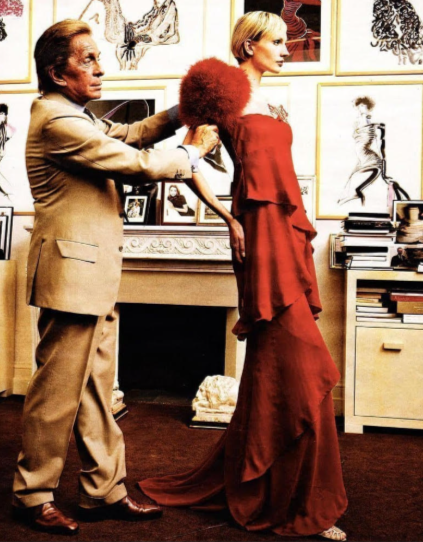
In that moment, a boy from a modest Italian household understood something about the power of clothing to transform. To elevate. To make a woman the heroine of her own story. Six decades later, his signature shade would have its own Pantone designation. His net worth would reach $1.5 billion. And every collection he ever designed would include at least one red dress.
Estimated Net Worth: $1.5 billion
Source of Wealth: Fashion design, brand sale ($300 million in 1998), real estate, royalties, art collection
Key Properties: Château de Wideville (Paris), Villa La Vignola (Rome), London mansion, New York penthouse, Gstaad chalet
The Yacht: TM Blue One ($15 million), named after his parents Teresa and Mauro
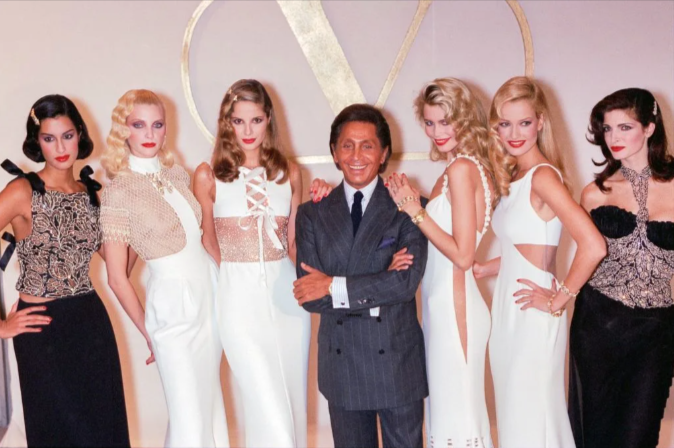
Unlike Bernard Arnault, who built his fortune through acquisitions, or Giorgio Armani, who never sold a single share, Valentino chose a different path. He and partner Giancarlo Giammetti sold their company in 1998 for $300 million, freeing themselves from corporate obligations while the brand continued without them. Today, Valentino lives among castles and yachts, surrounded by over a thousand varieties of roses and six beloved pugs, having traded the pressures of fashion for the pleasures of a life beautifully arranged.
The Wound: A Provincial Boy in a Modest Household
Valentino Clemente Ludovico Garavani was born on May 11, 1932, in Voghera, a small town in the Lombardy region of northern Italy, roughly halfway between Turin and Milan. His mother named him after Rudolph Valentino, the silent film star who had died six years earlier. It was an aspirational choice for a family of modest means.
His father, Mauro Garavani, worked in electrical supplies. His mother, Teresa de Biaggi, kept their provincial household running. The family environment, while not affluent, provided a supportive backdrop for Valentino’s emerging creative instincts. He was raised devoutly Catholic, with deep respect for the Virgin Mary. Yet from his earliest years, something else competed for his devotion.
The Theatre and the Magazines
Young Valentino accompanied his mother to the theatre, where elaborate costumes on performers captivated his imagination. He devoured fashion magazines, poring over images that fueled his artistic vision. While other children played outside, he sketched dresses in his schoolbooks, creating designs inspired by the styles he admired, even drawing outfits for his well-dressed cousins.
His parents hoped he would pursue law or medicine. Instead, his aunt Rosa and a local designer named Ernestina Salvadeo became his first teachers. They recognized what his parents eventually accepted: this boy belonged to fashion. By his mid-teens, he had exhausted every opportunity to learn in Voghera. The next step was Paris.
The Chip: The Italian in Hostile Territory
In 1949, at seventeen, Valentino moved to Paris with his parents’ support. He enrolled at the École des Beaux-Arts and the Chambre Syndicale de la Couture Parisienne. The timing was challenging. Post-war Paris was rebuilding itself as the fashion capital, and the scene was hostile to foreigners, particularly Italians. Yet Valentino possessed something that transcended nationality: talent that couldn’t be ignored.
He won a design competition sponsored by the International Wool Secretariat, the same prize that Yves Saint Laurent and Karl Lagerfeld would win in subsequent years. The victory led to a position at Jean Dessès, where he spent five years learning the intricacies of opulent eveningwear, including fine pleating, beading, and lightweight draping techniques inspired by ancient Greek motifs.
The Masters Who Shaped Him
Valentino’s Parisian education was comprehensive. He apprenticed briefly with Balenciaga, absorbing the Spaniard’s legendary precision and architectural approach to garments. Then he joined Guy Laroche’s emerging atelier in 1957, playing a key role in the house’s nascent operations for two years. Each master added a layer to his foundation: Dessès taught him draping; Balenciaga taught him structure; Laroche taught him business.
By 1959, Valentino was ready. He returned to Italy not as the provincial boy who had left, but as a designer trained by the greatest names in French couture. He would build his house in Rome, bringing Parisian technique to Italian sensibility. His father provided the financial backing. His vision provided everything else.
The Rise: From Via Condotti to the World
Valentino opened his fashion house on Rome’s exclusive Via Condotti in 1959. His first collection featured “La Fiesta,” a strapless mid-length tulle dress in a bright red shade that would become his signature. The following year, he met Giancarlo Giammetti, an architecture student who became his romantic partner and business collaborator. Giammetti’s financial acumen would prove as essential as Valentino’s creative genius.
The international debut came in 1962 at the Pitti Palace in Florence. Reviews were ecstatic. Orders flooded in from socialites and aristocrats worldwide. Within two years, Valentino was dressing the women who defined elegance: the Begum Aga Khan, Queen Paola of Belgium, Elizabeth Taylor, Audrey Hepburn.
Jackie Kennedy and the Dress That Changed Everything
In 1964, Jacqueline Kennedy saw a Valentino ensemble on a friend and asked for the designer’s name. When Valentino arrived in New York that September to present a collection at the Waldorf-Astoria, Jackie couldn’t attend. So he sent models and clothes to her Fifth Avenue apartment. She ordered six haute couture pieces immediately.
For the year following President Kennedy’s assassination, Jackie wore Valentino almost exclusively, her mourning wardrobe a statement of restrained elegance that introduced the designer to America. In 1968, she wore a short ivory lace Valentino dress for her wedding to Aristotle Onassis. “She inspired me, supported me during difficult times,” Valentino said. “With her style, she was able to get people talking about me by getting them to talk about her.”
The White Collection and the $300 Million Exit
While red remained his calling card, Valentino’s 1968 all-white collection proved equally revolutionary. Against the psychedelic excess of the era, he presented twelve dresses in pure white, cream, ivory, and beige. The collection introduced his iconic V logo and cemented his status as a master of restraint amid chaos.
By the 1990s, the Valentino brand had grown into a global powerhouse. In 1998, Valentino and Giammetti sold the company to Italian conglomerate HdP for $300 million. Unlike Tom Ford, who would later exit his own brand sale with over a billion dollars, Valentino’s deal came with a five-year consultancy arrangement that allowed him to continue designing. He retired in 2008, his final haute couture show featuring every model in red.
The Tell: How the Wound Still Shows
Valentino’s obsession with beauty extends far beyond clothing. His homes are decorated with museum-quality precision. His tables are set with Mottahedeh Chinese porcelain and Meissen swan figurines. He owns over a thousand varieties of roses at Château de Wideville and travels everywhere with his six pugs. The man who grew up in modest circumstances has spent his adult life surrounded by exquisite objects, as if beauty itself could fill whatever remained empty.
“I didn’t want to be part of a system that is not so much about designing but about managing the companies, about money, about conglomerates,” he told Architectural Digest explaining his retirement. “Why did I need to go through that? I had everything in my life.”
The Romance and the Partnership
Valentino’s relationship with Giammetti evolved from romance to profound partnership. They were together from 1960 until 1972 as lovers, then continued as business partners and lifelong companions. Giammetti managed the commercial side while Valentino created. “Valentino and Giancarlo are the kings of high living,” Women’s Wear Daily’s John Fairchild observed. “Every other designer looks and says, ‘How do they live the way they do?'”
The answer lay in Giammetti’s business acumen and Valentino’s willingness to invest in living beautifully. Their lifestyle became inseparable from the brand’s image: sophisticated, European, unapologetically extravagant.
The Location: Castles, Yachts, and a Thousand Roses
Valentino’s real estate portfolio reads like a European grand tour. Château de Wideville, his 17th-century residence outside Paris, was built by Louis XIII’s finance minister and once housed one of Louis XIV’s mistresses. Valentino acquired the eight-bedroom estate in 1995, commissioning legendary decorator Henri Samuel to restore it. The 280-acre property includes gardens designed by Wirtz International, a pigeonnier tower filled with chinoiserie, and a shell grotto dating to the 1630s.
His other properties include Villa La Vignola on Rome’s Appian Way, a London mansion, a Fifth Avenue penthouse in New York, and Chalet Gifferhorn in Gstaad, where he spends winters among celebrities and aristocrats. Each residence is filled with his art collection, which includes paintings by Picasso, Warhol, and Arcimboldo.
The Yacht Named for His Parents
The TM Blue One, Valentino’s $15 million superyacht, represents perhaps his most personal possession. Built by Picchiotti in 1988 and designed by Gerhard Gilgenast, the vessel is named after his parents: Teresa and Mauro. The boy from Voghera who watched his mother at the theatre now sails the Mediterranean on a boat bearing her initials.
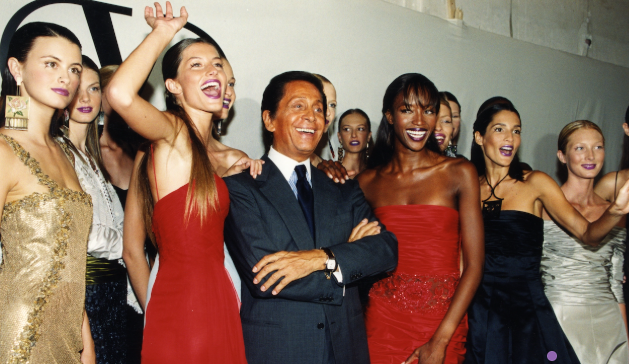
The yacht regularly hosted supermodels during Valentino’s working years. Elle Macpherson, Claudia Schiffer, Naomi Campbell, and Elizabeth Hurley were all guests aboard. Today, it remains part of his fleet of pleasures, a floating extension of the beautiful life he has constructed.
The Paradox of the Emperor
They called him “The Last Emperor” in the 2008 documentary that chronicled his final year in fashion. The title captured something essential: Valentino represented an era when designers were gods, when craftsmanship mattered more than commerce, when a single red dress could make a woman feel like a heroine.
Yet the boy who saw that grey-haired woman in Barcelona never forgot what he witnessed. A woman transformed by color. Elevated by fabric. Made singular by clothing that understood her power. Every red dress since has been an attempt to recreate that moment, to give other women what she had given him: the vision of what fashion could be.
His castles are beautiful, his yacht sails on, and his pugs are photographed for Instagram by Giammetti. But somewhere in all that splendor lives the provincial teenager who fell in love with the idea that clothing could change everything. The wound was never poverty. The wound was seeing perfection once and spending a lifetime trying to make it again.
Related Articles
- Giorgio Armani Net Worth 2025: The $12 Billion Designer Who Never Sold Out
- Ralph Lauren Net Worth 2025: The Bronx Kid Who Sold America Its Dream
- Tom Ford Net Worth 2025: From Texas Outsider to $2 Billion Empire
- Michael Kors Net Worth 2025: The Long Island Boy Who Renamed Himself
For more insider perspectives on the personalities shaping luxury fashion, visit Social Life Magazine or explore The Archive.
Experience luxury lifestyle at Polo Hamptons.
Contact us for features and partnership opportunities.
Author

Written by
Recent Posts
Aaron Paul Net Worth — His Character Was Supposed to Die in Season One. Instead He Made $30 Million.
Bryan Cranston Net Worth. He Played a Sitcom Dad for Seven Years. Then He Became the Most Dangerous Man on Television.
Breaking Bad Cast Net Worth. $130 Million Cooked in Five Seasons of Perfect Television

Cailee Spaeny Net Worth — From Springfield, Missouri to A24 and Alien in Three Years Flat
Wagner Moura Net Worth — He Learned Spanish to Play Escobar. Then He Learned English to Take Hollywood.
Categories
- Art
- Articles
- Beauty & Skincare
- Celebrities
- Celebrities|Movies
- Celebrities|The Chronicles
- Chronicles
- Entertainment|Culture
- Event Photos
- Events
- Fashion
- Fashion & Style
- Featured
- Food & Beverage
- Food, Spirits, Wine
- Hamptons
- Hamptons Celebrities
- Hamptons Celebrities|Celebrities|The Chronicles
- Health
- Health & Beauty
- Lifestyle
- Luxury Lifestyle
- Movies|Culture
- Movies|Hamptons Lifestyle
- Press
- Profiles
- Real Estate
- Technology
- The Chronicles
- Travel
- TV
- Uncategorized
- Weddings