
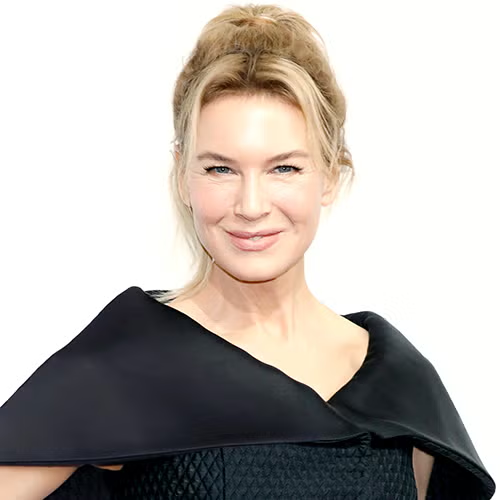
She disappeared for six years. When she came back, nobody talked about where she had been. They talked about her face.
Renée Zellweger’s net worth is $90 million. Furthermore, she holds two Academy Awards — one for Cold Mountain, one for Judy — which places her among the most decorated actresses of her generation. Consequently, the cautionary tale embedded in her story has nothing to do with her talent. It has everything to do with what the industry decided to do with her appearance the moment she stopped being useful as a symbol of relatable imperfection.

This is not a failure story. Rather, it is a story about what happens when a woman’s face becomes more interesting to the public than anything she actually does with it.
The Before: Katy, Texas, and the Face That Launched a Career
Renée Kathleen Zellweger was born April 25, 1969, in Katy, Texas, to a Swiss mechanical engineer father and a Norwegian nurse mother. The combination produced someone distinctly outside the Hollywood template before she ever stepped near one. Her father’s precision and her mother’s practicality produced someone who approached acting as craft rather than calling.
At Katy High School, she played soccer, cheered, ran track, and competed in speech. Additionally, she studied English literature at UT Austin. To fund her tuition after her father lost his job, she worked as a cocktail waitress. Notably, she graduated. Unlike Reese Witherspoon or Jennifer Lopez, she didn’t drop out. Notably, she earned the degree first, then pursued the career — a sequencing that would prove characteristic of everything she did afterward.
The Austin Years and the Slow Climb
Rather than relocating to Los Angeles immediately, Zellweger spent her early years auditioning in Austin and Houston, taking indie and low-budget roles that paid very little and taught her everything. Texas Chainsaw Massacre: The Next Generation. Empire Records. Love and a .45. Each role arrived without a guarantee of what followed. Meanwhile, she was developing the specific quality that would eventually make Tom Cruise request her personally for Jerry Maguire: an ability to make emotional truth visible without announcing it.
The Wound: Bridget Jones and the Body as Instrument

Jerry Maguire in 1996 made her famous. Bridget Jones’s Diary in 2001 made her a cultural institution. It also introduced a persistent dynamic. For the next two decades, the public treated her body as part of the performance — available for comment regardless of her wishes. Specifically, she gained weight for the role. She gained more for the sequel. Indeed, critics praised her commitment. The tabloids tracked her weight between films with the clinical attention of a cardiologist monitoring a patient.
Notably, Zellweger never complained publicly about this arrangement. Dutifully, she accepted the terms, delivered the performances, and collected the Oscar nominations. However, something in the transaction was wrong — visible only later. The implicit agreement was that her physicality was public property. Gaining and losing weight for roles was a story the audience owned alongside the films themselves.
Chicago and the Limits of Transformation

Chicago in 2002 demonstrated a different kind of physical commitment — singing, dancing, total stylistic reinvention as Roxie Hart. Accordingly, the Academy Award for Best Supporting Actress followed. Furthermore, Cold Mountain in 2003 earned her a second Oscar — Best Supporting Actress as Ruby Thewes. That performance was so grounded in working-class specificity it bore no resemblance to either Bridget Jones or Roxie Hart. By 2004, she had two Oscars and had played three completely different human beings convincingly. Her range was not in question. What the industry’s interest in her face was already doing, however, was overshadowing its interest in what she did with it.
The Rise: Fatigue, the Brief Marriage, and the Exit
In 2005, Zellweger married country singer Kenny Chesney. The marriage lasted four months. The annulment cited fraud — a legal term that generated enormous speculation and was never clarified by either party. She moved through the aftermath with the same compressed privacy she applied to everything personal. Cinderella Man followed. Miss Potter followed. By 2010, she told Vogue UK that she was fatigued, that she had stopped taking the recovery time she needed between projects, and that it had caught up with her.
Consequently, she stopped. After My Own Love Song in 2010, Renée Zellweger walked away from Hollywood for six years. During the hiatus, she studied international law at UCLA, wrote music, built a house from scratch, rescued dogs, and spent time with family. Moreover, she created a production company partnership that would eventually generate work she found meaningful rather than obligatory. The industry she left behind noted her absence and waited to see what she would look like when she returned. That waiting, in retrospect, was the tell.
The 2014 Appearance and the Week That Defined the Narrative
In 2014, still on hiatus, Zellweger attended the Elle Women in Hollywood Awards. That photograph circulated globally within hours. Within the day, the internet’s verdict was unanimous: she looked different. Specifically, her eyes appeared wider, the distinctive heavy lids that had been her most recognizable feature now absent or altered. “Renée Zellweger’s New Face Shocks Twitter” was a representative headline. The coverage was immediate, international, and almost entirely untethered from anything she had actually done or said.

She responded to People magazine that year: she was glad people thought she looked different. Life felt different, happier, more fulfilling. Thrilled it showed, she called the debate silly. Two years later, a HuffPost essay addressed it more directly. She had not altered her face or eyes. The coverage, she wrote, was a disconcerting illustration of society’s fixation on physicality — and that the possibility alone had become a public conversation among respected journalists. The essay was precise, controlled, and did almost nothing to redirect the narrative.
The Pivot Moment: Judy and the Second Oscar
Zellweger returned to screens in 2016 with Bridget Jones’s Baby. Bridget Jones’s Baby performed well. Furthermore, her appearance in it generated a second cycle of coverage about whether she looked like herself. Critical attention to her performance was secondary to cultural attention to her face. That reversal would have been unthinkable for a male actor returning after a six-year absence.
Judy in 2019 rendered the conversation briefly irrelevant. Her portrayal of Judy Garland in the final months of Garland’s life required physical transformation, vocal transformation, and emotional excavation. Playing a woman destroyed by the very industry that made her was the most demanding work of Zellweger’s career. Vanity Fair wrote that it was hard to tell where Garland stopped and Zellweger started. The Academy gave her the Best Actress Oscar. Notably, it was her second. She remains one of a small number of performers to have won in both acting categories. The face conversation went quiet for approximately one awards cycle.
The Deeper Irony
Consider the structure of the cautionary tale here. Zellweger spent the early part of her career transforming her body for roles — gaining weight, losing it, gaining it again — because the industry asked her to. Subsequently, when her face changed in ways she attributed to a healthier, happier life, the same industry treated the change as a transgression. The implicit message was clear: transformation on Hollywood’s terms was dedication. Transformation on her own terms was a scandal. Moreover, the coverage revealed less about Zellweger than about the specific conditions under which female faces are permitted to change in public life. She was, in that sense, the wrong person in the right story at the right moment. The double standard she experienced sits at the center of the celebrity body transformation conversation that defined this era — and the brand landscape it created.
The Hamptons Chapter: The East Coast Cultural Circuit

Zellweger’s relationship with the East End exists in the register of serious money and serious film culture rather than summer celebrity visibility. The audience for Judy, for Cold Mountain, for the particular kind of performance she delivers — that audience summers in the Hamptons. They read the Times reviews and understand the difference between a career and a franchise. Additionally, her transition into production places her in significant creative circles. Her work with More/Lear, Norman Lear’s production company, intersects directly with the kind of philanthropy and cultural investment the East End’s most discreet wealth supports.
For context on the women navigating similar cultural territory in this moment, see our full hub on female celebrities over 40 and the glow-up generation. The dining culture that hosts this conversation at the Hamptons’ best restaurants is precisely the audience that watched Judy and understood what they were watching.
The Real Estate That Tells the Story
Zellweger owns property in Los Angeles and maintains her roots in Texas. Her real estate choices reflect the same instinct toward privacy that characterizes everything about how she manages her public life. Furthermore, her $90 million net worth, while substantially smaller than Witherspoon’s or Lopez’s, was built without a production empire, without a fragrance line, and without a book club. It was built role by role, over thirty years, by someone who treated acting as the entire point rather than the marketing engine for something else. For context on what that kind of asset discipline looks like in the luxury real estate market, see our Hamptons luxury real estate guide.
What She Built: The Quiet Architecture
The six-year hiatus was not a crisis. Rather, it was a correction. Zellweger herself said she got sick of the sound of her own voice — that she needed to go away and grow up. The international law studies at UCLA, the music, the house construction — none of it was career maintenance. All of it was personal development pursued on a schedule accountable to nobody. Consequently, she returned not as a diminished version of herself but as someone who had spent six years building interior infrastructure that the previous decade had not permitted.

Bridget Jones: Mad About the Boy arrived in 2025, her fourth appearance as the character. Additionally, she is set to appear in Only Murders in the Building Season 5. The production work continues. Moreover, her relationship with Ant Anstead, the British television presenter she began dating in 2021, has generated low-key coverage with a specific quality. It suggests she has successfully negotiated a public life that permits happiness without requiring it to be performed. That negotiation, given what preceded it, represents a specific kind of achievement.
The Two Oscars Nobody Leads With
This is the structural problem with Renée Zellweger’s public narrative. She has two Academy Awards. Furthermore, she has delivered consistent range across thirty years — Ruby Thewes, Judy Garland, Bridget Jones across four films. Each role demonstrates something the dominant narrative refuses to lead with. However, the dominant cultural conversation about her remains organized around what her face looked like at the Elle Women in Hollywood event in 2014. Additionally, the Renée Zellweger net worth conversation almost always arrives with the context of the hiatus and the appearance change rather than the awards that precede and follow both. The cautionary tale, ultimately, is not hers. It belongs to the system that produced it.
The Soft Landing: Bridget Jones Forever and the Quiet Life
At 56, Zellweger is working on her own terms, in projects she has chosen, with a partner she keeps out of the tabloid machinery as effectively as anyone at her level of fame can manage. She told the industry she was going away to grow up. She did exactly that. Furthermore, she returned with an Oscar and a fourth Bridget Jones installment. Her face still gets discussed more than her work — by people who have watched far less of her career than they believe.
The soft landing here is quieter than Nicole Kidman’s divorce press tour and less architecturally impressive than Reese Witherspoon’s $900 million company sale. Nevertheless, it is real. She is working. Her health is restored. Privacy now protects the life she rebuilt. She has two Academy Awards in a house she built herself during a six-year absence that the industry interpreted as disappearance and she experienced as growth.
The Verdict at 56

Two Academy Awards. Four Bridget Jones films. One six-year hiatus spent building a life the industry couldn’t see. A net worth of $90 million assembled without a franchise, a fragrance line, or a production empire — just the work, taken seriously, for thirty years.
Renée Zellweger’s net worth is the smallest in this cluster. Moreover, her cultural footprint is among the largest. The gap between those two facts is the story. She spent her career making herself disappear into characters — Virginia Woolf’s contemporary, a Texas farmhand, Bridget Jones, Judy Garland. The industry responded by making her face the thing it couldn’t stop looking at. Ultimately, the cautionary tale embedded in her story has nothing to do with what she chose. It has everything to do with what was chosen for her, and what it cost, and what she did once she decided to stop paying it.
Related Reading
- The Glow-Up After 40: Women Who Peaked When Everyone Thought They Were Done
- Nicole Kidman Net Worth: $250M and Zero Regrets
- Angelina Jolie Net Worth: The $120M Ghost in Plain Sight
- It Girls of the Early 2000s: Where Are They Now?
Social Life Magazine has spent 23 summers documenting the people, brands, and ideas that shape how serious wealth lives and plays on the East End. The ones who matter aren’t chasing access. They’re already inside.
Place your brand inside the conversation: A select number of feature partnerships, print placements, and digital sponsorships are available each season — reserved for brands that belong in the room. Inquire at sociallifemagazine.com/contact
Join us at Polo Hamptons 2026: One afternoon. The right 2,000 people. Deals that don’t happen in conference rooms. polohamptons.com
The print edition arrives where it matters: 25,000 copies distributed Memorial Day through Labor Day, from Westhampton to Montauk — and 15,000 more delivered to Upper East Side doorman buildings each fall. Subscribe at sociallifemagazine.com/subscription
Keep independent luxury journalism alive: Support with $10 here. The publications that last are the ones their readers decide to protect.
Author

Written by
Recent Posts

Renée Zellweger Net Worth: The $90M Cost of a Famous Face

Reese Witherspoon Net Worth: The $400M Pivot Nobody Saw Coming

Female Celebrities Over 40 Net Worth: The Glow-Up Generation

From Artist to Atelier
Stress Relief Tips That Fit Into Any Busy Lifestyle
Categories
- Art
- Articles
- Beauty & Skincare
- Celebrities
- Celebrities|The Chronicles
- Chronicles
- Event Photos
- Events
- Fashion
- Fashion & Style
- Featured
- Food & Beverage
- Food, Spirits, Wine
- Hamptons
- Hamptons Celebrities
- Hamptons Celebrities|Celebrities|The Chronicles
- Health
- Health & Beauty
- Lifestyle
- Luxury Lifestyle
- Press
- Profiles
- Real Estate
- Technology
- The Chronicles
- Travel
- Uncategorized
- Weddings