
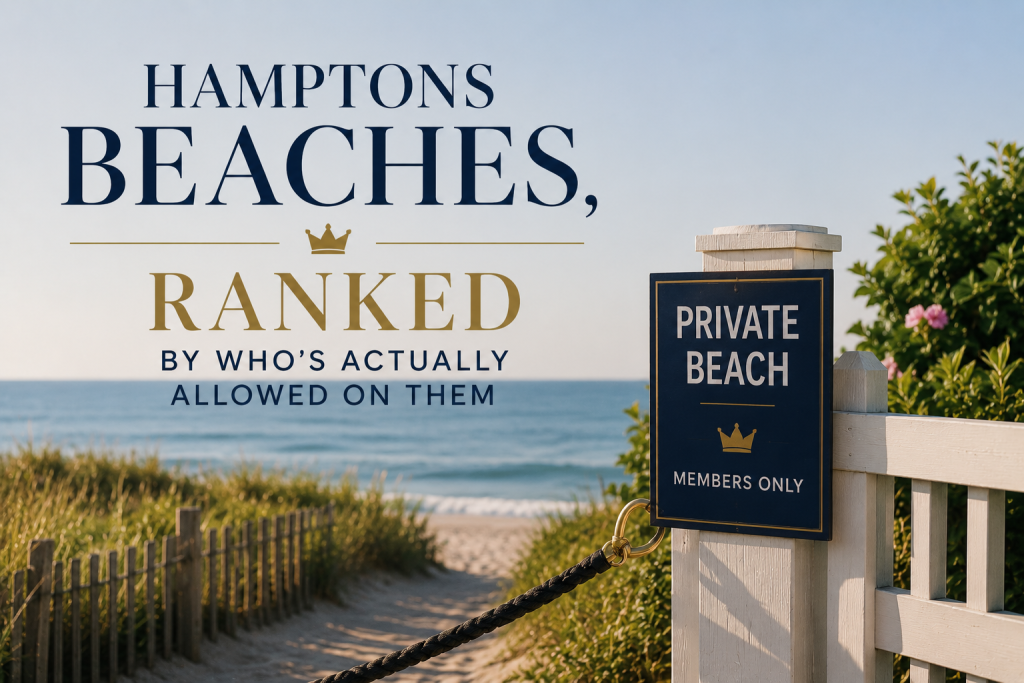
Out here, the house is your address, but the beach is your standing in public. And the beaches are ranked, whether or not anyone will admit it to your face. To see the Hamptons beaches ranked honestly is to expose a hierarchy that locals know by instinct and outsiders never quite crack. Some stretches of sand sort by sticker, others by birthright, and a precious few by simply belonging to the lawn behind them.
The mechanism is mostly invisible to a day-tripper. There are no ropes and no bouncers on a public beach. Instead, the sorting happens through parking permits, residency rules, and the quiet understanding of which sand is effectively spoken for.
This guide sits inside our map of the village rankings and the wider social order out here. Here is the real beach hierarchy, from the stretches anyone can pay to reach to the ones you have to be born near.
Why the Beach Is the Real Scoreboard
A house can hide behind a hedge, but a beach day happens out in the open. That visibility is exactly what makes the shoreline such a powerful status arena. Where you lay your towel becomes a public statement in a way your living room never is.
This is symbolic capital at its most literal. The beach, the setup, the access, and the crowd around you all broadcast a position to everyone within sight. So the sand becomes an open-air leaderboard where the standings are visible to anyone paying attention.
The genius of the system is how quiet it stays. Nobody posts the rankings, and nobody needs to. Because the rules live in residency permits and local knowledge, the hierarchy enforces itself without a single visible barrier.
For the newcomer, this is both a trap and an opportunity. The trap is showing up at the wrong beach and reading instantly as a tourist. The opportunity is learning the map well enough to land exactly where you mean to.
The Permit Is the Velvet Rope
The single most important fact about Hamptons beaches is the parking permit. In the prestige towns, the lots at the best ocean beaches require a resident sticker for most of the season. So access is gated not by a fee at the gate but by where you officially live.
This turns the humble parking permit into a velvet rope. A resident sticker signals that you belong to the town, not merely that you can afford a day out. Because the permit is tied to property and residency, it works as proof of membership rather than proof of wealth.
The system is unusually effective at its job. A billionaire renter without the right sticker can be turned away from a beach that a local schoolteacher strolls onto freely. So the permit quietly inverts the usual money rules, at least at the entrance to the lot.
Nonresident permits exist, but they are scarce and pricey by design. When you can get one at all, it costs a small fortune and still marks you as an outsider. The scarcity is the entire point, since easy access would defeat the purpose.
Tier One, the Beaches With No Sign
At the very top sit the beaches that are not really public at all. Along the legendary lanes of East Hampton and Southampton, the ocean stretches function as private extensions of the estates behind them. There is no sign, no lot, and no welcome.
Technically much of this sand is public below the high-tide line. In practice, reaching it without a house on the dune is nearly impossible, since there is nowhere to park and nowhere to enter. So the law says public while the geography says private.
The stretches off Further Lane, Meadow Lane, and the Georgica estates belong to this tier. The people on these beaches walked down from their own lawns, and everyone there knows it. Because access requires owning the dune itself, this is the purest status sand on the East End.
You cannot buy your way onto these beaches for a day. You can only buy the house behind them, which is rather the entire point. This tier is reserved for those who already arrived, whether generations or fortunes ago.
Tier Two, the Sticker Aristocracy
Below the private stretches comes the sticker aristocracy, the great resident-permit beaches. These are the famous, beautiful, technically public beaches that nonetheless demand the local pass. Main Beach in East Hampton is the flagship of the whole tier.
Main Beach earns its reputation honestly. It is regularly rated among the best beaches in the country, with a handsome pavilion and pristine sand. Yet that resident sticker on the windshield does the real social work, since it certifies belonging more than the view does.
Georgica Beach and Two Mile Hollow sit in similar company. Georgica anchors the most exclusive pond-side enclave, while Two Mile Hollow has long drawn a chic, fashion-forward crowd. So even within the sticker tier, the beaches quietly sort themselves by exactly who shows up.
This is the tier most aspiring locals actually aim for. A resident permit here is attainable with the right address, unlike the private dunes above it. So it represents the highest beach status that money and residency can genuinely buy.
Tier Three, the Pay-to-Play Coast
Then there is the democratic exception, and its name is Coopers Beach. Sitting in Southampton, Coopers lets anyone park for a hefty daily fee that runs around fifty dollars in season. So it trades the residency rope for a simple, if steep, price of entry.
This makes Coopers both excellent and faintly suspect to the old guard. The beach itself is genuinely first-rate and frequently tops the national rankings. Yet because anyone with cash can roll in, it lacks the membership cachet of the sticker beaches just east of it.
The trade-off here is revealing. Coopers offers quality without exclusivity, which is precisely the combination the status game refuses to reward. So the very accessibility that makes it pleasant also caps its prestige.
For a visitor without local connections, Coopers is the smart and honest choice. You pay, you park, and you enjoy a superb beach without pretending to belong. Just understand that the locals quietly file the pay-to-park crowd a tier below the sticker set.
The Cool Kids’ Coast
Not every beach competes on the same axis, and the surf coast proves it. Out toward Amagansett and Montauk, a different scale takes over entirely, one that prizes cool over pedigree. Here the status flows from authenticity and a good wave rather than from an old permit.
Indian Wells Beach in Amagansett is the spiritual center of this crowd. It draws a younger, looser, more design-adjacent set that values the laid-back over the grand. We map the hamlet’s whole studied-cool sensibility in our Amagansett dossier.
Ditch Plains in Montauk plays the surfer’s anthem even louder. The break draws a wetsuit crowd that would far rather catch a set than chase a sticker. We trace that whole authenticity story in our look at whether Montauk is even the Hamptons.
This coast scrambles the usual hierarchy in a genuinely useful way. A beach that ranks low on old-money prestige can rank high on cool, and the two scales rarely agree. So the surf set quietly wins a game the estate crowd is not even playing.
The Bay Beaches and the Family Tier
Flip to the other side of the island and the whole mood changes. The bay beaches, facing the calmer waters to the north, serve a quieter and more domestic crowd. The waves are gentle, the water is warm, and the scene is built for families.
Long Beach in Sag Harbor is a classic of this type. The shallow, placid water makes it a haven for small children and the parents chasing after them. So the bay beaches trade ocean drama and prestige for ease and sheer practicality.
This tier rarely enters the status conversation, which is a real part of its charm. The families here are not performing for anyone, and the lack of pretension is completely genuine. Because nobody comes to the bay to be seen, the bay stays refreshingly honest.
Still, the bay beaches hold their own quiet appeal to insiders. A longtime local often prefers the calm bay to the crowded ocean scene. So the choice to favor the bay can itself signal a certain unbothered confidence.
How the Villages Sort Their Sand
Each village applies the beach hierarchy a little differently. Southampton leans on Coopers for the public crowd and its private lanes for the rest, while East Hampton stacks Main, Georgica, and Two Mile Hollow into a dense prestige cluster. So the same rules produce a different map from one town to the next.
The contrast tracks the towns’ broader personalities closely. Southampton’s beach scene feels more buttoned-up and traditional, while East Hampton’s mixes old money with the art-and-fashion set. We unpack that larger rivalry in our Southampton versus East Hampton breakdown.
Sagaponack and Water Mill add their own wrinkles to the pattern. Sagg Main and Flying Point draw serious money without the marquee fame of the East Hampton beaches. So prestige out here stays stubbornly local, and a beach legendary in one town may be unknown two villages over.
The practical upshot is to read each beach in its village context. A great beach in a lesser-known town can offer the access and calm the famous ones cannot. So the savvy beachgoer happily trades fame for a better afternoon.
What Your Beach Says About You
By now the pattern is clear, and it is deeply personal. The beach you choose is a statement about who you are and where you sit. Long before you speak a word, your stretch of sand has already introduced you.
Walk down from your own dune and you signal inherited, established status. Flash a resident sticker at Main Beach and you signal a real local foothold. Pay your fifty dollars at Coopers and you signal a welcome visitor rather than a member. Each choice lands differently, and the locals read all of them fluently.
The surf beaches send yet another message entirely. Choosing Ditch Plains over Georgica says you value cool over pedigree, which is its own kind of flex. So even opting out of the prestige game turns out to be a move within it.
The lesson is to choose your beach on purpose. Your towel is a tell, whether you intend it to be or not. So the smart move is to know what your beach says before you ever unfold the chair.
What It Means for Brands
For a brand, the beach hierarchy is a precise targeting map. Each tier of sand gathers a distinct crowd with distinct tastes and distinct budgets. So the beach a brand chooses to associate with says nearly everything about who it wants to reach.
A luxury label chasing the establishment belongs near the sticker aristocracy and the private stretches. A surf or wellness brand finds its people on the cool coast at Indian Wells and Ditch Plains. Because the crowds barely overlap, the wrong beach reaches the wrong customer entirely.
Beach-adjacent activations reward exactly this kind of care. A thoughtful presence at the right beach club lands as belonging, while a clumsy one reads as a brand crashing the wrong party. So the choice of sand is really the choice of audience.
This is exactly the read we provide for the brands we work with. After more than twenty years out here, we know which beach gathers which crowd, and how to place a brand on the sand without striking a single false note.
Where The Conversation Continues
The Hamptons beach hierarchy is the most public status system out here, hiding in plain sight on every stretch of sand. Permits sort the prestige, the surf coast rewrites the rules, and your towel quietly announces your tier to everyone in sight. The question is which beach actually fits the position you hold.
If you are a brand planning a summer activation, or a newcomer learning where you belong on the sand, the read matters as much as the budget. We have mapped every beach out here for over twenty years, and we know which one says yes to you. Pick the wrong stretch and you read as a tourist with a very good chair.
The season is short, and the best stretches fill early. Tell us what you are building, and we will show you exactly where on the sand you belong. The ones who ask now are the ones placed well later.
Author

Written by
Recent Posts

The 15 Anonymized Targets: Reading GCP’s Special Opportunities Like a Treasure Map
Bruce Galloway, Gary Herman, and Russel Anmuth: The Team Behind 2,054 Percent

The Death Notices for Value Investing (And Why the Funeral Was Early)

The ETF-ization of Everything: How Passive Investing Quietly Rewired the Market

Small-Cap Hunting Before the Internet: The Craft of Finding What Nobody Else Would