
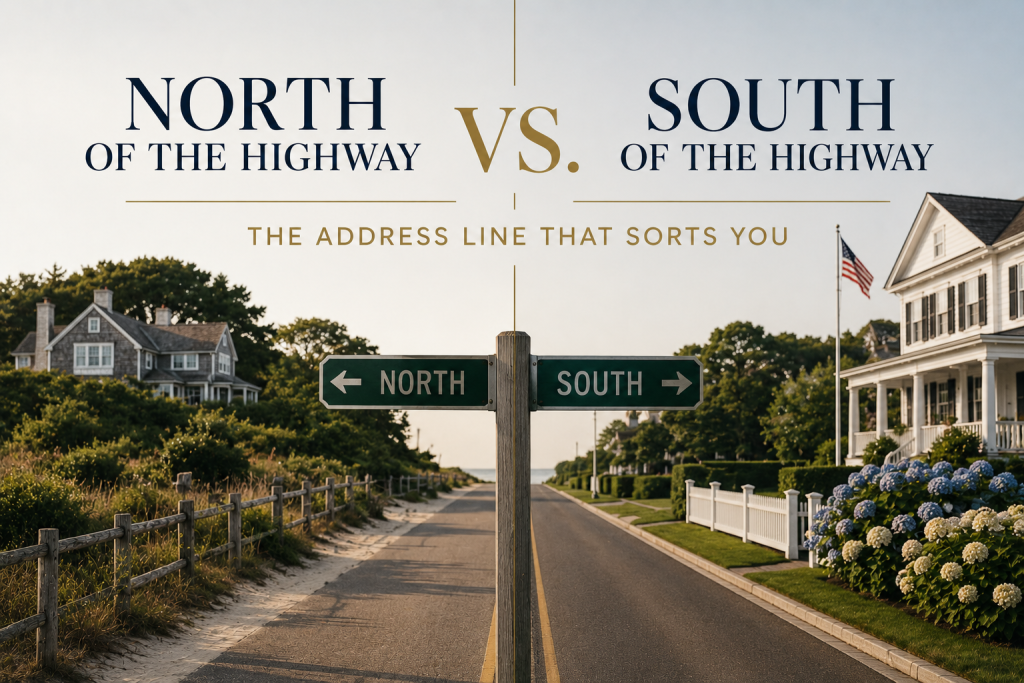
There is a phrase you hear at every Hamptons dinner, dropped lightly and always on purpose. Someone mentions, almost in passing, that their place is south of the highway. The table registers it instantly. To be north of the highway in the Hamptons is to sit, in the old logic, a tier below, and everyone at that table knows it without a word being said.
That single road, Montauk Highway, runs the length of the East End and quietly sorts every address along it. South means closer to the ocean, older money, and the lanes brokers lead with. North means farther from the water and, traditionally, a notch down the social ladder.
This guide sits inside our map of the village rankings and the larger social order out here. Here is how one ordinary road became the cleanest status line in the region, and whether it still means what it used to.
One Road, Two Worlds
Montauk Highway is not much to look at. For most of its length it is an ordinary two-lane road, lined with farm stands, gas stations, and the occasional summer traffic jam. Yet this unremarkable strip of asphalt does more social sorting than any other feature out here.
The logic is simple and a little brutal. Everything to the south slopes toward the Atlantic, and ocean proximity has always commanded the highest prices and the deepest prestige. Everything to the north stretches toward the bays, the farmland, and eventually the more ordinary world.
So the highway functions as a kind of property-value equator. Cross it heading south and the prices climb, the lots grow, and the addresses gain weight. Cross it heading north and all of that gently reverses.
The phrase itself does the work in conversation. Saying you are south of the highway is a quiet status claim, while saying nothing about your side usually means you are north of it. The line is so well understood that people read it entirely by omission.
Why the Highway Became the Line
The divide is older than the current money, and it grew out of pure geography. The earliest grand summer estates went up near the ocean, because the ocean was the entire point of coming out here. So the most prestigious land was settled to the south first, and the pattern hardened over generations.
Proximity to the water did several things at once. It delivered the views, the breezes, and the beach access that defined the whole Hamptons fantasy. Because that fantasy lived on the ocean side, the social weight naturally settled there too.
The north side developed differently and later. It held the working farmland, the service businesses, and the housing for the people who kept the estates running. For a long time the north was simply where the labor lived rather than where the leisure happened.
That history still echoes in the rankings today. The south-of-the-highway prestige is partly a memory of who settled where, and why. So the line carries a century of accumulated meaning, even as the reality on the ground keeps shifting beneath it.
What South of the Highway Really Means
The phrase is shorthand for a whole bundle of status signals at once. South of the highway means ocean access, or at least ocean proximity, which remains the ultimate luxury out here. It also tends to mean the larger lots and the older, more established addresses.
The numbers make the gap concrete. A south-of-the-highway address can command a steep premium over a comparable home just a few hundred yards to the north. So the same square footage and the same finishes can carry wildly different prices depending purely on which side of the road they happen to sit.
The premium is not really about the house at all. It is about the prestige and the proximity that the south side quietly encodes. Because buyers are paying for position as much as property, the line itself becomes part of what they are actually purchasing.
This is symbolic capital made geographic, and it is unusually legible. We trace the same logic across the whole region in our read on the social order. The highway is simply the place where that logic gets drawn as an actual line on the map.
The North Side’s Quiet Case
The north side is no longer content to play the poor relation. As prices everywhere have soared, buyers have looked north for value, and the north has answered with something the crowded south often cannot offer. It offers space, privacy, and genuine quiet.
A spectacular modern build north of the highway can now outprice a tired old cottage to the south. The farmland views, the larger parcels, and the relative calm carry real appeal for a certain buyer. So the old certainty that south always beats north has started to wobble.
Bridgehampton shows this shift especially clearly. The town straddles the line, and its northern reaches have drawn serious money and serious architecture in recent years. We map the town’s two-sided character in our Bridgehampton dossier.
The buyer profile has shifted north too. A younger, design-driven crowd increasingly prefers a bold modern house with land over a cramped cottage near the dunes. So the north now attracts taste, not merely thrift.
None of this has erased the old prestige, of course. South of the highway still carries the heavier social weight in most conversations. Yet the gap is narrowing, and the north side is making a quietly compelling argument for itself.
How Much Does the Line Still Matter?
The honest answer is that it matters less than it once did, but it still matters plenty. The old hierarchy was nearly absolute a generation ago, when south simply outranked north without any debate. That certainty has softened as money has spilled freely across the line.
Several forces are loosening the divide at once. Prices have climbed so high everywhere that buyers increasingly chase value over pure prestige. Because a great north-side property now costs real money too, the old stigma has faded into something closer to a preference.
Still, the language has not caught up with the market. People go on announcing they are south of the highway, because the phrase keeps its old social charge regardless of the numbers. So the line lives on in conversation even as it blurs in the actual prices.
The result is a divide in transition. The hierarchy is real but no longer rigid, and the sharp observer tracks both the market and the memory. They no longer move in perfect step, which is exactly what makes the line interesting right now.
The Line Means Different Things in Each Town
One complication is that the highway does not mean the same thing everywhere. In some villages the south side is a narrow, ultra-prestigious strip, while in others it sprawls across a wide estate section. So the premium attached to the line varies sharply from one town to the next.
In Southampton and East Hampton, the south-of-the-highway estate sections are vast and storied. The line there separates the legendary lanes from the merely very nice streets. We unpack that particular rivalry in our Southampton versus East Hampton breakdown.
In a town like Bridgehampton, by contrast, the split is more balanced and more fluid. The north side has gentrified fast enough to challenge the old assumptions outright. Because each village applies the line a little differently, any blanket rule about north and south will eventually mislead you.
The lesson is to read the line locally rather than regionally. What counts as a tier-down address in one town might be perfectly prestigious in another. So the phrase always needs a village attached to it before it means anything precise.
How to Read the Line at a Party
For the newcomer, the highway line is a social tool worth learning to read quickly. Listen for who mentions their side, and notice how fast they do it. The person who works south of the highway into the first ten minutes is placing themselves on the map for you.
Volume tells you something too. The truly established rarely need to announce their side, because their address is already known to the people who matter. By contrast, the eager newcomer often leads with it before anyone asks.
You can also read the renovation choices that follow from the address. A north-side buyer building big and bold is making a different statement than a south-side family quietly maintaining an old cottage. We decode those signals in our guide to what your renovation says about you.
Put together, the side and the signals sketch a quick portrait. Where someone sits relative to the highway, and how loudly they tell you about it, reveals their position and their anxieties at the same time. So the line is as much a read on people as it is on property.
The Smart Money Play
For a buyer with eyes open, the loosening line is a genuine opportunity. The south-of-the-highway premium remains steep, and much of it pays for prestige rather than substance. So the value-minded buyer can find more house and more land by looking to the north.
The trade is prestige for space, and increasingly that trade looks like the smart one. A larger, newer, more private property north of the road can deliver a better daily life for the money. Because the social stigma is fading, the practical advantages now outweigh it for many buyers.
The catch is resale and perception, which still tilt toward the south side. If you intend to flip quickly, or you care intensely about the social charge of the address, the south retains its edge. So the calculation really depends on whether you are buying a home or buying a status symbol.
The savviest move reads where the line is heading, not just where it stands today. As the north continues to gentrify, this year’s value buy may become next decade’s established address. The smart money, as ever, gets there a little early.
What It Means for Buyers and Brands
For a buyer, the practical advice is to weigh prestige against substance honestly. Decide whether you are paying for the ocean proximity or for the bragging rights, then buy accordingly. Because the two no longer come bundled at one price, the choice is now yours to make deliberately.
For a brand, the line offers a rough map of where its audience actually lives. The south-of-the-highway crowd skews older and more traditional, while the new north-side money often skews more design-forward and contemporary. So the side of the road hints at the taste of the household behind the hedge.
An activation or a partnership should match that geography to its message. A heritage brand belongs near the old south-side establishment, while a modern design label may find warmer ground among the north’s new builds. A mismatch wastes the spend and misreads the buyer entirely.
This is exactly the kind of read we provide for the brands and buyers we work with. After more than twenty years out here, we know what each side of the line actually wants, and how to speak to it without striking a single false note.
Where The Conversation Continues
The highway line is the cleanest status divide on the East End, and it is quietly in flux. South still carries the old prestige, north is making a strong and rising case, and the phrase itself stays loaded with meaning at every dinner. The question is which side suits the life you actually want to live.
If you are a buyer weighing prestige against value, or a brand deciding where your audience lives, the line matters as much as the budget. We have read both sides of this road for over twenty years, and we know which one says yes to you. Read it wrong and you overpay for a label or miss the better house.
The season is short, and the right rooms fill early. Tell us what you are building, and we will show you which side of the line fits. The ones who ask now are the ones placed well later.
Author

Written by
Recent Posts

The 15 Anonymized Targets: Reading GCP’s Special Opportunities Like a Treasure Map
Bruce Galloway, Gary Herman, and Russel Anmuth: The Team Behind 2,054 Percent

The Death Notices for Value Investing (And Why the Funeral Was Early)

The ETF-ization of Everything: How Passive Investing Quietly Rewired the Market

Small-Cap Hunting Before the Internet: The Craft of Finding What Nobody Else Would