
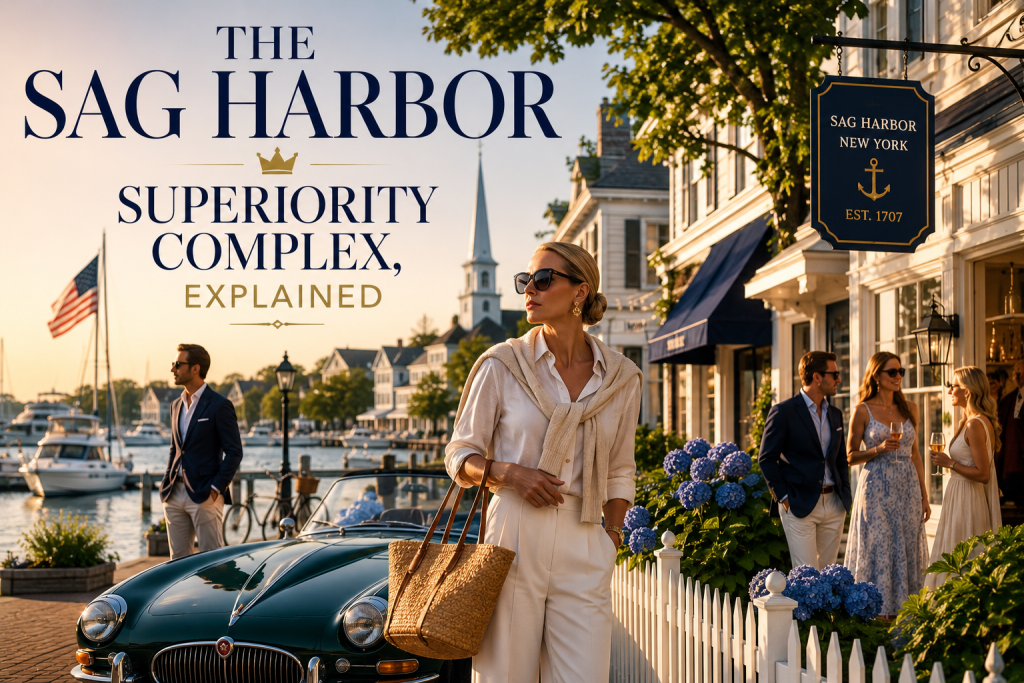
Walk down Sag Harbor’s Main Street on an August evening and the town tells you exactly what it thinks of itself. The whaling church spire still presides over everything. The independent bookstore stays lit. And somewhere a resident is explaining, gently and unprompted, that Sag Harbor is not really like the rest of the Hamptons. That little speech is the Sag Harbor superiority complex, and it is the most fascinating pose on the East End.
The claim is always the same. Sag Harbor has history, soul, and taste, while the glossier villages supposedly have only money. The town casts itself as the literate, soulful alternative to Southampton’s hedges and East Hampton’s galas.
This guide sits inside our map of the village rankings and the wider social order out here. Here is where that superiority comes from, how it works as a status move, and whether the town has earned the right to look down its nose.
The Town That Reads Books
Every Hamptons village runs on a brand, and Sag Harbor’s brand is the mind. While Southampton sells discretion and East Hampton sells culture, Sag Harbor sells something subtler. It sells the idea that the people here have actually read the books on their shelves.
The signals sit everywhere once you start noticing them. There is the beloved independent bookstore that locals treat as a civic treasure. There is the American Hotel, where the wine list runs long and the conversation is supposed to run longer. And there is the John Steinbeck connection, since the novelist lived and wrote here, a fact the town deploys with carefully practiced modesty.
The whaling past supplies the foundation under all of it. Long before the summer people arrived, Sag Harbor was a serious working port, and that history lends the town a gravity the resort villages simply lack. So the place gets to claim it was somewhere real before it was ever somewhere fashionable.
This literary self-image is the engine of the superiority. The message is that Sag Harbor predates the money and quietly outranks it. Taste, the town insists, is older and finer than mere wealth could ever be.
The Wharf, the Windmill, and the Wine List
Sag Harbor wears its self-image in its landmarks. The long wharf reaches into the bay where whaling ships once docked, and yachts now bob in their place, though the town would rather you notice the history than the hardware. The windmill on Long Wharf and the old whaling museum keep that working past visible and close at hand.
Social life clusters around a handful of beloved institutions. The American Hotel anchors Main Street with its dim, clubby dining room and its famously deep wine cellar. So a reservation there signals belonging in a way no flashy new spot can replicate.
Even the casual places carry the code. The crowd lingers over coffee and conversation rather than rushing off to be seen, since being seen is precisely the impulse Sag Harbor pretends to be above. The slow pace itself is part of the performance.
These landmarks do real status work for the town. They let residents point to history, craft, and continuity instead of mere price. Because the place can gesture at something older than money, it gets to feel richer than the towns that only have money.
A Different Kind of Old Money
Sag Harbor’s money carries a different pedigree from the rest of the East End. The classic Hamptons fortune is WASP-resort money, the kind that built oceanfront cottages and joined restricted clubs. Sag Harbor’s older wealth grew instead from trade, craft, and the sea.
That distinction matters more than it probably should. Because the town’s roots are commercial rather than purely genteel, residents can frame their status as earned rather than handed down. It is a flattering story, and it happens to be partly true.
The architecture reinforces the point at every turn. The captains’ houses lining the historic district are handsome but restrained, built by people who worked hard for their fortunes. By contrast, the mega-builds a few miles west read as new and faintly vulgar to the Sag Harbor eye.
So the town claims a moral high ground the richer villages cannot reach. Sag Harbor money, in this telling, was made by doing something rather than merely inheriting something. Whether that distinction survives close scrutiny is another matter entirely.
The Communities the Resort Towns Forgot
Sag Harbor holds a history the glossier villages cannot claim. Since the 1940s, the beachfront enclaves of Azurest, Sag Harbor Hills, and Ninevah have been a summer haven for Black families, artists, and professionals. Known together as SANS, these communities flourished during decades when much of the rest of the coast was effectively closed to them.
This legacy gives Sag Harbor a genuine depth of story. The neighborhoods drew teachers, doctors, writers, and entertainers who built a rich summer culture entirely their own. So the town’s past is broader and more textured than the WASP narrative that dominates everywhere else.
The community remains a defining feature today, even as rising prices put real pressure on it. Longtime families now weigh whether to hold or sell as values keep climbing. Because these enclaves are part of what makes Sag Harbor distinct, their future is bound up with the town’s soul.
For anyone reading the town’s superiority, this history matters a great deal. Part of what Sag Harbor claims over the resort villages is a more layered and more inclusive story. That particular claim, at least, has real substance behind it.
The Anti-Hamptons Pose
Here is where the superiority turns into a performance. Sag Harbor does not merely differ from the other villages. It actively positions itself above the entire status contest, which is a far more ambitious move than simple difference.
The pose has a familiar shape to it. Residents profess not to care about the rankings, the labels, and the flash that consume the rest of the East End. They prefer, they will happily tell you, a quiet dinner and a good book to any velvet-rope party.
Of course, this studied indifference is itself a status claim. By refusing to play the obvious game, Sag Harbor claims to be playing a more refined one. The town that does not chase prestige gets to feel superior to the towns that openly do.
It is the same trick Montauk pulls at the far end of the island. We dig into that parallel in our look at whether Montauk is even the Hamptons. Both towns score points by insisting they are not keeping score.
How the Superiority Actually Works
Bourdieu would have enjoyed Sag Harbor enormously. The town runs on cultural capital, the kind of status that flows from taste and knowledge rather than raw spending. And cultural capital comes with a special trick built quietly into it.
The trick is that it disguises itself as virtue. When Sag Harbor prefers the worn to the new and the literary to the flashy, it frames those preferences as simply better, not merely different. So the town converts its particular taste into a broad claim of moral superiority.
This is the most sophisticated status play in the entire region. Spending money loudly is easy, and frankly a little crude. Convincing everyone that your quiet taste is the higher path takes genuine cultural fluency, and Sag Harbor possesses it in abundance.
The money tells underneath all of this reward close study. We break them down in our field guide to how money signals status out here. Sag Harbor simply plays the quiet end of that spectrum better than any other town.
The Cracks in the Pose
The superiority complex has one stubborn problem, and the problem is the market. Sag Harbor is no longer the affordable, soulful secret it likes to remember being. A captain’s cottage that traded for under a million two decades ago now commands several times that figure.
The money the town claims to disdain has arrived anyway. New buyers come precisely because Sag Harbor markets itself as authentic, and their arrival steadily erodes the authenticity they came for. Because charm sells so well, the charm is being bought up and renovated season by season.
The same forces reshaping every village are reshaping this one too. The independent shops feel the pressure of rising rents, and the quiet streets fill with summer traffic. So the town that prides itself on resisting the Hamptons grows more like the Hamptons every year.
None of this has dented the pose, of course. If anything, the climbing prices have sharpened the town’s insistence on its own difference. The superiority complex, it turns out, survives even as its foundations quietly shift.
Who Actually Buys Here Now
The new Sag Harbor buyer is a specific and revealing type. Often this is someone who could afford Southampton or East Hampton outright but wants to be read as having better taste than that. The purchase is as much a statement as it is a home.
These buyers want the soul, the history, and the literary cachet the town sells so well. They are, in effect, buying cultural capital along with the square footage. So Sag Harbor has quietly become the place where the rich go to seem a little less obviously rich.
The irony is not lost on longtime residents. The very people the town claims to differ from are now its most eager customers, drawn by the promise of difference itself. Because that promise sells, it grows steadily more expensive and slightly less true.
For a newcomer reading the town, the lesson is sharp. Sag Harbor rewards the buyer who genuinely values its character and quietly punishes the one who treats it as a trophy. The town can tell the difference, and it keeps score.
Is the Superiority Earned?
So does Sag Harbor actually deserve to look down its nose? The fair answer is a qualified yes. This town genuinely has more history, more texture, and a more interesting story than the pure resort villages.
The whaling past is real, and so are the literary connections. Its historic Black communities are real, and they give the town a depth that Southampton and East Hampton cannot begin to match. On the substance alone, Sag Harbor holds a strong hand.
Yet the pose overreaches in one important respect. The claim to stand outside the status game is itself a status move, and a self-flattering one at that. Sag Harbor is not above the contest. It is simply winning a particular version of it.
The honest verdict, then, lands somewhere in the middle. The town has earned real distinction, and it has also wrapped that distinction in a comforting myth. Both things are true at once, which is precisely what makes the place so compelling.
What It Means for Brands
For a brand, Sag Harbor is a precise and unforgiving audience. The crowd here prizes the understated, the literary, and the quietly authentic above all else. Anything that reads as loud, logo-heavy, or obviously new-money gets politely ignored.
The winning approach leans hard into substance over spectacle. A brand with real heritage, genuine craft, or an honest story will find a receptive audience here. By contrast, a label that arrives shouting its own prestige has misread the entire town.
This makes Sag Harbor a poor fit for flash and a strong fit for quiet quality. The bookstore-and-wine-list crowd rewards the kind of taste it can feel superior about sharing. So the message has to flatter their sense of sitting above the obvious.
This is exactly the read we provide for the brands we partner with. After more than twenty years covering every town out here, we know how to speak to the Sag Harbor sensibility without tripping its considerable snobbery.
Where The Conversation Continues
Sag Harbor’s superiority is part earned and part performance, and that blend is exactly what makes the town so interesting to read. The history is genuine, the taste is genuine, and the pose of standing above it all is the most refined status move on the East End. The question is whether you can speak the language fluently.
If you are a brand chasing the literary, understated crowd, or a buyer drawn to the town’s particular soul, the read matters as much as the budget. We have covered Sag Harbor from the whaling district to the modern boom, and we know exactly which doors open here. Arrive loud and the town quietly files you away.
The season is short, and the right rooms fill early. Tell us what you are building, and we will show you how Sag Harbor says yes. The ones who ask now are the ones welcomed later.
Author

Written by
Recent Posts

The 15 Anonymized Targets: Reading GCP’s Special Opportunities Like a Treasure Map
Bruce Galloway, Gary Herman, and Russel Anmuth: The Team Behind 2,054 Percent
The Death Notices for Value Investing (And Why the Funeral Was Early)

The ETF-ization of Everything: How Passive Investing Quietly Rewired the Market

Small-Cap Hunting Before the Internet: The Craft of Finding What Nobody Else Would