
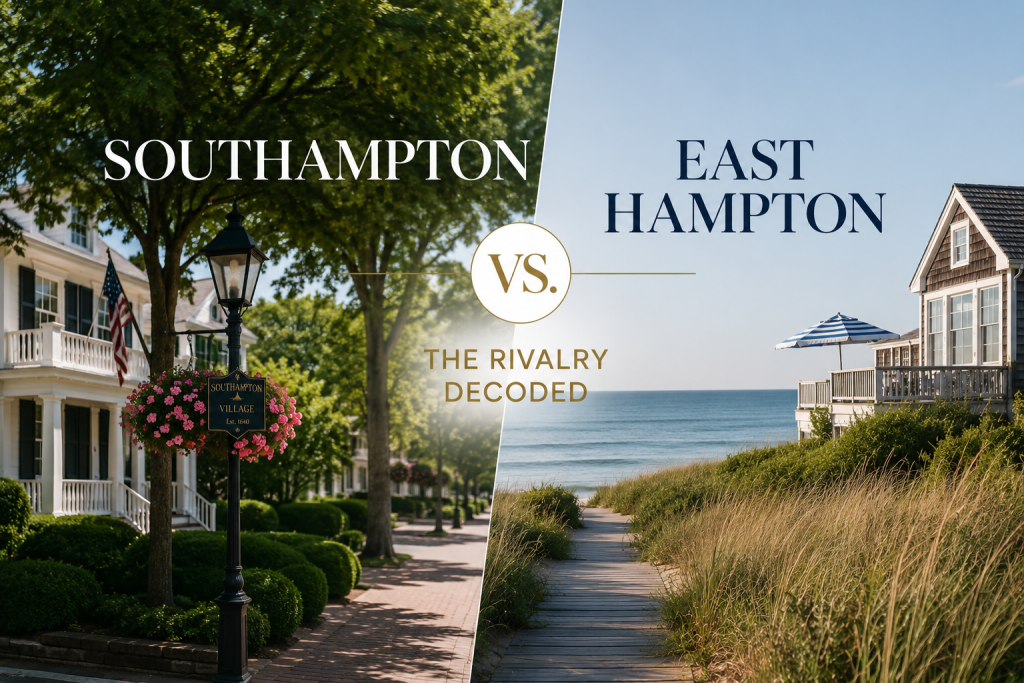
Southampton vs East Hampton is the oldest argument on the East End, and nobody ever wins it. Ask a Southampton family which town matters more and the answer is obvious. Ask an East Hampton family and the answer flips completely. In truth, both sides are certain, and both are partly right.
Of course, the two villages sit a few miles apart on the same ocean. Yet they run on different fuel. One trades on old money and discretion. The other trades on culture and a slightly louder kind of cool.
This rivalry is the headline match inside our guide to the village rankings. It also sits near the top of the wider social order out here. Here is how the two giants actually differ, and what picking a side quietly says about you.
Two Capitals, One Crown
Think of Southampton and East Hampton as rival capitals of the same small country. Certainly, each believes it sets the standard. Each treats the other as the slightly embarrassing relative.
Southampton is the older capital. The money here goes back generations, and the social codes were written long ago. By contrast, East Hampton built its prestige on a different foundation.
East Hampton drew artists and writers before it drew hedge funders. That history still shapes the town’s self-image. So the rivalry is not really about wealth, since both towns have plenty. It is about which kind of capital counts.
Bourdieu would recognize the fight instantly. Southampton leans on economic and social capital, the old fortunes and the closed clubs. East Hampton leans on cultural capital, the galleries and the names. Both are flexing, just in different currencies.
A Short History of the Feud
The rivalry did not appear overnight. Both towns were settled in the 1640s, within months of each other, by English colonists who promptly began competing. So the friction is nearly four centuries old.
Southampton holds the bragging right of being settled first, by a matter of weeks. East Hampton has never fully accepted the significance of that head start. Because the founding gap was so small, both towns still argue over who came first.
For generations the two villages developed in parallel. Each built its own grand summer colony, its own clubs, and its own sense of superiority. Still, the competition stayed mostly genteel, conducted through hedges rather than headlines.
That long shared history explains the intensity. Rivalries between near-equals always run hottest. So the feud endures precisely because the two towns are so evenly matched.
The Money Is Different
Both towns are rich, but the money wears different clothes. Southampton money tends to be older, quieter, and allergic to attention. It hides behind hedges and rarely explains itself.
East Hampton money mixes old fortunes with newer creative wealth. The film people, the gallery people, and the finance people all overlap here. Because the crowd is more varied, the displays of status are more varied too.
As a result, the texture on the ground differs by town. Southampton feels buttoned-up and a touch formal. East Hampton feels looser, artier, and more performative about taste.
Neither texture is richer than the other. Still, they attract different buyers. The discreet fortune drifts toward Southampton, while the expressive one drifts east.
The Case for Southampton
Southampton makes its case through history and restraint. This is the older money, the longer pedigrees, and the institutions that predate everyone reading this. The privet hedges along Gin Lane are the visual signature.
The Bathing Corporation anchors the social calendar. Locals call it the Bath, and its waitlist runs for decades. Because membership cannot be rushed, it works as proof of time, not just money.
The flex here is concealment. A proper family drives a faded Wagoneer and lives behind a wall of green. Showing less is the entire strategy, since anyone can show more.
For the buyer who values discretion above all, Southampton wins easily. The full picture lives in our Southampton dossier. The town rewards those who already know the codes and quietly punishes those who do not.
The Case for East Hampton
East Hampton answers with culture. Where Southampton guards fortunes, East Hampton collects artists, collectors, and the famous. The town wears its creative history like a badge.
Knowing the right painter matters more here than owning the biggest house. A casual dinner in Springs can outrank a formal party on the ocean. Because taste is the local coin, fluency in it becomes the real status marker.
Further Lane and Lily Pond Lane hold the trophy estates. Yet the most fluent residents underplay them. They mention the historic windmill the way other towns mention a parking lot.
For the buyer who values cultural capital, East Hampton is the obvious pick. The town offers relevance, not just wealth. So the choice between the two often comes down to which currency you already speak.
Hedges Versus Galleries
Every rivalry has its signature objects. For Southampton, it is the hedge. For East Hampton, it is the gallery. Each object tells you how the town wants to be seen.
The hedge says keep out and ask nothing. It turns a home into a fortress of privacy and treats discretion as the highest value. By design, it reveals nothing about the life inside.
The gallery says come look and understand. It treats taste as something to share and status as something cultural. Because it invites the eye, it performs in a way the hedge never would.
Neither object is superior. They simply encode different beliefs about how status should work. Read the hedge and the gallery correctly, and you have read the whole rivalry.
The Crowds Each Town Attracts
People sort themselves between the two towns almost on instinct. Southampton draws the discreet, the traditional, and the old-guard families. The crowd skews toward inherited money and inherited manners.
East Hampton draws a more mixed and creative set. The art world, the entertainment world, and a younger finance crowd all mingle here. So the energy feels more current, even when the money is just as old.
The highway line cuts through both towns and sorts them again. South of the road sits the ocean money, while north of it the prices and the status soften. We break that split down in our guide to the highway line.
Beaches sort the crowds too, since access is its own status marker. We rank the whole coast in our beach hierarchy guide. Where you sit on the sand says as much as where you sleep.
Where Each Town Eats and Shops
The two towns even dine differently. Southampton leans toward the established, the clubby, and the quietly expensive. The dinner reservation here signals membership more than novelty.
East Hampton leans toward the of-the-moment and the creative. A buzzy new restaurant or a gallery opening draws the crowd that wants to be current. Because relevance is the local currency, the newest table often wins.
Shopping splits along the same line. Southampton’s Main Street favors the traditional and the discreet, while East Hampton courts the artier and the trend-forward. So even the storefronts encode the rivalry.
For a brand, this is a useful tell. The retail mix of each town reveals exactly which audience it serves. Read the shops and you can read the customer before you ever open a door.
So Which One Is Better?
The honest answer frustrates everyone. Neither town is objectively better, because they optimize for different things. The question is which kind of status you actually want.
If you want discretion, lineage, and the comfort of old codes, Southampton wins. If you want culture, relevance, and a livelier scene, East Hampton wins. Both answers are correct, depending on the buyer.
The mistake is assuming one universal ranking exists. It does not. Each town sits at the top of its own scale and refuses to acknowledge the other’s.
So the smarter question is not which town is better. It is which town reads your kind of money as belonging. That answer is rarely the same for two different buyers.
What Your Choice Says About You
Picking a town is never just a real estate decision. It is a statement about which tribe you want to claim. The choice quietly broadcasts your values before you unpack a single box.
Choose Southampton and you signal a taste for the traditional and the discreet. The message is that you value privacy and pedigree over visibility. Old money tends to read that choice approvingly.
Choose East Hampton and you signal a taste for culture and currency. The message is that you want to be near the interesting people, not just the rich ones. The creative crowd reads that choice as fluency.
Either way, the town becomes part of your identity out here. So the choice deserves more thought than the square footage. You are not just buying a house. You are picking a side in a very old argument.
How to Choose Without Getting It Wrong
For a newcomer, the choice can feel high-stakes, and it partly is. Start by being honest about which currency you actually hold. Economic capital points one way, cultural capital points another.
For a brand, the calculation is similar. A label built on heritage and discretion belongs in Southampton. A label built on creativity and buzz belongs in East Hampton. Because the towns speak different languages, the wrong fit reads as a wrong note.
Either way, the move is to match the message to the town. A mismatch wastes money and signals outsider status at once. So precision matters more than budget here.
This is exactly the read we provide for the brands we work with. After more than twenty years out here, we know which town will welcome you and which will quietly file you as a tourist.
The Verdict for Each Buyer
Different buyers should hear different advice. The heritage-minded family that values privacy belongs in Southampton, full stop. Those codes will feel like home rather than a test.
The creative or entertainment buyer belongs in East Hampton. That town reads their cultural fluency as belonging and rewards it quickly. Because the currencies match, the welcome comes faster.
The pure status-chaser faces a harder call. Both towns offer top-tier prestige, yet each demands a different performance to access it. So the smart move is to chase the town that fits your existing capital, not the one with the louder name.
Either way, the worst choice is the mismatched one. Picking the town that misreads your money wastes both the budget and the summer. The right fit, by contrast, pays off for years.
The One Thing Both Towns Share
For all the sniping, the two towns agree on one rule. Neither has patience for the obvious striver. Loud arrival reads as a misstep in Southampton and East Hampton alike.
Both towns reward the person who already understands the codes. The difference is only which codes apply. So the newcomer’s task is the same in either place, which is to read the room before performing in it.
This shared intolerance for trying too hard quietly unites the rivals. They may disagree on everything else, yet they close ranks against the tourist. In that sense, the feud has a floor both sides respect.
Where The Conversation Continues
Southampton versus East Hampton is a rivalry with no final winner, only better and worse fits. The town that suits you depends on the kind of status you came here to claim. The choice is yours to make on purpose.
If you are a buyer weighing the two, or a brand deciding where to plant a flag, the village matters as much as the budget. We have read these two towns for over twenty years, and we know which doors open in each. Pick wrong and the spend reads as tourism.
The season is short, and the right rooms fill early. Tell us what you are building, and we will tell you which town says yes. The ones who ask now are the ones placed well later.
Author

Written by
Recent Posts

The 15 Anonymized Targets: Reading GCP’s Special Opportunities Like a Treasure Map
Bruce Galloway, Gary Herman, and Russel Anmuth: The Team Behind 2,054 Percent

The Death Notices for Value Investing (And Why the Funeral Was Early)

The ETF-ization of Everything: How Passive Investing Quietly Rewired the Market

Small-Cap Hunting Before the Internet: The Craft of Finding What Nobody Else Would