

Where This Method Began
Steve Chase used to open a bottle of Veuve Clicquot at every client reveal. Not to celebrate. To slow the room down. David Hornung was 24 the first time he saw it work, standing against the back wall of a Palm Springs living room, watching a woman who owned three homes realize she was about to cry over a fourth.
The champagne was not about hospitality. It was a design tool. Chase understood that the moment a client first sees their future home is the most psychologically consequential moment in the entire project. If that moment is cluttered with fabric swatches and tile samples scattered across a conference table, the client’s emotional response gets buried under cognitive overload. Chase eliminated the noise. One bottle. One reveal. One visual story told with absolute precision.
That philosophy became the foundation of the Visual Clarity Method that D&J Concepts practices today.
The Visual Clarity Method in Practice
Most interior design firms present mood boards. Loose material samples arranged on a tray. Maybe a digital rendering that approximates the final room but never quite captures how light will actually fall at 4pm in July. The client squints, imagines, and hopes. Then signs a contract based on a mental composite that may or may not match what gets built.
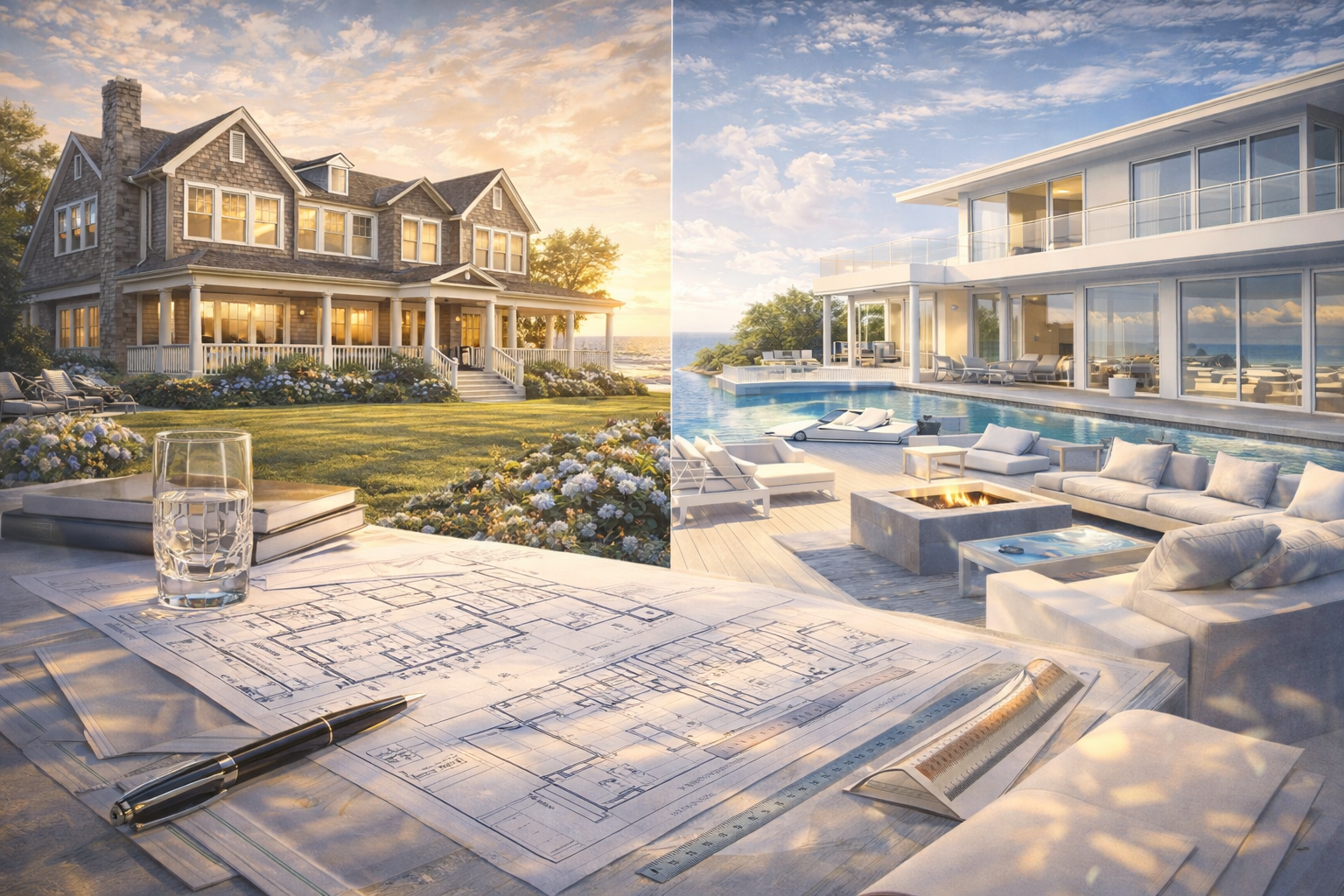
The Visual Clarity Method works differently. Every design decision is presented as a complete visual narrative, photographed and composed to editorial standards, before a single material is ordered. Rooms are shown in context, at scale, under the lighting conditions they will actually inhabit. Material palettes are displayed not as isolated samples but as coordinated compositions that show exactly how the Calacatta Borghini counter meets the rift-cut oak cabinetry meets the unlacquered brass hardware.
The result is a client who makes decisions with confidence rather than anxiety. And confident clients make better decisions. They commit faster, revise less, and end up in homes that feel intentional rather than assembled. According to research published in Harvard Business Review, decision confidence correlates directly with satisfaction, a finding that applies to design choices as powerfully as it applies to business strategy.
Why Visualization Matters at the $5M+ Level
At the scale of a $5M to $15M Hamptons renovation, a single material specification error can cost six figures to correct. Custom stone orders from Italian quarries require 16-week lead times. Bespoke millwork from European ateliers cannot be returned. The financial penalty for uncertainty scales with the project budget.
The Visual Clarity Method functions as a risk management tool as much as a design presentation approach. When a client sees their exact kitchen, their exact bathroom, their exact primary suite rendered with editorial precision before construction starts, the probability of costly mid-project revisions drops dramatically.
D&J Concepts developed this approach through the Farrell Building partnership in Southampton, where the firm staged entire residences for developer sales. Buyers were not just purchasing units. They were purchasing the complete staged environment, down to the towels and accessories. That experience proved something Steve Chase always intuited: when people can see the full picture, they commit completely. For the detailed case study, read why $15M homes need Visual Clarity first.
How the Method Differs from Standard Practice
Standard industry practice follows a predictable sequence. Concept sketches lead to schematic design. Schematics produce material selections. Materials generate specification documents. Construction begins. At each stage, the client approves abstracted representations of what will eventually become their home.
The Visual Clarity Method compresses that abstraction gap. Instead of asking clients to imagine how a room will feel based on a floor plan and a pile of samples, D&J presents the complete sensory experience upfront. This is not simply better rendering software. It reflects a fundamentally different philosophy about when in the design process the client should have emotional certainty.
Chase understood this instinctively in the 1980s. Technology has caught up to his intuition. But the principle remains unchanged: the client deserves to feel their home before they fund it.
The Editorial Photography Standard
There is a reason the best interiors look like Elle Decor spreads rather than real estate listing photos. Professional interior photography follows compositional rules that create emotional responses in the viewer. Sight lines are carefully constructed. Lighting ratios balance ambient warmth with directional drama. Every object in frame serves the visual narrative.
D&J applies these editorial standards to client presentations, not just to finished project photography. The design boards themselves are composed with the rigor of a magazine layout. This is not aesthetic pretension. It is strategic communication. When a design presentation looks and feels like a published feature in Architectural Digest, the client unconsciously evaluates the work at that standard. Expectations rise. Execution matches.
For a detailed exploration of why editorial standards matter throughout the design process, read why the best interiors look like Elle Decor.
From Arthur Elrod to the Present
The Visual Clarity Method exists within a broader historical tradition. Arthur Elrod, the Palm Springs modernist whose work defined mid-century desert luxury, pioneered immersive client experiences decades before the term existed. His showroom presentations placed clients inside fully realized environments rather than asking them to project from abstractions.
Steve Chase trained in that tradition and refined it. David Hornung carried it to the East Coast and adapted it for the specific demands of Hamptons residential design, where seasonal light conditions, salt-air material considerations, and a client base that splits time between Manhattan and the South Fork all create unique presentation challenges.
Today, AI-assisted visualization tools promise to democratize the rendering process. However, technology without methodology produces prettier versions of the same cognitive overload that mood boards always created. The value of Visual Clarity is not the rendering quality. It is the curatorial discipline that determines what the client sees, in what sequence, and in what emotional context. That discipline cannot be automated. It must be practiced. Our history of design presentation evolution traces this arc from Arthur Elrod to AI.
What Smart Clients Ask About This Process
Homeowners considering a luxury renovation should ask any prospective designer three questions about their presentation process. First, will I see my exact home before construction starts, or will I be approving abstractions? Second, how do you present material selections: as isolated samples or as coordinated compositions in context? Third, what happens when I want to change something after seeing the full visualization?
The answers to these questions reveal more about a firm’s design philosophy than any portfolio review. A designer who shows you the finished picture before asking you to commit is a designer who has confidence in their own vision and respect for your investment. For more on evaluating designers through their process rather than their portfolio, see the question every top Hamptons designer answers.
Related Reading: The Complete Guide to Luxury Home Design | Chase Served Champagne at Reveals. We Do This.
For features, advertising, or partnership inquiries: sociallifemagazine.com/contact | Events: polohamptons.com
Subscribe to Social Life Magazine | Support our journalism ($5)
Author

Written by
Recent Posts
The Complete Guide to Luxury Home Design

Luxury Home Design Trends: What’s Next
The Hamptons Design Vernacular

The Visual Clarity Method in Luxury Design
Why SYNCO XView M4 Touch is the ultimate touch screen monitor for phone
Categories
- 2025 Social Life Events
- Access to Digital + Physical Magazine
- Art
- Articles
- Beauty & Skincare
- Beauty & Wellness
- Business Strategy
- Celebrities
- Chronicles
- Event Photos
- Events
- Family
- Fashion
- Fashion & Style
- Featured
- Food & Beverage
- Food, Spirits, Wine
- Hamptons
- Hamptons Celebrities
- Health
- Health & Beauty
- Home & Design
- Home & Living
- Lifestyle
- Luxury Home Design|Design Process
- Luxury Home Design|Design Trends
- Luxury Home Design|Hamptons Design
- Luxury Home Design|Interior Design
- Luxury Lifestyle
- Press
- Profiles
- Real Estate
- Technology
- The Chronicles
- Travel
- Trending
- Uncategorized
- Weddings
- Wellness