
Role: Pillar

Primary style: Wolfe status X-ray with Gladwell framing. Short magazine paragraphs.
Target: 2,600–3,200 words
Focus keyphrase: eat-the-rich movies
The still arrives first. A woman in pearls, off-the-shoulder sequins, gold erupting from her mouth like a fountain at a bad gala. The overlay is white and loud: FILMS ABOUT THE UGLY SIDE OF PRIVILEGE. Sixteen slides later, the same account has walked you through a yacht, a Seoul basement, a private island restaurant, a Catalan villa, Queen Anne’s court, an Oxford dining club, a Beverly Hills shunt, and Versailles.
The caption does the rest. Privilege, it says, works by making itself look normal. Then it promises the opposite product: a watchlist about “the moments when the rich finally get what’s coming to them.”
That is not a film essay. It is a moodboard with a verdict attached. And the verdict is the point of sale.
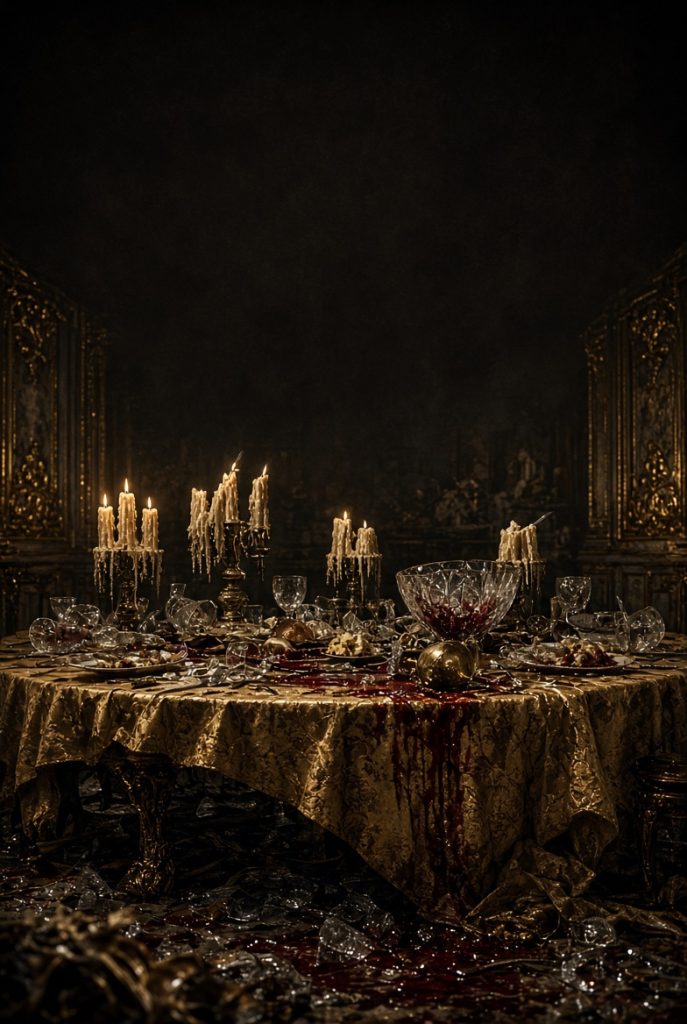
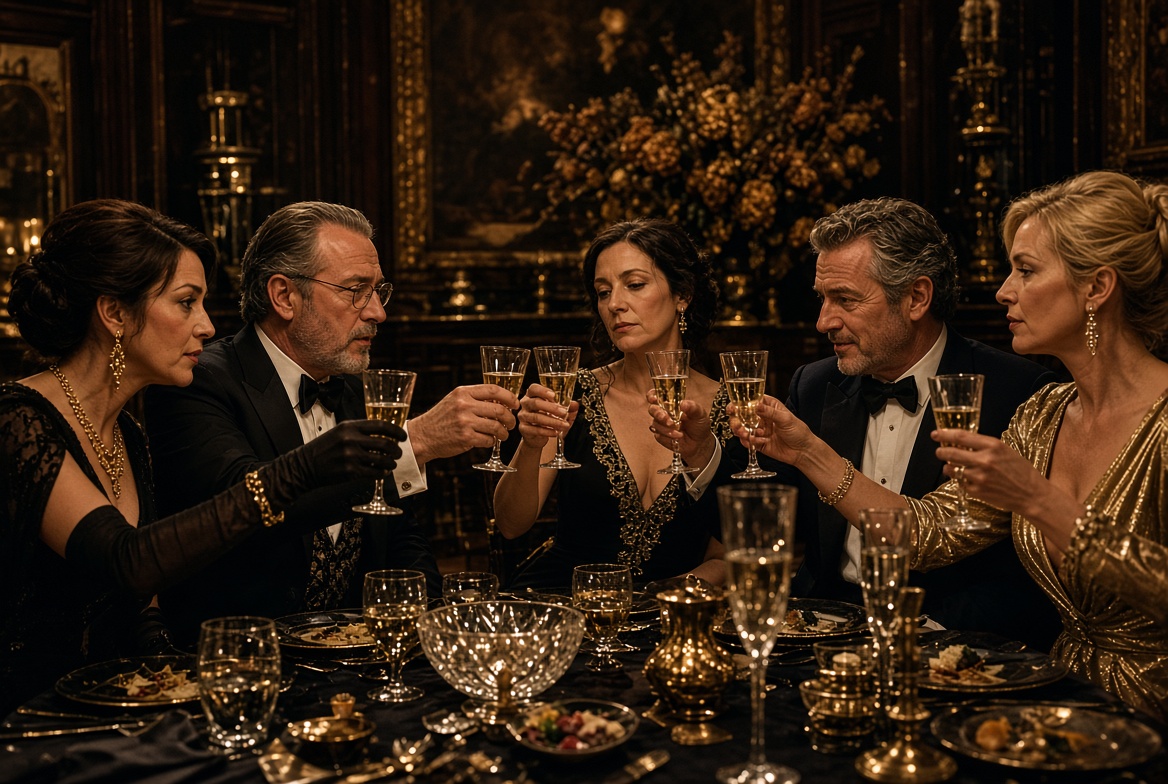
Eat-the-rich movies have become a luxury category. They sell rooms, clothes, tables, and moral credit in the same frame. You leave the carousel feeling you have seen through the game. You have also collected sixteen beautiful stills of the game being played. The corrective — films that teach equity, succession, taste, and the pitch — is the sibling pillar in this wave: the Prestige Watchlist.
The carousel is the tell
@popmybub posted the set in late August 2026. The design is cream paper, serif type, film grain, editorial crop. It looks like a lookbook. It performs like a sermon.
Look at the two sentences in the caption. First: privilege hides harm and leaves other people with the bill. That is a structural claim. Then: these films are about the rich finally getting what they deserve. That is a revenge fantasy.
Those are not the same movie.
A structural film watches how a house, a staff, a school, or a court reproduces itself. A revenge film waits for the vomit, the hunt, the shotgun, the island. The carousel treats them as one genre because the platform rewards one emotion: delicious disgust.
The comments follow the product. Saltburn “fucked me up.” Parasite had “the plot twist.” Someone asks for The Zone of Interest. Someone else asks for Titanic. The list is already a playlist, not a map.
This is what the post says about the culture that made it. Class analysis has been flattened into a content vertical. The stills do the work the argument used to do. You do not need to sit with Joseph Losey for two hours if you can screenshot Dirk Bogarde holding a towel.
Who gets to film the ugly side
Before the plots, look at the cameras.
Sofia Coppola directed two titles on the list, Marie Antoinette and The Bling Ring. She is Francis Ford Coppola’s daughter. Forbes Spain put her fortune near $40 million in 2025. Every film she has made is, at some level, about rooms that cost more than the people inside them can feel. That is not a smear. It is the job she is uniquely positioned to do. Our own archive already tracked the irony inside The Bling Ring: a movie about kids stealing celebrity closets, directed by a dynasty and starring a young actress whose net worth dwarfed the real burglaries.
Emerald Fennell directed Saltburn. Her father, Theo Fennell, is the London jeweler nicknamed the King of Bling. She boarded at Marlborough. She went to Oxford. She has said the “grotesque privilege” of that life is something she is “hyper-aware of.” Saltburn is that awareness turned into a country-house music video. The house is the star. The outsider is a device.
Ruben Östlund directed two more, The Square and Triangle of Sadness. He is not old money. He is festival money. Triangle cost about $15.6 million, won the Palme d’Or at Cannes in 2022, and grossed about $33 million worldwide. Neon released it in the United States the way a gallery releases a provocation. The gold-vomit still is now a meme. The film’s actual subject — what happens when the service hierarchy loses its script — is harder to screenshot.
Karim Aïnouz’s Rosebush Pruning arrived in 2026 with a script by Efthimis Filippou, Yorgos Lanthimos’s longtime writer. The cast is Callum Turner, Riley Keough, Elle Fanning, Jamie Bell, Tracy Letts, Pamela Anderson. Sight & Sound called it a hollow skewering of the ultra-rich. Variety called it sleek and silly. Rotten Tomatoes’ consensus landed on “stylish excess” without “genuine wit or insight.” Worldwide gross sat under $90,000 after a $13,700 domestic run. The carousel still included it. Beauty was enough.
The pattern is not that rich people should be forbidden to make movies about money. The pattern is that eat-the-rich movies are now a prestige assignment handed to people who already have access to the rooms. The critique travels with a production designer.
The scorecard the carousel will not print
Sixteen films is a lot of moral credit. It is not a lot of distinction. The useful split is not “about privilege / not about privilege.” It is what kind of machine the film thinks wealth is.
| Film | Year | Director | What the carousel sells | What the film actually studies | Verdict |
|---|---|---|---|---|---|
| Triangle of Sadness | 2022 | Ruben Östlund | Yacht vomit, hierarchy collapse | Service scripts when money stops working | Sharp, then cartoon |
| The Square | 2017 | Ruben Östlund | Progressive curator exposed | Prestige institutions as costume | Sharper than the sequel |
| Parasite | 2019 | Bong Joon Ho | Two families, one city | The house as a class machine | The modern standard |
| The Menu | 2022 | Mark Mylod | Fine dining as punishment | Taste as a weapon against customers | Fun, thin |
| Rosebush Pruning | 2026 | Karim Aïnouz | Isolated rich family rot | Decadence as wallpaper | Style without a blade |
| The Favourite | 2018 | Yorgos Lanthimos | Court as strategy | Affection as currency | Holds |
| Saltburn | 2023 | Emerald Fennell | Outsider eats the manor | Desire, not class | Souvenir house |
| The Bling Ring | 2013 | Sofia Coppola | Teens steal the lifestyle | Celebrity objects as sacrament | Honest about wanting |
| The Servant | 1963 | Joseph Losey | Roles reverse | The house as a trap for both men | Still the best |
| La Cérémonie | 1995 | Claude Chabrol | Maid + postmistress snap | Literacy, boredom, ritual murder | Cold and exact |
| The Riot Club | 2014 | Lone Scherfig | Oxford boys, no consequences | Club as pipeline to power | Underrated |
| The White Tiger | 2021 | Ramin Bahrani | Driver vs system | Ambition inside a stacked deck | Clear-eyed |
| Ready or Not | 2019 | Bettinelli-Olpin / Gillett | Wedding-night hunt | Dynasty as cult | Comic, useful |
| Society | 1989 | Brian Yuzna | Beverly Hills as other species | Literal class body-horror | Cult, on-the-nose |
| Marie Antoinette | 2006 | Sofia Coppola | Versailles bubble | Isolation as texture, not thesis | Beautiful, soft |
| The Favourite / court pair | — | — | Power as intimacy market | Same | — |
Parasite made about $90 million worldwide on an $11 million budget and won Best Picture. That is not a niche protest film. That is a global hit about stairs. Saltburn became a streaming event because of a bathtub and a grave, not because it explained primogeniture. Rosebush Pruning barely registered at the box office and still made the moodboard. Attention and insight have divorced.
What the good ones know
The films that last do not punish the rich. They watch the infrastructure.
The Servant is sixty-three years old and still sharper than the carousel’s last twelve slides. Tony buys a London house and hires Barrett. Barrett does not overthrow capitalism. He takes the house from the inside, using manners, sex, drink, and the master’s need to be looked after. Harold Pinter wrote it. Joseph Losey, an American exile, directed it. James Fox and Dirk Bogarde play the inversion so cleanly that you stop knowing who is serving whom. That is what privilege looks like when it is a relationship, not a slogan.
La Cérémonie is colder. Claude Chabrol hired Isabelle Huppert and Sandrine Bonnaire as a postmistress and an illiterate maid. The Lelièvre family is not cartoon evil. They are cultured, decent, slightly blind. They watch opera on television. Chabrol called the film “the last Marxist film,” then made it Freudian anyway. The murder is a ceremony. The class wound is real. So is the fact that the family never imagined the help could finish the night.
Parasite updated that architecture. The Park house is not a symbol. It is a machine with a basement. Bong Joon Ho understands what every estate manager on Further Lane already knows: the building does the class work. Stairs, sightlines, the smell of the subway that will not wash out. Money in that film is not a personality flaw. It is a floor plan.
The White Tiger, from Aravind Adiga’s novel, is the rare title on the list that is about mobility instead of collapse. The driver sees the system clearly. He also uses it. That is closer to how ambition actually behaves than a wedding-night hunt.
The Riot Club is the film people skip because it is British and sour. Lone Scherfig adapted Laura Wade’s play about an Oxford dining club standing in for the Bullingdon. The night ends in a smashed pub and a convenient scapegoat. The others walk. That is not satire as dessert. That is a pipeline.
What the souvenirs do
Then there is the other pile.
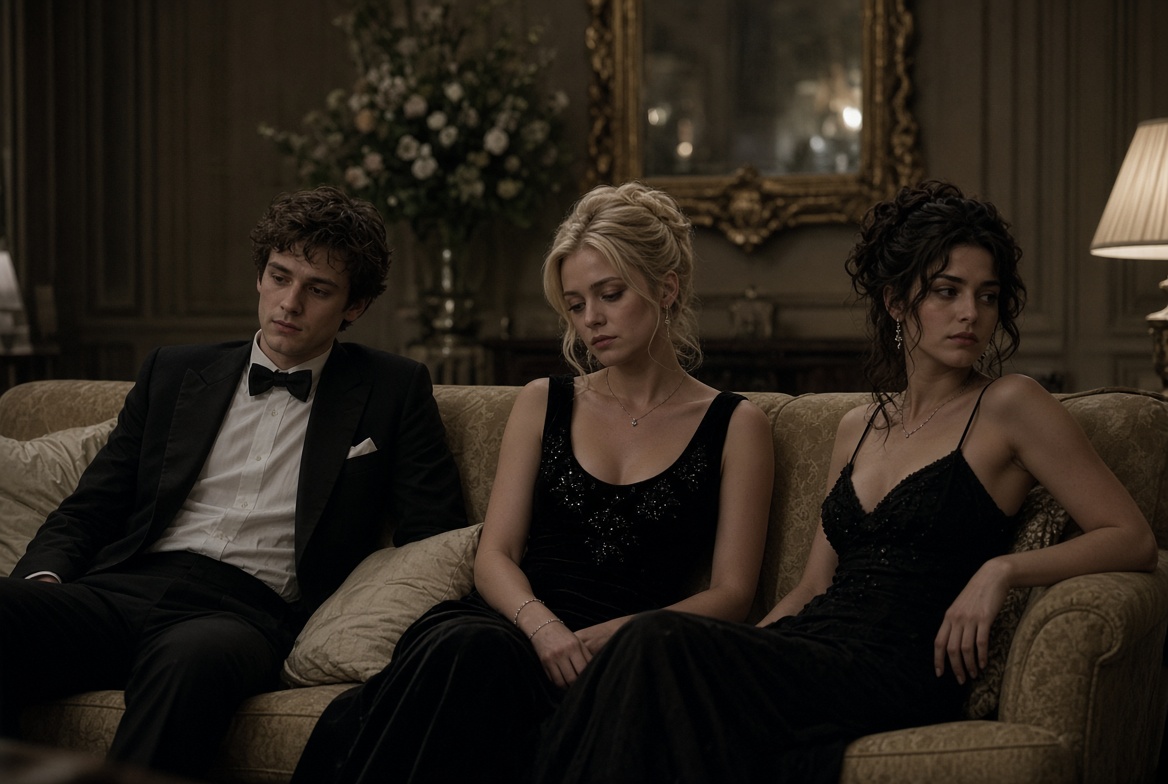
Saltburn wants you to want the house more than you want the argument. Felix Catton is beautiful. The lawn is a set. Oliver’s hunger is sexual and mimetic before it is economic. Veblen would recognize the lawn. Bourdieu would recognize the accent work. Neither needs the grave.
The Menu is a chef’s revenge on diners who collect experiences. It is also a restaurant commercial with a body count. Anya Taylor-Joy walks out with a cheeseburger, which is the film admitting it likes the idea of taste more than it likes thinking about labor.
Ready or Not and Society go literal. One turns in-laws into a hunt. The other turns Beverly Hills into a different species that melts together and feeds. Brian Yuzna’s 1989 shunt is still the most honest metaphor on the list, because it stops pretending. The rich are not “like” a monster. They are the monster. That is why it is a cult film and not a prestige cycle. Prestige needs deniability.
Marie Antoinette is the softest object here. Coppola’s Versailles is a teenage isolation chamber with pastries and Converse. The world outside gets worse. The camera stays with the fabrics. That choice is the film. It is also why the carousel can use Kirsten Dunst’s face as a privilege icon without quoting a single line about the deficit.
Rosebush Pruning is the newest proof that the cycle is tired. A rich American family in Catalonia, incest as décor, wolves at the grave, Filippou cadences without Lanthimos’s discipline. Critics noticed. The carousel did not. The stills were good.
What this says about the movie makers
Filmmakers are not villains for filming wealth. Wealth is photogenic. Staff corridors are photogenic. A long table is a ready-made composition.
The problem is the alibi.
Eat-the-rich movies let a director from Marlborough, Napa, or the festival circuit present a beautiful house as an act of opposition. The opposition is the marketing. The house is the product. Distributors know this. A24, Searchlight, Neon, Mubi, and Amazon Prime have all learned that moral disgust travels with the same audience that buys quiet-luxury knitwear and screenshots old-money interiors.
Östlund at least stages the contradiction. The Square is about a museum curator who cannot live his press release. Triangle of Sadness dumps the press release into the sea. Fennell stages the contradiction and then bathes in it. Coppola has spent a career admitting she lives inside the rooms. That honesty is why The Bling Ring still works. The teenagers are not an indictment of celebrity. They are celebrity’s most loyal customers.
Chabrol, Losey, and Bong do something else. They give the staff a point of view that is not a plot twist. Once the help can see, the house changes temperature.
Hamptons residue
On a wet Saturday in July, the same titles move through East Hampton and Sag Harbor like weather.
East Hampton Cinema still puts the prestige ones on Screen 1. Guild Hall will take the period piece. A guest house on Sagg Main will throw Saltburn on the projector after dinner because someone wants to see the library again. The conversation afterward is never about land law or payroll. It is about the bathtub, or the basement, or whether Barry Keoghan was “too much.”
Meanwhile the actual ugly work of privilege on the East End is dull. It is the Saturday staff run to Round Swamp Farm before the house wakes up. It is which bedroom the sponsor gets during polo weekend. It is the three rental estates that only work if twelve peak weekends clear. It is a renovation at 58 Wildwood that trades fixtures for magazine pages. None of that photographs like gold vomit. All of it decides who sleeps where.
The people who live inside that machinery can watch eat-the-rich movies without flinching. The films are not about them. The films are about a cartoon of them, sold to a third party that wants to feel clean.
Decoder: diagnosis or souvenir?
Use this on the next carousel, the next A24 one-sheet, the next Hamptons screening.
1. Where does the camera live?
If it lives in the dining room and visits the kitchen for a twist, it is a souvenir. If it lives with the driver, the maid, or the cook long enough to learn their schedule, it is a diagnosis.
2. Does money have a mechanism?
Inheritance, payroll, debt, visas, tuition, the club list, the floor plan. If the film cannot name one, it is using wealth as mood.
3. Is the outsider a person or a device?
Oliver in Saltburn is a device. Kim Ki-woo in Parasite is a person with a plan. Barrett in The Servant is a person with a plan who becomes the house.
4. Who paid for the beauty?
Check the director’s access, the production company, and the stills the marketing department chose. If the poster could sell a hotel, the critique is the wrapping.
5. What happens to consequences?
In The Riot Club, most of the boys walk. In La Cérémonie, the tape keeps rolling. A film that needs the rich to “get what’s coming” is writing a fairy tale for the comment section.
6. Could you screenshot it without the argument?
If yes, the argument was never the product.
What society is doing with these movies
The carousel is not a mistake. It is a market.
After 2016, after 2020, after every summer of mansion content, a large audience wanted two things at once: access to the rooms and permission to despise them. Eat-the-rich movies deliver both. Streaming made the delivery cheap. Instagram made the stills portable. Prestige distributors learned that a Palme d’Or and a vomit scene can live on the same one-sheet.
The deeper tell is who is missing. The Rules of the Game. The Leopard. Gosford Park. A Separation. Force Majeure, which is Östlund before he became a brand. Succession, which is not a movie and still understands family offices better than Saltburn understands land. The Zone of Interest, which a commenter named, and which is not about privilege as lifestyle. It is about a garden next to a camp.
Those titles do not flatten. They do not end with a wink that the audience was on the right side all along.
Society, in this feed, wants a side. Movie makers, in this cycle, want a side that still books the location. The result is a genre that looks radical in a square and conservative in a ledger. The house stands. The still circulates. The staff remains offscreen unless the plot needs a gun.
That is the ugly side the carousel cannot show. Privilege does not usually vomit gold. It books the next weekend.
FAQ
What are eat-the-rich movies?
A loose cycle of films, mostly 2013–2026, that use wealthy settings as the stage for humiliation, collapse, or revenge. The setting is the hook. The moral is the marketing.
**Is Parasite an eat-the-rich movie?**
Only if you ignore the basement. Bong’s film is a house movie and a labor movie. The Parks are not punished for having money. They are exposed by how their house is built.
**Why is Saltburn on every list?**
Because the house is unforgettable and the shocks travel. Emerald Fennell knows how to light inherited beauty. That is not the same as analyzing it.
What should I watch instead of the carousel?
Start with The Servant (1963) and La Cérémonie (1995). Then Parasite. Then The Riot Club. Then decide whether you still need the yacht.
**Did Triangle of Sadness deserve the Palme d’Or?**
It won in 2022 and earned three Oscar nominations, including Best Picture. The first hour is a real satire of the service economy. The island act is a different, cheaper movie.
**Is Rosebush Pruning worth seeing?**
As furniture, yes. As class critique, no. The 2026 reviews were consistent: lush, cast-heavy, thin.
Why do rich directors make these films?
Access, prestige, and a market that pays for beautiful condemnation. Some of them, Coppola especially, are honest about living in the rooms. Honesty is rarer than outrage.
What does the Instagram post get right?
That privilege prefers to look normal. That cruelty can hide inside manners. That a royal court and a guest list can run on the same fuel.
What does it get wrong?
That the interesting story is the rich “getting what’s coming.” The interesting story is how the house keeps running after the credits.
Is this genre over?
The moodboard is not over. The ideas in The Servant were not over in 1963 either. The cycle will keep minting souvenirs until a film remembers the staff schedule.
Author

Written by
Recent Posts

Unlocking the Berkshires

Dalia Forman Design

Alberto Luzzi
How to Pick a Homecoming Dress for Your Body Type and Feel Amazing in It
How to Prepare a Home for Sale When Major Repairs Are Not Affordable
Categories
- Art
- Articles
- Business of Luxury
- Celebrities
- Culture
- Entertainment
- Events
- Faces of Summer 2026
- Fashion
- Fashion & Style
- Featured
- Finance
- Food, Spirits, Wine
- Hamptons
- Hamptons Celebrities
- Health
- Health & Beauty
- Lifestyle
- Luxury Lifestyle
- Press
- Profiles
- Real Estate
- Technology
- The Chronicles
- Travel
- Uncategorized
- Weddings