
Two Streets, One Thesis
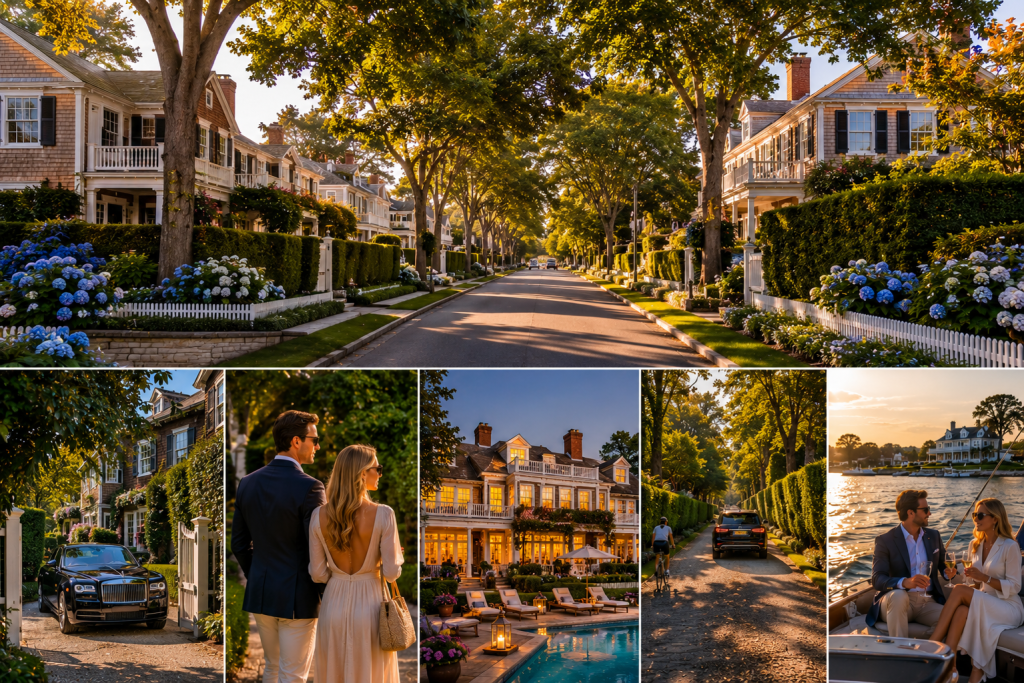
There are streets in America where the houses cost more. There are streets where the residents are more famous. But there is no street in America where the combination of price, privacy, and social weight concentrates as densely as it does on Gin Lane and Meadow Lane in Southampton, New York. These two oceanfront corridors, separated by a few hundred yards of dune grass and a shared commitment to twelve-foot privet hedgerows, collectively represent the apex of American residential real estate, and they do so while maintaining the one quality that most expensive addresses sacrifice first: invisibility.
You can drive the full length of Gin Lane in four minutes. Similarly, Meadow Lane takes seven. Yet you will not see a single house. That is the architecture.
She is a real estate broker. Twenty-three years selling property in Southampton. She has closed $800 million in transactions. Not once has she taken a client to Gin Lane without an appointment. “You do not drive Gin Lane to browse,” she says. “You drive Gin Lane when you already know which house you are looking at. And if you already know which house you are looking at, someone has already decided you are allowed to know.”
Gin Lane: The Address That Never Advertises
The Name
Gin Lane takes its name neither from the spirit nor from the debauchery that Hogarth depicted in his famous 1751 print. Rather, the name is a colonial-era corruption, likely derived from an old English or Dutch term related to the narrow lane’s geography near Agawam Lake and the ocean. It has been in use since at least the eighteenth century.
Naturally, the irony is that Gin Lane requires no introduction and has never sought one. It does not appear in advertising. The Village of Southampton tourism office does not promote it. Its residents do not give interviews about their homes. Instead, the address communicates through absence: no signage, no visible houses, no invitation to look.
The Geography
Gin Lane runs along the oceanfront south of Agawam Lake, a shallow freshwater pond that separates the estate section from the village center. The street begins where the Bathing Corporation stands at 14 Gin Lane (the most exclusive beach club in America, founded 1923, no website, no social media, approximately 400 families) and extends west along a corridor of oceanfront estates that range from Gilded Age Shingle Style mansions to contemporary architect-designed compounds.
Properties on Gin Lane sit on the dune ridge, which means direct ocean views, private beach access, and exposure to Atlantic wind. Lots range from one to four acres. Setbacks are generous. In effect, every house is positioned to maximize ocean views while minimizing visibility from the road.
The Transactions
La Dune (366 and 376 Gin Lane): The most significant Gin Lane transaction in recent history. Stanford White originally designed this dual-residence compound on over four acres in the nineteenth century. The main house offers more than 11,000 square feet with ten bedrooms, eight bathrooms, and staff quarters. Architect Francois Cartroux built a second residence in 2001, mirroring the proportions of the original.
The Red Queen’s Auction
Louise Blouin, the Canadian art publisher known in some circles as the “Red Queen,” owned the estate. She purchased it in the late 1990s for $13.5 million. Over the years, she listed it as high as $150 million, and once refused a $90 million offer. Then, in January 2024, after the property entered Chapter 11 bankruptcy, Sotheby’s Concierge Auctions conducted a live sale. Seven bidders competed. The winning bid (placed by phone, identity undisclosed) brought the total to $89 million.
Ultimately, the La Dune auction tells you everything about Gin Lane: a Stanford White original, listed at $150 million, sold for $89 million, and the buyer’s name is still unknown. Privacy is the product.
Other recent transactions: Properties on Gin Lane regularly trade between $20 million and $100 million. Of course, approximately 70% of transactions above $50 million occur off-market.
He wants to see Gin Lane. He has been told that you need to see Gin Lane. His broker drives him down the street at 15 miles per hour. There is nothing to see. Hedgerows, twelve feet high. Gravel driveways disappearing behind privet. Mailboxes that say nothing. After four minutes they reach the end. “That was it?” he asks. His broker says: “That was $2 billion in real estate. And you did not see any of it.” He understands. This is either the most sophisticated real estate market in America or the most absurd. He suspects it is both.
Meadow Lane: Where Finance Built Its Summer Campus
Billionaires Row
If Gin Lane represents old Southampton (inherited wealth, generational presence, Stanford White architecture), Meadow Lane represents what happened when Wall Street arrived. This five-mile oceanfront stretch runs south from the village along the barrier beach, with the Atlantic Ocean on one side and Shinnecock Bay on the other, creating a narrow corridor of sand, dune grass, and financial power that has earned the nickname “Billionaires Row.”
Naturally, the nickname is accurate. The combined net worth of Meadow Lane’s current and recent residents likely exceeds $50 billion. That figure, which is roughly the GDP of Luxembourg, is concentrated along a single residential road accessible by two-lane public streets. Meadow Lane is a public road. The estates behind the hedgerows are not.
The Residents
Ken Griffin (Citadel, net worth approximately $49 billion): In 2020, Griffin purchased 650 Meadow Lane from Calvin Klein for $84 million in an off-market deal that surfaced only after it closed. Previously, Klein had spent three decades and an estimated $45 million building the compound. Griffin did not renovate the aesthetic. He moved finance where fashion had been, which is, in compressed form, the story of the Hamptons over the past thirty years.
Leon Black (Apollo Global Management, net worth approximately $13 billion): Black owns one of the largest contiguous landholdings on Meadow Lane, a four-lot compound stretching from ocean to bay. The scale of the holding is unusual even by Meadow Lane standards, where most estates occupy one or two lots.
Robert Kraft (New England Patriots, net worth approximately $11 billion): Kraft purchased his seven-bedroom waterside property in 2021 for $43 million. The house was built in 2017 on grounds that include an 1880s summer retreat. Last summer, Kraft hosted a Fourth of July party attended by Jerry Seinfeld, Mike Tyson, Jon Bon Jovi, and Sylvester Stallone, with a performance by Elton John. When a Patriots owner throws a party on Meadow Lane and Elton John is the entertainment, you begin to understand the scale of what this address represents.
Henry Kravis (KKR, net worth approximately $8.7 billion): One of the founding fathers of leveraged buyouts, Kravis has maintained a Meadow Lane presence that predates the current era of hedge fund dominance.
Daniel Och (Och-Ziff Capital Management): Purchased his Meadow Lane property for approximately $26.5 million.
The Record
The Mylestone estate, a 15,000-square-foot modern Tudor on eight acres with 500 feet of ocean frontage, sold for $112.5 million in 2023. At the time, this was the Meadow Lane record. It remains among the top three Hamptons transactions ever. Former advertising executive and philanthropist Marcia Riklis had owned the estate. Previously, she listed it as high as $175 million in 2021 before reducing to $135 million.
Ken Griffin’s property is next door.
What Separates Gin Lane from Meadow Lane
The Social Distinction
In essence, the distinction between the two streets maps onto the distinction between the Bathing Corporation and Sebonack: old money versus new money, lineage versus liquidity, concealment as tradition versus concealment as preference.
Gin Lane trends toward inherited estates, Shingle Style architecture, families who have summered on the street for three or more generations, and membership in the Bathing Corporation. Houses are historic. Hedgerows are older than most marriages. Here, the social currency is not how much you paid but how long ago your family stopped needing to talk about it.
Meadow Lane trends toward self-made wealth, modern or postmodern architecture, helicopter commutes from Manhattan (35 minutes door to pad), and a social life organized around deal-making dinners and charity benefits. By contrast, the houses are newer, though the hedgerows are the same height.
Both streets share the same ocean and the same $50 billion in concentrated wealth. Ultimately, they also share the same commitment to privacy expressed through the same architectural medium: twelve feet of privet that took fifty years to grow.
The Price Comparison
| Metric | Gin Lane | Meadow Lane |
|---|---|---|
| Length | ~1 mile | ~5 miles |
| Price range | $20M to $150M+ | $25M to $175M |
| Record sale | $89M (La Dune, 2024) | $112.5M (Mylestone, 2023) |
| Off-market % | ~70% above $50M | ~70% above $50M |
| Architecture | Shingle Style, Colonial Revival, some modern | Modern, postmodern, contemporary |
| Predominant wealth type | Inherited/legacy | Self-made/finance |
| Key institution | Bathing Corporation | Dune Beach (residents only) |
| Helicopter pads | Rare | Common |
The Economics of Invisibility
Why the Hedgerows Cost What They Cost
The twelve-foot privet hedgerow that defines both streets is not ornamental. It is infrastructure. Maintaining a hedgerow on Gin Lane or Meadow Lane costs $5,000 to $15,000 annually depending on linear footage, and the linear footage on an oceanfront estate can run 400 to 800 feet. Trims happen multiple times per season. Meanwhile, the landscaping crews arrive in the early morning, before the residents wake, because the sound of the trimmer is the one thing the hedgerow cannot block.
In addition, the hedgerow has a secondary economic function: it protects property values. An estate section home with mature hedgerow frontage appraises higher than the same home with a fence, a wall, or nothing. Essentially, the hedgerow communicates not only privacy but permanence. A twelve-foot privet took fifty years to reach that height. It cannot be rushed or faked. Nor can it be purchased at any nursery and transplanted overnight (though people have tried, and the results are visible to anyone who knows what mature privet looks like).
The Off-Market Economy
Indeed, the majority of Gin Lane and Meadow Lane transactions above $50 million occur off-market. This means no MLS listing, no Zillow page, no open house, no sign in the front yard (as if there were a front yard visible from the road). The transaction happens between a seller’s broker and a buyer’s broker who have an existing relationship, often facilitated by a wealth advisor or family office that maintains a list of clients seeking specific types of properties.
For the buyer who aspires to either street, the first step is not searching online. It is engaging a broker with established relationships on both sides of the hedgerow. The best way to find that broker is the same way you find a recommendation for the Bathing Corporation or the Meadow Club: attend the right charity benefit, mention casually that you are looking, and let the system that operates behind the hedgerows do what it has been doing for over a century.
For a broader analysis of the Southampton market, from the $800,000 entry point to the $175 million apex, see the Southampton Real Estate Guide.
The Competition: How Gin Lane and Meadow Lane Compare
Further Lane, East Hampton
Further Lane is Meadow Lane’s East Hampton equivalent: an oceanfront corridor with trophy estates. Notably, it includes Barry Rosenstein’s $147 million combined purchase (2014, still the highest Hamptons transaction ever), Jerry Seinfeld’s 12-acre compound with a private baseball diamond, and Len Blavatnik’s holdings. Further Lane trends entertainment and media wealth. Meadow Lane trends finance. The Southampton vs East Hampton spoke (coming soon) explores this distinction in full.
Lily Pond Lane, East Hampton
Lily Pond Lane carries cultural weight (Martha Stewart, Jon Bon Jovi, David Geffen at various points) but is shorter, denser, and more visible than either Gin Lane or Meadow Lane. Hedgerows are shorter. Celebrities are more recognizable. In contrast, the social dynamic is different: Lily Pond is where you are seen. Gin Lane is where you are not.
Driving the Streets: What You Will See (and What You Won’t)
The Gin Lane Drive
Starting point: Intersection of Gin Lane and Lake Drive, near Agawam Lake.
Duration: Four minutes at 15 mph.
What you will see: Twelve-foot hedgerows. Gravel driveways disappearing behind privet. The Bathing Corporation at 14 Gin Lane (a Spanish hacienda-style clubhouse visible only from certain angles). Mailboxes that reveal no names. Occasional glimpses of rooflines above the privet. The Atlantic Ocean at the southern end.
What you will not see: Houses. People. Price tags. Any indication that you are driving past $2 billion in real estate.
The Meadow Lane Drive
Starting point: Junction with Jobs Lane in Southampton Village.
Duration: Seven minutes.
What you will see: The road narrows as it extends along the barrier beach. Ocean on the left (behind the dunes). Shinnecock Bay eventually on the right. Hedgerows taller than your car. Dune Beach access (residents only). The occasional Sikorsky helicopter descending toward a private pad that you cannot see.
What you will not see: Ken Griffin’s house. Leon Black’s compound. Robert Kraft’s property. The $50 billion in combined net worth that lives behind the privet. A single “For Sale” sign.
Where the Conversation Continues
Social Life Magazine has covered Gin Lane and Meadow Lane for twenty-three years, through record-breaking transactions and quiet off-market deals and the afternoon Elton John played a Fourth of July party for the owner of the Patriots. The Southampton Village Dossier is the definitive guide to the village these streets define. The Southampton Real Estate Guide maps the full market from $800K to $175 million.
If your brand, brokerage, or advisory practice serves the audience that reads this guide (and if you made it to the end of a 3,000-word article about two streets you cannot see the houses on, you are the audience), Social Life Magazine’s paid feature program places your story in front of 25,000 copies per issue, distributed at the restaurants, hotels, and beach clubs where the off-market conversation happens over lunch.
Polo Hamptons 2026 (July 18 and 25, 900 Lumber Lane, Bridgehampton) is the event where the Gin Lane residents and the Meadow Lane residents sit in adjacent cabanas, which is the closest these two streets come to sharing a patio. BMW North America sponsors. Christie Brinkley hosts. The cabana reservation is the one transaction in Southampton that does not require a hedgerow.
To receive Social Life Magazine delivered to your door, visit our subscription page.
Gin Lane is one mile long. Meadow Lane is five. Between them, they hold more wealth per linear foot than any residential corridor in America. Hedgerows are twelve feet high. Houses are invisible. Naturally, the residents prefer it this way. And the streets, which have been making the same argument since the Gilded Age, continue to prove that the most expensive thing in America is the right to not be seen.
Author

Written by
Recent Posts

How to Choose Useful Tech Gifts for Employees and Clients in 2026
The Garage Question: Which Car Goes South for the Season?
VandS Clinic Review Treatment: How Seoul Injectable and Laser Options Compare for US Patients
Before Buying a View Home: What a Sloped Lot Means for the Purchase

Powerful Strategies to Stay Ahead in a Fast-Moving Real Estate Market
Categories
- Art
- Articles
- Business of Luxury
- Celebrities
- Culture
- Entertainment
- Events
- Faces of Summer 2026
- Fashion
- Fashion & Style
- Featured
- Finance
- Food, Spirits, Wine
- Hamptons
- Hamptons Celebrities
- Health
- Health & Beauty
- Lifestyle
- Luxury Lifestyle
- Press
- Profiles
- Real Estate
- Technology
- The Chronicles
- Travel
- Uncategorized
- Weddings