
By David Hornung, Co-Founder & Principal Designer, D&J Concepts
Stone selection in luxury interiors is the decision clients most frequently get wrong. The showroom experience misleads. Polished samples under controlled lighting reveal nothing about coastal humidity, direct sunlight, or foot traffic. They certainly reveal nothing about the inevitable wine glass that tips on a Friday evening. After 25 years of specifying, installing, and maintaining stone in Hamptons homes, D&J Concepts has assembled performance intelligence that no showroom visit can replicate.
Every stone tells two stories. The first is visual: veining, color, texture, and luminosity under different light conditions. The second, however, is functional: porosity, hardness, chemical sensitivity, and aging over decades. Designers who select stone for the visual story and ignore the functional one produce beautiful rooms that frustrate their owners within five years. Understanding both stories is the foundation of intelligent natural stone interiors specification.
Marble: The Aristocrat That Demands Respect
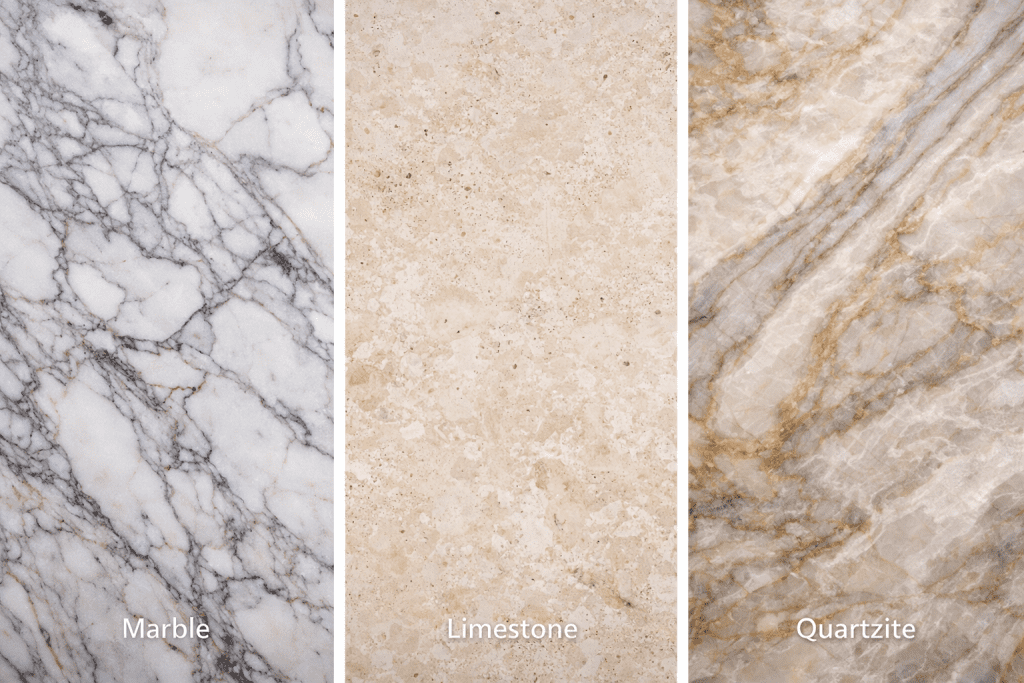
Marble remains the dominant stone in luxury Hamptons interiors for reasons that transcend trend. Its veining creates visual movement that no engineered alternative replicates. Notably, light passes through its surface at microscopic levels. This produces a luminosity that photographs capture but manufactured surfaces cannot achieve. Architectural Digest features consistently showcase marble in the most celebrated interiors because cameras detect what eyes sometimes miss: marble glows from within.
Calacatta marble from the Apuan Alps in Tuscany sits atop the hierarchy. Its white base with bold, dramatic veining commands $80 to $250 per square foot. Pricing depends on slab quality and vein pattern. By contrast, Statuario marble offers a cooler white with more subtle veining. It suits bathrooms where Calacatta’s drama would overwhelm smaller rooms. Carrara, the most affordable of the Italian whites, delivers softer gray veining and works beautifully in kitchens where book-matching across large islands creates understated elegance.
The maintenance reality of marble requires honest conversation. Marble etches from acidic contact. Lemon juice, wine, vinegar, and many cleaning products all leave dull marks on polished surfaces. Sealing reduces porosity but does not eliminate etching. Homeowners who accept marble’s living surface develop deep satisfaction with the material. They view each mark as evidence of a life lived rather than damage sustained. Those who expect marble to perform like granite endure perpetual frustration. D&J Concepts manages these expectations during the design phase, ensuring every client understands precisely what their natural stone interiors will deliver over time.
Limestone: The Quiet Authority
Limestone occupies the territory between marble’s drama and the understated consistency that some luxury homeowners prefer. French limestone, particularly from the Burgundy and Jura regions, has defined European estate interiors for centuries. Its warm, honey-toned surface carries none of marble’s veining drama, instead offering a textural consistency that creates calm spatial experiences.
In practice, Hamptons designers specify limestone primarily for entry foyers, hallways, and transitional spaces where foot traffic demands durability and the design program calls for quiet sophistication rather than visual statement. Over time, limestone floors develop a patina that homeowners consistently describe as the material becoming part of the house. In a 2008 Southampton project, D&J Concepts installed French limestone in a main hallway. Eighteen years later, it has developed a surface quality the homeowner considers the most beautiful element in the house.
Elle Decor’s coverage of European-influenced Hamptons interiors frequently highlights limestone as the preferred flooring material for designers seeking warmth without visual competition. Limestone allows furniture, art, and architectural details to command attention while providing a grounding surface that elevates everything above it. However, limestone shares marble’s sensitivity to acid and requires the same sealing and maintenance commitment.
Quartzite: The Modern Pragmatist
Meanwhile, quartzite has emerged as the preferred alternative for clients who desire natural stone’s beauty with superior performance characteristics. Unlike marble and limestone, quartzite resists etching from acidic substances. Its hardness exceeds granite, making it among the most durable natural stones for residential application. Taj Mahal quartzite, with its warm ivory tones and subtle golden veining, has become the most specified quartzite in luxury Hamptons kitchens.
Additionally, the visual range of quartzite has expanded dramatically as global sourcing has improved. Super White quartzite mimics Calacatta marble’s drama with none of its maintenance requirements. Fusion quartzite delivers bold blue and gold veining that serves as a room’s primary design element. Sea Pearl quartzite captures oceanic movement in stone, making it particularly appropriate for coastal Hamptons properties where the material references the landscape.
D&J Concepts increasingly specifies quartzite for kitchen countertops where marble’s etching sensitivity creates genuine functional problems. Clients who cook seriously find quartzite liberating. Squeezing lemons, splashing wine, and setting hot pans down without ceremony becomes possible after years of marble anxiety. The material costs roughly the same as mid-range marble while delivering performance that eliminates the tension between beauty and function.
The Room-by-Room Decision
Importantly, stone selection should follow each room’s functional demands. A single material aesthetic applied uniformly throughout the home rarely serves every space. D&J Concepts approaches natural stone interiors with a room-by-room methodology that optimizes each space independently while maintaining visual coherence across the home.
Kitchens benefit from quartzite countertops with marble or limestone backsplashes. The countertop endures the functional demands of cooking while the backsplash delivers the visual beauty of more delicate stone in a vertical application where etching risk is minimal. Bathrooms accommodate marble beautifully because the primary etching agents in kitchens, food acids, are absent. A Calacatta marble bathroom ages gracefully over decades with basic sealing and gentle maintenance.
Entry foyers and hallways favor limestone or honed marble. Honed finishes, which eliminate the polished sheen that shows every scratch and footprint, perform dramatically better in high-traffic applications. Polished marble floors in entries require daily maintenance to look presentable. Honed limestone in the same application requires weekly attention at most, and its developing patina actually improves the room’s character over time.
Living rooms and dining rooms offer the most design flexibility because functional demands are lightest. Here, stone selection can follow purely aesthetic logic, and the designer’s vision can drive the specification without performance compromise. Luxe Interiors + Design features of Hamptons living rooms demonstrate the full range of stone applications in settings where beauty faces no functional opposition.
Sourcing Intelligence
Stone sourcing at the luxury level requires viewing actual slabs, not samples. A 4-inch sample reveals nothing about how veining distributes across a 120-inch kitchen island. D&J Concepts visits stone yards with clients. Together, they select specific slabs and mark them for sequential cutting that ensures vein continuity across adjacent surfaces. This process adds two to four weeks to procurement. However, it prevents the most common regret in luxury renovation: discovering that installed stone looks nothing like the approved sample.
Italian quarries offer the finest marble. Brazilian quarries produce the most dramatic quartzites. French quarries deliver limestone with a warmth that domestic alternatives approximate but rarely match. Each source carries different lead times, shipping logistics, and slab availability constraints. D&J Concepts maintains relationships with importers and quarries developed over two decades, ensuring access to premium material that clients browsing domestic showrooms would never encounter.
Steve Chase understood that material provenance matters as much as material appearance. His specifications consistently favored stone with documented quarry origins. The best natural stone interiors begin with the best natural stone, sourced with the same care applied to every other design element. D&J Concepts honors that legacy with every specification.
Start Your Design Conversation
D&J Concepts brings 25 years of luxury residential design experience to every project. The Method of Visual Clarity ensures your vision is resolved before construction begins. Contact Social Life Magazine for features, advertising, or partnership inquiries. Visit polohamptons.com for event tickets and sponsorship opportunities.
Subscribe to Social Life Magazine for ongoing design intelligence. Join our email list for exclusive content. Support independent Hamptons journalism with a $5 contribution.
Read more: Materials, Brands & Budget Intelligence and Hamptons Bathrooms at the $15M Level.
David Hornung co-founded D&J Concepts in 2001 after training under Interior Design Hall of Fame inductee Steve Chase in Los Angeles. From Southampton headquarters, D&J serves clients across the Hamptons, Manhattan, Palm Beach, and Southern California. A member of the Society of Design Administration, Hornung brings 25 years of luxury residential design experience to every project. Discover the Visual Clarity Method at dandjconcepts.com.
Author

Written by
Recent Posts

Marble, Limestone, Quartzite: A Stone Guide

Light as Architecture: Steve Chase’s Lesson

Arthur Elrod to AI: How Design Process Evolved

Why the Best Interiors Look Like Elle Decor

Sand, Light, Restraint: 25 East End Years
Categories
- 2025 Social Life Events
- Access to Digital + Physical Magazine
- Art
- Articles
- Beauty & Skincare
- Beauty & Wellness
- Business Strategy
- Celebrities
- Chronicles
- Design History
- Design History|Hamptons
- Design Process
- Design Process|Luxury Living
- Design Trends
- Event Photos
- Events
- Family
- Fashion
- Fashion & Style
- Featured
- Food & Beverage
- Food, Spirits, Wine
- Hamptons
- Hamptons Celebrities
- Hamptons Design
- Hamptons Design|Design Process
- Hamptons Design|Luxury Living
- Health
- Health & Beauty
- Home & Design
- Home & Living
- Lifestyle
- Luxury Home Design|Design Process
- Luxury Home Design|Design Trends
- Luxury Home Design|Hamptons Design
- Luxury Home Design|Interior Design
- Luxury Lifestyle
- Luxury Living
- Luxury Living|Design Process
- Luxury Living|Hamptons
- Luxury Living|Hamptons Design
- Press
- Profiles
- Real Estate
- Technology
- The Chronicles
- Travel
- Trending
- Uncategorized
- Weddings
- Wellness